- The paper introduces a hierarchical ensemble pipeline using LoRA-adapted DinoBloom features for efficient white blood cell classification.
- It employs a three-stage method integrating coarse-to-fine feature retrieval, hierarchical kNN inference, and split ensembling to mitigate domain shifts and class imbalance.
- Experimental results on WBCBench demonstrate significant macro F1-score improvements, particularly enhancing rare subtype detection crucial for leukemia diagnosis.
Hierarchical Ensemble Inference for Robust White Blood Cell Classification Under Domain Shifts
Introduction
The classification of white blood cells (WBCs) is a critical task in hematology, directly impacting diagnostic and treatment protocols for conditions such as leukemia. Automated WBC recognition systems must contend with domain shifts arising from variations in staining protocols, image acquisition hardware, and laboratory-specific procedures, which often severely degrade the performance of deep learning models. The White Blood Cell Classification Challenge (WBCBench) at ISBI 2026 directly addresses these clinically relevant challenges by focusing on robust recognition under domain shifts, especially for rare subtypes such as blast cells.
This paper introduces a hierarchical ensemble pipeline leveraging LoRA-adapted DinoBloom features to enable robust WBC classification across domain boundaries. The methodology integrates a coarse-to-fine hierarchy, k-nearest neighbor (kNN) retrieval, and multi-split majority voting to mitigate class imbalance and domain shift artifacts. Strong empirical results on WBCBench validate the proposed approach, highlighting both theoretical and practical advancements for scalable clinical deployment.
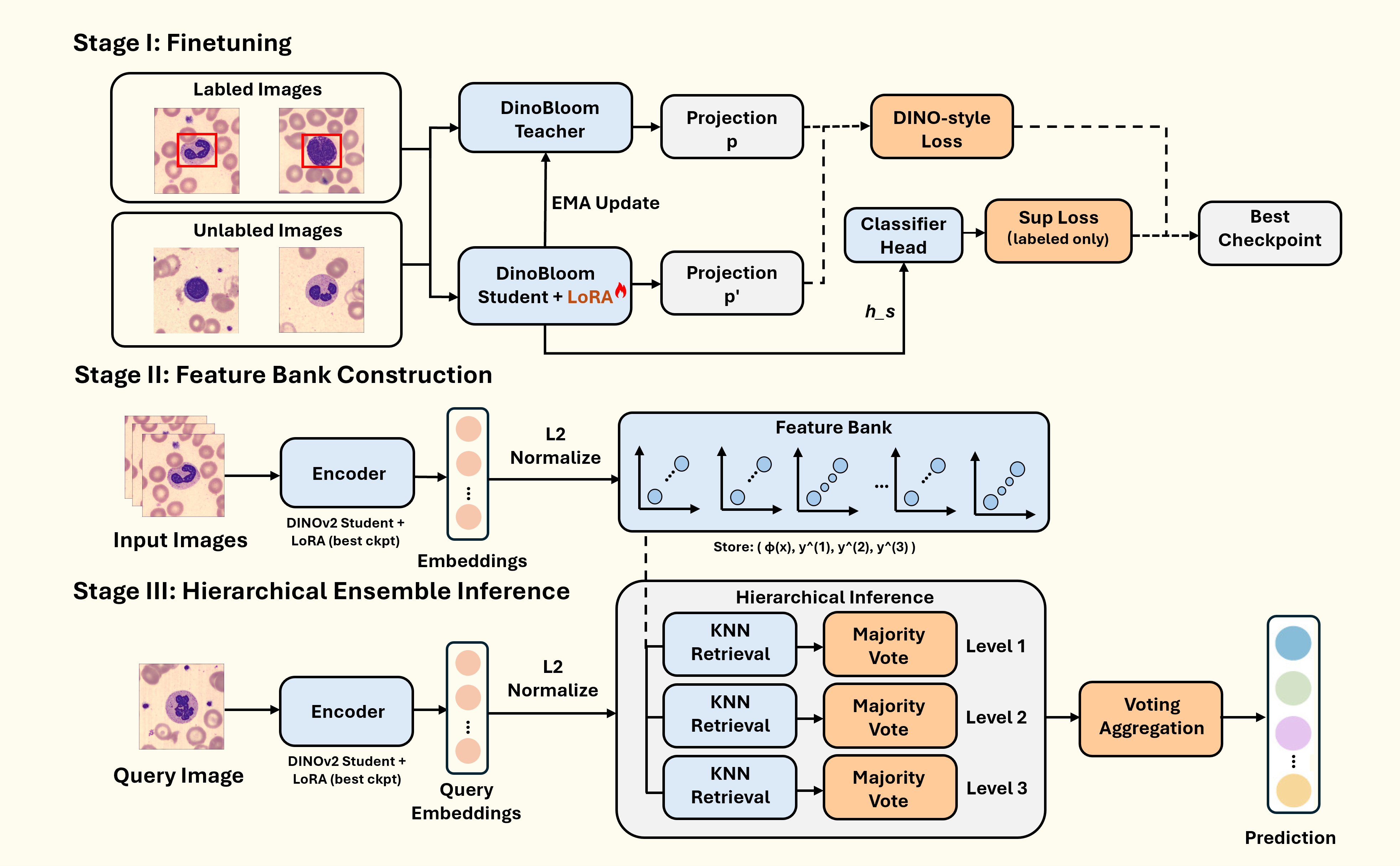
Figure 1: Overview of the proposed three-stage pipeline.
Methodology
The pipeline consists of three integrated stages designed to maximize robustness and generalization in the presence of domain shifts and class imbalance.
Stage I: LoRA Fine-tuning on DinoBloom Backbone
The first stage begins by initializing the DinoBloom backbone with pretrained weights and incorporates LoRA fine-tuning to generate transferable embeddings suitable for retrieval-based inference. Training employs a two-view teacher–student scheme with DINO-based self-supervised alignment and class-balanced supervised cross-entropy. The backbone produces ℓ2-normalized global feature vectors, facilitating efficient downstream retrieval. The optimal checkpoint is retained based on the macro F1-score across evaluation splits.
Stage II: Feature Bank Construction
Using the fine-tuned backbone, ℓ2-normalized embeddings are extracted for all database images and stored in a feature bank along with their hierarchical labels—corresponding to cell lineage (Myeloid, Lymphoid, Blast), subtypes, and leaves. Auxiliary public datasets (e.g., PBC, Raabin-WBC) are integrated post-label mapping to support domain alignment and mitigate imbalance.
Stage III: Hierarchical kNN Inference
Inference is performed by retrieving k nearest neighbors in the feature bank for the query embedding and applying majority voting at each hierarchy level. Hierarchical consistency is enforced by restricting child-level predictions to candidates compatible with the parent-level output, reducing cross-level errors and improving performance on rare classes. Aggregate predictions across multiple splits are combined using majority voting to further stabilize output against domain-induced variance.
Experimental Results
All experiments are benchmarked on the WBCBench dataset, evaluating models using the macro F1-score. Comparative analysis demonstrates:
- Swin-T outperforms classical CNNs (MF1: 0.643 vs. ResNet-50’s 0.635) in supervised settings.
- ConvNeXt-L, following hybrid (SSL+sup) full fine-tuning, achieves MF1 up to 0.679, while DinoBloom with LoRA fine-tuning reaches MF1 0.682—surpassing fully fine-tuned ConvNeXt-L.
- DinoBloom’s superiority stems from more parameter-efficient adaptation and better global feature representation, evidenced by incremental gains over ConvNeXt-L variants under different splits/augmentations.
Ablation studies prove both hierarchical inference and split ensembling are essential for robustness:
- Without hierarchical constraints, split ensembling alone yields MF1 increments from 0.596 (single split) to 0.625 (seven splits).
- With hierarchical voting, MF1 starts at 0.676 (single split) and reaches 0.682 (seven splits), highlighting the synergy between hierarchy enforcement and split aggregation.
- The hierarchical approach considerably reduces bias toward majority classes and improves detection of rare types vital for leukemia diagnosis.
Implications and Future Directions
This hierarchical ensemble framework advances the state-of-the-art in WBC classification under domain shifts, offering statistically significant improvements in macro F1-score. By combining LoRA adaptation with kNN retrieval and multi-level voting, the pipeline delivers scalable, generalizable solutions with minimal inference overhead. The approach is immediately applicable for robust deployment in multi-center scenarios where inter-laboratory variability is a major hurdle.
On the theoretical front, the work evidences the efficacy of hierarchical constraints in mitigating long-tail class imbalance and ensembling strategies for domain-adaptive reliability. The integration of self-supervision and LoRA fine-tuning demonstrates strong potential for foundation model construction in hematology.
Future research directions include expanding the framework to encompass more cell types, tasks (such as segmentation), and domains by leveraging larger foundation models and richer augmentation schemes. The pipeline could serve as a backbone for generalizable cell analysis and broader medical imaging applications characterized by domain drift and paucity of labeled data.
Conclusion
The hierarchical ensemble inference pipeline presented in this paper constitutes a robust and scalable methodology for white blood cell classification under domain shift. The combination of LoRA-adapted DinoBloom features, hierarchical kNN retrieval, and split ensembling yields strong macro F1-scores, outperforming classical supervised and hybrid baselines. Ablation results confirm that both hierarchy enforcement and ensembling are critical for mitigating class imbalance and enhancing rare subtype recognition. The method sets a foundation for future work on universal hematology foundation models and domain-adaptive automated screening.