- The paper introduces a new benchmark with a rigorously annotated dataset and two-phase evaluation protocol to expose limitations in current WBC classification algorithms.
- The methodology leverages synthetic domain shifts and a standardized macro-F1 metric to simulate real-world acquisition variability and address severe class imbalance.
- Results show top models achieved up to 0.777 macro-F1, underscoring the persistent challenge of robust rare-cell detection and the need for ensemble and self-training approaches.
WBCBench 2026: A Challenge for Robust White Blood Cell Classification Under Class Imbalance
Introduction
WBCBench 2026 establishes a new benchmark and ISBI challenge for robust white blood cell (WBC) classification in the context of fine-grained morphology and severe class imbalance. The benchmark is motivated by a clinical reality: while manual WBC morphologic classification is critical for hematologic disease diagnosis, deep learning methods have so far demonstrated limited robustness when evaluated under realistic acquisition, patient, and class imbalance scenarios. Existing public datasets are limited by weak patient-level separation, few rare classes, and minimal acquisition variability, restricting their clinical relevance.
In deploying WBCBench 2026, the organizers present a rigorously annotated dataset, a two-phase evaluation protocol involving synthetic domain shift, and a standardized macro-F1 evaluation metric. This combination is designed to expose the limitations of current algorithms and facilitate advances in robust, clinically-relevant computational pathology.
Dataset Construction and Annotation
The WBCBench 2026 dataset consists of 55,012 images from 493 patients, each sample being a 368×368 RGB patch containing a single, expertly-annotated WBC. Critically, the dataset comprises 13 morphologically distinct cell types, including not only mature and abundant WBCs (e.g., segmented neutrophils, lymphocytes) but also immature and rare classes (e.g., blasts, prolymphocytes, plasma cells). Annotation was performed by five hematopathologists, using consensus for ambiguous cases. The class distribution is intentionally left unbalanced, reflecting real-world incidence rates observed in clinical laboratories.
Splitting is done strictly at the patient level to prevent any leakage and overfitting, a key departure from most prior datasets. Phase 1 includes a pristine, clean training subset; Phase 2 introduces synthetically degraded data emulating domain shifts common in real-world deployment—blur, noise, illumination, and color perturbations—applied at varying severity levels.
Synthetic Degradation and Evaluation Protocol
To simulate domain shifts encountered in clinical practice, the benchmark introduces a controlled degradation pipeline in Phase 2. Degradation severity is stratified (pristine, mild, moderate, extreme), and operator parameters (e.g., blur sigma, noise levels, color jitter, vignetting) are drawn from severity-specific distributions. This pipeline preserves clean reference images for ultra-rare classes but ensures the remaining data experience a spectrum of degradations.
This design stresses model robustness to both acquisition variability and class imbalance. The evaluation metric is macro-averaged F1 across all 13 classes, thus penalizing models that ignore rare subclasses and highlighting performance on real diagnostic outliers.
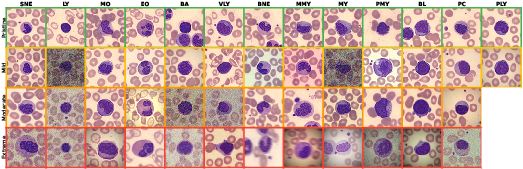
Figure 1: Representative samples of all 13 WBC classes in WBCBench 2026 at four levels of synthetic degradation severity.
Baselines and Challenge Organization
ResNet-50 and Swin-Tiny are implemented as strong supervised baselines, both pretrained on ImageNet and fine-tuned with cross-entropy loss and label smoothing. Weighted sampling is used to partially alleviate class imbalance. The baselines yield macro-F1 values of 0.635 and 0.643, establishing a nontrivial lower baseline for subsequent submissions.
The challenge attracted substantial international engagement: 241 teams registered, from diverse global regions (Figure 2), and 101 made valid submissions. The challenge structure, dataset access, and evaluation tools are publicly released, promoting reproducibility and external benchmarking.
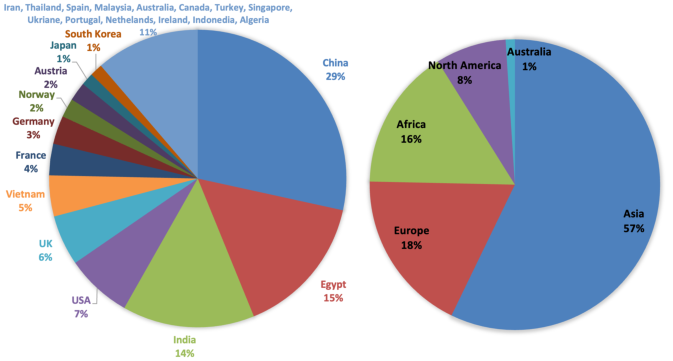
Figure 2: Global distribution of WBCBench 2026 participants by country (left) and continent (right).
Results and Analysis
Top-performing methods notably rely on ensemble strategies, foundation models (DINO, DINOv3, DinoBloom), and tailored rare-class handling pipelines. For example, the first-ranked FDVTS_WBC employs a hierarchical ensemble of three foundation architectures and a dedicated PLY classifier, along with self-training via pseudo-labelling. PathMedAI applies a GAN-based denoising step at inference and custom geometric filters targeting low-support classes.
While 73% of teams surpass the ResNet baseline, only seven submissions exceed macro-F1 of 0.70, and two exceed 0.75. The top solution achieves macro-F1 of 0.777, marking a 13.5-point gain over ResNet-50. However, all methods, including the best, exhibit dramatic F1 collapse on the rarest and morphologically ambiguous classes: plasma cells (PC) achieve a mean F1 of just 0.15 with a support of n=15, and prolymphocytes (PLY, n=2) yield unreliable and low-scoring predictions.
Analysis of per-class performance reveals that rare-class recall and morphological ambiguity remain major obstacles, not just heavy domain degradation. Abundant classes (e.g., segmented neutrophils and lymphocytes) are routinely classified with F1 above 0.95, but transitional and rare types (band neutrophils, promyelocytes) lead to high misclassification rates. The use of macro-F1 exposes this pathology: strong micro-averaged accuracy may mask systematic neglect of critical rare diagnoses.
Implications and Future Directions
WBCBench 2026 exposes several central research directions:
- Model robustness requires explicit architectural or training interventions: Foundation models alone provide limited uplift for rare or morphologically ambiguous cells unless augmented by targeted sampling, reweighting, or specialized inference modules.
- Class imbalance remains an unsolved bottleneck: Macro-F1 penalization ensures that progress in robust rare-cell detection cannot be avoided via majority-class bias.
- Synthetic domain shift provides a necessary but not sufficient challenge: Top scores plateau well below 1.0 even under moderate degradations, suggesting limitations in existing augmentation and adaptation pipelines, especially in the medical image analysis context.
- Ensemble and self-training approaches are necessary for competitive performance: Methods such as pseudo-labelling, bagging across backbone architectures, and hierarchical inference pipelines drive current top-line results.
- Interpretable and uncertainty-aware inference: In clinical deployment, both per-class confidence and explicit modeling of ambiguous or underrepresented subclasses are needed, given current model fragility.
The availability of an open-source evaluator, leaderboard, and a public dataset with rigorous patient-level separation supports further research and facilitates direct algorithmic comparison for the foreseeable future.
Conclusion
WBCBench 2026 sets a new standard for the community in benchmarking robust WBC image classification under realistic class imbalance and domain shift. Rigorous dataset curation, phase-wise synthetic degradations, and macro-F1-centered evaluation enable meaningful assessment of rare-class detection and overall robustness. While dramatic improvements over conventional baselines are observed via ensemble and foundation model strategies, robust rare-class recognition—especially under degradation—remains an unsolved challenge. The benchmark constitutes a critical resource for advancing practical computational pathology methodologies and evaluating future progress in clinical-grade cell classification.
Reference: "WBCBench 2026: A Challenge for Robust White Blood Cell Classification Under Class Imbalance" (2604.10797).

