- The paper demonstrates that in-situ cryogenic proton irradiation validates the radiation resilience of PRIMA/PRIMAger KIDs under L2-representative conditions.
- It details the DRACuLA facility's modular design, precise beam alignment, and critical temperature stabilization at 120 mK for accurate detector testing.
- Key findings include quantifiable thermal fluctuations and system anomalies, driving procedural improvements and enhanced qualification methods for cryogenic detectors.
Comprehensive Evaluation of the DRACuLA Irradiation Campaign on PRIMA/PRIMAger KIDs Detectors
Introduction
The deployment of highly sensitive superconducting detectors, such as Kinetic Inductance Detectors (KIDs), in future space missions (including PRIMA, Athena, and LiteBIRD) necessitates rigorous pre-flight qualification with respect to radiation resilience at sub-Kelvin operational temperatures. This paper presents the successful execution of a proton irradiation campaign using the DRACuLA (Detector irRAdiation Cryogenic faciLity for Astrophysics) cryogenic platform, specifically aimed at evaluating KIDs developed for the PRIMA mission under realistic space-representative total ionizing dose conditions. The DRACuLA facility's unique design enables in-situ irradiation and characterization of sub-Kelvin detectors, directly addressing limitations of prior studies that irradiated devices at room temperature, where annealing effects could obscure true radiation-induced damage.
The DRACuLA Facility: Architecture and Capabilities
DRACuLA is engineered as a mobile dilution refrigerator-based test platform facilitating beam-line integration with minimal procedural overhead and maximal modularity. The cryogenic architecture comprises cascading temperature stages (50 K, 4 K, 1 K, and 100 mK, based on a Bluefors LD400), with specialized, shielded sample spaces and multi-angle KF-50 ports for incident particle beams.
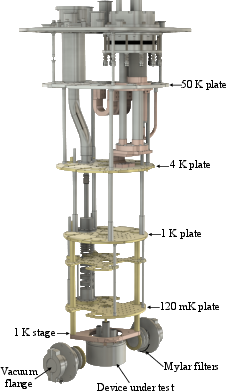
Figure 1: CAD view of the experimental setup (Device under test within the DRACuLA cryostat).
This modularity, combined with robust readout line filtering and thermalization strategies, ensures compatibility with diverse device architectures and accelerator infrastructures. DRACuLA supplies up to 500 μW cooling power at 100 mK—a critical requirement for the testing of large KID arrays and TESs under realistic loads mimicking operational environments in space.
Beamline Integration and Alignment Procedures
The campaign was executed at the PARTREC proton beamline (UMCG, Groningen), chosen for its capability to deliver beams up to 190 MeV, closely replicating the cosmic-ray spectrum encountered in L2 orbit. Geant4-based simulations confirm that, after transmission through the facility's shielding and sample enclosures, proton energies at the detector plane narrow to approximately 150 MeV, capturing the energy loss profile resultant from experimental geometry.
Mechanical alignment entailed custom frame supports to achieve isocentric positioning at 1.5 m—the beam axis of PARTREC.
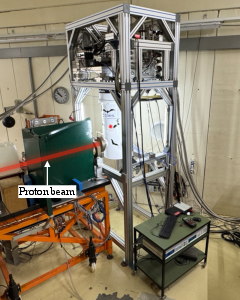
Figure 2: The cryostat mounted on its support frame in front of the beam line at PARTREC, raised to 1.5 m to align the beam axis with the cryostat windows.
A laser-aligned procedure ensured window-to-beamline collinearity, while an external collimator shaped the incident profile to 20×20 mm, matching the demonstrator array dimensions and confining energy deposition to the active area.
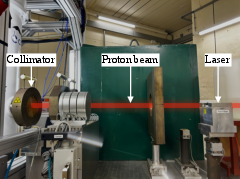
Figure 3: DRACuLA in front of the proton beam line with the collimator reducing the beam cross-section to 20×20 mm. The alignment laser is visible along the beam axis and was used to position the cryostat windows with respect to the beam.
Experimental Campaign Execution and Device Preparation
For this campaign, both absorber-coupled and antenna-coupled PRIMA KID arrays were evaluated. Devices were operated at 120 mK, enclosed within a magnetically and optically shielded sample box, and integrated with a dedicated readout chain (superconducting lines, cryogenic and room-temperature LNAs, and a PXI-based DAQ). In parallel, two-stage SQUIDs (targeting LiteBIRD) and LC resonators (for Athena X-IFU) underwent characterization without interfering with the primary irradiation protocol.
Temperature stabilization of the 120 mK stage demonstrated high precision prior to irradiation (±33 μK), but was observably degraded by beam-induced thermal fluctuations, with deviations reaching ±695 μK during active irradiation at 2×10⁶ protons/cm²/s. Critical analysis attributes this to both environmental (beam flux instability) and technical (PID controller latency) factors.
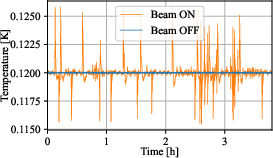
Figure 4: Temperature evolution of the 120 mK stage over a 4-hour window before beam operation (BEAM OFF) and during irradiation (BEAM ON). Temperature overshoots above 120 mK are induced by fluctuations in beam flux.
Cooling power analysis identifies three regimes—nominal operation (554 μW), reduced capacity due to single pump operation (467 μW following a turbo-molecular pump failure), and active beam time (203 μW, reflecting the combined effect of lower pumping and direct beam heating).
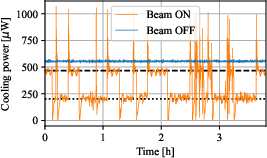
Figure 5: Cooling power at the 120 mK stage over a 4-hour window before (BEAM OFF) and during irradiation (BEAM ON). The three regimes correspond to nominal operation (blue), single turbo-molecular pump operation (-~-), and active beam time (..). Fluctuations during BEAM ON are driven by beam flux variations.
At the 1 K stage, the thermal load from irradiation exceeded available cooling power during beam ON states, resulting in an ascent to ~1.081 K with widened instability (±11.7 mK), compared to ±2.7 mK pre-irradiation. The PID control system's suppression of natural dilution unit oscillations was overcome during irradiation.
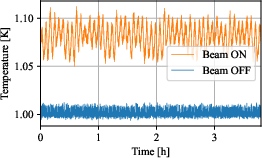
Figure 6: Temperature of the 1 K stage before (BEAM OFF) and during (BEAM ON) irradiation. The available cooling power was sufficient to maintain 1 K before beam operation but not during irradiation due to the combined effects of beam heating and reduced pumping capacity.
Frequency-domain analysis corroborates these findings, revealing the emergence of a ~34 mHz oscillatory component under irradiation.
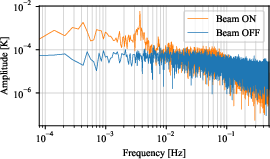
Figure 7: Discrete Fourier Transform of the 1 K stage temperature before and during irradiation. A peak near 34 mHz, corresponding to the natural oscillation frequency of the dilution system, appears during BEAM ON and is absent during BEAM OFF, where it is suppressed by the PID controller.
Results, Observations, and Detected Anomalies
The full irradiation protocol delivered a total dose equivalent to 10 years of L2 exposure (~5.7 krad) across a 12-hour period. The setup exhibited operational reliability, although two failure incidents were noted—loss of one turbo-molecular pump controller and failure of the control computer, hypothesized to result from radiation-induced upsets of nearby electronics.
Notable post-irradiation effects include a transient spike in detected glitch rates (from ~1% to 15%), traced to activation of 64Cu in the gold-plated sample enclosure, with a subsequent mandated cooldown period (24 hours) before scientific readout could reliably resume.
Instrumental learnings from this campaign have led to procedural improvements: increased redundancy in vacuum and control sub-systems, and potential electronic shielding, tailored to mitigate operational risk from beam-induced upsets.
Implications and Future Directions
The study provides direct empirical confirmation that KID arrays designed for the PRIMA mission do not suffer significant permanent radiation-induced degradation under L2-representative total doses at operational cryogenic temperatures. This yields a substantial evidence base for the adoption of KIDs (and, by extension, TESs and other sub-Kelvin detector technologies) in future space and sub-orbital applications where in-situ resilience to cosmic rays is paramount.
From a technical perspective, the DRACuLA platform sets a standard for transportable, modular, cryogenic irradiation facilities with demonstrable flexibility and reliability across multiple detector architectures and beam environments. Further campaigns will benefit from the system hardening and procedural modifications prompted by real-world operational experience reported herein.
Anticipated developments include increased automation, expanded sensor multiplexing capabilities, and adoption by a broader user community for TRL advancement. These efforts will bridge critical gaps in the qualification pipeline for spaceflight hardware, fostering more robust, reliable astrophysical instrumentation.
Conclusion
This study delineates the DRACuLA facility’s architecture, operational validation, and lessons learned from the September 2025 irradiation campaign on PRIMA/PRIMAger KIDs at the PARTREC beamline (2604.23216). The results substantiate the radiation hardness of KIDs under mission-relevant conditions, reinforce the importance of in-situ cryogenic irradiation testing, and outline key facility upgrades for future campaigns. The work materially contributes both to practical detector qualification schemas and to theoretical understanding of low-temperature superconducting device resilience under high-energy particle flux, supporting the continued evolution and deployment of such technologies in next-generation observatories.

