- The paper demonstrates that Al-based KIDs retain stable lifetime and responsivity post proton irradiation, confirming their robustness in space environments.
- It employs cryogenic irradiation and resonance sweeps to compare absorber- and antenna-coupled KIDs, with detailed assessments of NEP increases.
- The study reveals increased low-frequency noise due to residual glitches, highlighting the need for enhanced shielding and improved deglitching techniques.
Effect of Total Dose Proton Irradiation on Kinetic Inductance Detectors for Far-Infrared Space Observatories
Introduction
The deployment of Kinetic Inductance Detectors (KIDs) in far-infrared (FIR) space observatories presents significant opportunities for high-sensitivity astronomical observations. However, the harsh radiative environment of space, particularly at the L2 Lagrange point, introduces a critical need to characterize the radiation tolerance of KID arrays when subjected to high-energy particle fluxes. This study systematically investigates the effect of total ionizing proton dose equivalent to a 10-year L2 mission on two types of aluminum-based KIDs—absorber-coupled and antenna-coupled—operating at deep cryogenic temperatures (120 mK) (2604.23233).
Experimental Methodology
The experiment utilized a cryogenic irradiation setup at the PARTICLE Therapy Research Center (PARTREC), with KID arrays cooled using the DRACuLA facility. Two distinct KID architectures were assessed:
- Absorber-coupled KIDs: Fully fabricated on Si, incorporating wide NbTiN CPWs terminated with Al absorbers, backside lens-coupled.
- Antenna-coupled KIDs: NbTiN CPW section loaded with an IDC and terminated in a thin Al section for the sensing element.
The assembly was magnetically shielded and maintained in a dark, thermally stabilized environment. A 150 MeV proton beam, collimated to 20 × 20 mm², delivered a dose of 5.7 krad, matching the expected exposure for a 10-year L2 mission. In situ electrical measurements, including resonance sweeps, noise spectral density (PSD), and NEP calculations, were performed both preceding and 24 hours following irradiation.
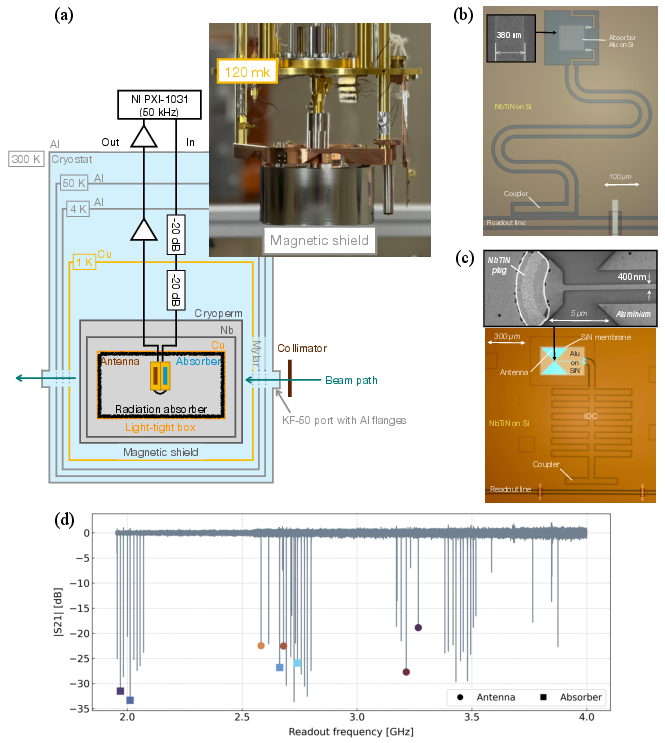
Figure 1: Experimental setup and KID device architectures, including absorber- and antenna-coupled geometries, and readout electronics.
For each detector, the following critical performance metrics were extracted:
- Quasiparticle Lifetime (τqp∗): Assessed through analysis of the PSD roll-off at fixed temperature (200 mK), providing a direct measure of recombination dynamics.
- Responsivity (dθ/dPdark): Determined from phase response to excess quasiparticle population.
- Noise Equivalent Power (NEP): Evaluated following [janssen_equivalence_2014], using dark measurements as a proxy for under-illumination optical NEP.
The time-ordered data streams were processed to remove transient “glitches” arising from cosmic ray interactions or radioactive byproducts. A rolling mean and multi-pass outlier rejection scheme ensured effective deglitching, though with increased data loss in the post-irradiation regime owing to enhanced glitch rates.
Results
Quasiparticle Lifetime and Responsivity
The comparative measurements reveal no significant degradation in τqp∗ or phase responsivity for either KID type after the full-dose irradiation within experimental uncertainties. This confirms the robustness of Al-based KIDs against total ionizing dose effects on intrinsic pair-breaking and recombination physics, in line with prior room-temperature irradiation studies [Karatsu_2015].
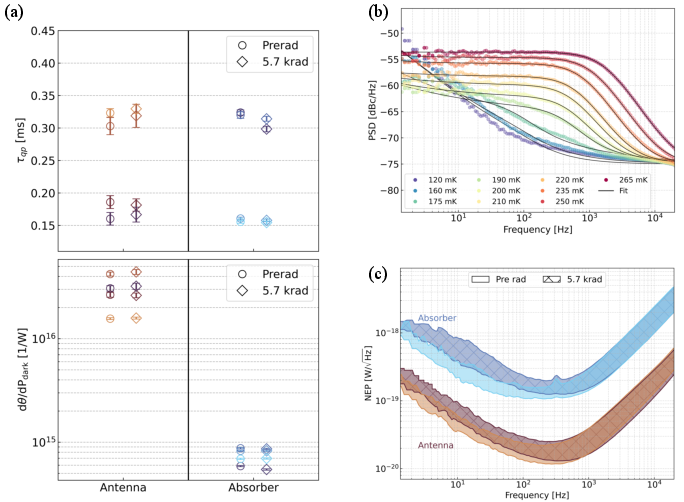
Figure 2: Summary of post- and pre-irradiation device metrics: (top) quasiparticle lifetime and (bottom) responsivity; comparison of NEP values across KID types; (right) representative PSDs and device-by-device NEP changes.
Noise Equivalent Power
In contrast, a notable increase in dark NEP is observed post-irradiation for both device types:
- Absorber-coupled KIDs: NEP increase at 10 Hz by 53–207%; attenuated to 13–77% at 100 Hz
- Antenna-coupled KIDs: NEP increase at 10 Hz by 28–49%; attenuated to 13–17% at 100 Hz
This NEP increase directly reflects higher measured noise, as the responsivity remains stable. The frequency dependence and device type variance suggest greater susceptibility of absorber-coupled KIDs to artifacts in the low-frequency noise after irradiation. The authors attribute this primarily to incomplete removal of “glitch” artifacts in data processing, especially for absorber-coupled devices, rather than to intrinsic radiation damage.
Noise Spectral Shape and Deglitching Challenges
The advanced analysis of noise PSD reveals persistent low-level temporal artifacts even after iterative deglitching. The low-frequency 1/f noise enhancement did not correlate cleanly with residual glitch statistics, indicating that further optimization of both hardware shielding and analysis pipelines is necessary. The nature of these persistent low-amplitude transients is under further investigation.
Implications and Future Directions
Practical Implications:
- Device Robustness: Al-based KIDs, both absorber- and antenna-coupled, demonstrate stable core properties (lifetime, responsivity) under L2-scale proton irradiation, supporting their suitability for deployment in missions such as PRIMA and analogous FIR space observatories.
- Analysis Overhead: Achieving photon background-limited performance will require careful mitigation of radiation-induced glitch artifacts, both by design (material choice, shielding) and post-processing.
Theoretical Implications:
- The negligible impact on intrinsic superconducting properties implies radiation-induced defects—predominantly from non-ionizing energy loss—do not substantially alter pair-breaking efficiency, lifetime, or resonator Q, at least up to the tested dose and absorbed film thicknesses.
Future Research:
- Extended Lifetime Studies: Longer post-irradiation intervals and higher total doses may clarify the regime of onset for cumulative, subtle degradations.
- Materials and Architectures: Alternative superconductors or integrated shielding may further enhance resilience.
- Automated Glitch Rejection: Improvement of deglitching algorithms and possibly in situ veto techniques will be central for extending KID technology to even more extreme environments or higher multiplexing factors.
Conclusion
This work provides the most comprehensive cryogenic evaluation to date of Al-based KIDs’ performance under space-relevant total ionizing and non-ionizing doses. The core detection metrics are unaffected for both absorber- and antenna-coupled arrays at a 5.7 krad lifetime-equivalent dose, whereas dark NEP sees a moderate, frequency-dependent increase attributed mainly to enhanced noise from residual transient artifacts rather than intrinsic device degradation. These findings reinforce the feasibility of KIDs for future FIR observatories, with ongoing refinement required in data analysis to maintain performance in radiation-rich environments.
(2604.23233)

