- The paper reveals that conservation laws induce algebraic relaxation in quantum coherence, contrasting with the rapid delocalization seen in unconstrained circuits.
- It employs a resource-theoretic approach along with exact diagonalization, replica tensor network, and MPS methods to analyze global and local coherence dynamics.
- The study highlights that Hilbert space fragmentation in fractonic circuits and energy diffusion in the MFIM fundamentally alter coherence spreading timescales.
Coherence Dynamics in Quantum Many-Body Systems with Conservation Laws
Introduction and Motivation
The paper "Coherence dynamics in quantum many-body systems with conservation laws" (2604.23192) investigates the impact of conservation laws on the spreading and relaxation of quantum coherence in many-body systems. The study operates at the interface of quantum information theory and out-of-equilibrium condensed matter, employing a resource-theoretic approach to coherence. The analysis targets three central classes of dynamics: (i) local U(1)-symmetric random circuits (both spin-$1/2$ and spin-$1$), (ii) random circuits conserving both charge and dipole moment (fractonic circuits), and (iii) ergodic Hamiltonian evolution via the mixed-field Ising model (MFIM). The work combines exact diagonalization, replica tensor network (RTN), and matrix product state (MPS) methods to access regimes beyond the reach of traditional approaches.
The core focus is on the subtle interplay between conservation-induced hydrodynamic slow modes and the dynamics of quantum coherence, using both global and local resource-theoretic quantifiers. The global probe is provided by the R\'enyi-2 participation entropy, Sd, while local coherence is characterized by the relative entropy of coherence, Cd, constructed from the difference of diagonal and entanglement R\'enyi-2 entropies on subsystems.
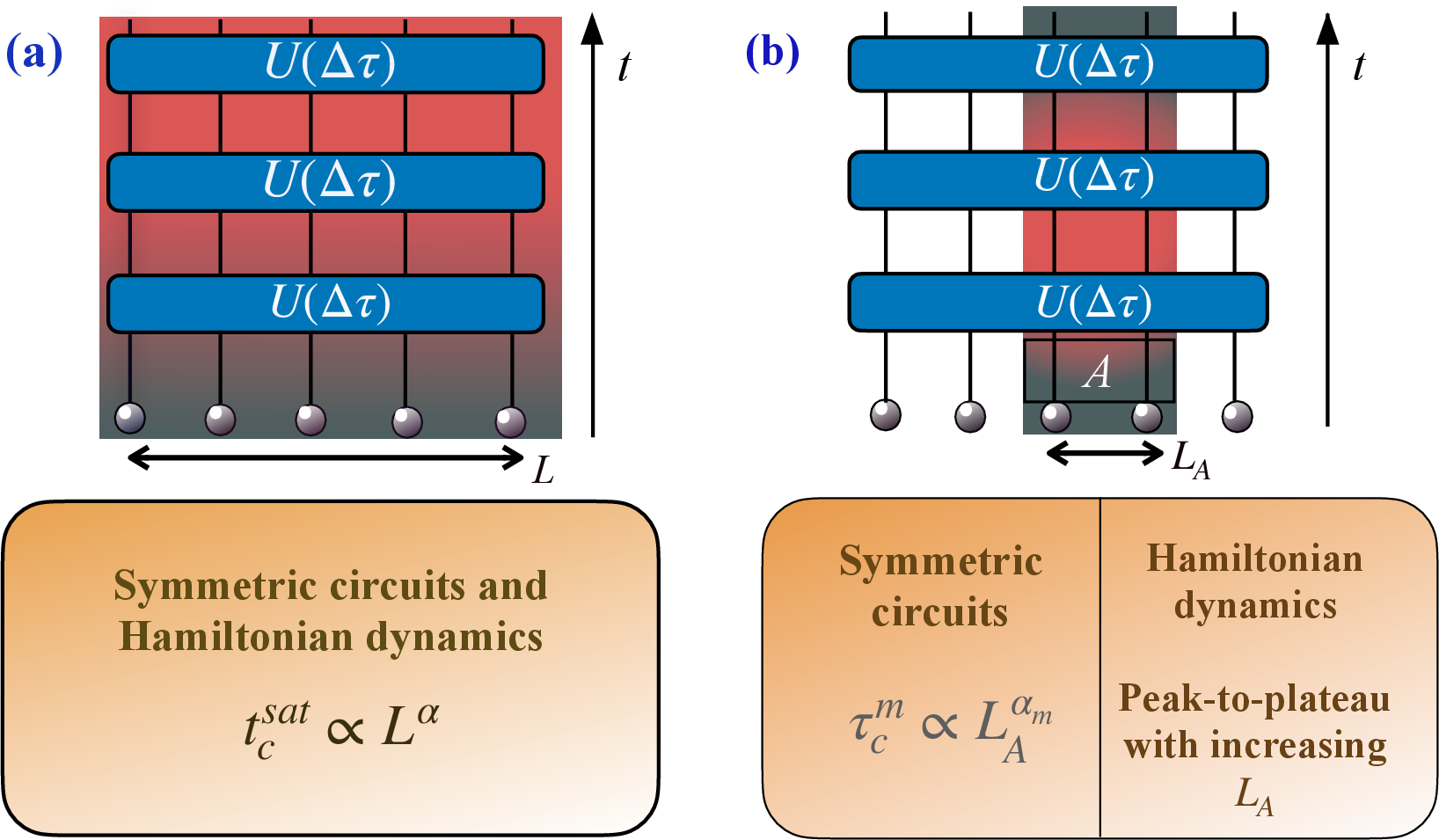
Figure 1: Schematic representation of the global and local spreading of quantum coherence under various dynamics; red indicates maximum and gray indicates minimal coherence resources.
Resource-Theoretic Framework and Diagnostics
The operational approach utilizes the resource theory of quantum coherence, in which basis-diagonal states are classified as free, and operations unable to generate coherence are incoherent. The key global metric, the participation entropy Sd, quantifies the delocalization of the many-body state in the computational basis, reflecting the extent of anticoncentration. Locally, the relative entropy of coherence Cd subtracts the growth of entanglement (quantified by the R\'enyi-2 entropy SR) from the diagonal entropy Sd on subsystems, capturing the accessible coherence resource.
Distinct dynamical scenarios require context-dependent Haar-averaged benchmarks, both for global delocalization and for the local asymptotic structure, accommodating symmetry sectors or fragmented Hilbert spaces. Analytical Haar expressions are derived for all relevant cases, including symmetry-restricted and fragment-resolved scenarios.
U(1)-Symmetric Random Circuits: Global and Local Coherence Dynamics
In $1/2$0-symmetric random circuits, the dynamics is constrained to a fixed total charge sector, fundamentally altering the wavefunction's exploration of Hilbert space. The saturation value of $1/2$1 is determined not by the total Hilbert space size but by the symmetry sector dimension. The global relaxation of $1/2$2 is characterized by a robust two-stage process: an intermediate power-law decay regime $1/2$3 with $1/2$4 (nearly diffusive), followed by a finite-size-cutoff exponential decay. Importantly, the timescales for saturation and for crossover from power-law to exponential decay both scale \textbf{algebraically} with system size $1/2$5, in stark contrast to the logarithmic scaling seen in unconstrained circuits.
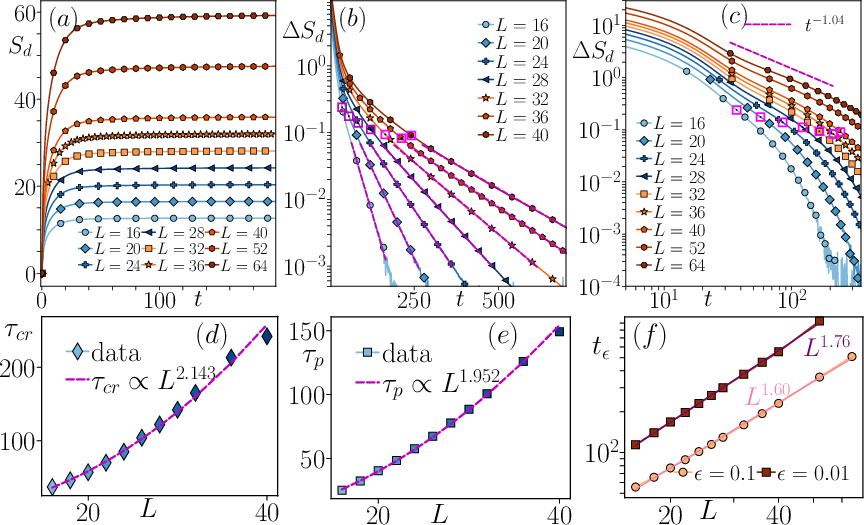
Figure 2: $1/2$6 global dynamics for $1/2$7-symmetric spin-1/2 circuits, showing algebraic relaxation and power-law scaling of saturation time with $1/2$8.
Local coherence $1/2$9 exhibits a pronounced rise–peak–fall profile, with peak time $1$0 scaling as a power law in subsystem size $1$1, $1$2. The value of $1$3 is controlled by the diffusive exponent extracted from the algebraic decay of local $1$4, with the empirical relation $1$5 for $1$6-symmetric dynamics.
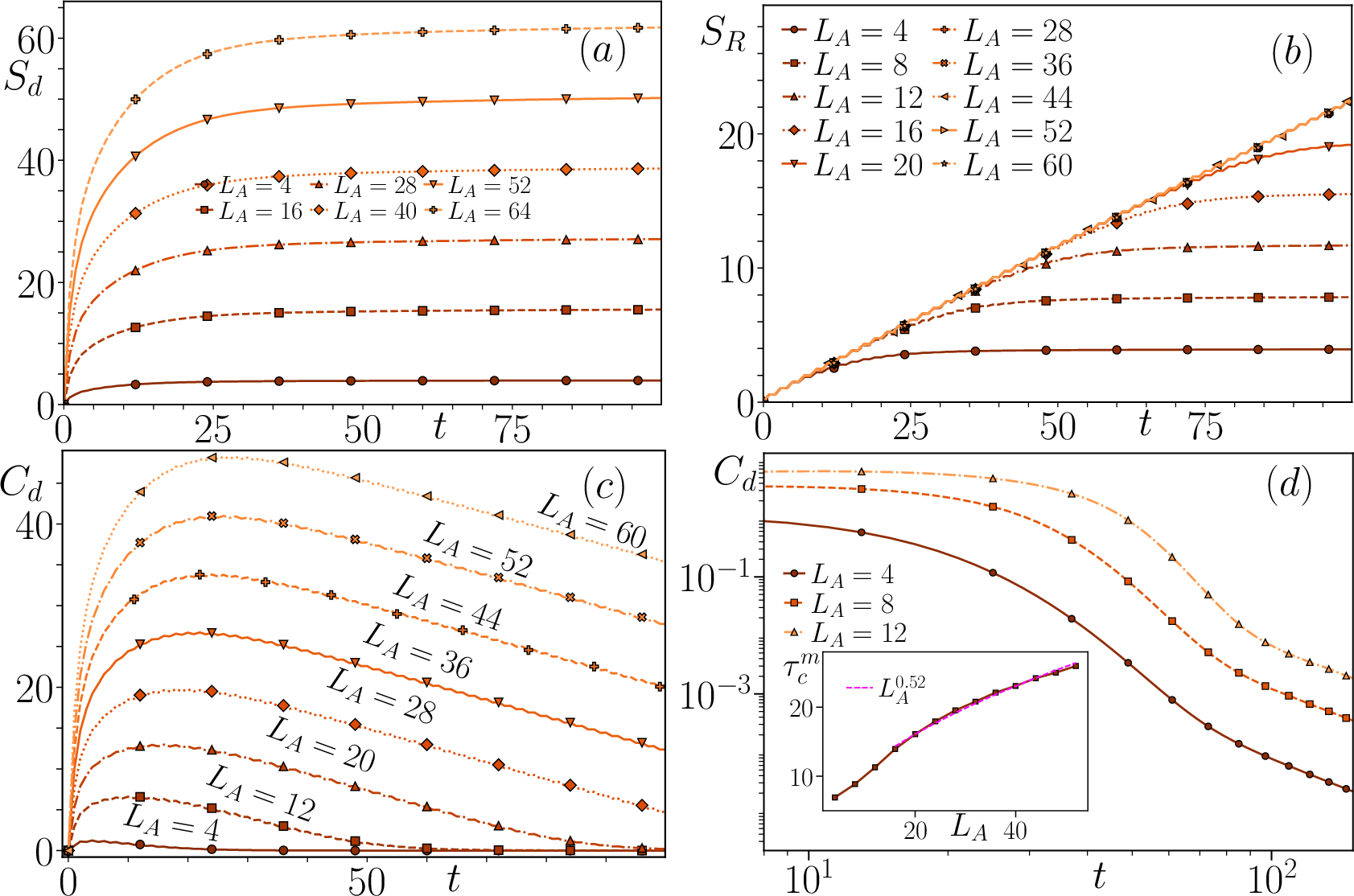
Figure 3: Local coherence dynamics in $1$7-symmetric spin-1/2 circuits, displaying the peak structure and its subsystem-size dependence.
This phenomenology is robust across local dimension ($1$8 vs.\ $1$9) and generic initial product states within the symmetry sector.
Fractonic Circuits: Charge and Dipole Conservation, and Hilbert-Space Fragmentation
Random circuits conserving both charge and dipole (fractonic dynamics) induce severe Hilbert space fragmentation, restricting the dynamics to Krylov fragments whose dimension is exponentially smaller than the full symmetry sector. Within the largest connected fragment (e.g., mapped to dimer sequences), the global Sd0 again exhibits power-law to exponential relaxation, but with exponents reflecting both the effective mode structure and the strong fragmentation-induced kinematic constraints.
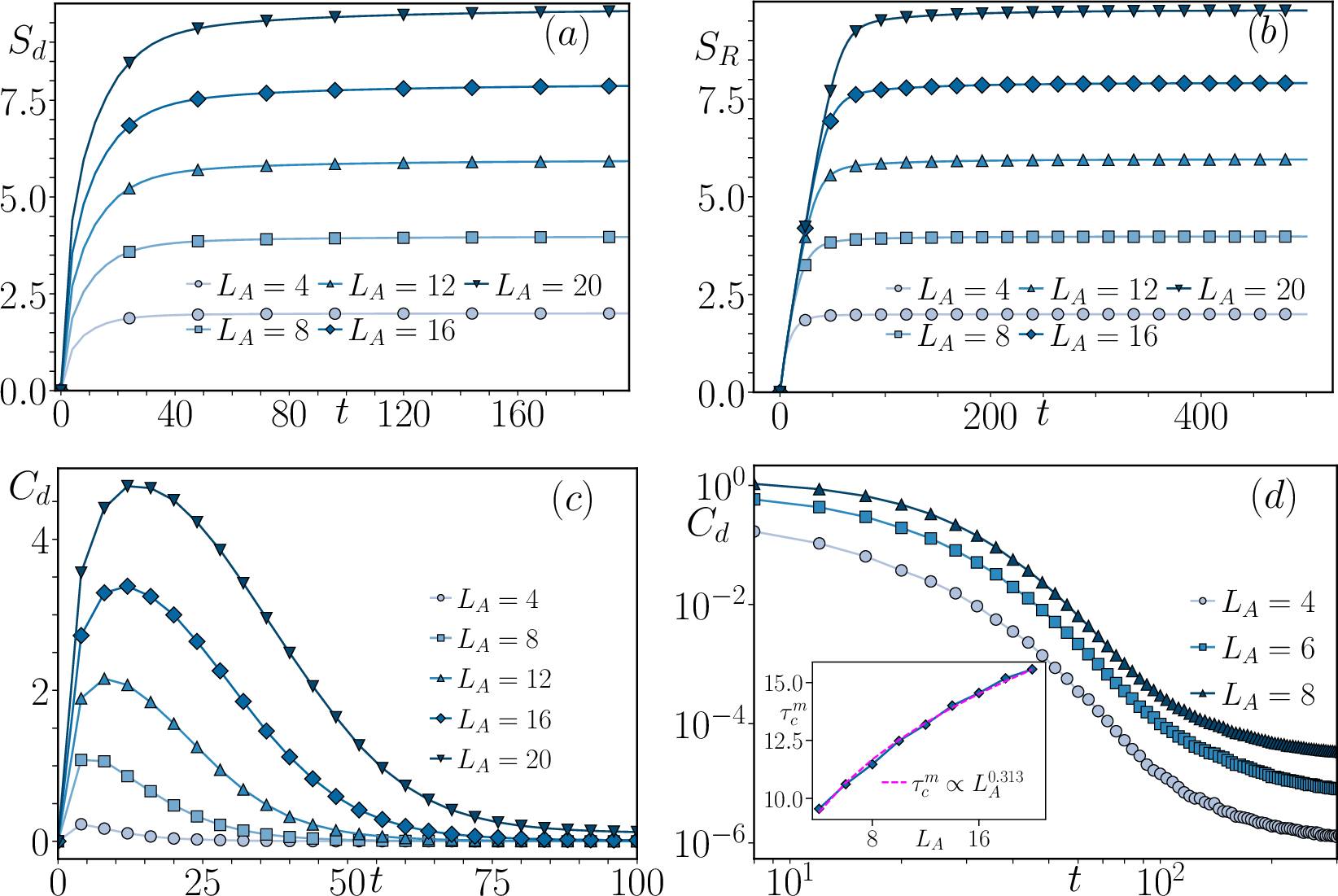
Figure 4: Local coherence dynamics for charge- and dipole-conserving (fractonic) random circuits; dynamics are confined to a dimerized Krylov fragment.
Local coherence dynamics Sd1 retains the rise–peak–fall structure, but the algebraic scaling exponents for both the decay and the peak time are smaller (e.g., Sd2), reflecting the more restricted mode space and distinct hydrodynamic processes. The algebraic decay of local Sd3 is quantitatively described by a coupled domain-wall pair model, yielding a Sd4 mode-sum behavior consistent with a product of two diffusive modes.
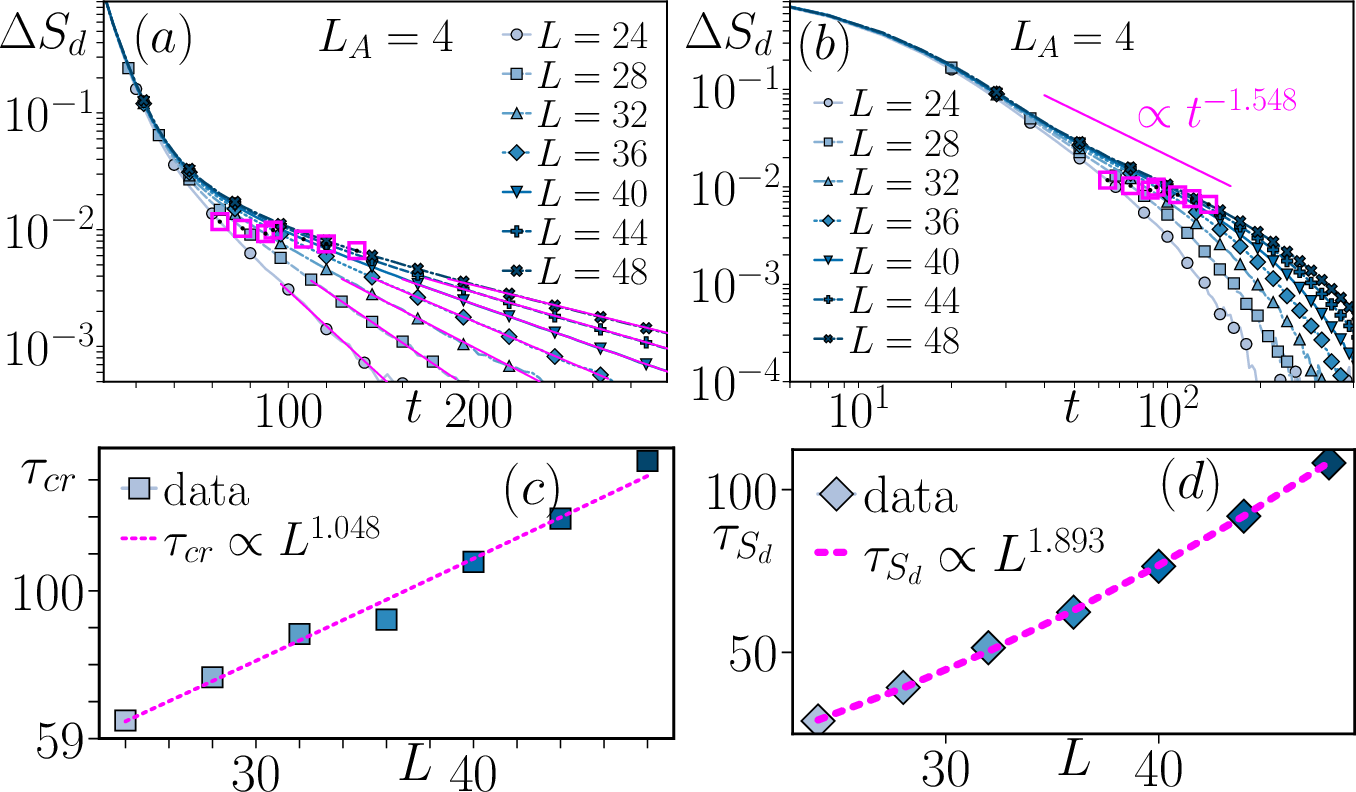
Figure 5: Algebraic decay and scaling of local diagonal entropy deviations in the fractonic Hilbert fragment.
Late-time asymptotics in all cases are determined by the Haar average within the fragment—not the full symmetry sector—emphasizing the dynamical importance of fragmentation.
Ergodic Hamiltonian Dynamics: Mixed-Field Ising Model
In the MFIM, the global Sd5 dynamics exhibits a power-law decay governed by energy diffusion, mirroring the behavior seen in random circuits with conservation laws. However, local coherence dynamics deviate qualitatively: the sharp rise–peak–fall in Sd6 seen in circuits is replaced at large Sd7 by a broad, extended plateau, indicating different microscopic mechanisms of resource spreading and a more pronounced role for rare-region or many-body effects.
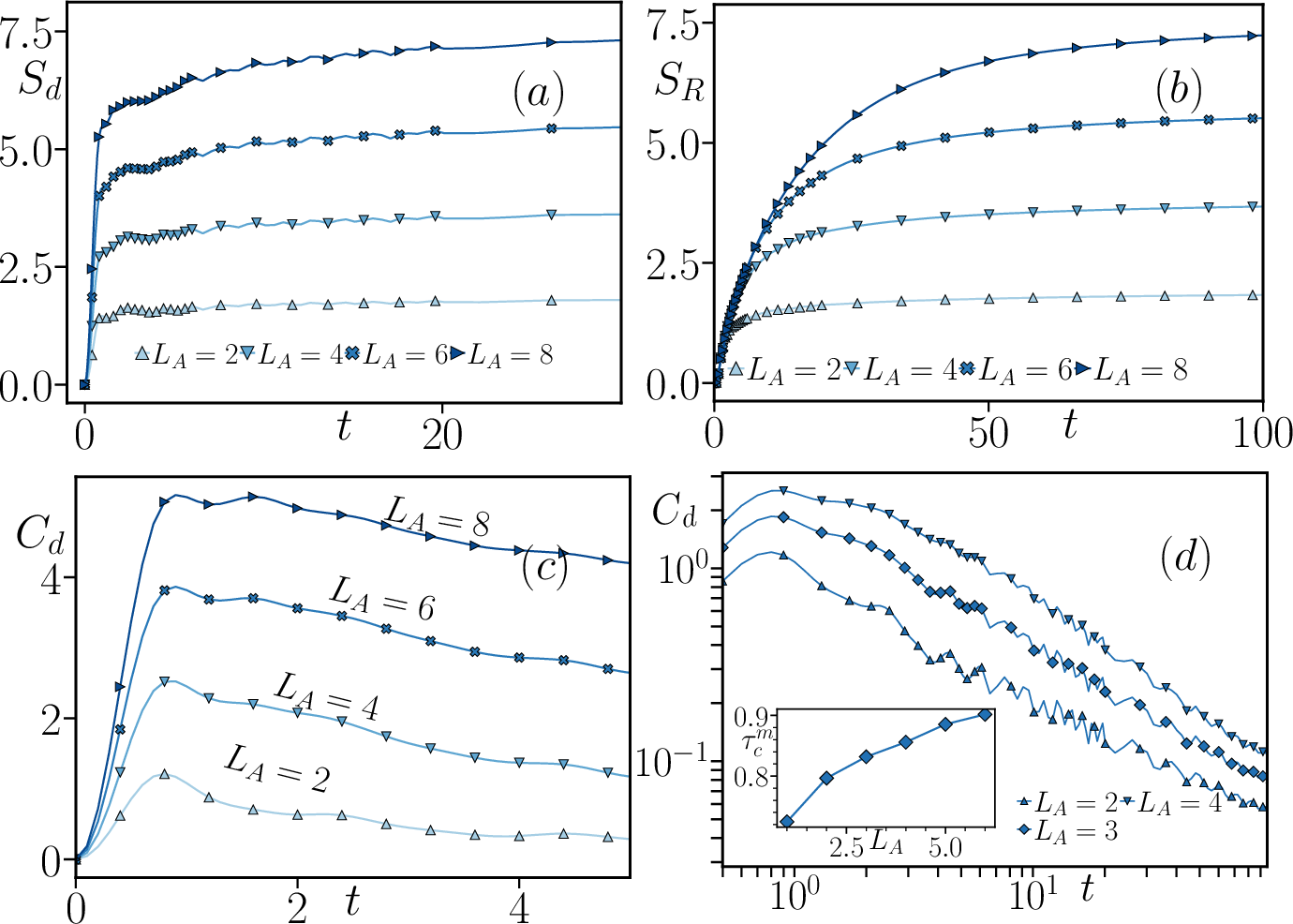
Figure 6: Local coherence, entanglement, and relative coherence entropies in the MFIM; extended plateaus arise for large subsystems, signifying non-ballistic resource relaxation.
The temporal relaxation of both global and local Sd8 in the MFIM is algebraic but with exponents that are distinct from the random circuit cases, reflecting the underlying diffusive energy transport and the absence of explicit random-unitary-induced scrambling.
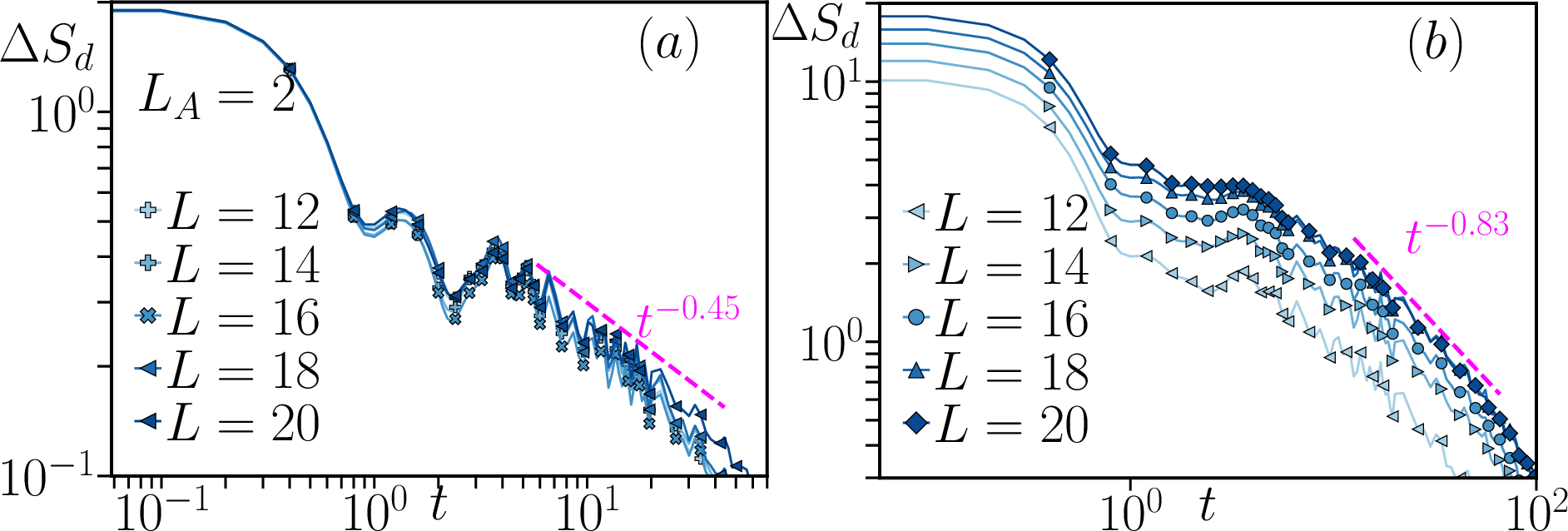
Figure 7: Comparison of the scaling and algebraic relaxation exponents for local and global diagonal entropy in the MFIM.
The work provides detailed Haar-averaged diagonal and subsystem purity formulas accommodating arbitrary symmetry and fragment structures. For large systems, the RTN framework allows efficient computation of R\'enyi-2 observables using transfer-matrix techniques that fully incorporate Sd9 constraints. For Hamiltonian evolution, an MPS-based algorithm efficiently evaluates the norm of the diagonal ensemble, providing access to Cd0 for large Cd1 and Cd2.
Implications, Perspective, and Future Directions
The results demonstrate that quantum coherence, as a resource, sensitively probes both hydrodynamic slow modes induced by conservation laws and the impact of strong kinematic constraints (fragmentation). The emergence of algebraic resource relaxation in contrast to the exponentially fast delocalization of unconstrained circuits has significant consequences for quantum equilibration, resource theory, and complexity growth.
Applications to quantum simulation, benchmarking, and random sampling protocols are immediate, as the diagonal entropy is central to classical shadows and anticoncentration theorems. The observed scaling of resource relaxation times, which grow polynomially rather than logarithmically with system size, raises new questions about the scaling of thermalization and randomization in realistic constrained environments.
Future theoretical developments could extend these resource-theory-based hydrodynamic approaches to non-abelian symmetries, higher moment conservation constraints, and interplay with magic and non-stabilizer resources, or to open and measured systems. The analytical machinery and simulation frameworks developed here are directly applicable to such investigations.
Conclusion
This work establishes that conservation laws fundamentally reshape coherence dynamics in many-body quantum systems, enforcing hydrodynamic power-law relaxation and altering the timescales for resource equilibration. Both global delocalization and local resource depletion slow dramatically compared to unconstrained dynamics, with clear signatures in the dynamical scaling of coherence quantifiers and a deep link to transport phenomena and Hilbert space structure. The methods and findings set the stage for a quantitative hydrodynamics of quantum resources in complex many-body systems.