- The paper introduces an explicit upstream reasoning module that enhances VideoQA interpretability by exposing intermediate logic steps.
- The paper demonstrates improved accuracy for object recognition tasks by integrating structured outputs from large reasoning models into the VideoQA pipeline.
- The paper reveals that explicit reasoning modules boost performance when baseline LMMs have room for factual grounding but may degrade results when LMM performance is already high.
Explicit Upstream Reasoning for Video Question Answering: The UpstreamQA Framework
Motivation and Framework Design
VideoQA presents a multifaceted challenge requiring spatial, temporal, and linguistic integration, with causal inference. Existing large multimodal models (LMMs) typically use end-to-end pipelines, which obscure their internal reasoning and are vulnerable to adversarial perturbations and modality biases. Recent approaches have begun to modularize such systems, but explicit reasoning—particularly in the form of large reasoning models (LRMs) generating intermediate logical steps—has not been systematically evaluated as an upstream module in VideoQA.
The UpstreamQA framework proposes a two-stage, modular pipeline: first, a multimodal LRM executes a specified upstream task (object identification or scene context generation) using 50 uniformly sampled frames and audio; second, the LRM’s structured output is passed, along with the original video and question, to a downstream LMM. This design allows for a principled investigation of how explicit reasoning affects both interpretability and accuracy in VideoQA, uniquely enabling task-agnostic drop-in evaluation of upstream modules.
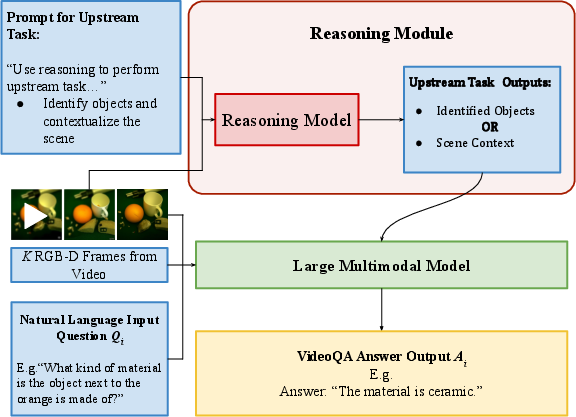
Figure 1: An explicit reasoning model performs a designated upstream task, and its output is provided to the LMM alongside the original video and question.
Experimental Protocol
The experimental setup uses NExTQA and OpenEQA datasets. NExTQA contains annotated questions about object interactions in daily activities, whereas OpenEQA focuses on embodied Question Answering based on episodic histories (RGB-D walkthroughs) of real environments. Both datasets are processed with uniform frame sampling and paired audio.
LRMs evaluated are o4-mini and Gemini 2.5 Pro; LMMs are GPT-4o and Gemini 2.5 Flash. All are used off-the-shelf with zero-shot prompting, without finetuning. Baseline performance is measured by standalone LMMs without upstream augmentation. Explicit reasoning is assessed by inputting structured outputs from LRMs for object identification (detailed inventory, spatial relations) or scene context (environment type, ambiance, architectural details) into LMMs for final QA.
Numerical Results and Analysis
The results show dataset and model-dependent impacts. On OpenEQA, Gemini 2.5 Flash baseline LLM-Match Score improves from 58.8 to 67.1 (object identification) and 67.8 (scene context generation) when combined with an LRM. Notably, GPT-4o baseline (67.7) exhibits performance degradation when explicitly augmented, with scores dropping as low as 48.1. This is significant: explicit reasoning boosts accuracy where baseline LMM performance is low, but may degrade results when baseline is already strong.
For NExTQA, GPT-4o benefits from upstream reasoning: accuracy rises from 62.32% baseline to 67.48% (object identification, o4-mini), and to 67.68% (scene context, o4-mini). Conversely, Gemini 2.5 Flash, which starts at a higher baseline (78.32%), sees accuracy decline by up to 0.88% when augmented.
This demonstrates that integration of explicit reasoning yields substantial improvements only when baseline LMM performance leaves room for factual grounding; otherwise, reasoning modules may introduce noise or redundancy, resulting in score drops. This is a strong claim that contradicts the commonly held belief that explicit reasoning universally enhances performance.
Stratified Evaluation by Question Type
Object recognition questions on OpenEQA see notable gains when using explicit upstream modules, while world knowledge questions remain unchanged. This indicates explicit reasoning is primarily beneficial for structured, fact-driven queries that align tightly with upstream object identification or scene context—rather than for questions demanding broad background knowledge.
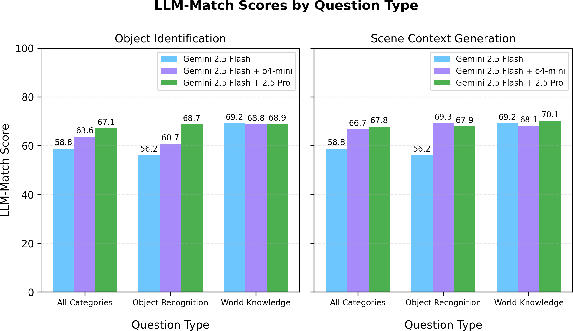
Figure 2: Upstream reasoning, when added to Gemini 2.5 Flash, enhances accuracy for object recognition questions but yields negligible improvement for world knowledge queries.
Further, direct examination of scene context generation outputs shows highly structured, domain-specific descriptions, improving factual answers but not general, externally-referenced questions.

Figure 3: Scene context generation delivers comprehensive environmental reasoning, supporting object-related QA but less so for knowledge-based queries.
Interpretability and Modular Reasoning
UpstreamQA advances VideoQA interpretability by exposing intermediate reasoning steps rather than relying on black-box end-to-end evaluation. This enables diagnostic transparency, making it feasible to leverage or scrutinize logical outputs, and decompose failures or successes at the module level.
In practical terms, the linear, two-stage framework is amenable to finer-grained control and combinatorial testing, supporting task-agnostic insertion or removal of reasoning modules. Future extensions can exploit this modularity to integrate additional upstream subtasks or alternate reasoning strategies (e.g., causal graphs, event-based decomposition).
Implications and Future Directions
The results underscore that modular explicit reasoning is not a panacea and its utility is sensitive to task structure and the baseline capabilities of the downstream LMM. Explicit reasoning assists with factual grounding and structured queries, but its integration can degrade performance in systems already optimized for the target task.
Theoretical implications include a call for more selective, adaptive combination of reasoning and multimodal processing, possibly governed by meta-learners or confidence-triggered module selection. Further work should examine the precise sources of degradation, the interplay with prompt design, and the impact of reasoning module fidelity.
Practically, the UpstreamQA approach illustrates that diagnostic transparency and modularity can facilitate controlled improvements and targeted debugging, particularly in real-world deployment scenarios with complex, unstructured video inputs. There is substantial potential to extend the framework to broader reasoning subtasks—temporal action tracking, causal chain extraction, or event graph generation—and to explore granular submodular integration.
Conclusion
UpstreamQA introduces a task-agnostic, interpretable, and modular framework for explicit upstream reasoning in VideoQA, empirically demonstrating that performance gains are contingent on baseline model strengths and query structures. Explicit reasoning modules improve accuracy for fact-driven object recognition questions and enhance interpretability, but can degrade performance for high-performing LMMs or when applied to world knowledge queries. The framework’s modularity and transparency offer meaningful avenues for extension, diagnostic analysis, and adaptive integration in continued VideoQA research and deployment.