- The paper introduces EX-FIQA, leveraging intermediate early exit representations within Vision Transformers to significantly reduce computational cost while maintaining accuracy.
- The paper details two fusion strategies—uniform averaging and depth-weighted fusion—that effectively integrate predictions from multiple transformer exits.
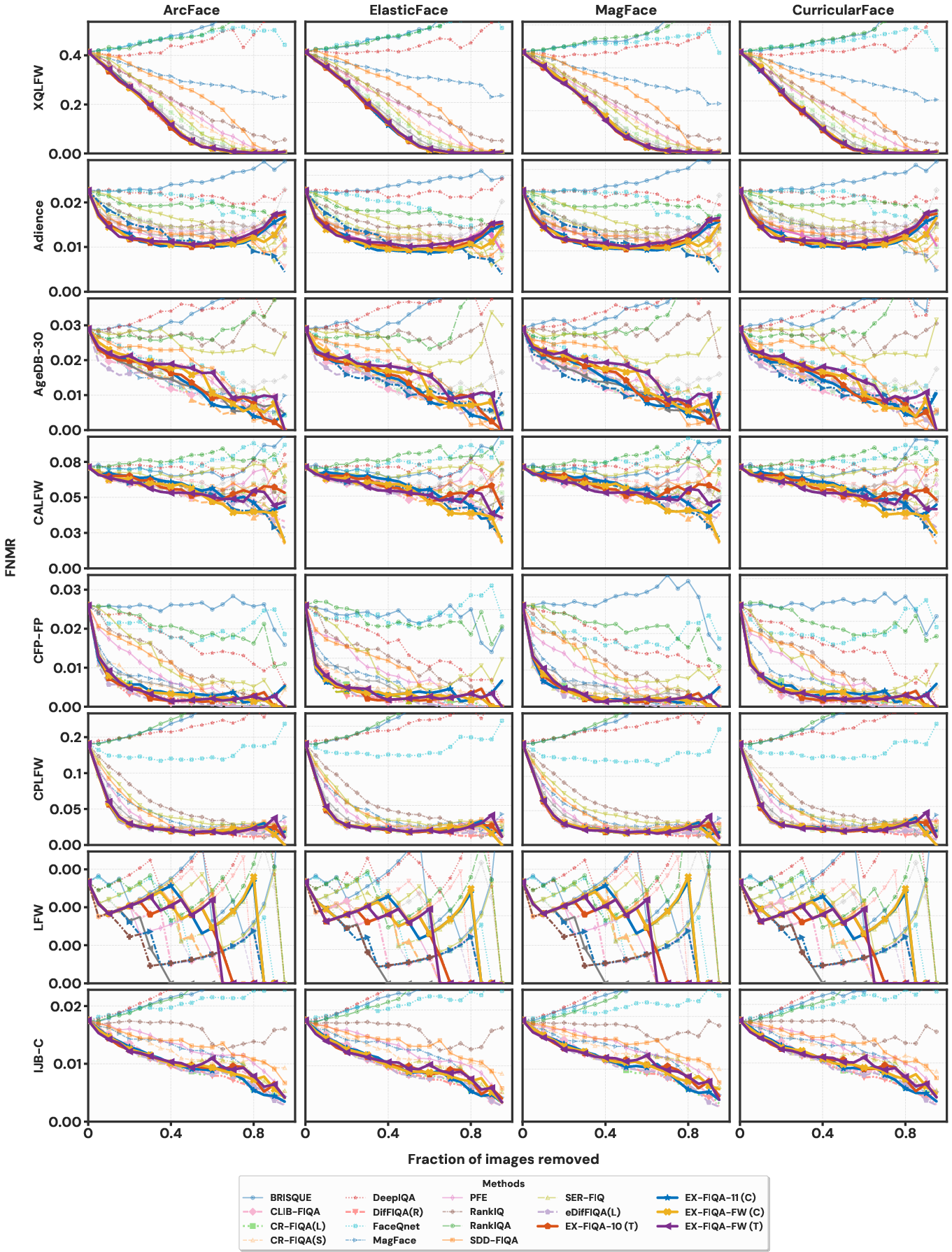
- The paper demonstrates strong performance improvements on eight benchmarks, enabling efficient and accurate face quality assessment in real-world scenarios.
Introduction and Problem Definition
Face Image Quality Assessment (FIQA) plays a critical role in biometric systems, directly determining which face samples are retained for downstream recognition or verification tasks. Traditional FIQA methods—both supervised and unsupervised—predominantly employ deep CNNs or Vision Transformer (ViT) architectures, but rely exclusively on the final-layer representations, discarding potentially valuable quality signals present at intermediate depths. Deploying ViTs for FIQA in real-world, resource-constrained environments (e.g., edge biometrics, live surveillance) is further hampered by their heavy computational demands.
This paper introduces EX-FIQA, a methodological framework for leveraging intermediate early exit representations within ViTs to enhance FIQA. The central thesis is that intermediate transformer blocks encode complementary, quality-relevant information, and that judicious use of early exit strategies and multi-exit score fusion can yield substantial gains in both computational efficiency and accuracy. Extensive evaluation on eight public benchmarks demonstrates that the proposed EX-FIQA system enables up to 50% reduction in computational cost while sustaining or even improving upon state-of-the-art FIQA performance (2604.22842).
EX-FIQA: Architectural Design and Mechanisms
EX-FIQA is built upon the ViT-FIQA architectures (CR-FIQA-style and quality-token variants), each consisting of 12 stacked transformer blocks. Unlike CNNs, ViTs maintain a constant token dimensionality across all blocks, enabling the seamless application of early exit heads at arbitrary depths without auxiliary adaptation layers.
An early exit at block l corresponds to direct extraction and processing of either:
- The CR-FIQA-style patch embeddings (EX-FIQA (C)), which are concatenated and passed through a lightweight MLP and regression head;
- The quality token (EX-FIQA (T)), which is regressed to a scalar score by the pre-trained head, by design (no extra training or parameters needed).
EX-FIQA thus sidesteps the redundancy of running the full transformer for samples whose quality can be confidently assessed at shallower depths.
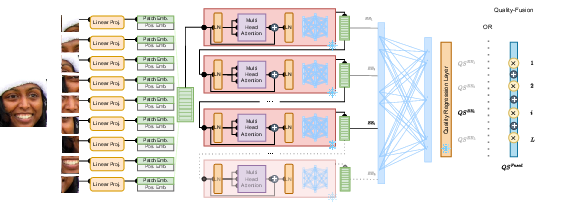
Figure 1: Overview of EX-FIQA (C) architecture and early exit mechanism; inference can be terminated at any intermediate block, with score fusion for robust quality prediction.
Fusion Strategies Across Depth
The paper proposes two fusion approaches that aggregate scores from all 12 exits:
- Uniform averaging (EX-FIQA-F): All layer-specific predictions are equally weighted.
- Depth-weighted fusion (EX-FIQA-FW): Predictions from deeper blocks are assigned higher weights, consistent with the empirical finding that deeper layers generally yield more discriminative quality scores.
This fusion capitalizes on complementarity between shallow and deep block predictions, consistently outperforming reliance on any single exit.
Analysis of Layer-wise Attention and Quality Prediction
A comprehensive study of quality predictions and attention map evolution across exits underpins the core claim: intermediate blocks capture distinct and semantically diverse aspects of facial quality (e.g., low-level texture in shallow blocks, occlusion patterns in mid-level blocks, and global face configuration in deeper stages).
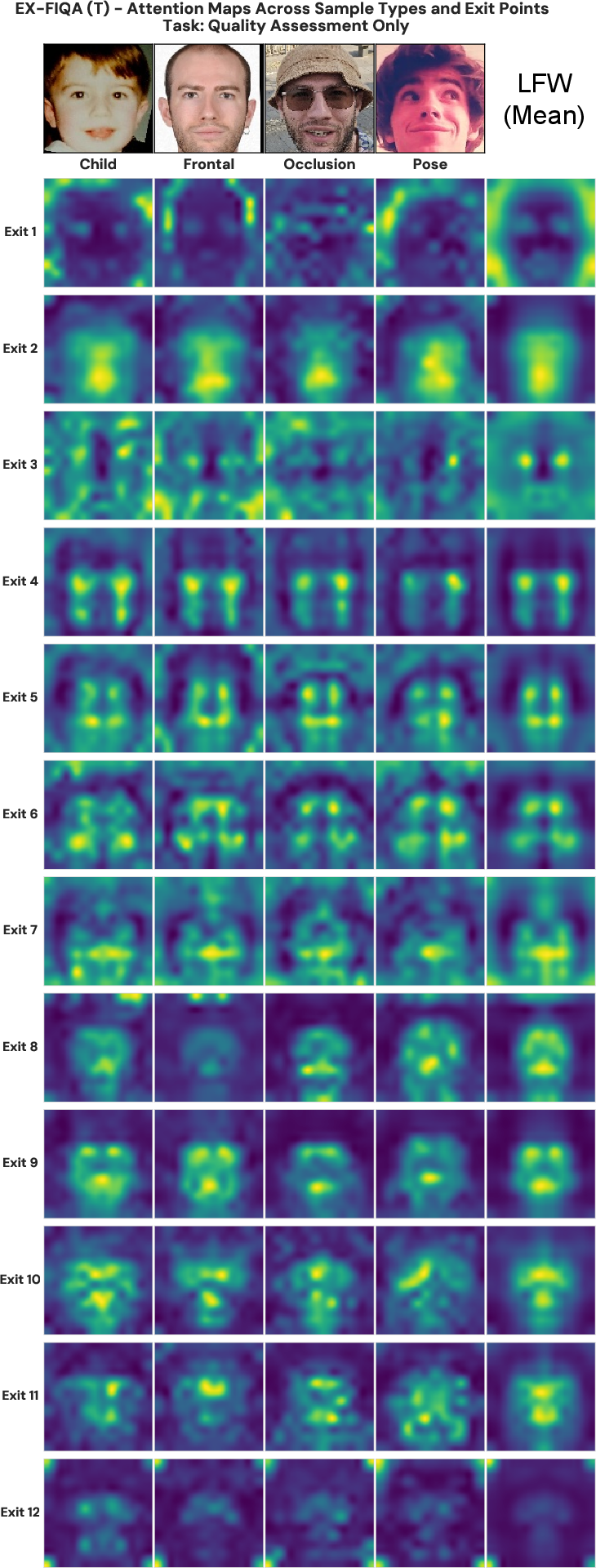
Figure 2: EX-FIQA (T) quality token attention maps across images and exit points demonstrate progressive semantic refinement.
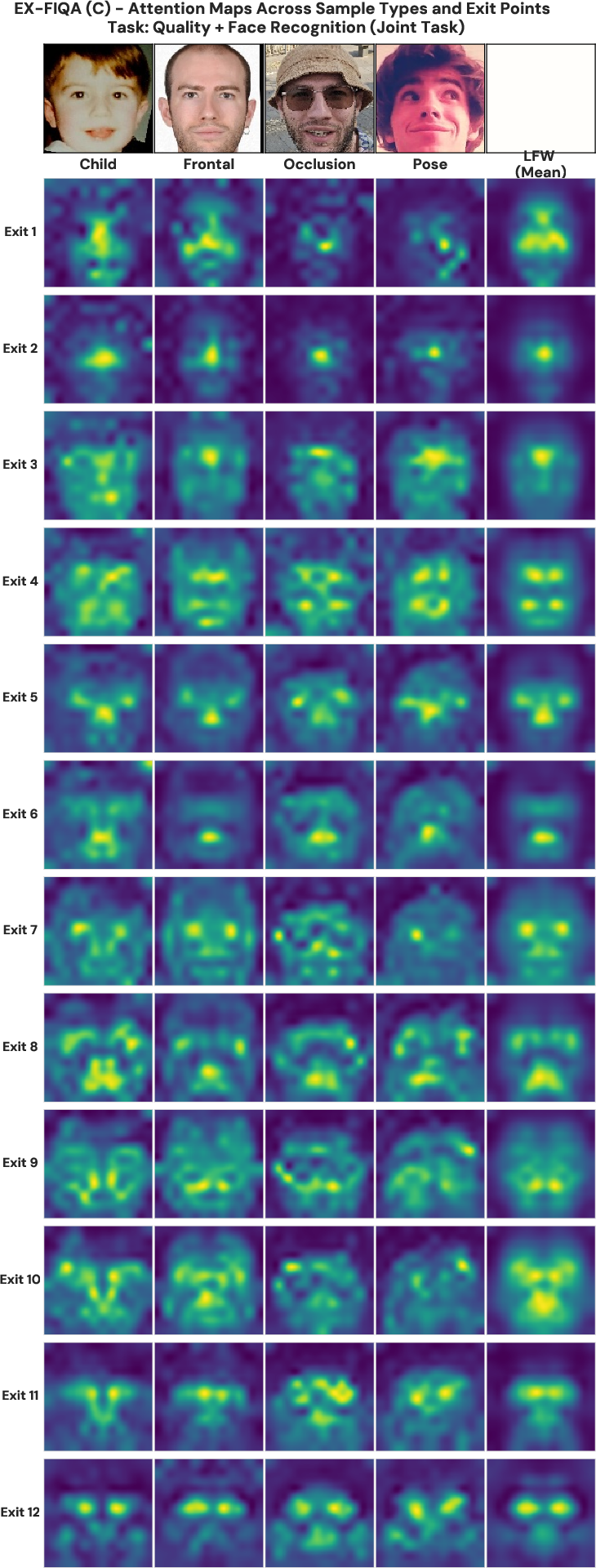
Figure 3: EX-FIQA (C) patch-level attention map evolution, visualizing shifting network focus and integration over block depth.
Consistent trends are observed:
- Early exits attend to image-level artifacts and local details.
- Middle blocks increasingly focus on canonical facial regions while suppressing background.
- Deepest blocks establish global, identity-relevant context.
These dynamics enable intermediate exits to function as valid, sometimes optimal, quality predictors—particularly for samples with distinctive noise types, occlusions, or challenging poses.
Trade-off Analysis: Computational Cost vs. Predictive Accuracy
The most substantial practical advantage of EX-FIQA is the demonstrated computational efficiency gained via early exits, without significant degradation in FIQA performance.
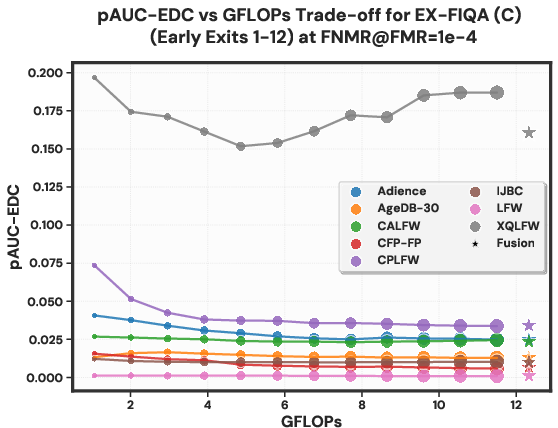
Figure 4: Performance-efficiency trade-off for EX-FIQA exits; pAUC-EDC improves monotonically with exit depth, but early to mid-level exits yield most of the gains at a fraction of the FLOPs.
Middle-block exits (6–10) achieve comparable pAUC-EDC to the final layer, but at 41–50% lower FLOPs. Similarly, fusion (especially EX-FIQA-FW) requires all exits but only imposes sub-10% additional overhead when fully parallelized. The marginal benefit of propagating all the way to exit 12 is dataset-dependent and only justified under stringent accuracy constraints.
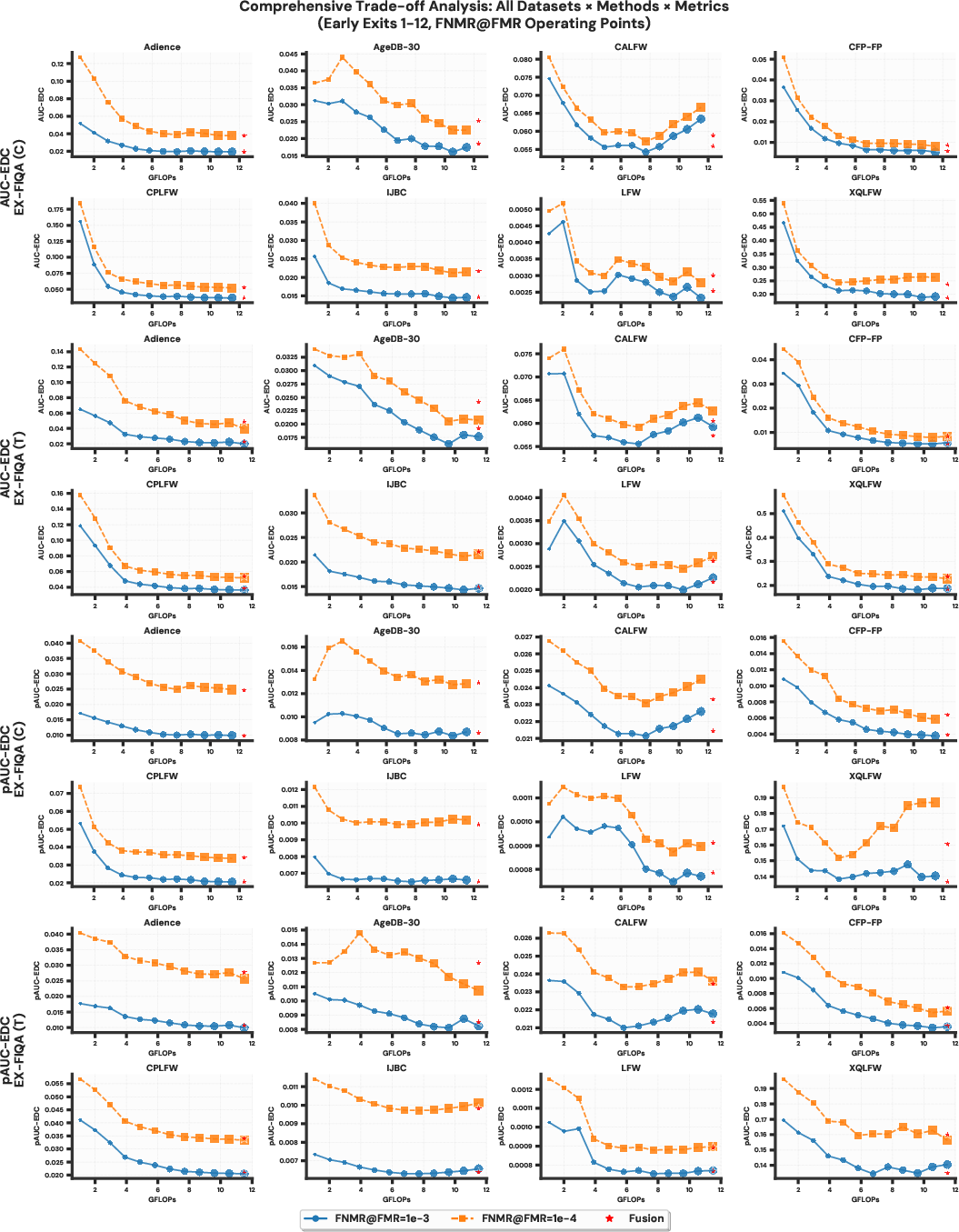
Figure 5: Joint depiction of AUC/pAUC-EDC and complexity, highlighting the sweet spot for deployment in constrained environments.
Benchmark Results versus State-of-the-Art
Quantitative evaluation on LFW, AgeDB-30, CFP-FP, CALFW, Adience, CPLFW, XQLFW, and IJB-C shows that EX-FIQA-FW achieves:
Theoretical and Practical Implications
The results challenge the standard assumption that only final-layer transformer features encode utility for biometric quality. EX-FIQA reveals a dense distribution of task-relevant information throughout the ViT stack, suggesting potential for layer-wise, adaptive model deployment across other computer vision applications, such as object detection, medical image triage, or multimodal fusion, where inference efficiency is paramount.
In practice, EX-FIQA provides an architecture-agnostic pathway to application-specific trade-off tuning: sub-selecting optimal early exit layers according to time, hardware, or energy constraints. Adaptive inference—leveraging prediction confidence or thresholding at intermediate blocks—becomes directly feasible with this technique.
Future Directions
Further research is warranted to:
- Incorporate dynamic routing and conditional computation informed by quality score uncertainty.
- Jointly train early exit heads with auxiliary distillation/fusion losses rather than relying on single-head pre-training, closing the residual gap for very shallow exits.
- Extend EX-FIQA to other modalities or cross-modal biometric quality assessment, e.g., iris or fingerprint image utility.
Additionally, integration with lightweight ViT variants and quantization will further reduce resource footprints for on-device quality screening.
Conclusion
EX-FIQA systematically demonstrates that intermediate ViT representations can be exploited for high-fidelity, computationally efficient FIQA. Through early exit and score fusion, it achieves strong operating points, allowing practitioners to flexibly balance performance and efficiency. The findings redefine best practices in both biometrics and ViT-based assessment, opening new avenues for adaptive, scalable, and robust quality evaluation in practical face recognition pipelines (2604.22842).