- The paper introduces a training-free FIQA method that utilizes pre-softmax attention magnitudes from ViT-based models as quality scores.
- The method achieves robust, interpretable quality assessment through a single forward pass, validated across synthetic and real benchmarks.
- Comparative studies show competitive performance with state-of-the-art FIQA methods, offering advantages in deployment simplicity and bias diagnosis.
Motivation and Problem Definition
Face Image Quality Assessment (FIQA) is a critical pre-processing step in face recognition (FR) pipelines, directly influencing recognition performance by filtering out poor-quality samples. Traditional FIQA methods—both supervised and unsupervised—often require significant computational resources such as multiple forward passes, backpropagation, or additional model training. Moreover, many existing approaches provide only scalar quality scores with limited or no spatial interpretability, hindering diagnosis and mitigation of quality failures in operational biometric systems.
While Vision Transformers (ViTs) have excelled in FR tasks, recent research indicates that their attention mechanisms naturally encode spatial saliency and can capture sample utility. The central hypothesis of "ATTN-FIQA: Interpretable Attention-based Face Image Quality Assessment with Vision Transformers" (2604.22841) is that pre-softmax attention scores computed within pre-trained ViT-based FR models can serve directly as robust, interpretable face quality indicators, obviating the need for any retraining or architectural modification.
Methodology: Quality from Pre-Softmax Attention Magnitudes
The core technical contribution is a fully training-free FIQA mechanism that operates as follows: a face image is passed through a pre-trained ViT-based FR network, and the pre-softmax attention matrices from the final transformer block across all attention heads are extracted. These matrices—computed as scaled dot products between patch-level queries and keys—preserve the true affinity magnitudes between input regions, which are otherwise normalized and obfuscated post-softmax. The intuition is that high-quality images offer clear, discriminative facial features that drive strong and concentrated (high-magnitude) attention alignments between relevant regions, while degraded images (due to blur, occlusion, pose, etc.) lead to diffuse, lower-magnitude attention patterns due to ambiguous or uninformative cues.
All pre-softmax attention values across heads and patches are flattened into a single vector, and the final quality score is defined as the mean of these values. This process is universal to any ViT-based FR architecture and operates in one forward pass, providing an immediate plug-in for quality filtering. Importantly, since the spatial attention patterns are available, the approach affords inherent interpretability: practitioners can visualize which facial areas the model deems influential for quality prediction and diagnose region-specific quality failures.
Empirical Validation: Robustness and Generalization
The authors validate the pre-softmax attention hypothesis on both synthetic and real benchmarks:
- Synthetic Validation: Using the SynFIQA dataset (550,000 synthetically degraded images grouped by ground-truth utility bins), ATTN-FIQA scores increase monotonically across quality levels and clearly discriminate between degraded and reference samples.
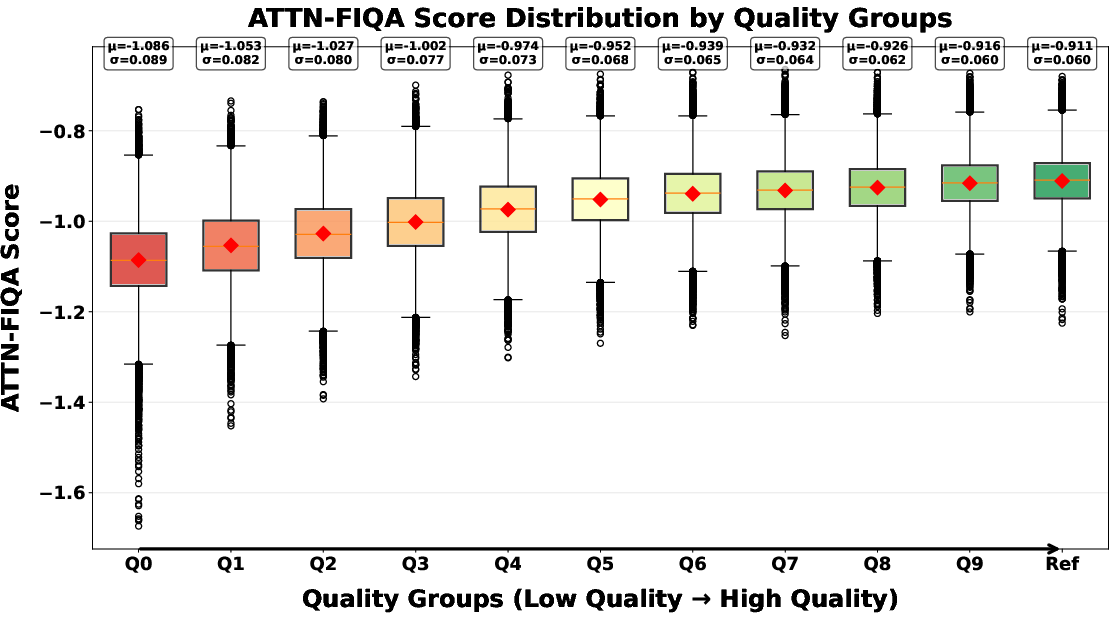
Figure 1: ATTN-FIQA scores on SynFIQA: Quality increases from Q0 (low) through Q9 to reference images, demonstrating monotonic quality sensitivity.
- Controlled Degradation and Interpretability: Visualization with controlled degradations demonstrates that attention heatmaps for high-quality images are focused and high-magnitude on pivotal facial features, whereas attention is diffuse and weak under occlusion, pose, or other quality reductions.
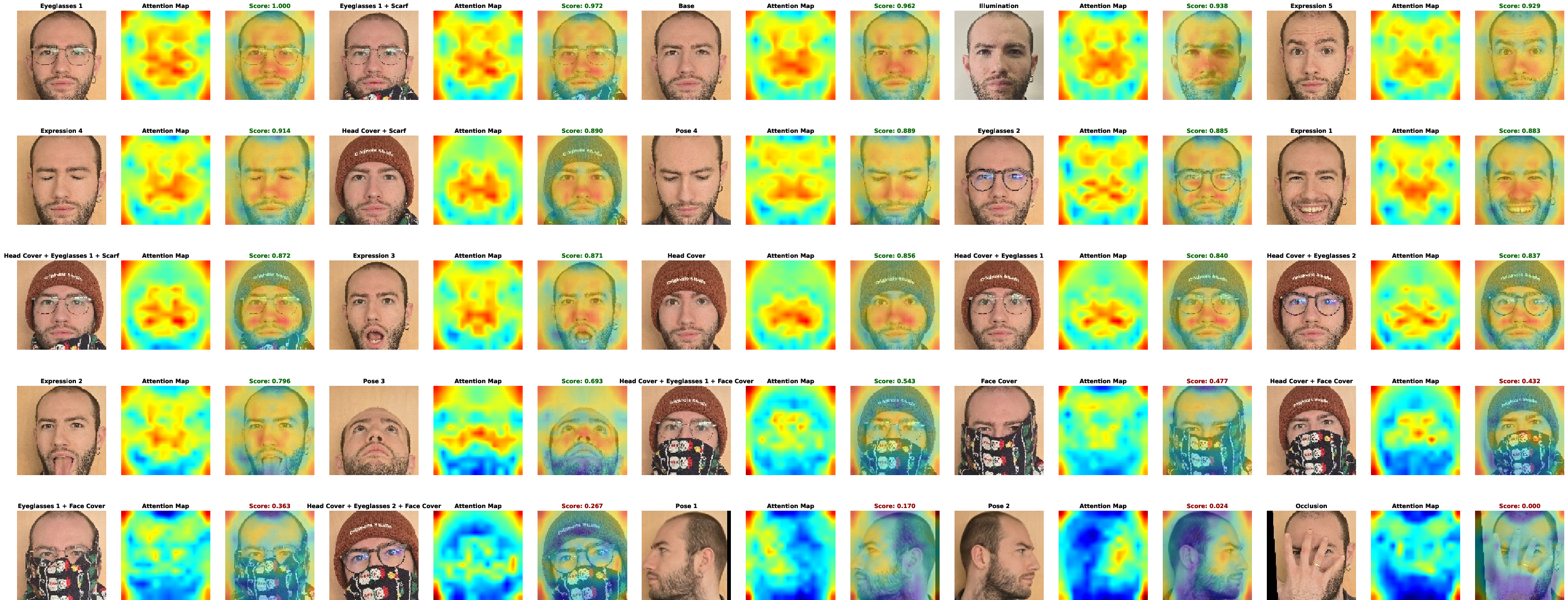
Figure 2: Attention heatmaps for diverse degradations using ViT-S/AdaFace, showing focused high attention for pristine samples and dispersed low attention for degraded ones.
- Multi-Dataset Generalization: Analysis across eight real-world benchmarks (LFW, AgeDB-30, CFP-FP, CALFW, Adience, CPLFW, XQLFW, IJB-C) and multiple FR models (ArcFace, ElasticFace, MagFace, CurricularFace) exhibits strong correlational capacity between ATTN-FIQA scores and recognition utility across unconstrained and constrained settings.
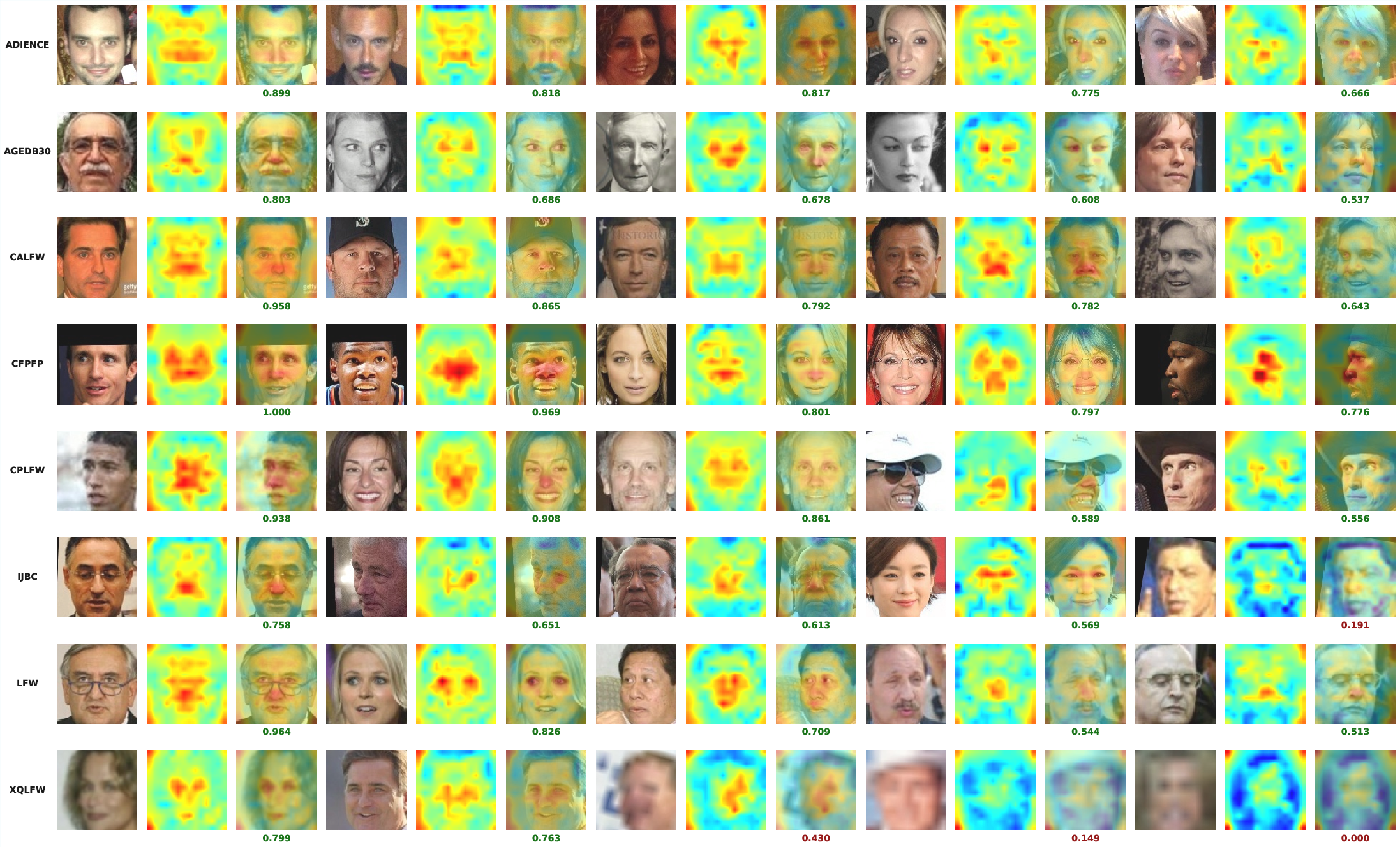
Figure 3: Multi-dataset attention analysis with ViT-S/AdaFace: attention-quality relationships are consistent across datasets and quality regimes.
Ablation Studies: Architecture, Training Loss, Aggregation
Comprehensive ablation analyses demonstrate:
- Architecture Depth: ViT-S (12 blocks) consistently outperforms ViT-B (24 blocks) in quality prediction robustness, indicating that increased depth does not improve attention-based quality discrimination.
- Training Objective: The quality attention relationship is stable across margin-based loss functions (AdaFace vs. ArcFace), suggesting generality across FR optimization objectives.
- Aggregation Strategies: Concatenating all heads and using mean aggregation produces the most discriminative and stable quality scores. Neither maximum, median, nor inverse-standard-deviation aggregation improved performance.
- Interpretability: Visual analyses using alternative models (such as ViT-B, or ViT-S with ArcFace) confirm architectural and training-objective invariance of attention-based quality patterns.
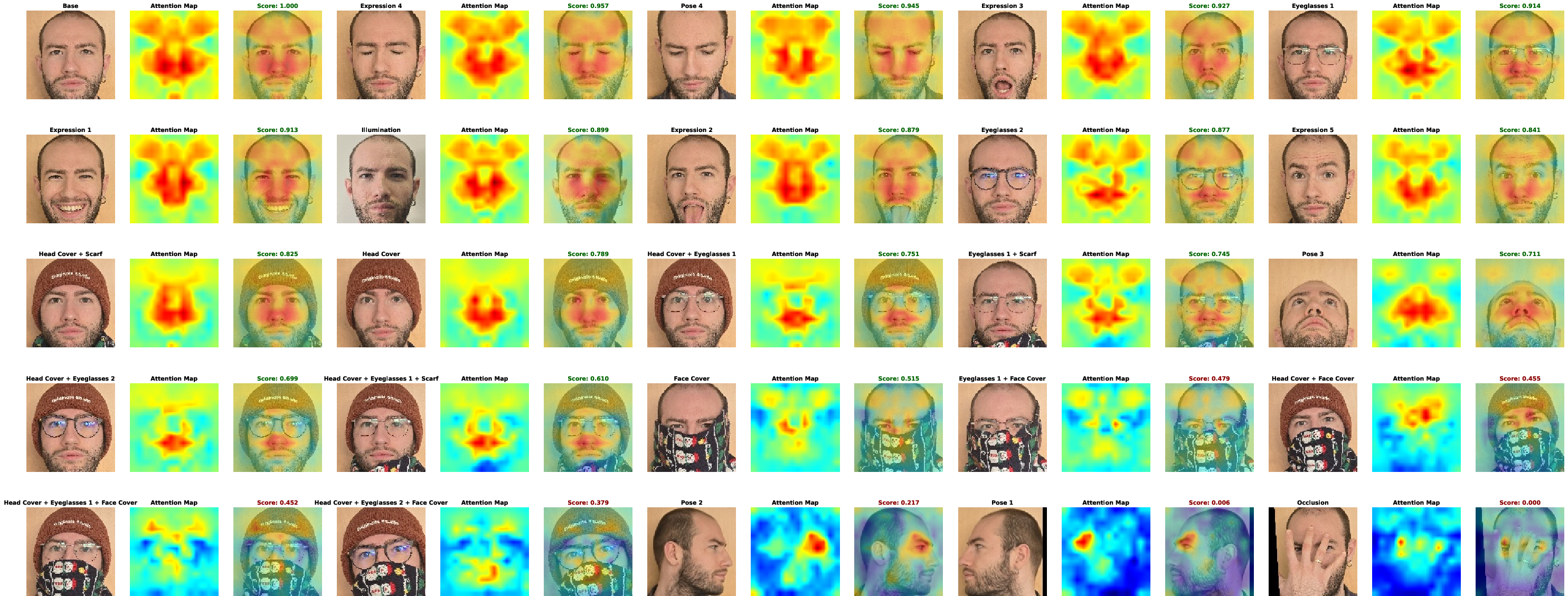
Figure 4: Attention maps for ViT-S/ArcFace reveal the same attention-quality encoding structure as found for AdaFace training.
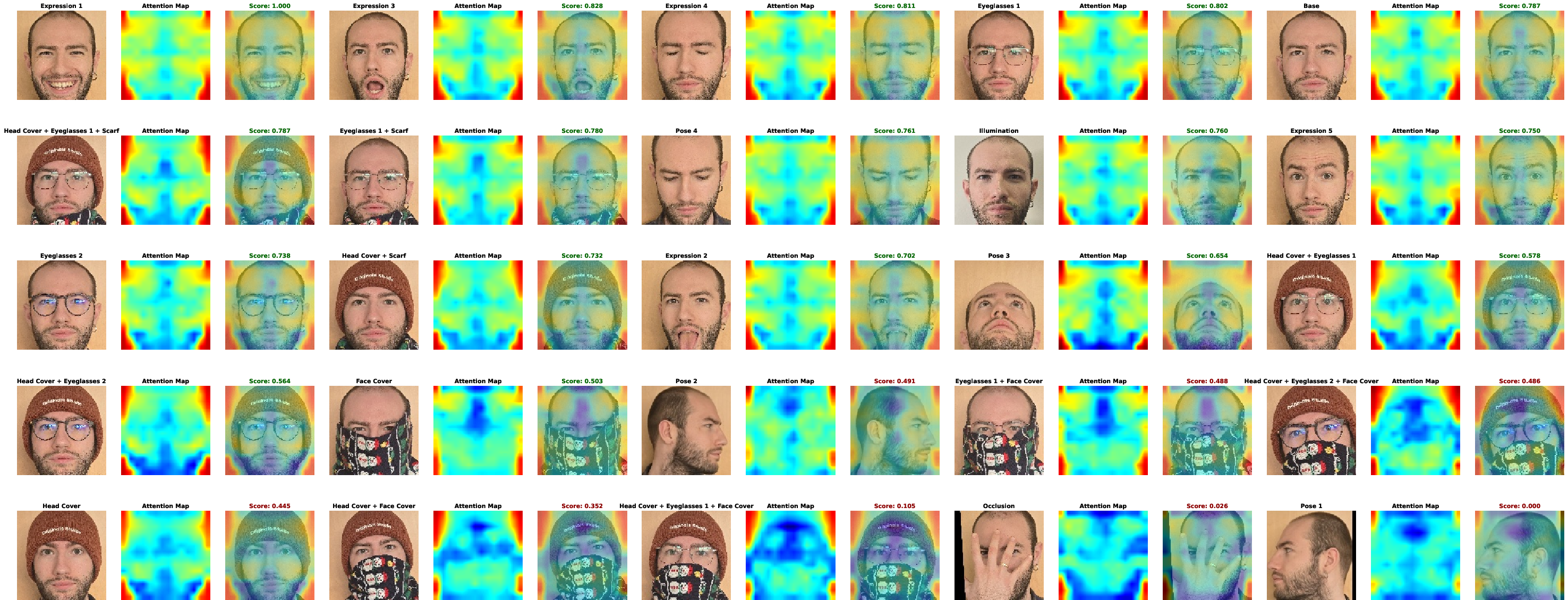
Figure 5: ViT-B (deeper architecture) attention remains correlated with quality—a further demonstration of architecture-independence.
ATNN-FIQA is benchmarked against 15 state-of-the-art IQA and FIQA methods, including both classical no-reference metrics and recent deep learning-based approaches. Using error-versus-discard characteristic (EDC) curves and (partial-)AUC metrics at FMR=$1e-3$ and $1e-4$, the method achieves:
- Competitive or superior performance in unconstrained, real-world datasets (notably IJB-C), with pAUC-EDC for ArcFace at 6.74/10.28, ElasticFace at 6.49/10.00, and CurricularFace at 6.46/9.44 (for FMR@1e-3/1e-4).
- Comparable performance to more computationally intensive or purpose-trained FIQA algorithms, especially in unconstrained scenarios; modest performance gaps appear only on datasets where quality degradations are extremely constrained or uniform.
- Unprecedented computational and deployment simplicity: a single forward pass with any ViT-based FR model yields robust, interpretable quality scoring with no additional resources, making it highly practical for production biometrics.
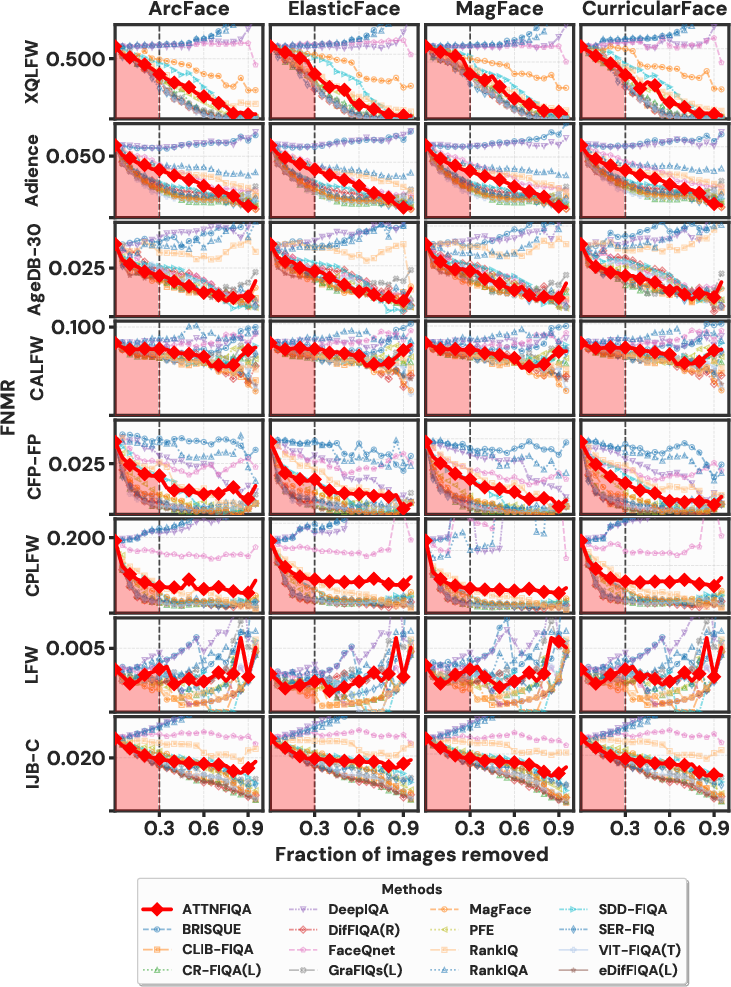
Figure 6: EDC curves for FNMR@FMR=1e-3 show that ATTN-FIQA's discard-reject performance closely tracks or exceeds leading FIQA baselines.
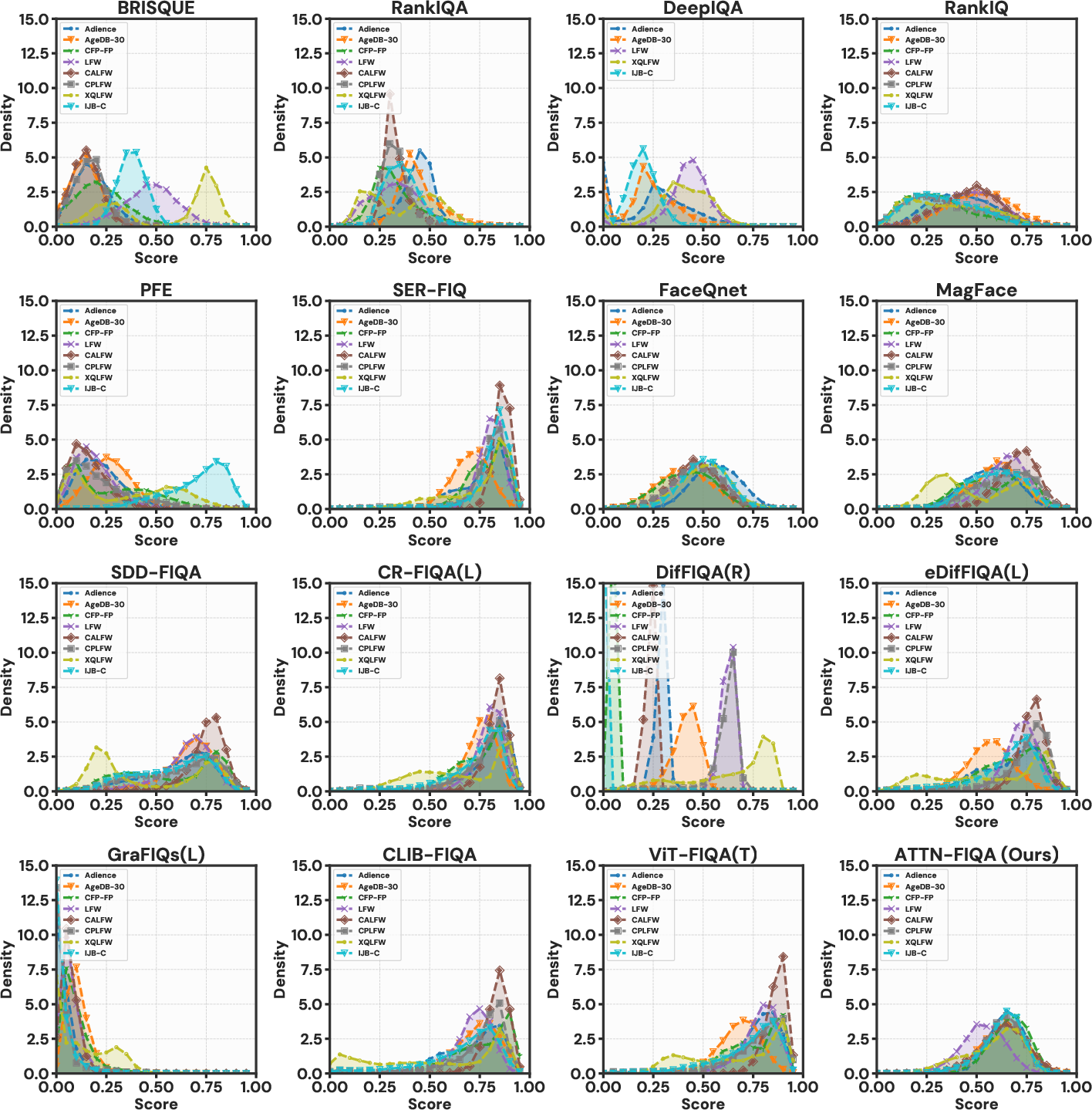
Figure 7: ATTN-FIQA quality scores (normalized) are well-spread and sensitive, reflecting robust discrimination versus SOTA methods.
Transparency, Bias, and Ethical Considerations
Because ATTN-FIQA is built on the implicit attention structure of pre-trained ViTs, its interpretability is not just an academic nicety but crucial for bias auditing and practical deployment. The approach surfaces which facial regions contribute to score drops—valuable for debugging operational systems. However, since attention may itself encode or perpetuate demographic biases learned during FR training, the method inherits risks, underscoring the importance of demographic bias auditing and holistic system evaluation.
Implications and Future Directions
The work demonstrates that spatial attention distributions in standard ViTs—without any specialized training—reliably encode global facial utility. This insight supports future development in several directions:
- Universal Quality Proxies: Attention-based quality estimation should generalize not just for FR but for any ViT-driven vision domain where recognition utility is quality-sensitive.
- Dynamic and Real-Time Filtering: Such efficient, interpretable metrics enable online sample rejection or human-in-the-loop escalation in high-throughput or edge systems.
- Bias Mitigation Tools: Interpretations at the attention level foster improved bias diagnostics, and facilitate the construction of more equitable AI pipelines.
- Synergy with Self-/Unsupervised Learning: The framework encourages exploration of self-supervised ViTs, where quality proxies naturally emerge without manual curation or domain labels.
Conclusion
ATTN-FIQA introduces a training-free, attention-based FIQA framework leveraging pre-softmax attention magnitudes from any ViT-based FR model to deliver interpretable, efficient, and robust face image quality assessment. The method delivers competitive or superior performance relative to existing approaches in complex recognition scenarios, provides actionable spatial interpretability, and is immediately deployable on any pre-trained ViT. This work positions transformer attention analysis as a general lens for utility assessment in deep vision architectures, with direct implications for reliability and transparency in AI deployment.