Boolean PCSPs through the lens of Fourier Analysis
Published 24 Apr 2026 in cs.CC | (2604.22742v1)
Abstract: We develop an analytical framework for Boolean Promise Constraint Satisfaction Problems (PCSPs) that studies polymorphisms through the notion of influence from Fourier analysis of Boolean functions. Extending the work of Brakensiek, Guruswami, and Sandeep [ICALP'21] on Ordered PCSPs, we identify two general phenomena in Boolean minions indicative of hardness or tractability: (1) preservation of coordinate influence under random 2-to-1 minors and (2) the presence of sharp thresholds. We demonstrate that these phenomena occur in broader settings than previously established, yielding new hardness/tractability results for minions consisting of unate or polynomial threshold functions.
The paper demonstrates that random 2-to-1 minors preserve significant coordinate influence in Boolean functions, introducing a novel technique for hardness reductions.
The study leverages sharp threshold phenomena to establish tractability criteria for unate and polynomial threshold Boolean PCSPs.
The analysis unifies combinatorial, algebraic, and Fourier methods to delineate a complexity dichotomy, paving the way for future advances in PCSP research.
Analytical Frameworks for Boolean PCSPs via Fourier Analysis
Introduction and Motivation
The study of Boolean Promise Constraint Satisfaction Problems (PCSPs) forms a cornerstone in understanding the boundary between tractable and intractable computational problems. Traditional Constraint Satisfaction Problems (CSPs) admit a rich algebraic theory characterizing complexity via polymorphisms. The PCSP generalizes CSPs by incorporating both "strong" and "weak" constraint templates, seeking solutions to weak constraints under the promise that strong ones are satisfiable.
Boolean PCSPs, due to their simplicity, serve as fundamental benchmarks and are central in theoretical computer science. The complexity of even natural Boolean PCSPs—such as approximate graph coloring—remains unresolved in general, motivating the search for structural and analytic approaches to their study. Recent developments, such as the conditional dichotomy for Ordered PCSPs [brakensiek2021conditional], leverage classical tools from Boolean function analysis—in particular, the notion of coordinate influence—suggesting that analytic and Fourier techniques can provide new insights and generalize prior ad hoc methods.
This work establishes an analytic framework for Boolean PCSPs centered on the Fourier analysis of Boolean functions and the influence of coordinates, extending and unifying prior algebraic and combinatorial methods for understanding complexity dichotomies.
Influence Preservation under 2-to-1 Minors
A guiding phenomenon observed in the PCSP complexity landscape is the role of influential coordinates in polymorphisms. Informally, the presence of coordinates with high influence (i.e., those whose flips significantly affect function output) often indicates computational hardness, while the absence—especially coupled with symmetry—suggests tractability.
A major technical innovation herein is the demonstration of influence preservation under random 2-to-1 minors. Formally, for a Boolean function f with bounded total influence (with respect to a reasonable probability distribution such as the p-biased or Shapley), the influence of a coordinate is preserved under random identification of pairs of inputs with constant probability. That is, no adversarial identification of variables can consistently erase all influential coordinates if the identifications are random.
Figure 1: The random 2-to-1 minor process preserves significant coordinate influence with constant probability at each step.
This lemma generalizes previous combinatorially tailored results [brakensiek2021conditional] to arbitrary Boolean minions, minions of polynomial threshold functions (PTFs), and unate functions, provided the relevant bounds on total influence hold.
From a reduction standpoint, this property is directly tied to the hardness of PCSPs under the Rich 2-to-1 Conjecture. If every polymorphism admits a coordinate with influence at least δ (for some constant δ>0) under a reasonable measure, then the PCSP becomes as hard as solving Rich 2-to-1 Label Cover instances—implying NP-hardness assuming the conjecture.
Sharp Thresholds and Tractability
Another analytic phenomenon with algorithmic implications is the presence of sharp thresholds: Boolean functions whose expectation transitions rapidly from 0 to 1 over a small parameter interval. The classic Margulis-Russo formula connects the derivative of a function's expectation under the p-biased measure to its total influence.
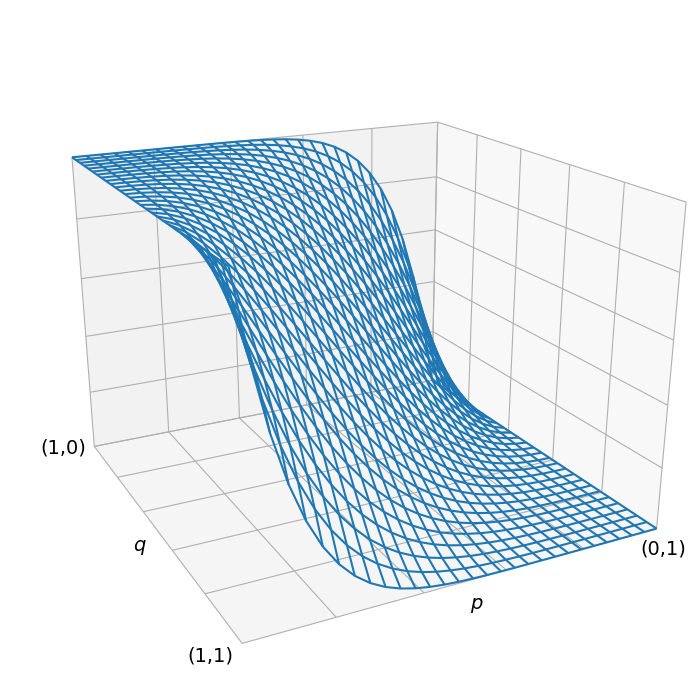
For minions comprising increasing (Ordered PCSPs) or unate functions, the presence of sharp thresholds (measured either in a 1D or, more generally, 2D density parameter space for unate functions) constitutes a succinct tractability criterion. Specifically, if there exists a sequence of polymorphisms whose expectation exhibits a sharp transition, one can algorithmically construct minors (e.g., majority or symmetric threshold functions) to solve the template efficiently.
Notably, this analysis yields a dichotomy: minions displaying sharp threshold behavior (with respect to these biased measures) contain tractable polymorphisms such as max, min, or appropriate threshold/minority functions.
Figure 2: The expectation of a unate PCSP polymorphism under (p,q)-biased distributions exhibits a sharp, nearly step-like threshold.
Application to Subclasses: Unate and Polynomial Threshold Functions
Unate PCSPs
Unate PCSPs, whose polymorphisms are unate functions (monotonic in each variable, but the direction—up or down—may vary), generalize both Ordered and Linear Threshold PCSPs. The authors provide a full analytic reduction framework for this class: by showing that the total influence of unate Boolean functions under p-biased or Shapley distributions is O(n), and leveraging the aforementioned influence preservation lemma, they conclude that any unate PCSP where all polymorphisms have coordinates of influence at least p0 is hard under the Rich 2-to-1 conjecture.
However, proving a complete analytic dichotomy for unate PCSPs (e.g., for non-product measures or for the Shapley distribution) remains open, as the construction of minors with many influential coordinates or adequate spectral concentration is subtle for this class.
Polynomial Threshold PCSPs
For PCSPs where all polymorphisms are bounded-degree PTFs, the analysis leverages noise sensitivity and low-degree concentration results from Boolean function analysis. Using the hypercontractivity and invariance principles, the authors show that PTFs of bounded degree have sublinear total influence, and only a constant number of highly influential coordinates (with respect to p1-biased measures). As with unate functions, this allows the analytic hardness reduction to apply, yielding a conditional NP-hardness result for all such PCSPs unless the maximal coordinate influence vanishes in the limit. The extension to the Shapley measure follows by integrating influence bounds over the full bias range.
An explicit adversarial construction demonstrates that, unlike in the linear case, identification minors for PTFs can obfuscate influential coordinates—necessitating the randomness in identifications.
Broader Implications and Open Directions
The analytic framework advanced here unifies and extends a variety of technical approaches to Boolean PCSP complexity, enabling reductions and tractability results in classes containing or strictly generalizing those previously handled via combinatorial or algebraic means. Importantly, it highlights the deep connection between classic notions from Boolean function analysis—such as influence, sharp thresholds, and noise sensitivity—and the algebraic complexity of PCSPs, cementing Fourier analysis as a foundational methodological tool in this domain.
In addition to providing concrete dichotomy theorems for Ordered, Unate, and PTF PCSPs (under appropriate assumptions), the results raise several immediate theoretical questions. Paramount among them is whether the analytic tractability and hardness conditions fully capture the complexity frontier for unate and polynomial threshold PCSPs, and whether the framework can be broadened to encompass even more general minion classes and product/non-product measures. Furthermore, the structural limitations of reasonable distributions, and the gap between influence preservation under product versus non-product distributions, present natural directions for future work.
Similar influence preservation lemmas recently appeared in the context of dictatorship tests on multislices [multislices], suggesting the possibility of a deeper, more general analytic theory encompassing even non-product domains.
Conclusion
The analytic approach established here—anchored in the Fourier analysis of Boolean functions, the dynamics of coordinate influence under minors, and sharp threshold phenomena—advances both the technical and conceptual toolkit for understanding Boolean PCSP complexity. By generalizing prior algebraic, combinatorial, and spectral methods, it lays the groundwork for future dichotomy theorems and offers a principled path toward resolving longstanding open complexity problems in constraint satisfaction and approximation.
References
"Boolean PCSPs through the lens of Fourier Analysis" (2604.22742)
Brakensiek, Guruswami, Sandeep, "Conditional hardness and tractability upgrades for Boolean ordered promise CSPs" (Tewes et al., 2021)
O'Donnell, R. "Analysis of Boolean Functions"
Mossel, O'Donnell, and Oleszkiewicz, "Noise stability of functions with low influences: invariance and optimality"
Harsha, Mossel, O'Donnell, "Bounds on the noisy stability of functions with low influences: theory and applications"
Braverman, Makarychev, Makarychev, Mossel, "Multislices, Matching Tests and Dictatorship Results" (Bevilacqua et al., 2023)