- The paper demonstrates that 3GPP-standard beamforming widens the 3D EIRP envelope of 5G gNBs, affecting energy distribution in both azimuth and elevation.
- It employs simulation-based analysis of varying port configurations to quantify interference risks, achieving up to a 15 dB EIRP reduction with beam-nulling schemes.
- The study reveals that while beam-nulling mitigates interference, it incurs SNR penalties of 3.5–4.5 dB and highlights a performance gap compared to channel-matched precoding.
Introduction
This paper offers an in-depth analysis of how 3GPP-standardized beamforming architectures and practical channel estimation affect the three-dimensional Effective Isotropic Radiated Power (EIRP) of a 5G base station (gNB). In contrast to prior work grounded in simplified analytical models, the authors undertake a comprehensive simulation-based approach, reflecting actual 3GPP-compliant codebooks and real-world advanced antenna system (AAS) designs. The motivation is coexistence challenges in shared mid-band spectrum, where highly directional gNB transmissions can inadvertently interfere with incumbent radar and satellite services, particularly in the 4.4–4.9 GHz and 7.125–7.4 GHz ranges.
The physical implementation of the AAS panel is pivotal in determining the gNB’s 3D EIRP. As per ITU/3GPP models, the studied array is a single uniform planar array, virtualized as a composition of subarrays and dual-polarized antenna elements. Each subarray aggregates several closely-spaced elements via a distinct RF chain, and the panel aggregates many subarrays in a grid, delivering high spatial resolution in both azimuth and elevation planes.
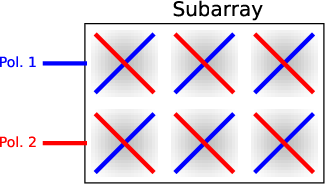
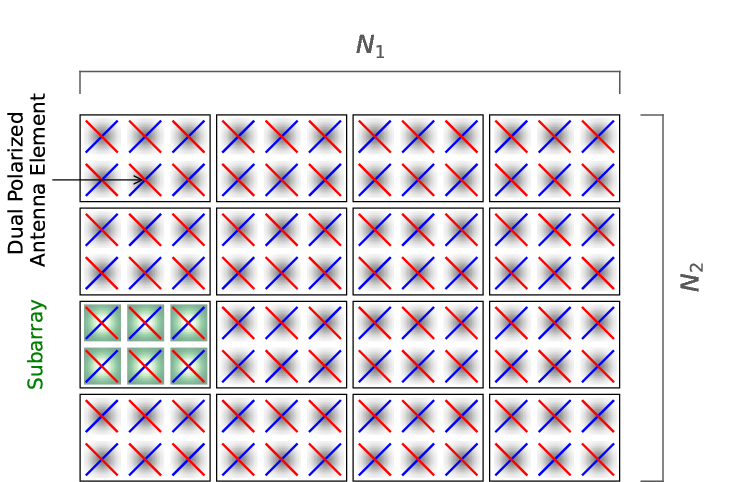
Figure 1: Physical architecture of the AAS panel employed in the gNB, as per ITU/3GPP-FR1 standards.
Port mapping is dictated by the 3GPP’s codebook-centric precoding matrices (PMs). In Release-18 FR-1, Type I codebooks often map up to 32 antenna ports, providing granularity in beamforming while keeping codebook complexity tractable. The spatial signature of each port is a function of the subarray's placement and polarization. The paper demonstrates, with array simulation, how both SSB-based (Synchronization Signal Block) initial-access beams and PM-based user beams differ in their 3D coverage and side-lobe structures.
Three-Dimensional EIRP Characterization
The main technical contribution is a systematic simulation and statistical assessment of the aggregate 3D EIRP across all codebook-defined beamforming directions. By evaluating for two representative port configurations—(2,2) and (4,4) subarray grids (yielding 8 and 32 ports, respectively)—the authors demonstrate that the EIRP envelope widens in azimuth and elevation as port count increases, with notable upward radiation. This broader energy distribution, extending up to ±50° in the (4,4) case, indicates heightened exposure to airborne incumbents.
This multidimensional approach highlights an often-neglected reality: interference is not solely a function of worst-case beam direction, but of a spectrum of sidelobes originating from the composite codebook, especially when multi-user transmissions occur.
3GPP-Compliant Beam Nulling Methodologies
To mitigate interference with incumbent systems, the authors propose two novel, 3GPP-compliant beam-nulling schemes:
- Threshold-Based PM Selection: Discards all PMs radiating above a configurable threshold ε in the direction of interest (θi,ϕi), ensuring EIRP suppression in all relevant lobes.
- HPBW-Based PM Selection: Excludes PMs whose main beam’s half-power width (HPBW) enshrouds the target direction; this targets suppression of the main lobe alone.
Simulation confirms both approaches can substantially reduce median EIRP (up to 15 dB along critical directions), and the threshold-based method provides stricter maxima control by also curbing side lobes. However, both reduce the PM set size—HPBW-based more aggressively so—modulating the trade-off between interference avoidance and spatial multiplexing capability.
A key finding is the quantified impact of subset PM selection on user data-plane performance. Monte Carlo simulations with a MIMO-OFDM NR link-level simulator show that beam-nulling strategies enabling an 11 dB EIRP reduction toward protected directions incur SNR penalties of 3.5–4.5 dB (at 10−4 BER) across several QAM modulations, relative to the full codebook. This SNR penalty is substantially greater than anticipated by analytic (e.g., SVD-based) nulling performance, which neglects codebook and implementation constraints.
The study also confirms that standard 3GPP codebook-based precoding is inherently suboptimal for per-user link performance compared to channel-matched SVD precoding, with up to a 5 dB performance gap at moderate BER.
Practical and Theoretical Implications
These results underscore important real-world considerations:
- AAS design and configuration are crucial: Port count, layout, and vendor variations substantially alter the 3D EIRP profile.
- Interference mitigation via codebook manipulation is non-trivial: Exclusion of PMs for nulling can decrease user link quality and overall cell throughput; theoretical analyses may understate this effect.
- Side-lobe energy remains problematic: Even with main-lobe nulling, aggregate sidelobe effects are non-negligible, complicating incumbent protection.
For standardization and practical deployment, this implies the necessity for:
- Refinement of codebook design to support more flexible and granular nulling,
- Development of dynamic PM subset management strategies that balance link performance with regulatory EIRP constraints,
- Field validation and calibration against real-world gNB deployments and propagation environments.
Future Research Directions
The paper suggests extending the analysis to additional precoding schemes beyond 3GPP Type I codebooks as codified in Release 18, as well as incorporating real-world measurement data. This includes considering newer, possibly non-codebook-based, precoding approaches and evaluating the coexistence impact on both terrestrial and airborne/satellite incumbents as 5G/6G deployments move up in frequency and densify spatially.
Conclusion
This research provides a quantitative evaluation of the interplay between advanced 3GPP-compliant beamforming, channel estimation, and 3D EIRP exposure in contemporary 5G gNBs. The proposed beam-nulling methodologies are shown to robustly limit EIRP in sensitive directions at the cost of a measurable SNR penalty in user link quality, an effect magnified compared to previous analytic predictions. The complexity of managing 5G coexistence in shared spectrum is accentuated, highlighting the pressing need for more intelligent precoding design, dynamic codebook management, and hardware-aware coexistence solutions.