- The paper demonstrates gNB monostatic sensing using CP-OFDM waveforms achieves a 70% detection probability at a 0.05 false alarm rate under realistic UAV conditions.
- It employs 3GPP Release-19 ISAC channel models with advanced signal processing techniques like FFT and CA-CFAR to assess impacts of residual SI, antenna geometry, and CPI length.
- The study establishes a reproducible benchmark with meter-level 3D localization (6 m horizontal, 4 m vertical errors) to guide future ISAC research and standard enhancements.
Evaluation of Monostatic 5G NR Sensing for UAVs in 3GPP UMa-AV
Introduction and Motivation
This paper presents a comprehensive evaluation of monostatic sensing capabilities in 5G New Radio (NR) base stations (gNBs) for UAV detection and localization, leveraging the integrated sensing and communication (ISAC) paradigm formalized in 3GPP Release 19. By applying standardized channel and hardware impairment models, and by utilizing actual NR positioning reference signals (PRS) as probing waveforms, the paper fills an important gap in providing reproducible, end-to-end benchmarks for ISAC in challenging urban macro-aerial (UMa-AV) environments.
System Model and Processing Pipeline
The evaluation considers a gNB acting as a monostatic radar using a full-duplex CP-OFDM waveform, with both transmission and reception co-located at a transmission–reception point (TRP). The waveform, subcarrier allocation, antenna array geometry (up to 8×8 URA), and receiver architecture (full digital and hybrid) are parameterized according to 3GPP guidelines.
The signal processing chain comprises least-squares channel estimation on PRS resources, per-RF-chain range and Doppler processing via FFT, background clutter suppression using slow-time averaging, CA-CFAR detection for range–Doppler cells, angular estimation (2D FFT or Bartlett scan), and subsequent 3D localization. The approach incorporates realistic factors such as self-interference, physical antenna patterns, and array subarraying.
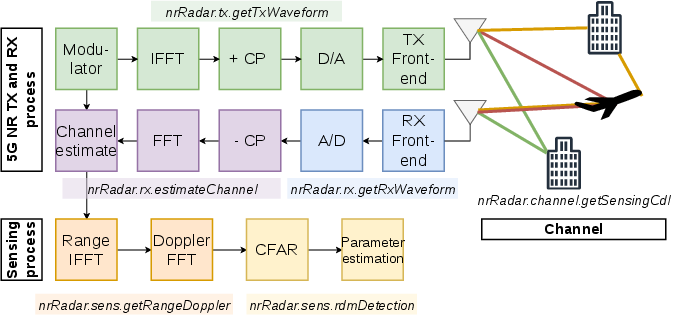
Figure 1: A TRP transmits and receives a CP-OFDM waveform, which propagates through the 3GPP channel model.
3GPP Release-19 ISAC Channel Model
A notable contribution is rigorous adherence to the 3GPP Release-19 ISAC channel model. UAV targets are represented as monostatic scatterers with structured radar cross section (RCS) models, capturing mean, deterministic, and small-scale fading components. The channel is composed by cascading the TRP–target–TRP links and adding clustered multipath clutter via synthetic reference points, precisely parameterized per 3GPP UMa-AV recommendations.
This modeling ensures that both direct target echoes and practical confounders such as multipath and nonideal hardware are faithfully represented, thereby enabling credible performance assertions.
Simulation Assumptions
Simulations are performed over a single macro cell/sector at fc=4 GHz and B=100 MHz, with UAVs distributed at altitudes of $25$–$300$ m, speeds up to $180$ km/h, and realistic RCS statistics. Both full digital and hybrid receiver architectures are evaluated, reflecting current and future hardware trends.
Detection and localization results are evaluated using conventional metrics: probability of detection (Pd), probability of false alarm (PFA), positive predictive value (PTP), and F1 score. The effect of system parameters (residual SI, coherent processing interval duration, element spacing, RF chain count) is quantified.
At a fc=40 of 0.05, the configuration achieves fc=41.
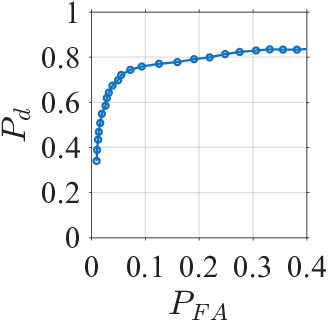
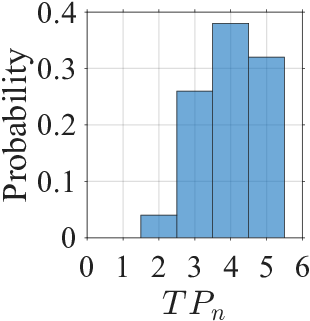
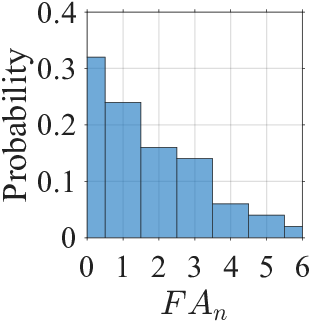
Figure 2: Detection performance versus CA-CFAR threshold: ROC (fc=42 vs.\ fc=43) and distributions of true positives and false alarms.
A detailed error analysis reveals meter-level 3D localization, with the 90th-percentile horizontal and vertical errors at 6 m and 4 m, respectively.
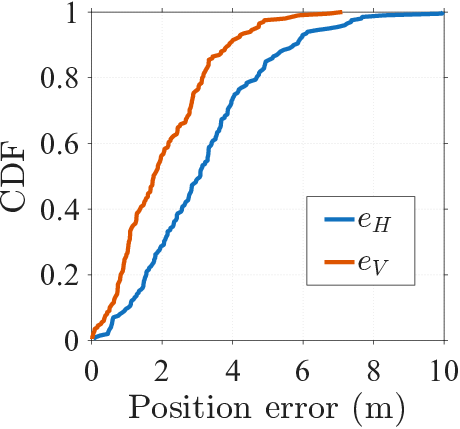
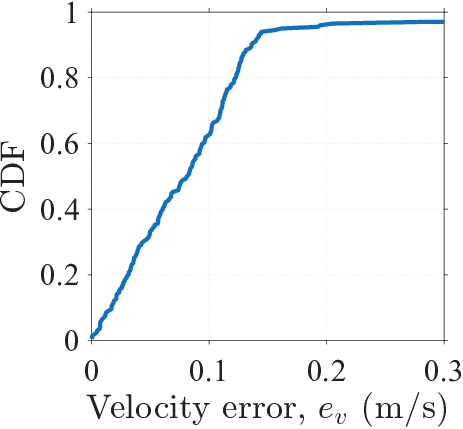
Figure 3: Empirical CDF of 3D positioning error and velocity error for detected targets.
The false negative (FN) rate increases significantly for low-SNR, greater range, high elevation, and especially for slow-moving UAVs due to their confusability with clutter residuals in the near-zero-Doppler regime.
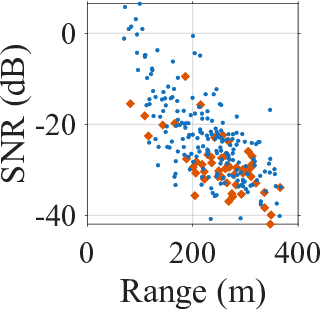
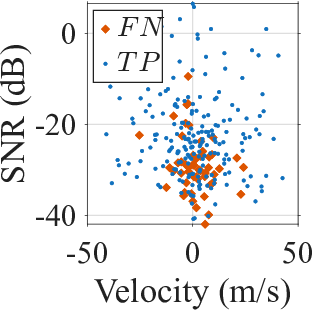
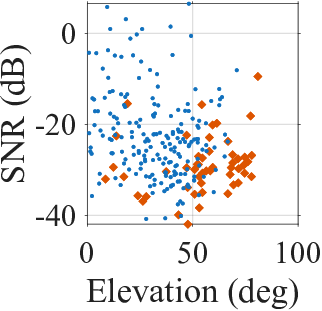
Figure 4: TP and FN versus range, elevation angle, and radial velocity—demonstrating the influence of geometry and kinematics on detection reliability.
Parameters such as increased residual SI or suboptimal coherent processing intervals degrade fc=44 but have nuanced effects on fc=45 and fc=46, reflecting real-world trade-offs.
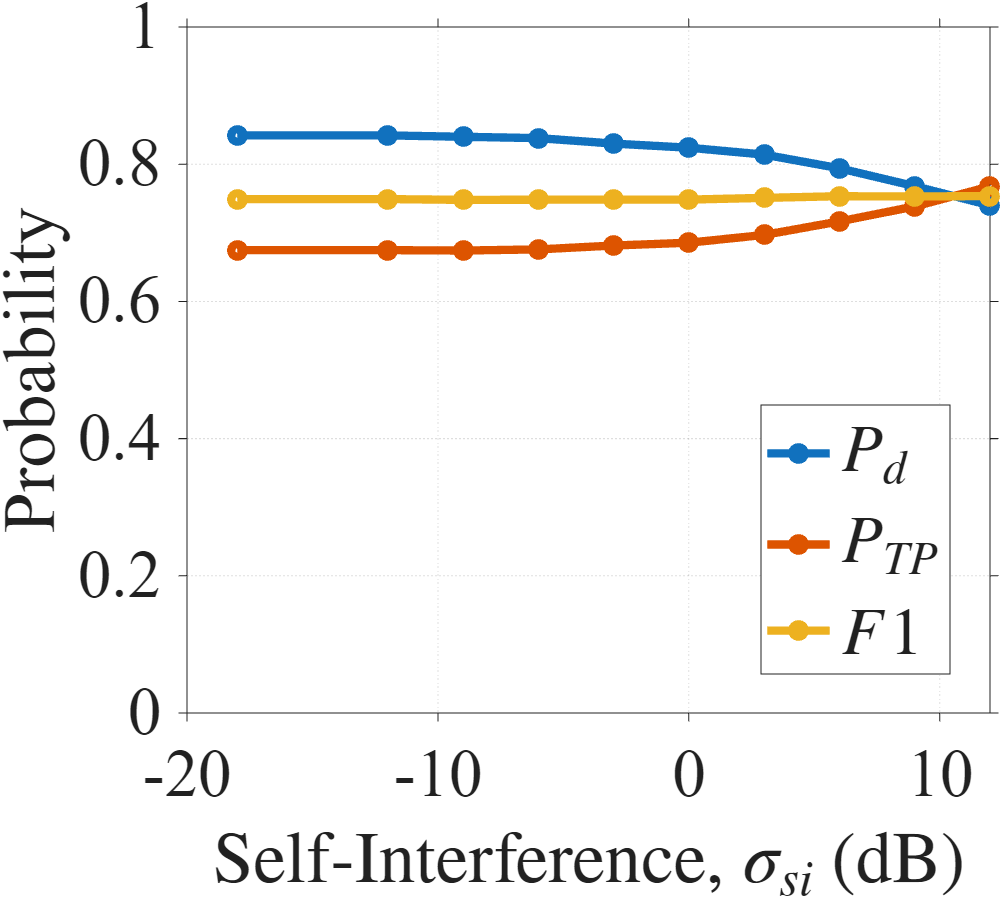
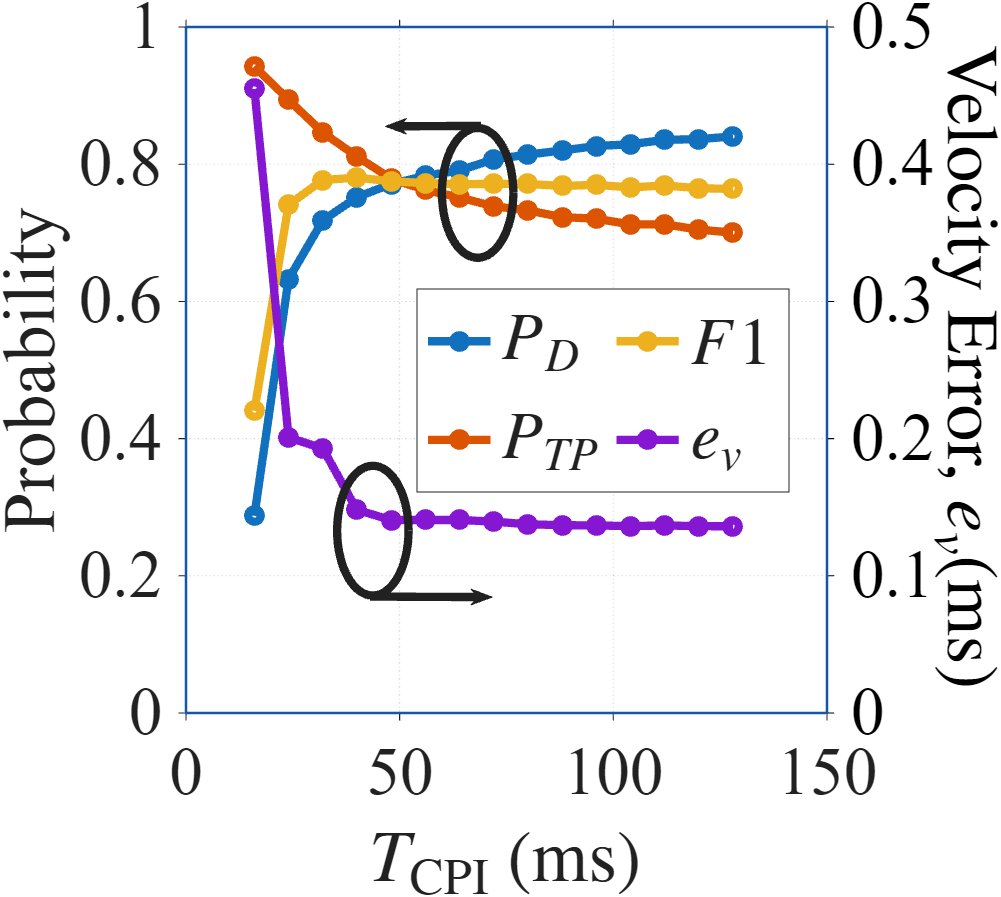
Figure 5: (Left) Sensitivity to residual self-interference; (Right) Sensitivity to CPI length, delineating operational robustness margins.
Hybrid analog/digital receiver architectures reduce fc=47 due to higher false alarm rates, while increasing vertical element spacing further reduces both fc=48 and fc=49, indicating the importance of array geometry for target separability and clutter rejection.
Implications and Future Directions
These results provide a reproducible baseline for evaluating 5G NR-based monostatic sensing in the UAV use case, demonstrating that current-standard PRS signals can support reliable, meter-level 3D target localization at moderate false alarm rates—without bespoke waveform or hardware modifications. However, detection performance remains tightly coupled to realistic SNR regimes, antenna array configuration, self-interference, and multipath conditions.
The open-source release of the 5GNRad simulator and reference processing pipeline is a substantive enabler for community-driven advances, fostering fair comparison of new algorithms, architectural enhancements, and facilitating standardization cycles. The demonstrated impact of array topology and analog combining strategies will influence both hardware design and adaptive processing techniques in the ISAC roadmap.
Theoretical implications include the need for enhanced clutter suppression (especially for slow UAVs), robust detection in the presence of colored SI, and extension to multi-static and cooperative scenarios—areas ripe for future research leveraging these standardized, reproducible evaluation methodologies.
Conclusion
This work systematically benchmarks 5G NR monostatic sensing for UAV detection in urban macro-aerial environments, delivering rigorous, reproducible performance estimates under 3GPP Release-19 assumptions. The study underpins subsequent innovation in both ISAC algorithm research and 3GPP-standard enhancements, and, through open-sourcing, positions itself as a foundational reference for the community.

