Published 24 Apr 2026 in quant-ph, cond-mat.other, and physics.comp-ph | (2604.22704v1)
Abstract: Precise and autonomous clocks are of fundamental interest and central importance to both foundational studies and practical applications. Here, we construct a blueprint for a quantum clock governed by time-independent interactions. By carefully-engineered coherent transport in dissipative spin chains, we achieve a scaling exponent at the precision-resolution trade-off fundamental bound, bringing this within reach of physically realistic and experimentally accessible systems. We further introduce a sudden-quench protocol that enables repeated operation through a simple initialization and detachment mechanism. Remarkably, the protocol is robust to imprecise detachment timing, implying that high-precision timekeeping can be achieved even when driven by a clock with much lower precision.
The paper introduces a dissipative spin chain clock design that achieves the fundamental precision–resolution limit with scaling N ∝ ν⁻² through tailored boundary coupling optimization.
The methodology leverages a hybrid analytic-numerical Differential Evolution strategy to optimize terminal couplings, ensuring fast excitation transfer while minimizing stochastic broadening.
The study establishes experimental feasibility by demonstrating robust decoupling protocols and applicability to platforms like superconducting qubits and photonic waveguides.
Approaching the Limit of Quantum Clock Precision: Optimal Scaling via Engineered Spin Chains
Introduction
This work presents a comprehensive analysis and practical scheme for realizing quantum clocks that saturate the fundamental precision–resolution trade-off (PRT). The central contribution is the construction and optimization of a dissipative spin chain system capable of delivering timekeeping with a precision scaling at the theoretical upper bound, specifically N∝ν−2, where N is precision and ν is resolution (tick rate). The scheme is based on modifications of perfect state transfer (PST) profiles in open-ended XX spin-$1/2$ chains, leveraging efficient numerical optimization of boundary couplings, and supports experimental feasibility in currently accessible quantum hardware modalities.
Theoretical Background: Limits of Quantum Clock Precision
In both classical and quantum settings, clock precision is ultimately constrained by stochastic fluctuations in tick events, subject to thermodynamic uncertainty relations and the PRT. For memoryless autonomous clocks, the PRT sets the scaling limit: N≤Γ2/ν2, with Γ as the maximum decay rate. Most prior architectures, including dissipatively coupled spin chains with homogeneous or conventional PST couplings, have failed to approach this upper bound, typically achieving weaker scaling exponents in N as a function of ν.
Clock Architecture: Dissipative Spin Chains and the PST Paradigm
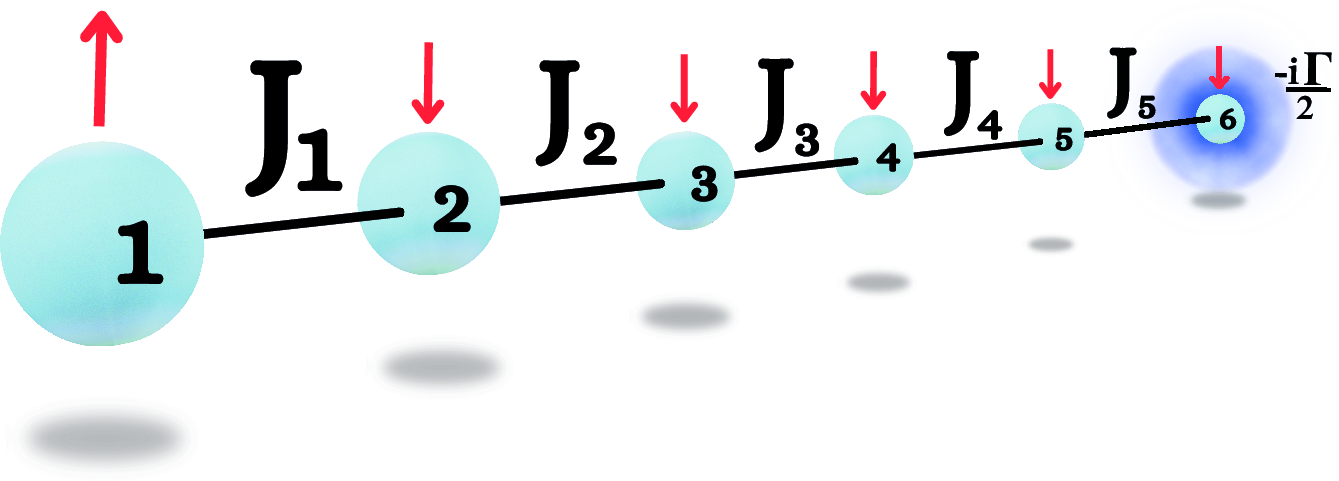
The proposed clock operates via a one-dimensional, open XX spin chain, with site-dependent nearest-neighbor couplings and a dissipative (sink) site at one end. The system evolves autonomously from a localized initial excitation, with tick events corresponding to quantum jumps induced by the Lindblad-engineered sink.
The chain Hamiltonian is
H^XX=i=1∑N−12Ji(σ^ixσ^i+1x+σ^iyσ^i+1y),
with Ji=J0i(N−i) implementing the PST coupling profile. The quantum clock's figures of merit—resolution and precision—are derived from the tick probability density N0 and the survival probability N1 under the non-Hermitian effective Hamiltonian formalism.
Figure 1: Schematic of an N2-site clock chain, with the initial excitation (red arrow) and the dissipative sink at the boundary.
Optimization and the Precision–Resolution Scaling
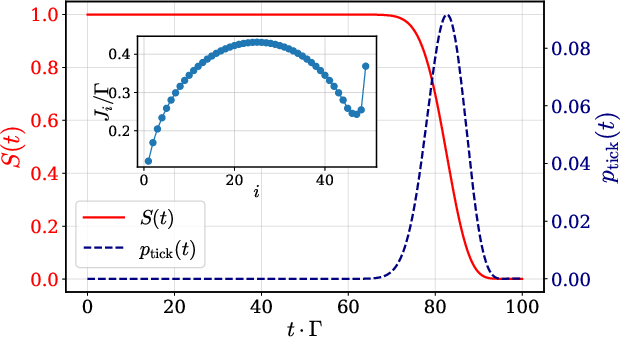
The work employs Differential Evolution (DE) optimization to fine-tune the final N3 couplings near the dissipative end, augmenting the standard PST profile. This hybrid analytic-numeric strategy enables the system to both maintain fast excitation transfer (necessary for high resolution) and suppress stochastic broadening (maximizing precision).
Figure 2: Survival probability N4 and tick PDF N5 for an N6 chain using optimized boundary couplings.
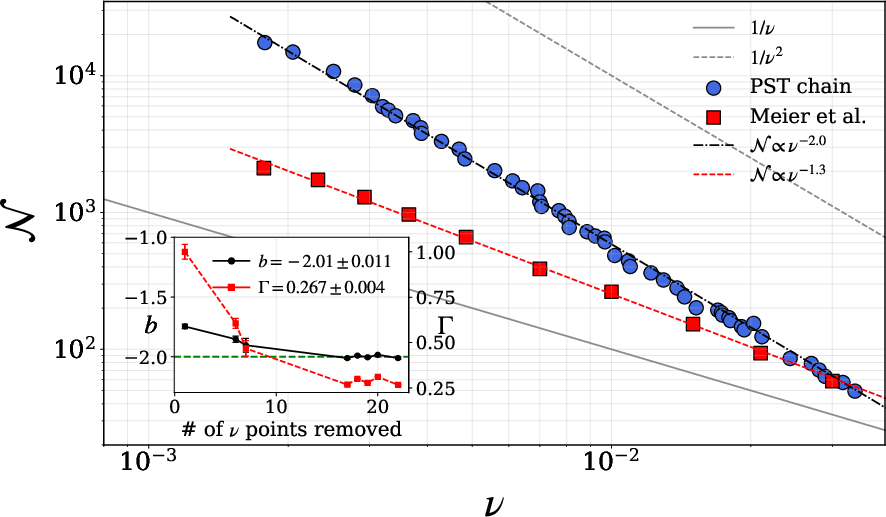
Critically, when optimizing the last four couplings, the resulting precision demonstrates the desired scaling N7 for large systems (N8), directly reaching the PRT upper limit.
Figure 3: Precision–resolution log–log scaling for optimized clock chains (N9 up to 2000), demonstrating ν0 compared to previous approaches.
A systematic enhancement of terminal couplings is necessary to accelerate excitation extraction into the sink and suppress finite-size effects, as illustrated by the convergence behavior in large chains.
Engineering Boundary Couplings and Dynamical Trends
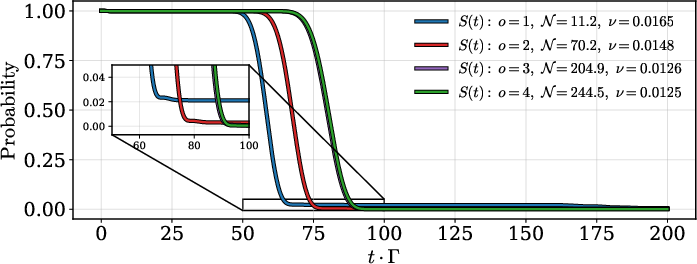
Progressively increasing the number of optimized couplings ν1 from the sink end leads to pronounced improvements in survival probability decay and hence clock precision. Engineering more than four couplings exhibits diminishing gains beyond the PRT-bound regime.
Figure 4: Survival probability dynamics for various numbers of optimized end couplings ν2 in a 40-site chain.
Protocol Robustness: Re-initialization and Decoupling Flexibility
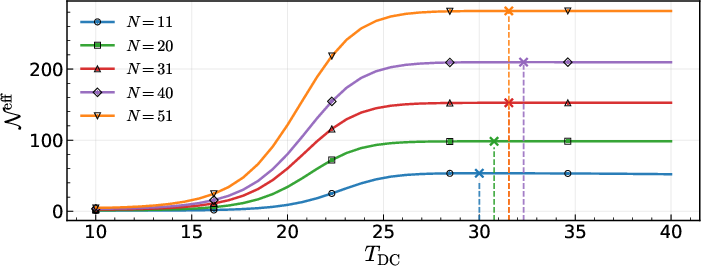
A significant practical feature is the robustness of the protocol to imprecise detachment/re-initialization timing of the first spin. The scheme admits a wide window for the decoupling operation (quenching the initial site), maintaining peak precision across a broad plateau in decoupling times. Empirically, the minimum decoupling time scales favorably with system size as ν3.
Figure 5: Effective clock precision as a function of decoupling time, showing sustained optimal performance over a broad range.
Experimental Feasibility
The protocol is compatible with established experimental platforms, including superconducting qubit arrays and photonic waveguides, both of which provide the necessary control for modulating inter-site couplings and realizing dissipative boundary conditions. Dynamical decoupling and single-photon detection techniques can be employed for practical tick detection and chain re-initialization.
Scaling Analysis and Coupling Profiles
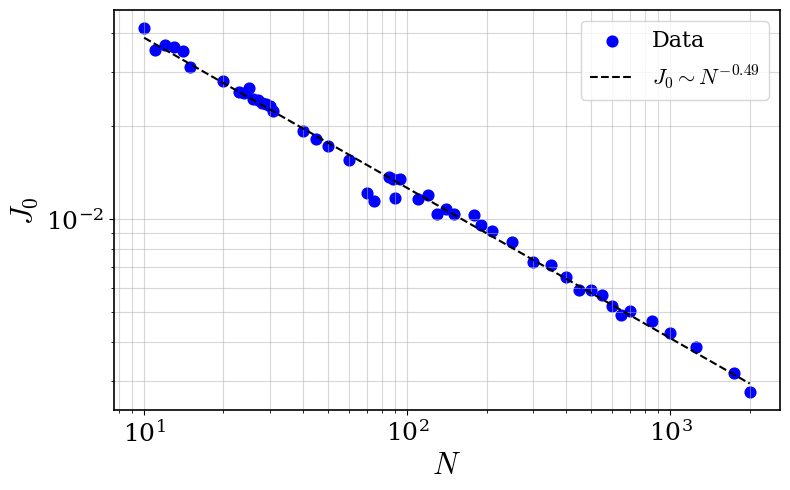
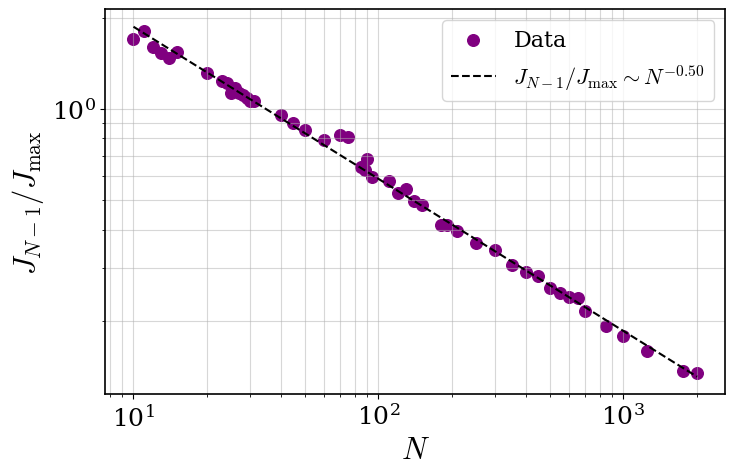
Detailed data analysis reveals that both the bulk coupling scale ν4 and the optimized terminal coupling ν5 display an empirical ν6 scaling with system size, underscoring the systematic character of the optimal coupling profile required to achieve PRT-saturating performance.
Figure 6: Scaling of the bulk coupling ν7 (top) and terminal coupling ratio ν8 (bottom) as a function of system size ν9.
Implications and Future Directions
This work demonstrates the practical attainability of the PRT upper bound in fully autonomous, experimentally feasible quantum clocks. The implications are twofold:
Quantum Foundations and Metrology: Realizing clocks at the fundamental trade-off limit deepens understanding of irreversibility and stochasticity in time reference generation, with relevance for quantum thermodynamics and resource theory.
Quantum Technologies: The protocol leverages the same architectures required for efficient quantum information transfer, suggesting hardware reuse and new synergies between quantum communication and quantum timing.
Interesting directions for future research include exploiting correlated tick sequences (beyond i.i.d. events), exploring networked topologies or non-nearest-neighbor coupling, and adapting design principles to the constraints of specific quantum hardware platforms. Early theoretical works suggest an exponential gain in precision is possible with engineered temporal correlations, further enhancing the application scope of quantum clocks.
Conclusion
The study establishes a physically grounded, optimization-backed framework for quantum clocks that reach the fundamental precision–resolution bound by exploiting engineered coherent transport in dissipative spin chains. This approach not only offers a pathway to optimal quantum timekeeping but also bridges theoretical and practical aspects of quantum device engineering, potentially impacting quantum metrology, distributed timing, and synchronization in scalable quantum networks (2604.22704).
“Emergent Mind helps me see which AI papers have caught fire online.”
Philip
Creator, AI Explained on YouTube
Sign up for free to explore the frontiers of research
Discover trending papers, chat with arXiv, and track the latest research shaping the future of science and technology.Discover trending papers, chat with arXiv, and more.