- The paper introduces a non-minimal sampling strategy that leverages statistical fluctuations in inlier ratios to generate accurate model hypotheses even with high outlier contamination.
- The approach employs estimator-agnostic hypothesis generation and robust scoring rules, such as the truncated Lp cost, to select the best model efficiently.
- Extensive experiments on relative pose, PnP, and point cloud registration demonstrate NONSAC's scalability and superior performance in scenarios with up to 99% outliers.
NONSAC: Non-Minimal Sampling and Consensus for Scalable Robust Estimation
Introduction and Motivation
Geometric model estimation is a critical component in computer vision and robotics, forming the basis for problems such as relative pose estimation, Perspective-n-Point (PnP), and point cloud registration. The shift toward data-rich applications has resulted in the proliferation of massive correspondence sets populated by high proportions of outliers. Classical approaches—such as RANSAC and global methods—are effective up to moderate outlier ratios and tractable dataset sizes, but they either become infeasible or deteriorate in performance as scale and outlier contamination escalate.
This paper introduces NONSAC (Non-Minimal Sampling and Consensus), providing a robust and scalable alternative. NONSAC is a wrapper paradigm: it repeatedly draws independent non-minimal subsets, applies any core estimator to propose hypotheses, and aggregates the outcomes using robust selection rules. This approach decouples computational requirements from the dataset size and leverages statistical variability across subsets, which is crucial for model discovery under extreme outlier fractions.
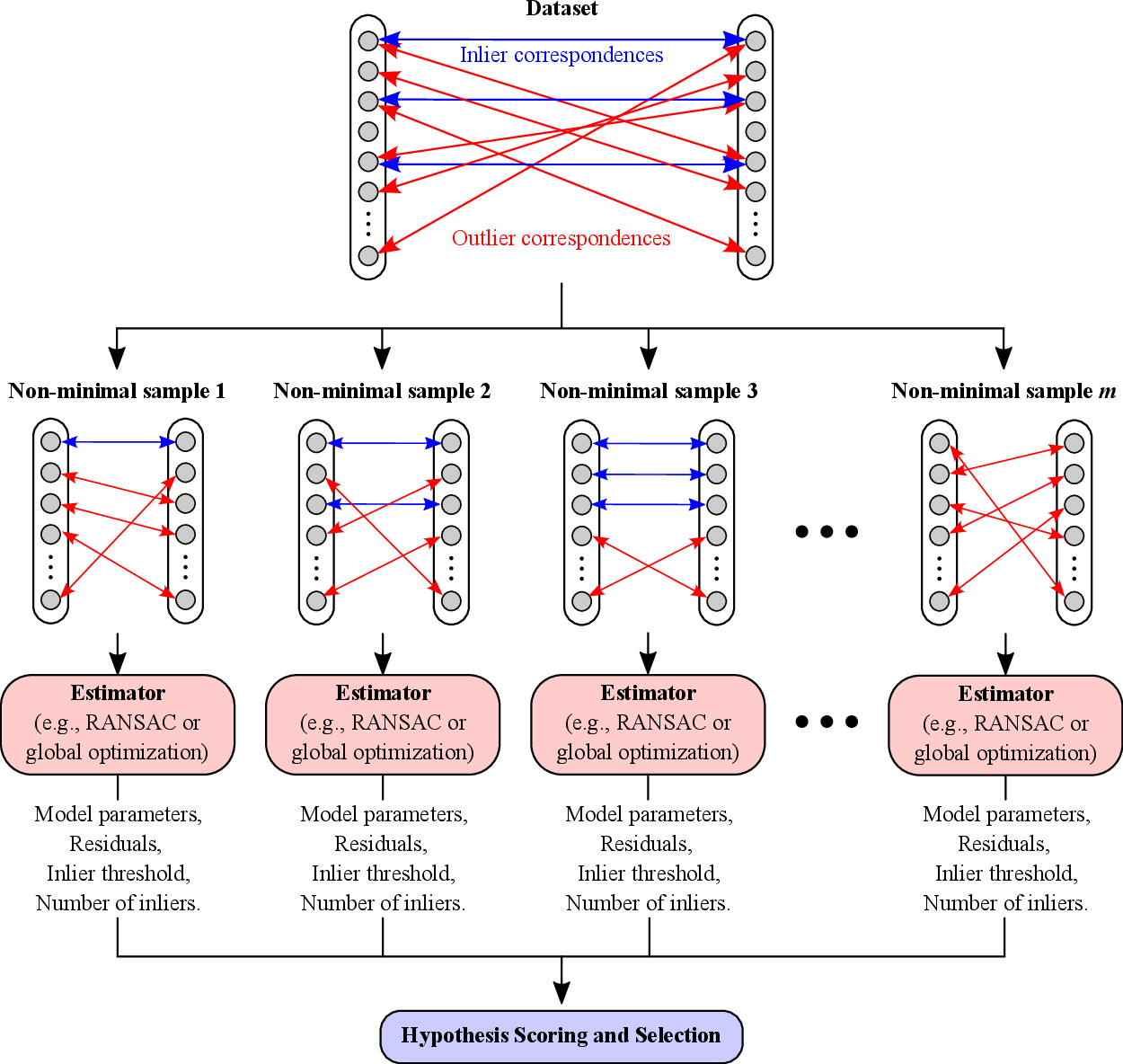
Figure 1: NONSAC pipeline: independent non-minimal samples yield model hypotheses, whose qualities are aggregated via various selection rules.
Methodology
Non-Minimal Sampling Strategy
Classically, robust estimation operates either by repeated minimal sampling (as in RANSAC) or by global batch processing. NONSAC deviates fundamentally by sampling non-minimal subsets—fixed-size groups larger than the minimal sample size but much smaller than the full data volume—from potentially enormous correspondence sets. Each subset is guaranteed to be processable in memory. The Central Limit Theorem ensures that the inlier ratio in these samples will fluctuate; some samples will possess outlier contamination significantly below the global rate, which is essential for any robust estimator to produce accurate hypotheses when facing extremely high outlier ratios.
Estimator-Agnostic Hypothesis Generation
The NONSAC framework is compatible with arbitrary geometric estimators. For each non-minimal subset, an estimator (e.g., RANSAC over minimal samples within the subset) hypothesizes model parameters, computes residuals, and determines an inlier set. Key to scaling is that the estimator never consumes or scores hypotheses against the entire correspondence set, only the manageable subset.
Hypothesis Selection via Scoring Rules
After multiple hypotheses are generated, NONSAC uses explicit scoring rules to select the final model. The rules range from simple (choosing the hypothesis with the most inliers) to composite (e.g., truncated Lp (TLP) cost, pairwise costs between models). These rules differ in their robustness and ability to distinguish between plausible and spurious hypotheses, especially in regimes of low inlier ratios.
Experimental Evaluation
The authors conduct extensive experiments on three core estimation problems: relative pose, PnP, and point cloud registration, including a particularly challenging correspondence-free setting with all-to-all putative matches. Datasets include both simulations and real point clouds (e.g., Stanford Bunny).
Relative Pose Estimation
For relative pose, the methodology simulates two-camera geometries with controlled noise and outlier fractions, drawing thousands of non-minimal samples. NONSAC wraps a RANSAC+five-point core estimator. Strong numerical results are obtained: mAA values of 0.90–0.99 with TLP scoring at up to 97% outliers, and outperformance of inlier-based and L-estimator rules under extreme outlier or noise conditions.
Perspective-n-Point
PnP evaluations follow a similar setup, employing the P3P estimator and numerous configurations in noise and outlier space. NONSAC with TLP (using powers p=0.5,1,2) gives mAA upwards of 0.86 in the 97% outlier regime, with robustness across incremental sample numbers.
Point Cloud Registration
In the standard setting, a modified PCR-99 serves as the estimator. Pair cost and TLP rules are benchmarked. NONSAC with TLP achieves consistent registration with mAA near 0.80–0.90 at 99% outliers for thousands of 3D correspondences, while minimum residual estimators collapse under these outlier ratios.
Correspondence-Free Registration
The most critical experiment is the all-to-all correspondence setting, where existing methods either run out of memory or exceed actionable runtimes. NONSAC remains tractable (processing times ~$30$ seconds, sub-3∘ error in 75%+ cases), while all other baselines fail.
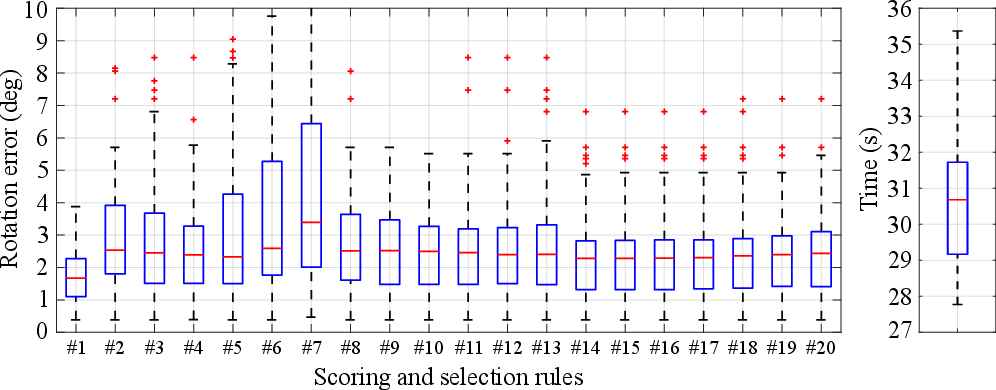
Figure 2: Distribution of rotation errors under various NONSAC scoring rules and processing times; only NONSAC remains feasible and numerically effective in correspondence-free registration.
Analysis of Scoring Rules
A critical insight is the dominant performance, across tasks, of the truncated Lp (TLP) cost rule, with optimal p depending on problem and sample configuration. While pair cost scoring is competitive at moderate noise and outlier levels, TLP succeeds in the densest, noisiest, and most contaminated data. The gap to the "ideal hypothesis" (based on ground truth) highlights room for further refinement, possibly via adaptive or hybrid score selection.
Practical and Theoretical Implications
NONSAC demonstrates that estimator-agnostic, non-minimal, incrementally processed correspondence subsets are sufficient for robust model estimation even under outlier fractions upwards of 99.9% and at dataset scales previously out of reach. The decoupling of computational load from full dataset size implies tractable geometric estimation in current and future massive-data applications (dense image matching, SLAM under ambiguity, Lidar-data robotics).
Theoretically, NONSAC reshapes the consensus-based estimation paradigm, emphasizing sample diversity and hypothesis aggregation over exhaustive sampling or direct global optimization.
Future Directions
Potential extensions include adaptive selection or combination of scoring functions, statistical analysis of sample sizing for fixed estimator strengths, and integration into end-to-end learning frameworks where geometric model estimation bottlenecks scale. Moreover, studying sample overlap and dependence, as well as deploying NONSAC in distributed or parallel architectures, are viable avenues.
Conclusion
NONSAC presents a general, robust, and scalable approach for geometric model estimation under extreme data volume and adversarial outlier rates. Its non-minimal sampling and estimator-agnostic design, coupled with robust scoring, enable tractable and effective hypothesis selection where prior methods fail. Among scoring strategies, the truncated Lp cost consistently yields the best trade-off in accuracy and robustness. The framework opens new opportunities for high-volume, high-contamination geometric inference in practical vision and robotics deployments.