- The paper presents a covariant extension of Onsager and Onsager-Machlup principles that unifies active, dissipative, and inertial dynamics by ensuring coordinate invariance.
- It employs a generalized Rayleighian incorporating dissipation, free energy rate, and active work to derive coordinate-invariant equations of motion.
- The study reconciles Onsager-Machlup functionals with fluctuation theorems, advancing the modeling accuracy in stochastic thermodynamics.
Introduction
The Onsager variational principle (OP) and the Onsager-Machlup principle (OMP) underpin the theoretical description of non-equilibrium thermodynamics and stochastic processes. This work presents a rigorous covariant extension of these principles, enabling the unified treatment of dissipative, active, and inertial dynamics within a geometrically consistent framework. The paper addresses several key open problems in the field: establishing full covariance under coordinate transformations, incorporating both activity and inertia, and reconciling the Onsager-Machlup functional with the requirements of stochastic thermodynamics, including the fluctuation theorems.
Covariant Thermodynamic Structure
The analysis starts with a generalized system coupled to a thermal bath (Figure 1). The system is described by a microscopic state space, a Hamiltonian, and a non-equilibrium probability density. Coarse-grained meso-state variables are introduced, providing a reduced description relevant to practical thermodynamic modeling.
The central contribution is the decomposition of the total system entropy into microscopic and mesoscopic components, with careful attention to the transformation properties of the probability densities and metric factors. The paper defines a non-equilibrium free energy F as a coordinate-invariant quantity:
F(q)=U(q)−TSmic(q)
where U is the mesoscopic internal energy and Smic is the microscopic entropy derived from conditional microstate probabilities.
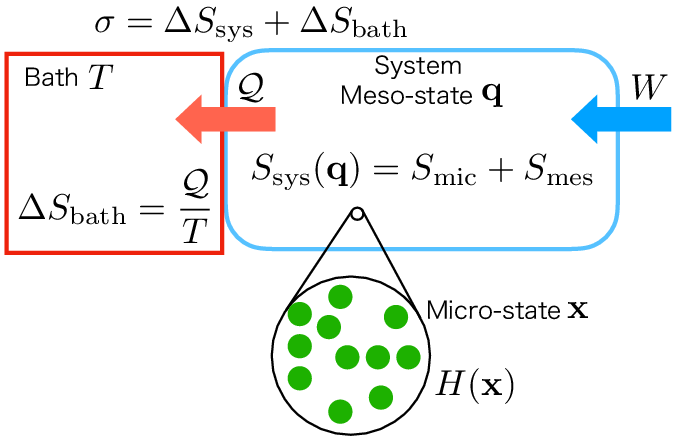
Figure 1: Entropy balance for a system coupled to a heat bath at temperature T, explicitly separating microscopic and mesoscopic entropy contributions.
Thermodynamic fluxes and forces, as well as the entropy production rate σ, are cast in a manifestly covariant form, ensuring the invariance of all key thermodynamic quantities under smooth changes of meso-state coordinates. The necessity of using scalar probability densities and geometric measures is highlighted, resolving long-standing ambiguities regarding the free energy's transformation properties.
Covariant Onsager Principle for Active and Inertial Systems
The Rayleighian is generalized to include dissipation, free energy rate, and active work:
R(q,q˙)=Φ(q,q˙)+F˙(q,q˙)−W˙(q,q˙)
where Φ is the quadratic dissipation function determined by a friction tensor, and the active work W˙ allows the inclusion of non-conservative forces (self-propulsion, external driving).
The fundamental OP equation,
∂q˙i∂R=0
yields the phenomenological equations of motion. The invariance of this variational procedure under arbitrary (point) coordinate transformations is explicitly demonstrated. This covariance is essential for consistent modeling, especially when using curvilinear coordinates, collective variables, or complex manifolds in soft matter, active matter, and biophysical systems.
The extension to inertial systems is carried out by incorporating the kinetic energy and ensuring that variations are performed with covariant accelerations held fixed:
F(q)=U(q)−TSmic(q)0
where F(q)=U(q)−TSmic(q)1 is the covariant acceleration defined via the metric tensor and Christoffel symbols.
Covariant Onsager-Machlup Principle and Stochastic Thermodynamics
Thermal fluctuations are incorporated through the Onsager-Machlup functional (OMF), which is constructed from the Rayleighian. The OMF describes the most probable trajectory and provides the weight for stochastic path integrals:
F(q)=U(q)−TSmic(q)2
where F(q)=U(q)−TSmic(q)3 is minimized along the phenomenological path.
The covariant Euler-Lagrange equations generated by the minimization of F(q)=U(q)−TSmic(q)4 recover the most probable dynamics, both in the presence and absence of inertia. The path probability assigned by the Onsager-Machlup principle is shown to satisfy the detailed fluctuation theorem, ensuring consistency with the central results of stochastic thermodynamics:
F(q)=U(q)−TSmic(q)5
where F(q)=U(q)−TSmic(q)6 is the total entropy production associated with the trajectory.
The theoretical construction ensures that the entropy production obtained from the Onsager-Machlup approach matches that of stochastic thermodynamics, including contributions from free energy changes, work, and coordinate-invariant entropy components.
Application Examples
Active Brownian Particles
The framework is applied to the stochastic dynamics of a 3D active Brownian particle, including both translational and rotational degrees of freedom, self-propulsion, and thermal noise. The OMF for this system,
F(q)=U(q)−TSmic(q)7
yields the most probable path matching the deterministic active particle motion in the noise-free limit, and reproduces the statistics of fluctuations around this path.
Polar Coordinates and Covariance
The treatment of a dissipative inertial particle in polar coordinates provides a concrete demonstration of the necessity and sufficiency of covariance. The correct equations of motion are recovered when the variational procedure is performed with covariant accelerations fixed, validating the main theoretical claims.
Implications and Outlook
The presented covariant framework achieves several advances:
- Geometric Consistency: All thermodynamic and dynamical quantities transform appropriately under coordinate changes, resolving longstanding issues in the generalized Onsager formulation.
- Unified Treatment of Activity and Inertia: The formalism treats active, driven, and inertial processes on an equal footing.
- Rigorous Path Probabilities: Onsager-Machlup theory is shown to be fully consistent with modern stochastic thermodynamics, including detailed and integral fluctuation theorems.
- Separation of Coordinate Transformations, Constrained Representations, and Coarse-Graining: The paper distinguishes between mere reparametrizations, constrained trial-manifold approaches, and changes in coarse-graining, clarifying the implications for both entropy and free energy landscapes.
Practically, this formalism enables the modeling of complex systems subject to geometric constraints (particles on manifolds, collective coordinates), collective phenomena, and fields with non-trivial dissipation and noise. The framework is poised for extension to high-dimensional field theories, information-driven active matter, and systems with feedback and control.
Conclusion
A covariant, thermodynamically consistent extension of the Onsager and Onsager-Machlup variational principles has been formulated for active and inertial dynamics. This approach closes fundamental gaps related to geometric invariance, reconciles stochastic thermodynamics with variational methods, and enables systematic modeling of complex non-equilibrium systems. Future research directions include non-trivial geometries, information flows, and many-body field-theoretic generalizations.

