- The paper introduces FILTR, a transformer-based model that extracts persistence diagrams from pretrained 3D point cloud encoders.
- The approach leverages the DONUT dataset, a balanced synthetic benchmark with topological annotations for manifold meshes.
- Empirical results reveal limited linear topological signal in standard encoders, demonstrating the need for nonlinear extraction methods.
Introduction
The paper "FILTR: Extracting Topological Features from Pretrained 3D Models" (2604.22334) addresses the question of whether pretrained 3D point cloud encoders retain implicit topological information in their learned representations and how this information can be efficiently extracted. The work introduces two major contributions: the DONUT dataset, a synthetic benchmark curated for robust topological annotation, and FILTR, a transformer-based architecture enabling direct feed-forward prediction of persistence diagrams from features produced by pretrained encoders. Through rigorous evaluation, the authors demonstrate limited but nontrivial topological signal retention in current 3D encoders and establish FILTR as a practical mechanism for data-driven persistent homology estimation. This essay provides a comprehensive technical overview of the paper’s methodology, empirical findings, implications, and prospective directions.
DONUT: A Benchmark for Topological Reasoning
A central bottleneck in quantitative evaluation of topological understanding is the scarcity of datasets with reliable and diverse topological labels. The authors construct DONUT (Dataset Of maNifold strUcTures), consisting of 29,517 manifold meshes with explicit annotation for number of connected components (β0) and total genus (g). Each sample comprises 1–6 connected components, with global genus ranging from 0–10. The creation pipeline balances label sampling, component-level genus allocation, and mesh generation across cones, superquadrics, and k-tori, applying topology-preserving augmentations to maximize geometric diversity.
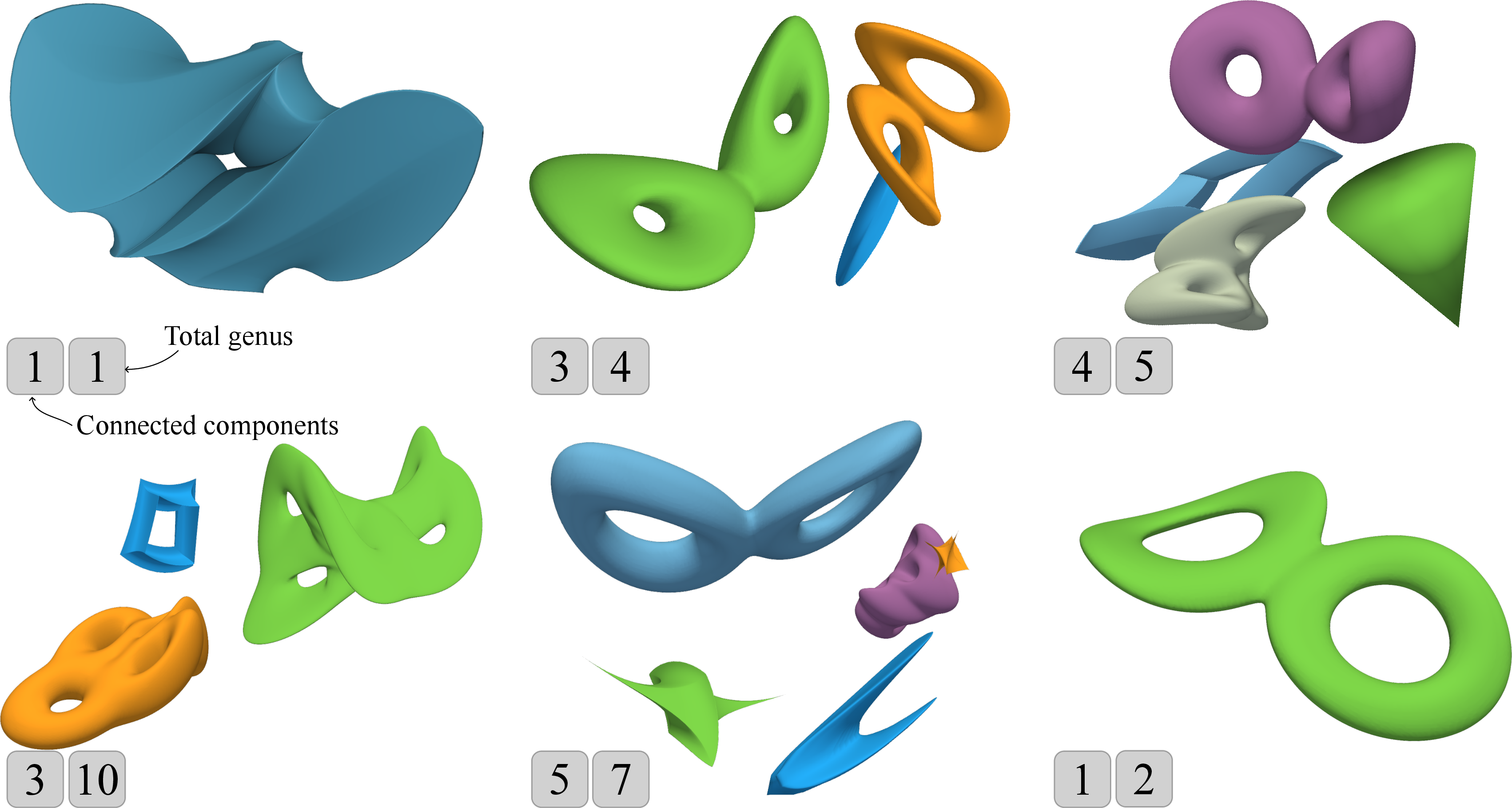
Figure 1: Representative samples from DONUT with their topological labels (β0, g), illustrating geometric and topological variability.
Label distribution across the dataset is approximately uniform, mitigating bias and preventing trivial decision boundaries during model training and evaluation.
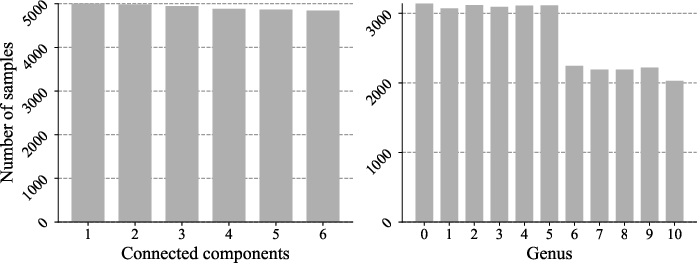
Figure 2: Distribution of DONUT's topological labels, verifying even coverage for both number of connected components and genus.
The study performs probing of four prominent pretrained transformer-based 3D encoders: Point-BERT, Point-MAE, PointGPT, and PCP-MAE, all pretrained on semantic and/or geometric objectives using ShapeNet. Probing entails training linear heads atop frozen encoder features for two classification tasks: prediction of β0 and genus. Layer-wise probing allows assessment of topological information localization across depth.
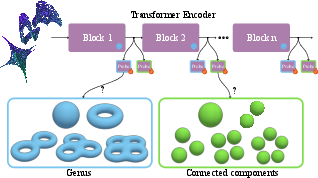
Figure 3: Encoder probing pipeline; features from each frozen transformer block are used to predict topological invariants.
Results indicate that pretrained encoders expose only weak global topological information via linear probes. Point-BERT’s CLS token yields the highest accuracy among frozen encoders, with deeper layers offering marginal improvements. End-to-end baselines with surface-aware architectures (e.g., RepSurf) significantly outperform frozen transformers, suggesting topological signal is primarily encoded nonlinearly within transformer representations.
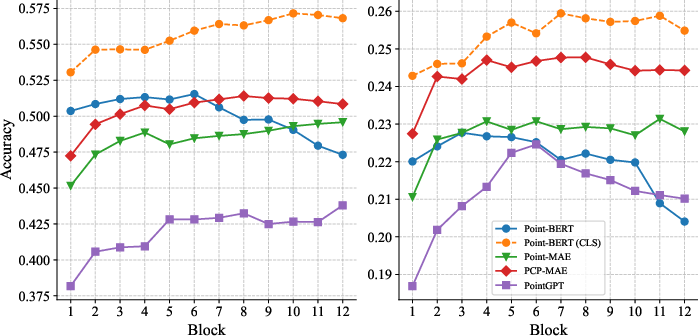
Figure 4: Layer-wise probing accuracy for various pretrained 3D encoders, highlighting improvement in deeper blocks and best performance with Point-BERT CLS token.
Representation Alignment: Encoder Features vs. Persistence Diagrams
Persistence diagrams provide multiscale topological summaries unattainable via conventional local geometric descriptors. The authors compute H1 persistence diagrams using the α-filtration, then employ analytic and learned vectorizations (e.g., ATOL) to enable comparison with encoder features. Centered Kernel Alignment (CKA) quantifies linear representational similarity.
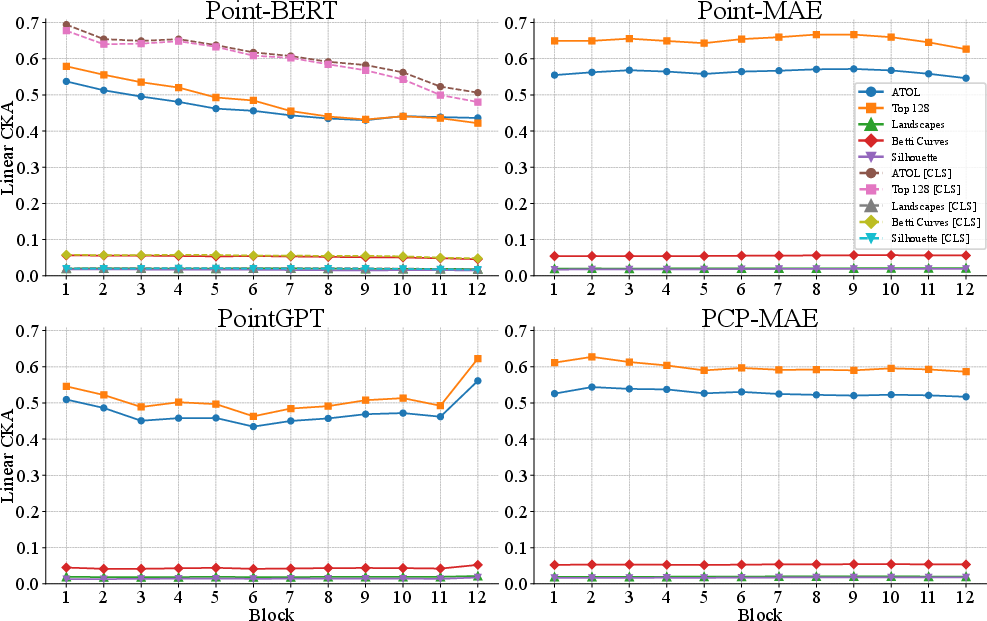
Figure 5: CKA alignment scores between encoder features and persistence diagram vectorizations for four encoders and multiple vectorization methods.
CKA analysis reveals that MAE-derived features, particularly from Point-MAE, align consistently with persistence diagram vectorizations across layers, indicating latent preservation of multiscale topological features. However, global topological invariants (genus, β0) remain poorly encoded linearly, underscoring the necessity of nonlinear extraction mechanisms.
FILTR (Filtration Transformer) is proposed as a feed-forward architecture for persistence diagram estimation from frozen encoder outputs. The design adapts DETR-style set prediction to the persistence diagram domain: a fixed set of learned queries attends to encoder features via cross-attention, producing unordered collections of persistence pairs, each accompanied by an existence probability.
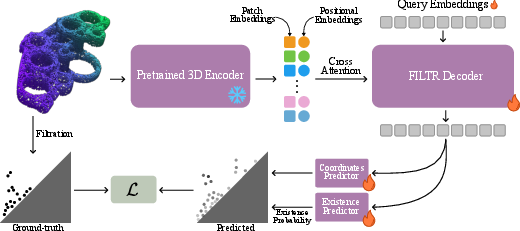
Figure 6: FILTR pipeline architecture; frozen encoder features and positional encodings are used by a transformer decoder to predict persistence pairs and probabilities.
Two variants of feature input are evaluated: last block only versus summation across all blocks.
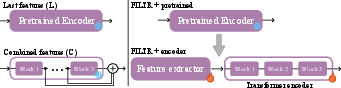
Figure 7: (left) Comparison of FILTR variants on encoder feature input (last vs. sum across blocks); (right) end-to-end baseline setup with feature extractor and lightweight transformer encoder.
Loss functions combine pairs matching (Hungarian assignment with coordinate regression), binary existence classification, and diagonal regularization to push unmatched predictions toward the diagonal.
FILTR Evaluation and Empirical Results
FILTR is trained on DONUT point clouds to predict H1 persistence diagrams, using a fixed quantile to exclude topological noise. Generalization is assessed on ModelNet40 and ABC.
FILTR with pretrained frozen encoders achieves competitive or superior reconstruction performance relative to end-to-end baselines for the 2-Wasserstein distance (g0), bottleneck distance (g1), and Persistence Image Error (PIE), except for edge cases (PointNet++) not representative of typical pipeline behavior. Certain pretrained models (PointGPT, Point-BERT) provide strongest out-of-distribution results, contrary to probing-based ordering, attesting to the necessity of nonlinear extraction.
Decoder depth improves generalization up to six blocks, after which gains plateau.
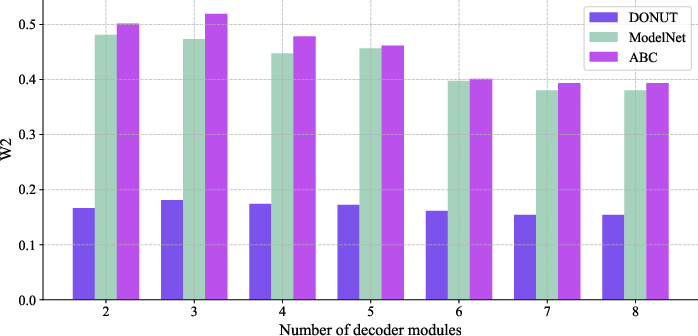
Figure 8: Effect of FILTR decoder depth; increasing depth yields consistent improvements up to a threshold on DONUT, ModelNet, and ABC.
Qualitative assessment further confirms that FILTR accurately reconstructs persistence diagrams for diverse shape distributions.
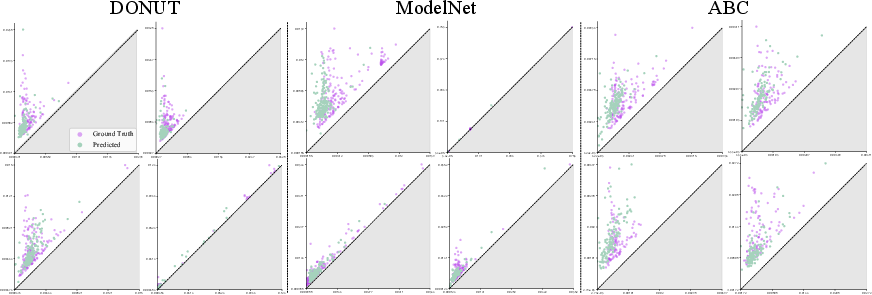
Figure 9: Predicted vs. ground-truth persistence diagrams; alignment of persistence pairs and overall structure is evident across datasets.
Failure cases predominantly involve positional shifts of predicted pairs, especially for highly persistent features, evidencing the challenge of encoding global topology in pretrained encoders.
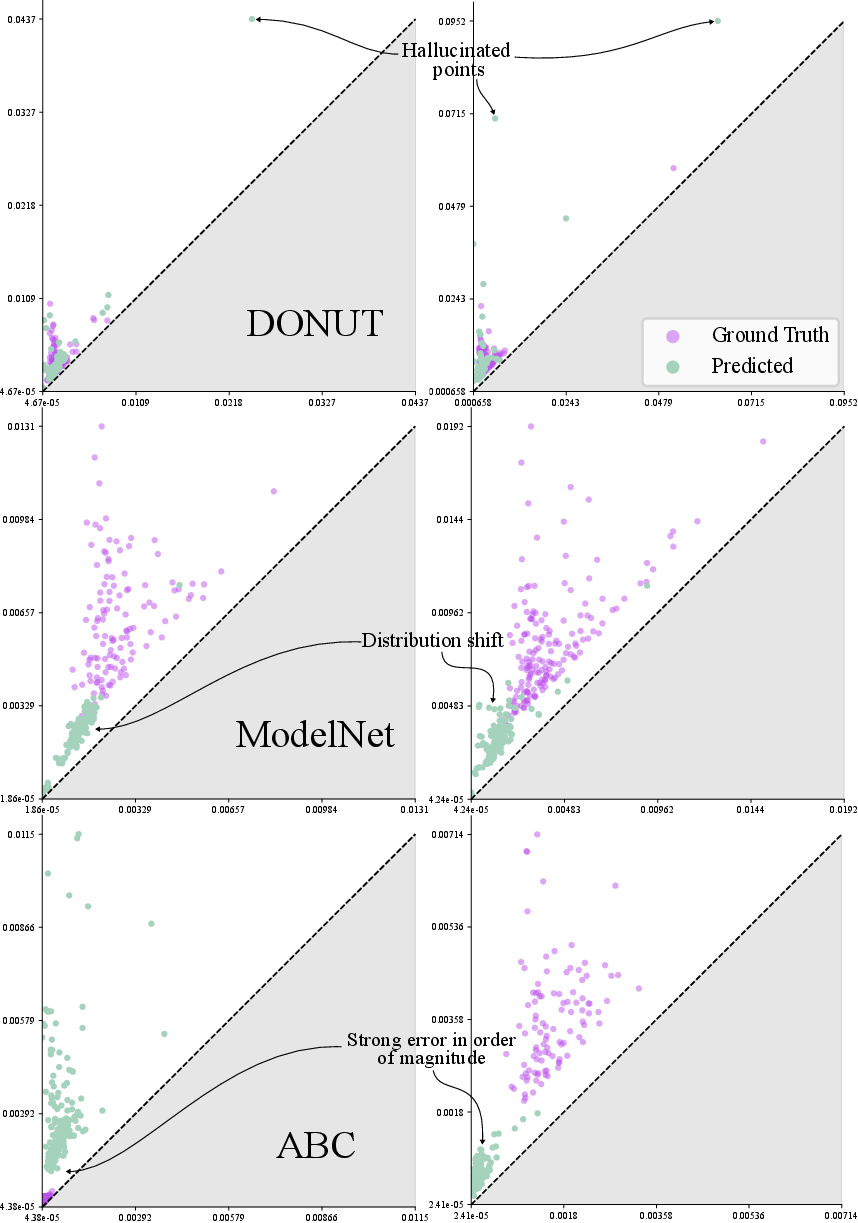
Figure 10: Typical failure cases for FILTR; predicted diagrams exhibit location errors, especially in distribution-shifted scenarios.
Limitations and Implications
The paper highlights the limited encoding of global topological invariants in state-of-the-art pretrained 3D encoders and the efficacy of transformer-based nonlinear decoders for persistent homology estimation. The feed-forward regime provides computational efficiency and modularity, enabling integration with other learning-based systems and facilitating out-of-distribution generalization.
Nevertheless, applicability is fundamentally restricted by the representational scope of pretrained encoders—strong results stem from ShapeNet-exposed architectures, and transferability to domains with distinct topological structure, such as graph learning, remains unresolved.
In feed-forward form, persistence diagram prediction circumvents classical pipeline bottlenecks and opens avenues for end-to-end topological regularization, unsupervised topological learning, and multimodal integration. Extension to large-scale multimodal foundation models may uncover alternative pathways for structural reasoning in high-dimensional data.
Conclusion
FILTR establishes a systematic approach for extracting multiscale topological information from pretrained 3D point cloud encoders, combining the rigor of classical topology with the scalability and flexibility of transformer architectures. The DONUT benchmark underpins meaningful evaluation, and empirical results substantiate both practical utility and theoretical constraints. While global topological invariants are weakly encoded, nonlinear transformer decoders yield effective persistent homology proxies, facilitating integration of topological reasoning in data-driven 3D analysis pipelines. Future work should address foundation model generalization, multimodal representation alignment, and scalable, cross-domain topological learning.