- The paper proposes a unified AFDM optimization framework using reserved chirp-subcarriers to achieve up to 14.5 dB ISL reduction and improved ambiguity function shaping.
- It introduces the JIPD-MM algorithm, which integrates convex-hull relaxation and negative square penalty to efficiently handle nonconvex ISL-PAPR optimization with discrete phase constraints.
- Numerical results demonstrate significant gains in sensing accuracy and communication robustness under practical PA nonlinearities, making it promising for next-generation ISAC applications.
Authoritative Summary of "A Unified Framework for Ambiguity Function Shaping and PAPR Control in AFDM Systems" (2604.22198)
Introduction and Motivation
Affine Frequency Division Multiplexing (AFDM) is rapidly emerging as a compelling waveform for Integrated Sensing and Communication (ISAC) in 6G and beyond, offering inherent chirp signaling properties adaptable to doubly selective channels and high-mobility environments. However, AFDM suffers from prominent ambiguity function (AF) sidelobes—degrading sensing accuracy—and high peak-to-average power ratio (PAPR), which compromises practical transmitter efficiency due to amplifier nonlinearities. This paper addresses these dual challenges by introducing a unified AFDM waveform optimization framework leveraging reserved chirp-subcarriers (RCS) and per-subcarrier pre-chirp parameter design, targeting simultaneous ambiguity function shaping and PAPR minimization under discrete phase constraints.
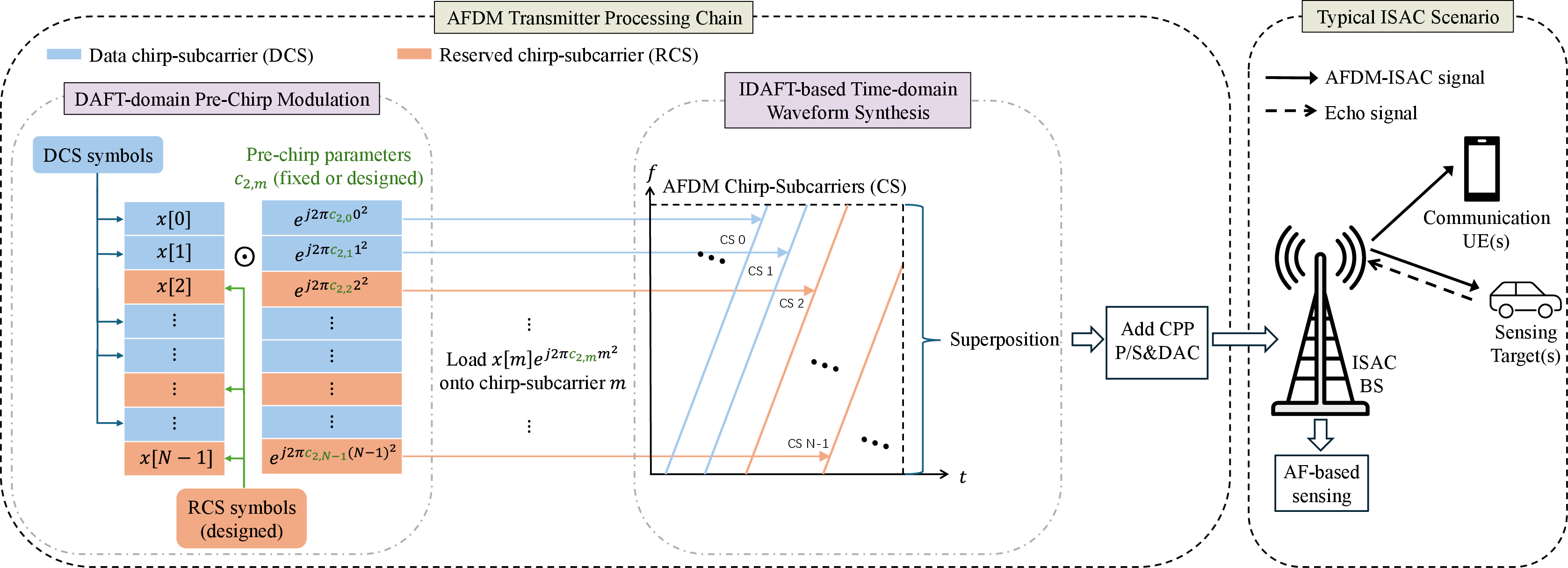
Figure 1: Proposed AFDM transmitter processing chain and typical ISAC scenario.
The authors propose a comprehensive waveform design architecture rooted in the strategic partitioning of AFDM subcarriers into data chirp-subcarriers (DCS) and reserved chirp-subcarriers (RCS). RCS subcarriers do not convey user data and are instead optimized for waveform properties, while DCSs remain dedicated to communication payload. This design enables three operational modes:
- AF Shaping Mode: Minimizes weighted integrated sidelobe level (ISL) within a specified low-ambiguity zone (LAZ), enhancing sensing performance.
- PAPR Minimization Mode: Focuses on reducing the dynamic range of the AFDM waveform, alleviating power amplifier (PA) induced nonlinear distortion.
- Joint AF Shaping and PAPR Control Mode: Simultaneously minimizes ISL subject to explicit PAPR constraints, balancing sensing and hardware efficiency.
The optimization problem couples nonconvex ISL and PAPR objectives with discrete-phase per-subcarrier pre-chirp constraints, configurable via a finite alphabet. This architecture accommodates backward compatibility, physical-layer security enhancement, and flexible spectral efficiency trade-offs.
Algorithmic Contributions
To address the inherent nonconvexities, the authors introduce the Joint ISL-PAPR-Discrete-Phase Majorization-Minimization (JIPD-MM) algorithm. The approach leverages smooth majorization-minimization (MM) surrogates for both weighted ISL and PAPR objectives, incorporates the PAPR constraint via a quadratic penalty, and employs convex-hull relaxation augmented with negative square penalty (NSP) reformulation to handle discrete phase constraints per DCS. Per iteration, the algorithm efficiently projects onto the convex hull of the discrete alphabet, followed by normalization and block updates, forming tractable subproblems that facilitate convergence even under the tight coupling between sensing and communication performance metrics.
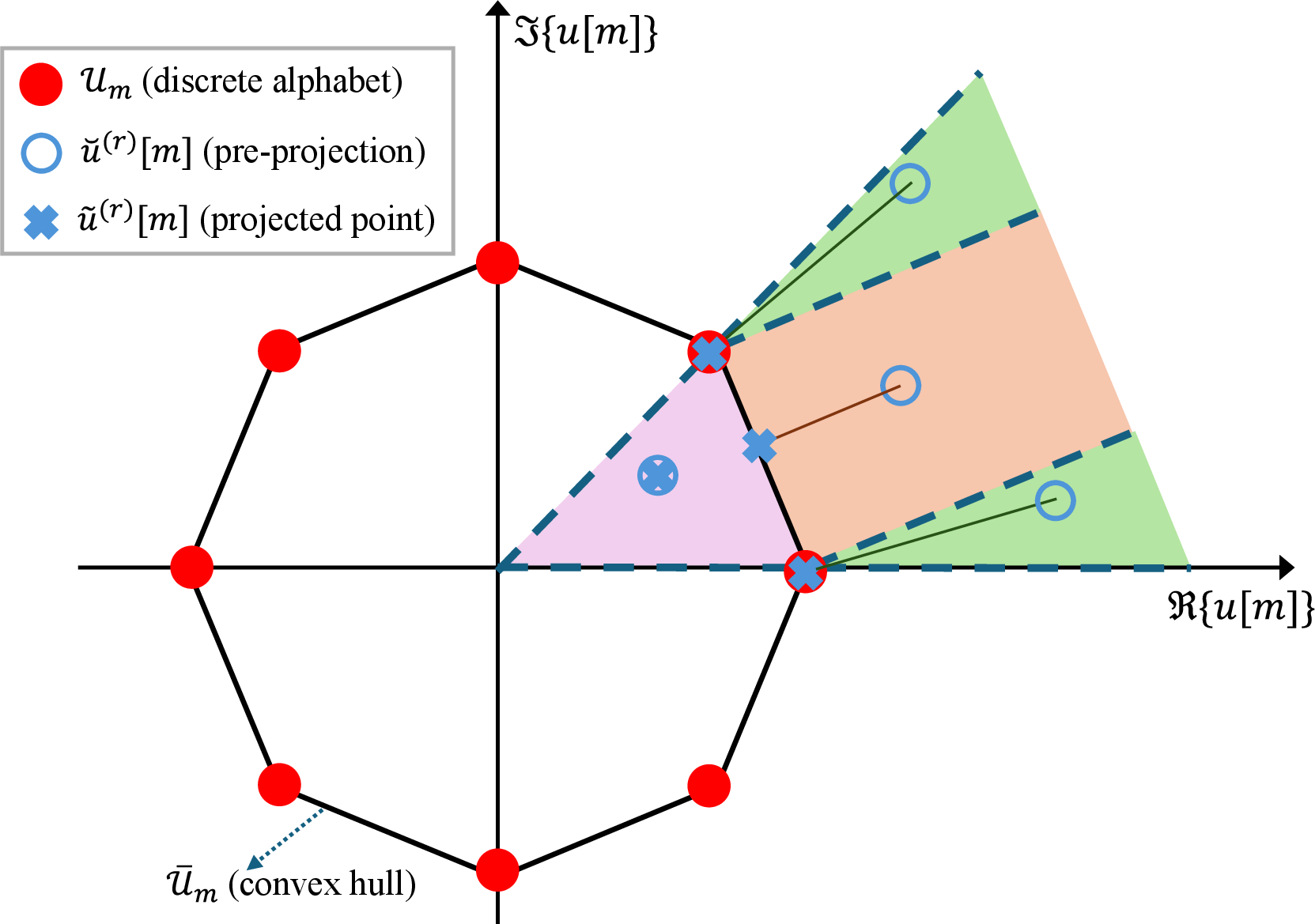
Figure 2: Illustration of the convex-hull relaxation and per-subcarrier projection for a DCS m with discrete alphabet Um.
The paper reports extensive simulation results under realistic ISAC parameters (e.g., carrier at 28GHz, N=128 subcarriers, 8PSK constellation). Key findings are:
- ISL Reduction: The proposed AF shaping mode—jointly optimizing RCS and pre-chirp parameters—achieves up to 14.5 dB ISL reduction relative to conventional AFDM, with moderate RCS ratios (∣R∣/N≈0.2) often outperforming RCS-only designs with higher reservation (∣R∣/N≈0.6). Effective spectral efficiency remains competitive due to reduced signaling overhead.
- PAPR Control: Under PAPR minimization, the framework attains PAPR values as low as 3.5dB at CCDF 10−3, outperforming both baseline AFDM and previously proposed GPS methods, even when optimized pre-chirp signaling is incorporated.
- Joint Optimization: The joint AF shaping and PAPR constraint mode achieves meaningful ISL suppression (up to 11.7dB below baseline) while maintaining PAPR strictly below prescribed targets (≤5dB) in all tested scenarios. Notably, the penalty-based Um0-norm peak-power surrogate enforces slightly conservative PAPR bounds in practice.
- Sensing Impact: Weak-target detection rate and ROC curves demonstrate substantial improvement, with higher detection probability at fixed false alarm rates, driven by reduced AF sidelobes and lower probability of masking in multitarget scenarios.
- Communication Robustness: BER analysis under nonlinear PA amplification (Rapp model, 8PSK modulation, doubly selective channel) confirms lower error rates for optimized waveforms—especially in low IBO regimes—validating practical transmitter advantages. The joint mode preserves communication performance without sacrificing sensing capabilities.
Theoretical and Practical Implications
The unified framework bridges sensing-communication trade-offs at the waveform level, enabling adaptable ISAC designs for scenarios ranging from vehicle networks to satellite links. The leverage of per-subcarrier pre-chirp parameterization not only enhances the design space but serves as a tool for physical-layer security, as unintended receivers without knowledge of the pre-chirp alphabet cannot demodulate DCSs reliably. The convex-hull relaxation and NSP mechanisms are effective in enforcing discrete alphabet constraints while maintaining computational scalability.
The results assert that waveform-level optimization—rooted in MM surrogate theory and discrete-phase constraints—can efficiently mitigate legacy AFDM limitations (high ISL, high PAPR) and improve end-to-end system metrics under practical PA nonlinearities. The paradigm is compatible with current OFDM infrastructure, enabling migration via minimal transmitter modifications.
Future Directions
Anticipated extensions include:
- Generalization to MIMO and multi-user ISAC, with space-frequency waveform design.
- Adaptive online waveform shaping under real-time channel and hardware feedback.
- Lower-complexity surrogate construction and statistical-metric-based design for scalable deployment.
- Experimental validation under hardware-in-the-loop scenarios, confirming algorithmic gains.
Conclusion
This paper rigorously establishes a unified, highly adaptable AFDM waveform optimization framework that supports ambiguity function sidelobe shaping and PAPR minimization for ISAC. The JIPD-MM algorithm, combining MM surrogate optimization, convex-hull relaxation, and NSP penalty enforcement, demonstrably achieves improved sensing accuracy and communication robustness under stringent practical constraints. The results hold immediate promise for next-generation ISAC systems, with theoretical contributions to waveform design optimization and practical impact on hardware range and detection performance.