- The paper introduces a sequential decision-making framework that uses MDP and POMDP models to mitigate error propagation in modular digital twins.
- It integrates data-driven HMM for extracting latent error regimes and employs value iteration and PBVI to derive optimal corrective policies despite noisy observations.
- The approach demonstrates superior performance over heuristic methods by effectively balancing intervention costs and system fidelity through belief-state planning.
Optimal Error Propagation Mitigation in Modular Digital Twins: MDP and POMDP Approaches
This paper rigorously formulates error propagation mitigation in modular digital twins as a sequential decision-making problem, grounding the framework in Markov Decision Processes (MDPs) and extending to Partially Observable Markov Decision Processes (POMDPs). The modular digital twin is addressed as a pipeline of interconnected surrogate models (e.g., ARX, neural networks) where regime misalignments, sensor noise, plant dynamics drift, and cumulative faults incite residual discrepancies that propagate and impact overall system fidelity. Central to this work is the extraction of discrete latent error regimes from residual statistics via a data-driven Hidden Markov Model (HMM), forming the state space for subsequent decision-making.
Corrective interventions, each aligned with specific fault mechanisms (e.g., sensor down-weighting, bias correction), constitute the action set. The transition model is parameterized by a baseline regime evolution (learned via the HMM), action-dependent repair probabilities, and an explicit reward function codifying tradeoffs between fidelity and intervention cost. Importantly, the observation model realistically incorporates classifier confusion, especially severe for ambiguous error states, leading to significant partial observability.
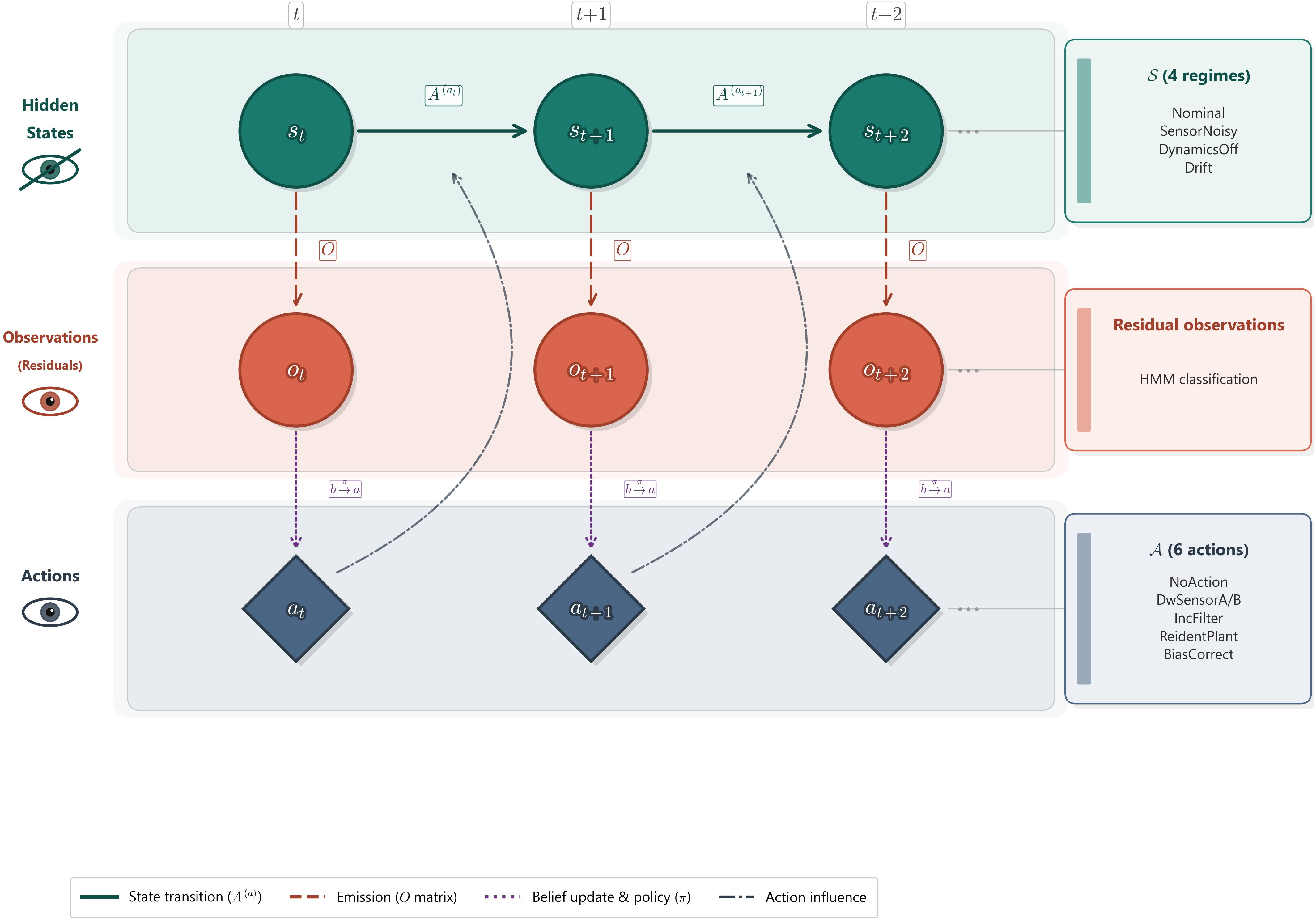
Figure 1: The graphical structure of the POMDP framework in the digital twin, where latent error regimes evolve via action-dependent dynamics and are observed through a noisy classifier linkage.
Model Construction and Solution Methods
The MDP is specified by the tuple (S,A,T,R,γ), with transition matrices extracted directly from data, enabling the solution of the optimal policy via value iteration. For the more pragmatic POMDP setting, classification uncertainty is accommodated through a belief update under the HMM confusion matrix, and the policy is solved by point-based value iteration (PBVI) over sampled beliefs. The solution pipeline is computationally validated against stochastic simulation (Gillespie algorithm), and, for increased realism, a continuous-time Markov chain embedding is provided.
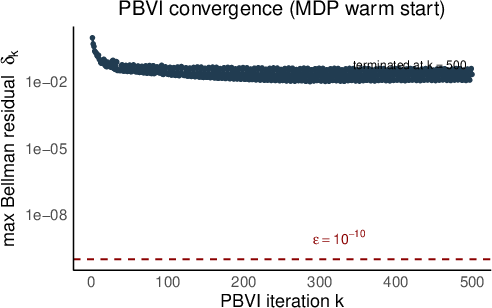
Figure 2: Convergence trajectory of PBVI under MDP warm start, evidencing rapid stabilization of the policy within computational budget.
Empirical validation is conducted on a synthetic six-module ARX-based digital twin, with four error regimes (Nominal, SensorNoisy, DynamicsOff, Drift) and six corrective actions. HMM fitting and confusion analysis reveal regime-dependent asymmetries, e.g., only 21% accuracy in SensorNoisy. The resulting observation matrix directly governs partial observability effects.
The MDP controller serves as a performance upper bound, with immediate and state-aligned repairs driving system restoration. POMDP policy, based on posterior beliefs, recovers ∼95% of MDP performance despite severe observational noise.
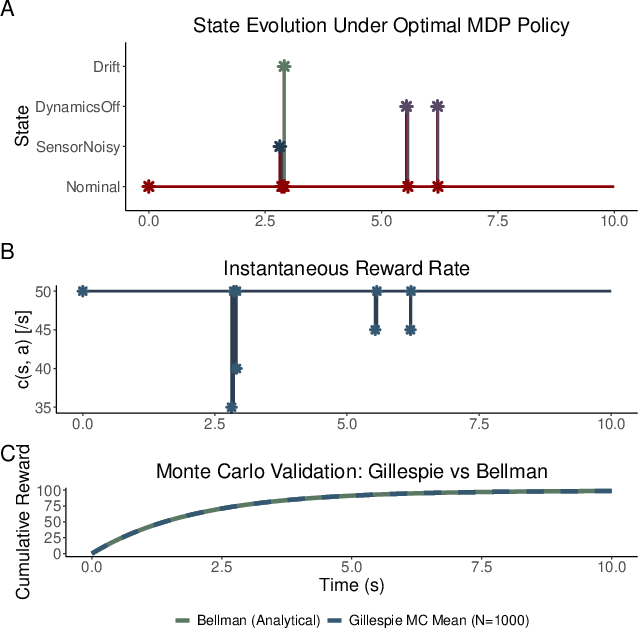
Figure 3: MDP-based trajectory analysis demonstrating rapid regime recovery, correct action selection, and high simulation-theory alignment.
Comparison to heuristic MCDA (TOPSIS) and reactive baselines underscores the catastrophic performance degradation from myopic, hard-classification strategies under poor observability. The MCDA's action mismatch rate reaches ∼64%, resulting in nearly nullified cumulative reward gains compared to no intervention, elucidating the criticality of sequential planning and explicit belief maintenance.
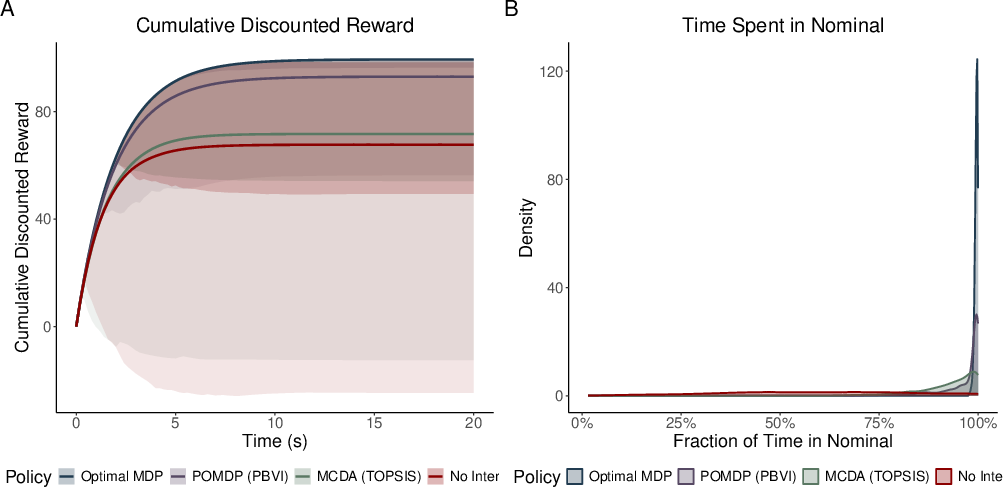
Figure 4: Policy performance comparison, with cumulative reward and time in Nominal regime highlighting POMDP's advantage over MCDA and reactive baselines.
Robustness is demonstrated across classification accuracy, repair probability scaling, discount factor selection, and reward matrix perturbation. The POMDP outperforms MCDA across all settings, while the value of information (difference between MDP and POMDP) decays as classification improves, but remains secondary compared to the performance gap between POMDP and MCDA—indicating that improvements in policy structure yield higher returns than investments in classifier accuracy.
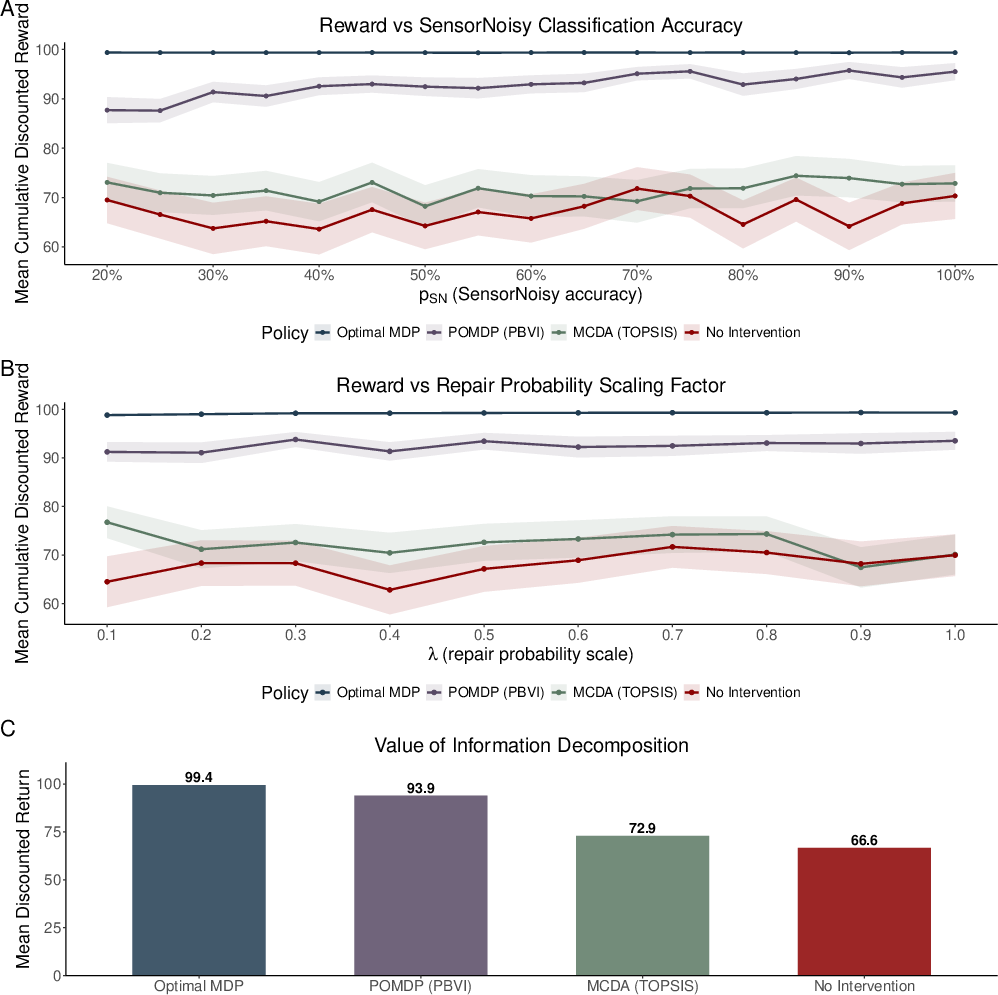
Figure 5: Sensitivity of cumulative reward to classification accuracy and repair efficacy; decomposition of performance gaps emphasizing the pronounced benefit of sequential planning over mere observability improvements.
Mechanistic Insights
Detailed analysis of POMDP belief vector trajectories reveals fast convergence to the correct regime for accurately classified faults (DynamicsOff, Drift), and delayed detection under ambiguous noise (SensorNoisy). The optimality stems from conservative default actions (NoAction) when belief is diffuse, preventing costly mismatches, in contrast to MCDA's over-eager interventions.
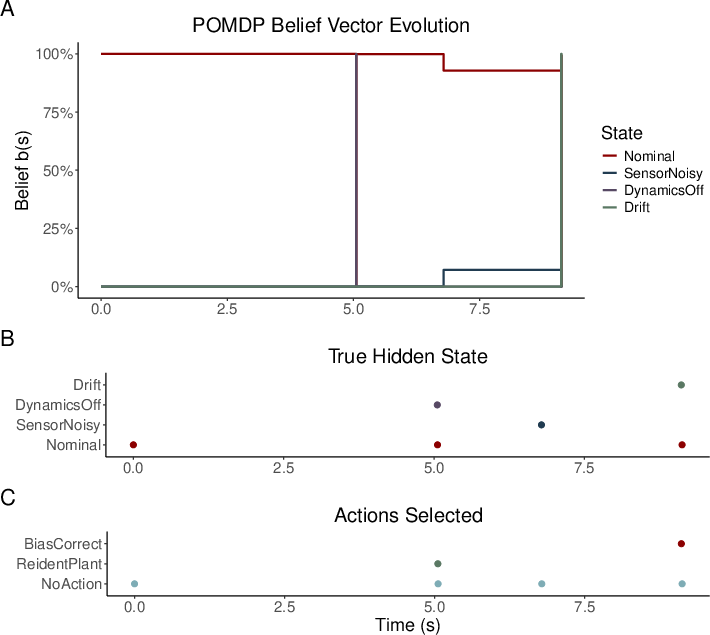
Figure 6: Evolution of POMDP belief vectors throughout a multi-regime trajectory, showing selective and delayed response to ambiguous states.
Action-mismatch analysis definitively supports that the POMDP's superiority is derived from precision—not intervention frequency. Statistical tests corroborate all key policy performance hierarchies.
Computational Considerations
The fully data-driven MDP/POMDP pipeline (with all but repair probabilities and reward set learned from operation data) ensures scalability and ease of deployment. Model-based solutions prove orders of magnitude more efficient and performant than model-free RL approaches (tabular Q-learning, REINFORCE) for problems of this scale. However, RL retains value for adaptation in nonstationary or high-dimensional domains where explicit modeling is infeasible.
Practical and Theoretical Implications
The results underscore that state-of-the-art error propagation mitigation in digital twins must transition from heuristic or hard classification-based controllers to sequential, probabilistic planning frameworks. The demonstrated POMDP systematically closes the detect--classify--decide loop with minimal assumptions and quantifies the value of both better classification and better policies.
The analysis demonstrates that the largest performance increments are achieved not by improving regime detection (classifier accuracy), but by switching from heuristic to belief-state planning; the planning advantage is approximately four times the value of eliminating partial observability.
Future extensions should address module scaling (factored POMDPs), continuous action spaces, data-driven adaptation of repair probabilities, non-instantaneous action effects (semi-Markov kernels), and full-covariance emission models. These avenues would directly enhance real-world digital twin operations for process, manufacturing, and infrastructural systems.
Conclusion
The paper establishes a complete, formally derived, and data-driven sequential decision framework for mitigating error propagation in modular digital twins. By integrating HMM-based regime inference with model-based MDP/POMDP controllers and comprehensive computational validation, it sets a benchmark for both the theoretical and operational treatment of uncertainty, observability, and intervention in AI-driven digital twin systems. The methodology demonstrates robust, interpretable, and scalable strategies, highlighting that rigorous sequential planning infrastructure is essential for robust and cost-effective digital twin operation in the presence of regime misclassification and stochastic faults.
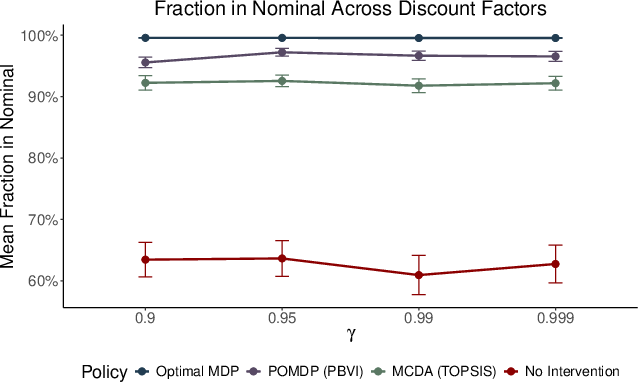
Figure 7: Fraction of time spent in Nominal across a variety of planning horizons (discount factors), confirming robustness of policy hierarchy and insensitivity to horizon selection.

