- The paper identifies a critical velocity, c̄, that marks the transition between extinction and invasion regimes in the generalized Burgers-Fisher-KPP equation.
- It employs dynamical systems reduction, phase-plane analysis, and sub-/supersolution techniques to rigorously prove the existence of sharp convective thresholds.
- Explicit results on the threshold coefficient k*(n,p,q) highlight how parameters influence the balance of diffusion, reaction, and nonlinear convection.
Large Time Asymptotics and Critical Convection in the Generalized Burgers-Fisher-KPP Equation
Introduction and Motivation
This paper conducts an in-depth analysis of large-time dynamics for the Cauchy problem associated with the generalized Burgers-Fisher-KPP equation: ∂tu=uxx+k(un)x+up−uq,(x,t)∈R×(0,∞),
where n≥2, p>q≥1, and k∈R. Extending the classical Fisher-KPP and Burgers-Fisher-KPP frameworks, this study incorporates the interplay between diffusion, nonlinear reaction, absorption, and convection, with exponents and coefficients outside the regime classically considered in population dynamics and reaction-diffusion theory.
The work focuses on the precise mechanisms underlying vanishing versus spreading phenomena and identifies critical transitions governed by the coupling of the nonlinear convection term k(un)x and other system parameters. It demonstrates that, unlike the prototypical Fisher-KPP scenario, the presence and strength of convection can fundamentally alter the long-term fate of the solution—ushering in a scenario where spreading and vanishing compete, with the ultimate outcome determined by a critical velocity whose analytic expression is generally inaccessible.
Mathematical Framework and Main Results
Traveling Waves, Critical Velocities, and Dynamical Systems Reduction
The investigation begins by revisiting the construction of traveling wave solutions of the form u(x,t)=f(x+ct), leading to a reduced dynamical system for (f,f′). The analysis classifies critical points—namely, P1=(0,0) and P2=(1,0)—and characterizes all admissible trajectories joining these points, depending on the wave velocity c and parameters n≥20.
A key technical device involves identifying a critical velocity n≥21, determined as the supremum of values for which the phase-plane trajectory directly connects n≥22 to n≥23 without oscillations or crossing the n≥24-axis. The value of n≥25 depends subtly on all parameters and, crucially, is not given by a closed-form algebraic expression except in special cases.
Asymptotics for Heaviside and Anti-Heaviside Initial Data
Two canonical initial conditions are considered: the Heaviside function n≥26 (step up at n≥27) and the anti-Heaviside n≥28. The main theorems can be summarized as follows:
- For the Heaviside initial data:
- The solution n≥29 evolves asymptotically as a traveling wave with speed p>q≥10: it converges either to p>q≥11 (spreading) or p>q≥12 (vanishing), depending on the sign of p>q≥13.
- Sharp transition: There exists p>q≥14 such that for p>q≥15, p>q≥16 (spreading regime); for p>q≥17, p>q≥18 (vanishing regime).
- For the anti-Heaviside data:
- The solution always vanishes asymptotically, with propagation dictated by a more explicit velocity p>q≥19.
These results are realized via rigorous sub- and supersolution constructions, comparison principles, and phase-plane analysis.
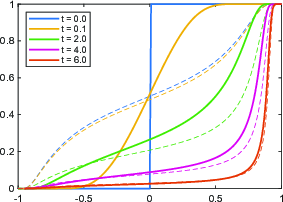
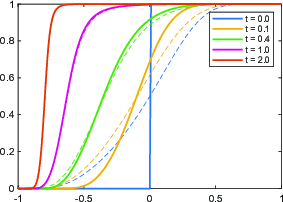
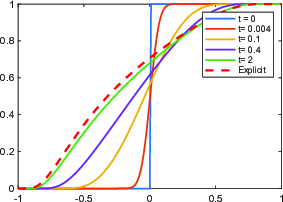
Figure 1: Behavior of the solution with initial condition k∈R0 for all the relative positions of k∈R1 with respect to k∈R2: numerical experiment for k∈R3, k∈R4, k∈R5, with k∈R6 shows the transition from vanishing to spreading.
Critical Coefficient and Transition Phenomenon
The manuscript elucidates the threshold convection coefficient k∈R7, which separates long-term extinction from invasion. This threshold depends intricately on the exponents, with the following bounds established: k∈R8
and explicit expressions are proven in several cases (e.g., k∈R9, k(un)x0, yielding k(un)x1).
Key explicit and analytical results include:
- In the regime k(un)x2, the threshold takes the value k(un)x3.
- The transition is rigorously shown using a mix of explicit trajectories, monotonicity arguments, and topological conjugacy via self-maps of the traveling wave phase system.
This sharp transition from vanishing to spreading as k(un)x4 crosses k(un)x5 is a strong and nontrivial effect of nonlinear convection, contrasting starkly with the purely diffusive or linear convective Fisher-KPP case.
Extension to General Initial Data
Beyond step-type initial data, the theorems and proof techniques accommodate a broader class of initial conditions, provided they have the correct asymptotic behavior at k(un)x6 (quantified in terms of exponential or algebraic decay rates related to the linearization at the critical points). Thus, the long-term behavior manifests robustness with respect to perturbation of the initial configuration in the prescribed function space.
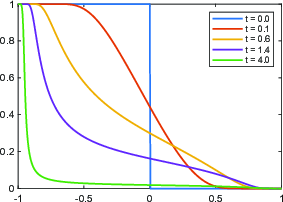
Figure 2: Evolution in time of the ``anti-Heaviside" solution k(un)x7, confirming the uniform vanishing regime; numerical experiment for k(un)x8, k(un)x9, u(x,t)=f(x+ct)0, u(x,t)=f(x+ct)1.
Several methodological contributions distinguish this work:
- Dynamical systems reduction: The phase plane for traveling wave ODEs is carefully analyzed, with nontrivial geometric and topological arguments to identify critical trajectories.
- Invariant region and comparison arguments: The construction of positively invariant sets and the use of sub- and supersolutions facilitate rigorous identification of the critical velocity and threshold coefficient.
- Explicit connection with pushed/pulled fronts: The threshold u(x,t)=f(x+ct)2 plays an analogous role to the pushed-pulled transition in front propagation, although here the selection mechanism is genuinely nonlinear and convection-driven.
- Self-map for phase-plane equivalence: A transformation between parameter sets yields a topological equivalence, elucidating further parameter regimes with explicit or improved estimates for u(x,t)=f(x+ct)3.
Implications and Perspectives
From a theoretical viewpoint, these results challenge the universality of vanishing in competitive reaction-diffusion-convection systems by showing that convection can effect a qualitative regime shift in population, combustion, or chemical systems. The emergence of a non-algebraic, system-dependent selection mechanism for critical speed underscores the complexity introduced by nonlinear convection and higher-order exponents.
Practically, the characterization of u(x,t)=f(x+ct)4 provides a parametric guideline for controlling regime transitions in engineered and natural systems subject to reaction, absorption, and transport. Computational demonstrations highlight the theoretical findings and provide benchmarks for future simulation studies in nonlinear pattern formation and wavefront propagation.
Conclusion
This paper achieves a comprehensive characterization of the long-time dichotomy in the generalized Burgers-Fisher-KPP equation with nonlinear convection, revealing that the fate of solutions (extinction vs. invasion) hinges on a delicate balance of diffusion, reaction, and convection, as captured by a critical velocity and threshold parameter. The analytical and methodological advances, such as explicit construction of critical trajectories and the invariant-phase-plane framework, enrich the understanding of nonlinear wave selection and should inform further research in nonlinear PDEs with complex transport and reaction mechanisms (2604.22108).

