- The paper introduces a two-stage 'Wiggle and Go!' pipeline that infers rope-specific parameters from a diagnostic wiggle for zero-shot real-world manipulation.
- A simulation-trained temporal convolutional neural network, Phi-NN, predicts nine key rope parameters to guide physics-based trajectory optimization via CMA-ES.
- Empirical results demonstrate marked improvements in manipulation accuracy, reducing trial-and-error risks and ensuring task-agnostic transferability across rope types.
Wiggle and Go! System Identification for Zero-Shot Dynamic Rope Manipulation
Motivation and Context
Dynamic rope manipulation presents fundamental challenges for robotic systems: task success often hinges on a precise understanding of rope dynamics, while real-world failures can be catastrophic, causing irrecoverable tangling or hardware damage. Existing methods depend on large real-world datasets (Nair et al., 2017), iterative refinement (Chi et al., 2022, Zhang et al., 2020), or explicit sim-to-real calibration (Lim et al., 2021). This paper introduces a two-stage pipeline—Wiggle and Go! (WaG)—which leverages simulation-trained neural network system identification to enable zero-shot, goal-conditioned rope manipulation in the real world, entirely bypassing risky trial-and-error or dataset-intensive approaches.
System Architecture and Core Methodology
The WaG pipeline decouples system identification from task execution. A predefined diagnostic "wiggle" is performed with the robot in the real world; observations from this motion are passed to a simulation-trained temporal convolutional neural network (Phi-NN) to infer rope-specific parameters (e.g., stiffness, damping, mass distribution, geometry). These parameters condition a physics-based trajectory optimization (CMA-ES-traj) which computes actions for downstream manipulation tasks (target striking, lobbing, draping). Only the wiggle and the final task action are performed in real, while all policy learning occurs in simulation.
The architecture's task-agnostic identification module enables seamless switching between manipulation tasks with a single model, and the use of explicit physical parameters supports robust trajectory optimization, providing interpretability and transferability.
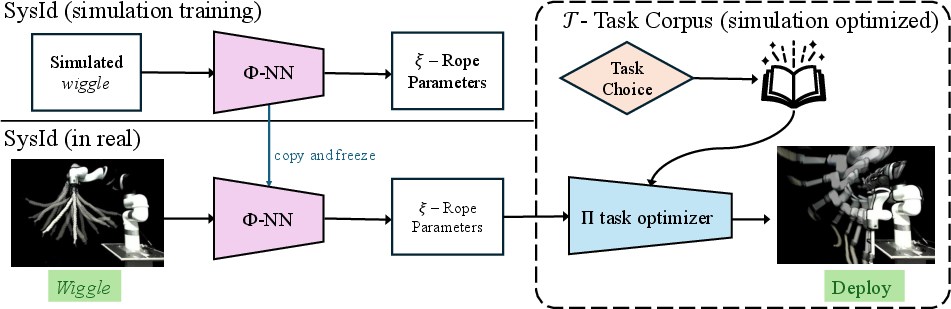
Figure 1: The WaG pipeline utilizes a brief diagnostic wiggle for system identification, informing task-optimized actions executed zero-shot in real.
Simulation, System Identification, and Domain Randomization
Training data is synthetically generated across a wide range of rope parameters within simulation (Drake), allowing access to ground truth unavailable in real-world deployments. Observations consist of normalized position and angular trajectories from the rope, projected to 2D with calibrated camera models. Phi-NN is trained via supervised learning augmented with domain randomization (calibration noise, tracking noise, trajectory padding) to bridge the sim-to-real gap. Feature engineering includes normalization and angular derivation, facilitating robustness and decoupling appearance variations.
Wiggle trajectory design is shown empirically not to be critical—as long as excitation is sufficient for discriminating dynamics, planar trajectories are effective.
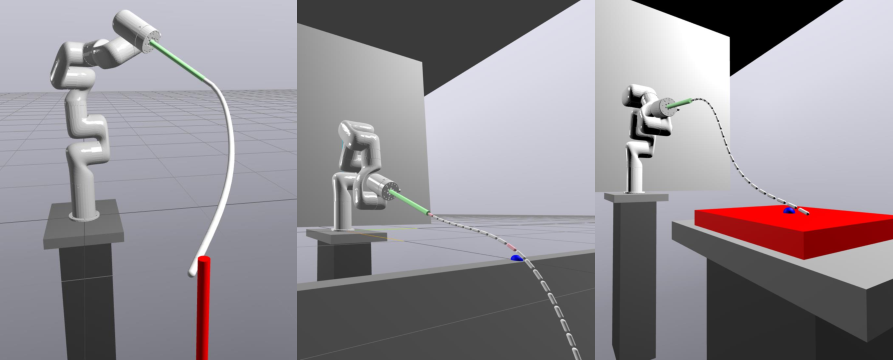
Figure 2: Task setups in Drake, showing representative configurations for 3D target striking, lobbing, and draping.
Rope Parameterization and Policy Optimization
Ropes are modeled as ball-joint chains with link count, stiffness, damping, mass, and lead tip properties, providing nine behavioral descriptors for system identification. CMA-ES-traj operates with low-dimensional joint-space waypoint parameterization, minimizing collision risk and respecting velocity/joint constraints. Reward functions are customized per task: point striking (endpoint proximity), lobbing (transient and final position), draping (multi-point proximity and stability).
Strong results are obtained for all tasks with CMA-ES-traj in simulation, with median rope tip distance of 0.8 cm for 3D striking, indicating efficient optimization given accurate parameters.
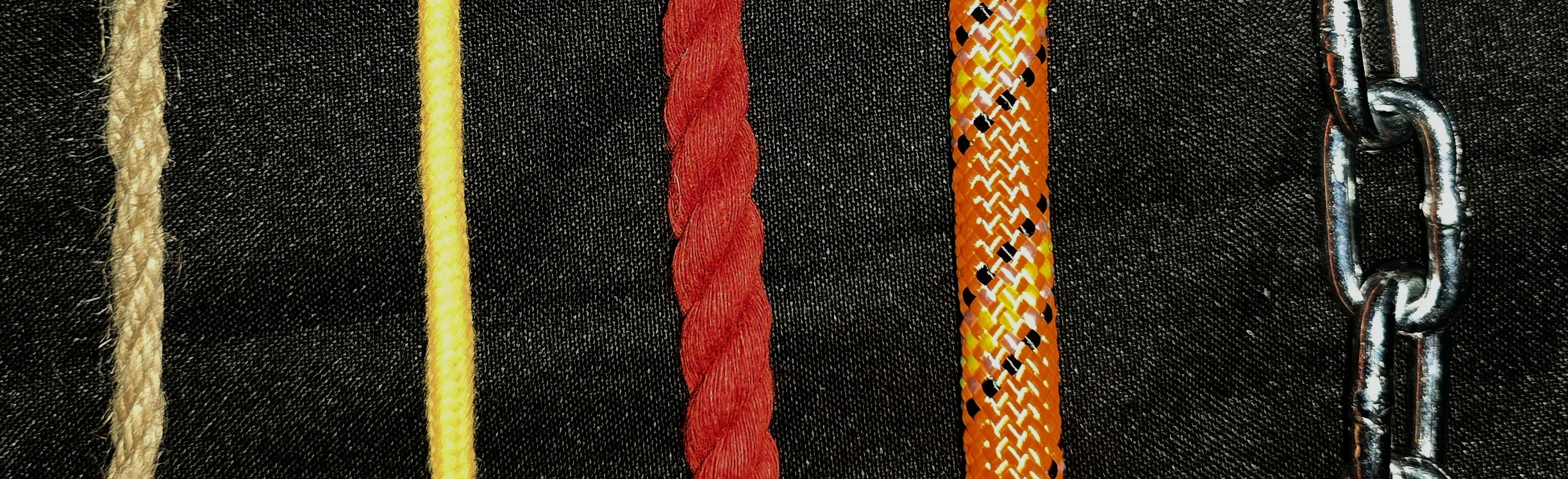
Figure 3: Five distinct rope types used in experiments, spanning a range of geometric and material properties.
Parameter Estimation and Robustness
Phi-NN achieves 30.7% aggregate relative error across all parameters in simulation, with geometric parameters (length, link count) <1.1% error. Inertial/damping properties are harder to estimate. Saturation beyond training bounds is observed: predictions clamp to boundary values for out-of-distribution ropes.
Parameter-wise ablations show that each dimension substantially affects downstream trajectory; accuracy requires all nine parameters, not just globals like length or lead mass.
Motion Fidelity and Transferability
Predicted parameters generalize between dynamic contexts, validated by Fourier correlation (0.95 Pearson) between simulated and real rope motions in unseen trajectories.
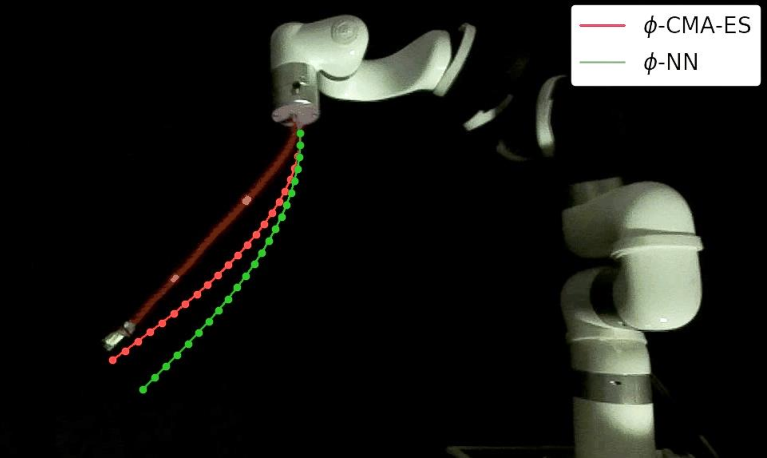
Figure 4: Real and simulation comparison for Phi-NN and Phi-CMA-ES on a test rope motion, demonstrating high fidelity in trajectory matching.
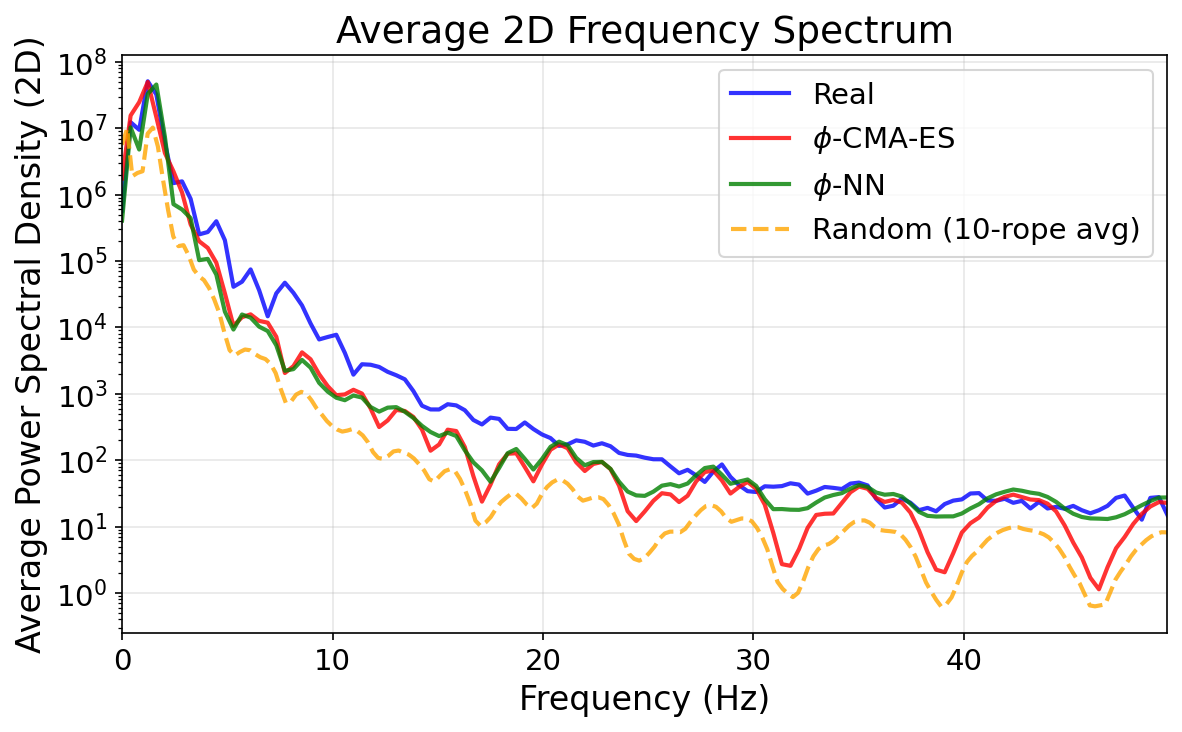
Figure 5: Fourier frequency distributions for a representative rope, showing strong correlation between predicted and actual dynamic response.
CMA-ES fitting (Phi-CMA-ES) serves as a baseline, being slower but robust for out-of-distribution objects (e.g., chains), while Phi-NN generalizes efficiently across typical ropes.
Task-level transferability in simulation shows predicted parameters enabling 2.1 cm median error in target striking versus 1.2 cm for ground truth, and 12.8 cm for random parameters. This quantifies the necessity of informative system identification.
Real-World Deployments
In hardware experiments, Phi-NN achieves an average accuracy of 3.55 cm for 3D pole-striking—approximately a four-fold improvement over baselines without system identification (15.34 cm). Phi-CMA-ES sometimes outperforms for out-of-distribution ropes but is less efficient.
Secondary tasks (lobbing and draping) validate the architecture's flexibility; the same identification supports diverse manipulation primitives, achieving 54–67% success rates across configurations.
The method stands in contrast to dataset-intensive approaches (Nair et al., 2017, Zhang et al., 2020, Wang et al., 2024), iterative refinement-based methods (Chi et al., 2022) [bristow_survey_2006], and material-propertied system identification frameworks (Kuroki et al., 2023, Lim et al., 2021, Kuroki et al., 2023). Unlike GenORM/GenDOM (Kuroki et al., 2023, Kuroki et al., 2023), WaG directly estimates rope behavioral parameters rather than generic material properties, demonstrates transfer across multiple 3D tasks, and analyzes observation strategies (wiggle design) for parameter inference quality.
Adaptation draws inspiration from privileged information and rapid motor adaptation paradigms (Kumar et al., 2021, Liang et al., 2023, Qi et al., 2022), but differs by producing explicit physical parameters instead of latent representations, supporting offline identification and task-agnostic deployment.
Limitations and Implications
CMA-ES trajectory optimization is CPU-bound, restricting throughput per task; integration with GPU-based or differentiable simulators offers future scalability. Parameter estimation saturates at training distribution bounds, potentially degrading task performance for ropes with radically different dynamics. Noise in real segmentation/tracking remains a bottleneck.
The practical implication is that safe, task-agnostic system identification unlocks robust zero-shot dynamic rope manipulation—a significant reduction in operational risk and development overhead. Theoretically, explicit parameter estimation provides pathways for interpretability, transfer learning, and integration with advanced model-based control architectures.
Future Directions
Potential extensions include reinforcement learning policy optimization for trajectory generation, investigation of wiggle excitation strategies for isolating individual parameters, and deployment with broader classes of deformable objects. Improved differentiable simulators [hu2019chainqueen] [chen2024deform] [si2024difftactile] and high-fidelity real-to-sim mapping could further narrow the sim-to-real gap.
Conclusion
Wiggle and Go! exemplifies a scalable, task-agnostic system identification paradigm for dynamic rope manipulation by combining simulation-trained neural inference with physics-based policy optimization. Empirical results demonstrate marked improvements in real-world manipulation accuracy and task generalization. The architecture's explicit parameterization and decoupling of identification and policy optimization suggest broad applicability to other deformable object domains, advancing the integration of safe system identification as a core principle in robotic manipulation (2604.22102).