- The paper introduces a full-stack virtualization framework that transforms legacy cellular hardware into precise ISAC systems through space-time-frequency synthesis.
- It demonstrates how map-assisted environmental synthesis converts multipath reflections into virtual radar sensors, achieving centimeter-level localization accuracy under NLOS conditions.
- It validates a sub-Nyquist signal acquisition method that recovers wideband sensing parameters with reduced ADC rates, maintaining target resolution in challenging scenarios.
Enabling High-Precision ISAC through Resource Virtualization on Commercial Cellular Infrastructure
Motivation and Problem Statement
The emergence of Integrated Sensing and Communication (ISAC) as a foundational technology for 6G necessitates transforming commercial cellular infrastructure into high-precision, ubiquitous sensing platforms. Despite ISAC’s theoretical potential, legacy networks are fundamentally constrained by narrowband spectrum allocations, small antenna apertures, intermittent transmission protocols, and prohibitive costs of high-rate analog-to-digital converters (ADCs). These barriers preclude the realization of fine-grained sensing for critical applications, such as autonomous navigation, industrial automation, and immersive spatial computing. The paper proposes a unified full-stack virtualization framework—moving from physical resource constraints to computational resource synthesis—that upgrades legacy infrastructure without costly retrofitting.
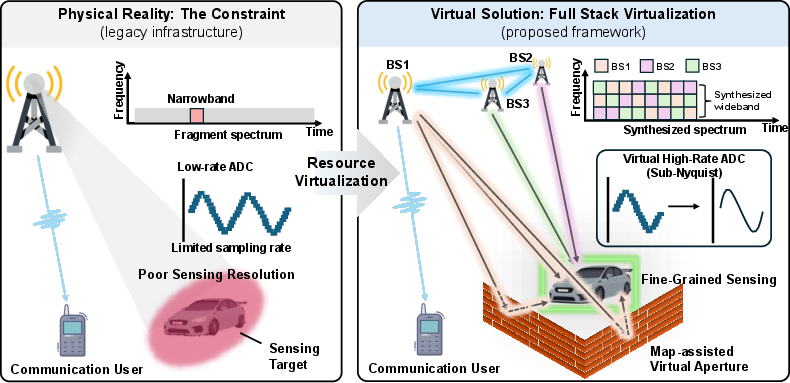
Figure 1: Conceptual overview of full-stack resource virtualization transforming narrowband legacy cellular infrastructure into a fine-grained ISAC sensing system by virtualizing signal generation, propagation, and acquisition.
Full-Stack Resource Virtualization Framework
Network-Level Virtualization: Space-Time-Frequency Synthetic ISAC
Traditional cellular BSs are limited by isolated bandwidth and aperture. The framework constructs a synthetic ISAC network by aggregating resources across distributed BSs, staggered time intervals, and disjoint frequency bands. Frequency synthesis leverages carrier agility for virtual wideband construction, enabling fine range resolution via sequential aggregation of fragmented spectrum. Time synthesis integrates intermittent signals across frames—exploiting synchronization signal blocks and channel state information reference signals as pseudo-radar pulses—to accumulate Doppler information and extend coherent processing intervals. Spatial synthesis fuses multistatic measurements from several BSs to form a distributed virtual phased array, surpassing diffraction-limited beamforming performance of individual sites.
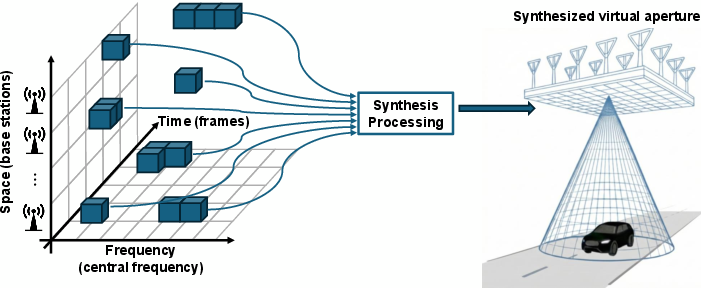
Figure 2: Space-time-frequency synthetic ISAC network architecture enabling unified aperture and bandwidth through distributed resource aggregation.
An important analytical insight is the delay-velocity coupling induced by frequency hopping. This coupling modifies identifiability and estimation stability for delay and velocity, necessitating careful scheduling with balanced hopping patterns to minimize estimation variance. Spectral agility yields disproportionately greater gains than temporal extension, as CRLB analysis shows prioritizing bandwidth expansion is preferable under legacy traffic constraints.
Channel-Level Virtualization: Map-Assisted Environmental Synthesis
Even with network synthesis, the angular resolution of single BSs is limited by physical array size. The environmental virtualization layer leverages digital mapping and propagation geometry to reinterpret multipath as virtual radar sensors. Dominant specular reflections serve as synthesized sensing points, expanding the effective aperture using map-assisted signal inversion. This approach transforms multipath from a source of interference to a resource for massively expanding the array geometry. The CRLB for localization is reduced substantially, achieving centimeter-level accuracy using commercial hardware.
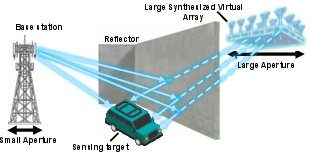
Figure 3: Map-assisted environmental synthesis depicting virtual array expansion through multipath exploitation and digital map fusion.
Notably, the system can sustain localization and tracking under non-line-of-sight (NLOS) conditions by exploiting reflective surfaces when direct paths are blocked. Time synthesis further accumulates energy from weak multipath returns, mitigating mmWave and THz band reflection losses, which are significant for high-frequency signals. Experimental validation in indoor NLOS scenarios confirms that map-assisted localization delivers centimeter-level error, substantially outperforming single-channel baselines.
Device-Level Virtualization: Sub-Nyquist Signal Acquisition
The requirement for gigahertz-level bandwidths normally imposes stringent Nyquist sampling rates, demanding costly, power-intensive ADCs. The receiver virtualization layer bypasses the ADC bottleneck via sub-Nyquist sampling schemes exploiting the sparsity of signal structures. By strategically placing pilots to control aliasing of wideband components into orthogonal baseband regions, the receiver recovers sensing parameters without distortion at a fraction of the traditional sampling rate.
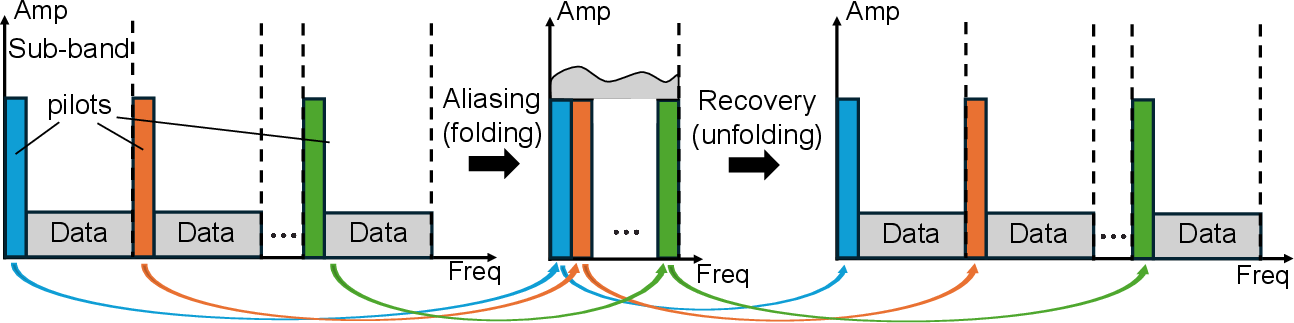
Figure 4: Controlled aliasing under sub-Nyquist sampling allows sparse pilots to fold into recoverable regions in baseband, enabling wideband channel response reconstruction.
Extension of this paradigm to OTFS modulation ensures robustness under high mobility (e.g., vehicular or high-speed train scenarios), where standard OFDM fails due to Doppler spread. Sensing pilots are embedded in delay-Doppler bins so that after sub-Nyquist sampling, radar parameters are perfectly recoverable. Joint iterative refinement with data demodulation progressively suppresses symbol-induced interference, ensuring reliable communication and sensing concurrently. Laboratory experiments demonstrate clear resolution of closely spaced targets using 16× sub-Nyquist sampling, directly validating practical feasibility.
Experimental Validation
The framework is substantiated through experimental setups that demonstrate map-assisted localization and sub-Nyquist OTFS-ISAC receiver efficacy. Indoor NLOS scenarios exhibit centimeter-level localization errors with synthesized-wideband signals, and laboratory OTFS experiments successfully resolve targets separated by sub-meter distances even under aggressive ADC rate reductions.
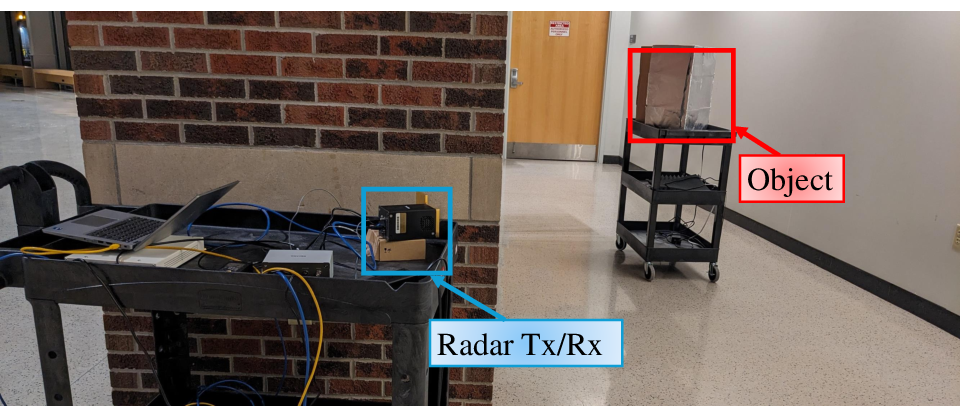
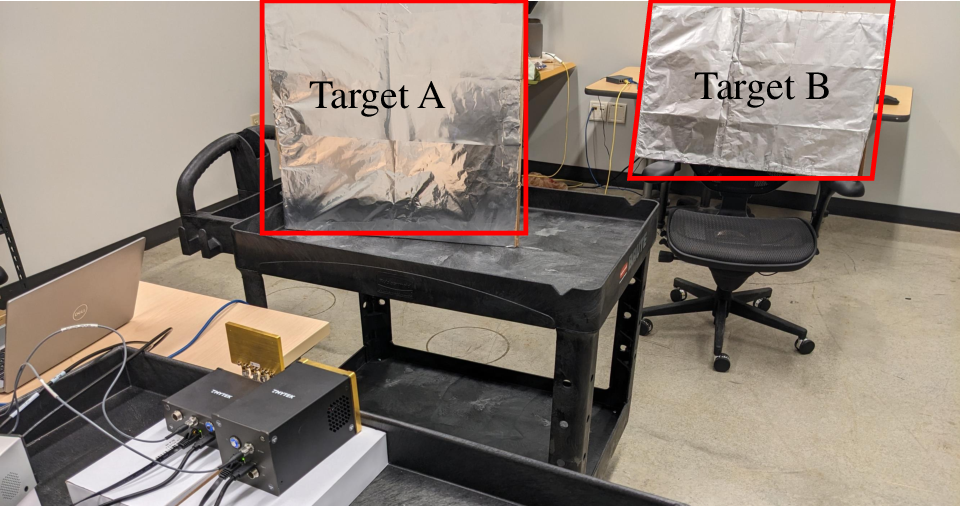
Figure 5: Experimental setups for map-assisted NLOS localization and sub-Nyquist OTFS-ISAC receiver with closely spaced targets.
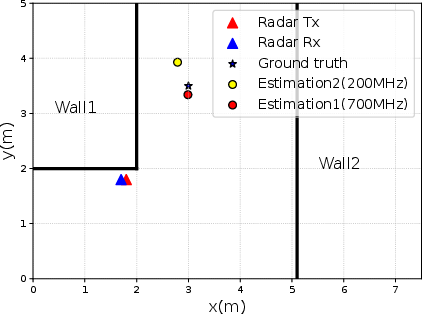
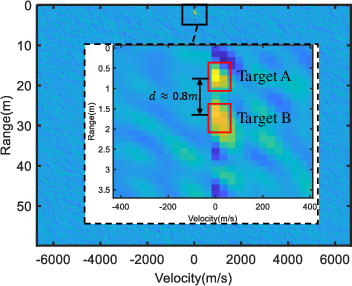
Figure 6: Experimental results highlighting improved localization accuracy with synthesized signals and maintained target resolution under 16× sub-Nyquist sampling.
Implications and Future Directions
The virtualization paradigm shifts the locus of ISAC performance from hardware capability to computational intelligence and orchestration. While enabling scalable high-precision sensing using ubiquitous commercial BS deployments, key challenges remain:
- Distributed coherent sensing is limited by legacy synchronization and local oscillator drift; algorithmic phase alignment and self-calibration using environmental anchors are essential for advancing toward distributed coherent arrays.
- Environmental dynamics necessitate real-time SLAM capability, with ISAC continuously updating the environmental map to preserve virtual array integrity.
- Protocol standardization and scheduling flexibility are required for seamless coexistence of virtualized sensing layers with legacy communication traffic, motivating specification of sensing bandwidth parts and adaptive numerologies.
Advancements toward distributed and cell-free ISAC, intelligent network scheduling, and online environment mapping will further expand the practical and theoretical boundaries of virtualization-enabled sensing in 6G and beyond.
Conclusion
The proposed unified full-stack virtualization framework demonstrates that high-precision ISAC sensing is achievable on legacy cellular infrastructure by shifting reliance from hardware resources to computational synthesis at the network, channel, and device levels. By virtualizing signal generation, propagation, and acquisition, centimeter-level sensing resolution can be layered onto commercial BS deployments, enabling transformative applications in cyber-physical systems, automation, and immersive spatial computing. This virtualization-driven paradigm is poised to redefine ISAC system design, ensuring future networks are not bound by physical constraints but empowered by adaptive, intelligent resource coordination.

