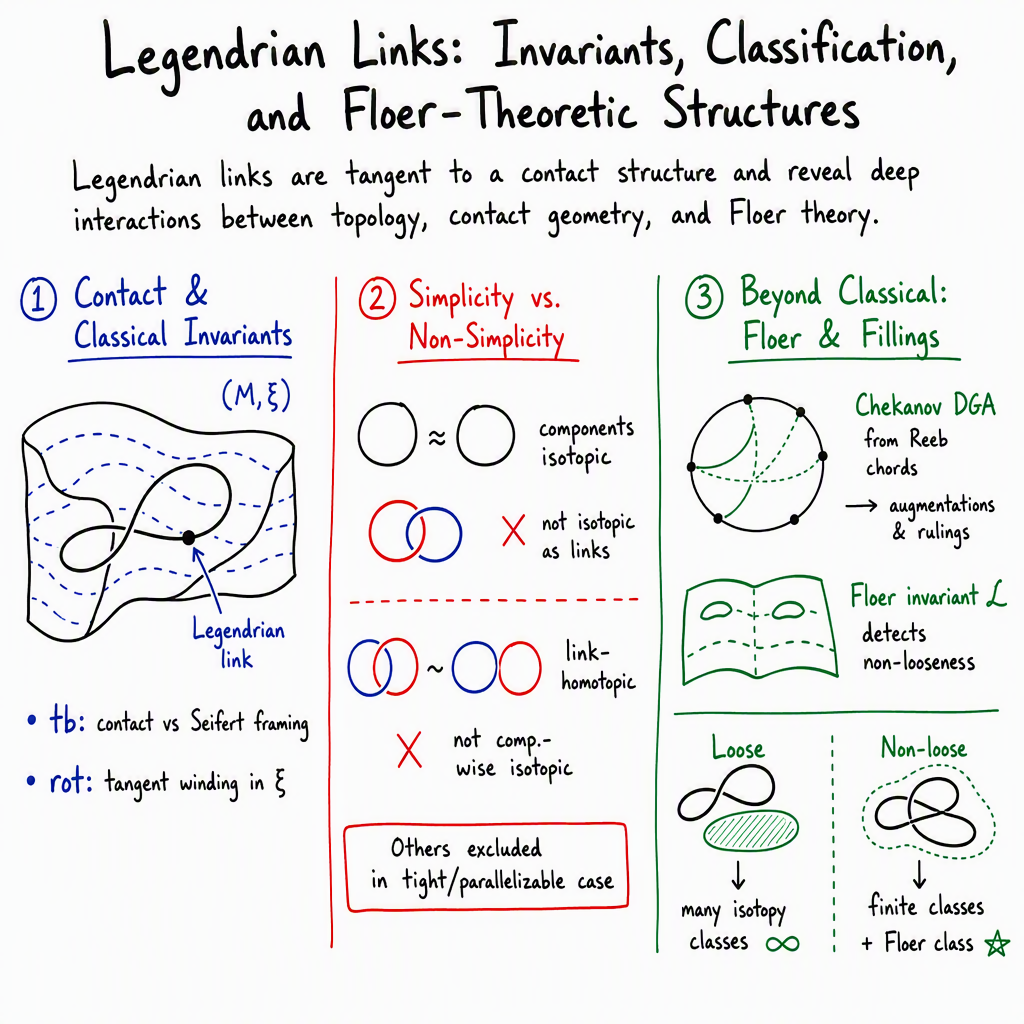
Legendrian Links in Contact Topology
- Legendrian links are smooth embeddings in contact 3-manifolds that are tangent to the contact structure, serving as key objects in contact topology.
- They are characterized by classical invariants like the Thurston–Bennequin and rotation numbers, which, along with Floer-theoretic invariants, distinguish link isotopy classes.
- Recent studies reveal nuanced classification methods for torus and cable links, highlighting phenomena such as component-wise non-simplicity and connections to Lagrangian cobordism and cluster algebras.
A Legendrian link is a smooth link in a contact 3-manifold everywhere tangent to the contact structure, playing a central role in contact topology and the study of low-dimensional invariants. The classification, topology, and algebraic invariants of Legendrian links encode rich interactions between knot theory, contact geometry, and Floer-theoretic invariants, as well as deep connections to symplectic and cluster algebraic structures.
1. Contact Structures, Legendrian Links, and Classical Invariants
Let be a closed, oriented 3-manifold with a co-oriented contact structure where . A Legendrian link in is a smooth embedding everywhere tangent to : for all .
The two primary classical invariants are:
- Thurston–Bennequin number $\tb(L)$, which measures the framing difference between the contact and Seifert framings via a small Legendrian pushoff,
- Rotation number 0, which is the winding of the tangent vector to 1 in 2, relative to a trivialization extending over a Seifert surface.
If 3 is null-homologous, these invariants are integer-valued; they are fundamental for distinguishing Legendrian links up to isotopy, but, except in "simple" settings, do not suffice for complete classification (Dalton et al., 2021, Cahn et al., 20 Dec 2025).
2. Legendrian Simplicity, Non-Simplicity, and Isotopy Classification
Legendrian knots or links are Legendrian simple if their Legendrian isotopy class is determined solely by the tuple 4 for each component. Many classical link types in 5 are not Legendrian simple: for instance, negative torus links and cable links of non-simple knot types.
Recent work exhibits explicit phenomena where Legendrian links are isotopic as framed links and component-wise Legendrian isotopic, yet not Legendrian isotopic as links—demonstrating component-wise non-simplicity—and, conversely, links that are link-homotopic as Legendrian links but not component-wise isotopic (Cahn et al., 20 Dec 2025, Chatterjee et al., 3 Jul 2025). In overtwisted contact 3-manifolds, such non-simplicity phenomena can be constructed in infinite families, leveraging the flexible h-principle applicable in the overtwisted regime.
The table below summarizes non-simplicity mechanisms in Legendrian link theory:
| Non-Simplicity Type | Description |
|---|---|
| Component-wise non-simplicity | Links with Legendrian isotopic components, not Legendrian isotopic as links |
| Link-homotopic but not comp.-wise | Links that are Legendrian link-homotopic but not component-wise isotopic |
| Both in same framed isotopy class | Both above phenomena co-occur in a single smooth isotopy class |
Such behaviors are possible in overtwisted contact manifolds with nontrivial Euler class, but are excluded in the tight/parallelizable case, where all framed isotopy classes are Legendrian-simple (Cahn et al., 20 Dec 2025).
3. Classifications of Legendrian Cable and Torus Links
The classification of Legendrian torus and cable links is nuanced and reflects both topological and contact-geometric data. For torus links 6 (with 7), the classification splits into positive, negative with p>1, and negative with p=1 cases (Dalton et al., 2021). Cable links of uniformly thick knot types (i.e. those for which every solid torus representative thickens to a standard neighborhood of a maximal 8 Legendrian) exhibit similar complexity (Chatterjee et al., 3 Jul 2025). The key points are:
- Sufficiently Positive Cables (9): Legendrian isotopy classes correspond bijectively to standard cables of top-level (non-destabilizable) Legendrians in the companion knot type, up to stabilizations and classical invariants.
- Lesser-Sloped Cables (0): Fine structure governed by "twisted n-copies" and stabilization patterns; non-simplicity phenomena arise, including links that are pairwise component-wise isotopic but not isotopic as links (Chatterjee et al., 3 Jul 2025).
New classification techniques using surgery on companion knots, contact-topological recursion, and parametric convex surface theory provide comprehensive descriptions, particularly for the "negative cable" and Seifert-fibered link regimes (Fernández et al., 2023). The presence, or absence, of Legendrian isotopies realizing all smooth symmetries of the link components is itself a subtle invariant (Dalton et al., 2021).
4. Floer-Theoretic and Algebraic Invariants
For refined distinction of Legendrian links, classical invariants are supplemented by
- Legendrian Contact Homology DGA: The Chekanov–Eliashberg differential graded algebra (DGA) built from Reeb chords of a Legendrian link, defined combinatorially in 1 and extended to higher-dimensional boundaries of Weinstein domains (Karlsson, 2020). Augmentations and graded homology are crucial Legendrian invariants.
- Link Floer Homology–Based Invariants: The invariant 2, built via adapted open book Heegaard diagrams, is a class that detects non-looseness, encodes tightness of the complement, and behaves predictably under connected sums (Cavallo, 2017).
Legendrian racks, ruling polynomials, and combinatorial invariants such as generalized normal rulings in solid torus settings further refine the isotopy-type classification (Karmakar et al., 2023, Lavrov et al., 2011). The existence of augmentations in the Chekanov DGA is equivalent to the existence of generalized normal rulings and is tightly correlated to sharpness of skein-theoretic bounds on 3.
5. Non-Loose and Exceptional Legendrian Links in Overtwisted and Tight Manifolds
Legendrian links in overtwisted manifolds bifurcate into:
- Loose links: Classified coarsely by smooth isotopy type and classical invariants; any two loose links with the same invariants are related by a contactomorphism isotopic to the identity (Chatterjee, 2020).
- Non-loose links: Those whose complement is tight. Non-loose links—crucial for distinguished contact-topological phenomena—can be detected by the nonvanishing of Floer-theoretic invariants (4, contact class 5), or by obstruction-theoretic means, e.g., via the presence of positive Ozsváth–Szabó contact class or the taut foliation construction (Cavallo et al., 2023).
The intricate distinction between loose and non-loose links underpins the flexibility/rigidity dichotomy of overtwisted vs. tight contact topology: non-loose links support exceptional knot invariants and Floer classes, often admitting only a finite number of Legendrian isotopy classes with fixed invariants, as opposed to the infinite possibilities in the loose case (Chatterjee, 2020, Cavallo et al., 2023).
6. Legendrian Links, Lagrangian Cobordism, and Cluster Structures
The study of Lagrangian cobordism classes of Legendrian links reveals a preorder structure, with existence of upper bounds and minimal Lagrangian genus concepts (Sabloff et al., 2021). Invariant-theoretic progress links Legendrian links of affine/Coxeter type—arising from cluster algebras and positroid strata in Grassmannians—with spaces of Lagrangian fillings that reflect the combinatorial structure of cluster seeds and their mutations (An et al., 2021, Casals et al., 2021). Infinite-order loops in the space of Legendrian links act on the DGA, inducing Floer-theoretic distinction between fillings and underlining the rich relationship between Legendrian topology, representation varieties, and algebraic geometry (Casals et al., 2021).
7. Legendrian Singular Links and Higher Algebraic Structures
Legendrian singular links, where the link may have a finite number of transverse self-intersections (singular points), admit a natural singular connected sum operation, extending the usual (smooth) connected sum to the singular category. Their classification involves local invariants at singular points (orderings, markings), enriched resolution sets, and intrinsic algebraic invariants descended from contact topology (An et al., 2015). The resulting structures serve as test-cases for the refinement of classical vs. non-classical invariants and provide a pathway for understanding how Legendrian invariants behave under singularization and tangle-replacement operations.
In summary, Legendrian links are a central object in 3-dimensional contact topology, with their classification, algebraic invariants, and filling properties reflecting deep interactions between geometry, algebra, and topology. The study of Legendrian links—simple and non-simple, loose and non-loose, classical and singular—constitutes an active frontier, developing new link invariants, exploring connections to Floer theory and cluster algebras, and unveiling fresh contact-topological phenomena (Cahn et al., 20 Dec 2025, Chatterjee et al., 3 Jul 2025, Fernández et al., 2023, Chatterjee, 2020, Cavallo, 2017, Casals et al., 2021, An et al., 2021, Casals et al., 2021, Cavallo et al., 2023, Lavrov et al., 2011, Karmakar et al., 2023, An et al., 2015, Boranda et al., 2012).