- The paper introduces a novel spectrographic gradient (Hz/s) metric that quantifies the expressive steepness of portamento slides.
- It employs calibrated spectrogram analysis with gain-enhancement to reliably measure portamento in both analogue and digital recordings.
- Results show a continuous decline in portamento gradients correlated with tempo, indicating evolving performance aesthetics over time.
Spectrographic Portamento Gradient Analysis in Historical Cello Recordings
Introduction and Motivation
Historically, the evolution of expressive techniques in string instrument performance—particularly portamento—has been documented primarily through event frequency and, less often, duration. Existing literature has established a pronounced decline in portamento usage throughout the twentieth century, but previous analytic paradigms have largely framed this decline as binary: slides were either present or absent. This paper, "Spectrographic Portamento Gradient Analysis: A Quantitative Method for Historical Cello Recordings with Application to Beethoven's Piano and Cello Sonatas, 1930--2012" (2604.22037), challenges that dichotomy by introducing a new continuous quantitative descriptor: the spectrographic gradient of the portamento slide, measured in Hz/s.
The primary thesis is that portamento's expressive character—how steeply and decisively a performer glides between notes—is neither reducible to simple presence, absence, nor mere duration, but is encoded in the steepness of the pitch trajectory captured via calibrated spectrographic measurement. This innovation enables fine-grained, reproducible comparisons across recordings from the analogue and digital eras, thus providing more rigorous answers to questions of stylistic change.
Prior Work and Measurement Frameworks
Event-counting and duration-based schemes have dominated portamento measurement (cf. Kennaway's score-annotation of Elgar's Cello Concerto; Leech-Wilkinson's duration metrics). These methods facilitate anatomical comparisons of portamento usage but remain insensitive to the qualitative differences between steep, overt slides and subtle, nearly imperceptible transitions.
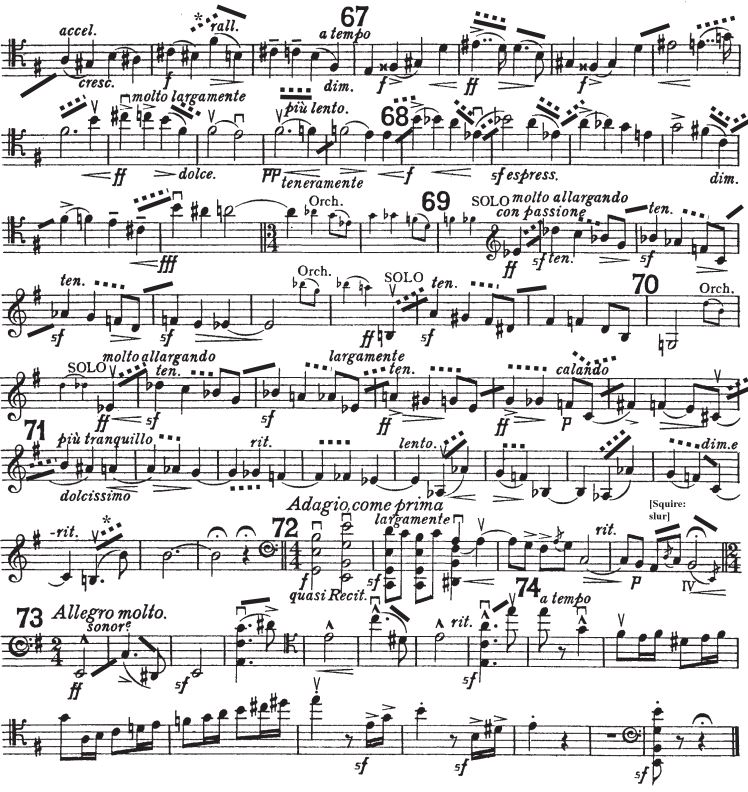
Figure 1: Kennaway’s detailed score annotation of portamento types in Elgar’s Cello Concerto, distinguishing different performers by symbol.
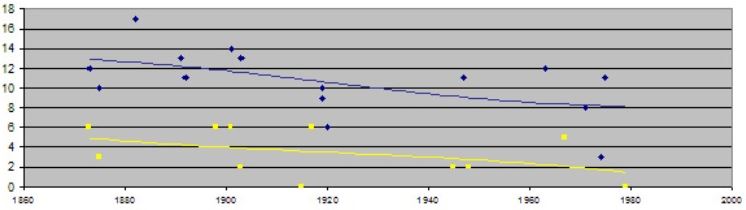
Figure 2: Leech-Wilkinson’s scatter chart demonstrating the historical decline in portamento usage in violin concerto recordings, 1920s onward.
Recent computational approaches, e.g., AVA (Yang), introduce automated detection but remain constrained to monophonic textures and fail to deliver explicit gradient quantification. The current paper identifies these methodological lacunae and positions the spectrographic gradient as a physically grounded and musically meaningful descriptor.
Measurement Protocol and Calibration
The measurement procedure leverages Sonic Visualizer's melodic spectrograms to extract the pitch trajectory for monophonic cello lines. The protocol involves exporting spectrogram segments and post-processing within GIMP, marking onset and termination points of each portamento. Pixel-based gradients (Gpx) are computed and calibrated to physical units using well-defined frequency and time scaling constants, yielding gradient values in Hz/s. This calibration ensures comparability across both different sessions and historical eras.
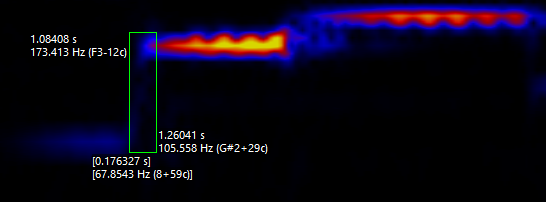
Figure 3: Melodic spectrogram with visible portamento (diagonal trajectory) and vibrato (oscillation), illustrating the direct visual basis for gradient measurement.
Early analogue recordings often suffer from poor signal-to-noise ratios, necessitating a gain-recovery protocol in the analytic workflow. By incrementally enhancing spectrogram gain until portamento traces become visible, the protocol succeeds in extending the corpus' chronological boundaries to include historically critical yet technically degraded 1930s and 1940s recordings.
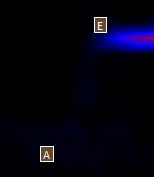
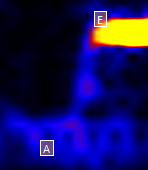
Figure 4: Original unenhanced spectrogram with faint portamento trace.
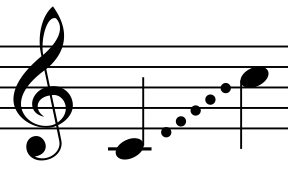
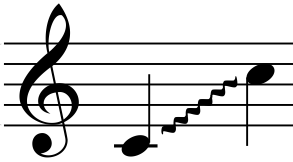
Figure 5: Gain-enhanced spectrogram in which the portamento slide is now clearly visible and measurable.
Corpus and Analytical Scope
The corpus comprises 22 commercial and archival recordings of Beethoven’s Sonata Op. 69 and Op. 102 No. 1 spanning 1930–2012, with targeted analysis of unaccompanied opening bars. This constraint controls for spectrographic masking and musical confounds, isolating performer choice as the primary independent variable.
Manual score annotation precedes gradient measurement, distinguishing between sliding portamento and clean shifts for a methodologically robust taxonomy. All events are codified in a structured, publicly available database.
Results: Temporal and Expressive Trends
Event prevalence analysis confirms prior art: portamento usage declines monotonically through the chronology of recorded cello performance, with a noticeable drop-off after 1970 and virtual disappearance after 1990.
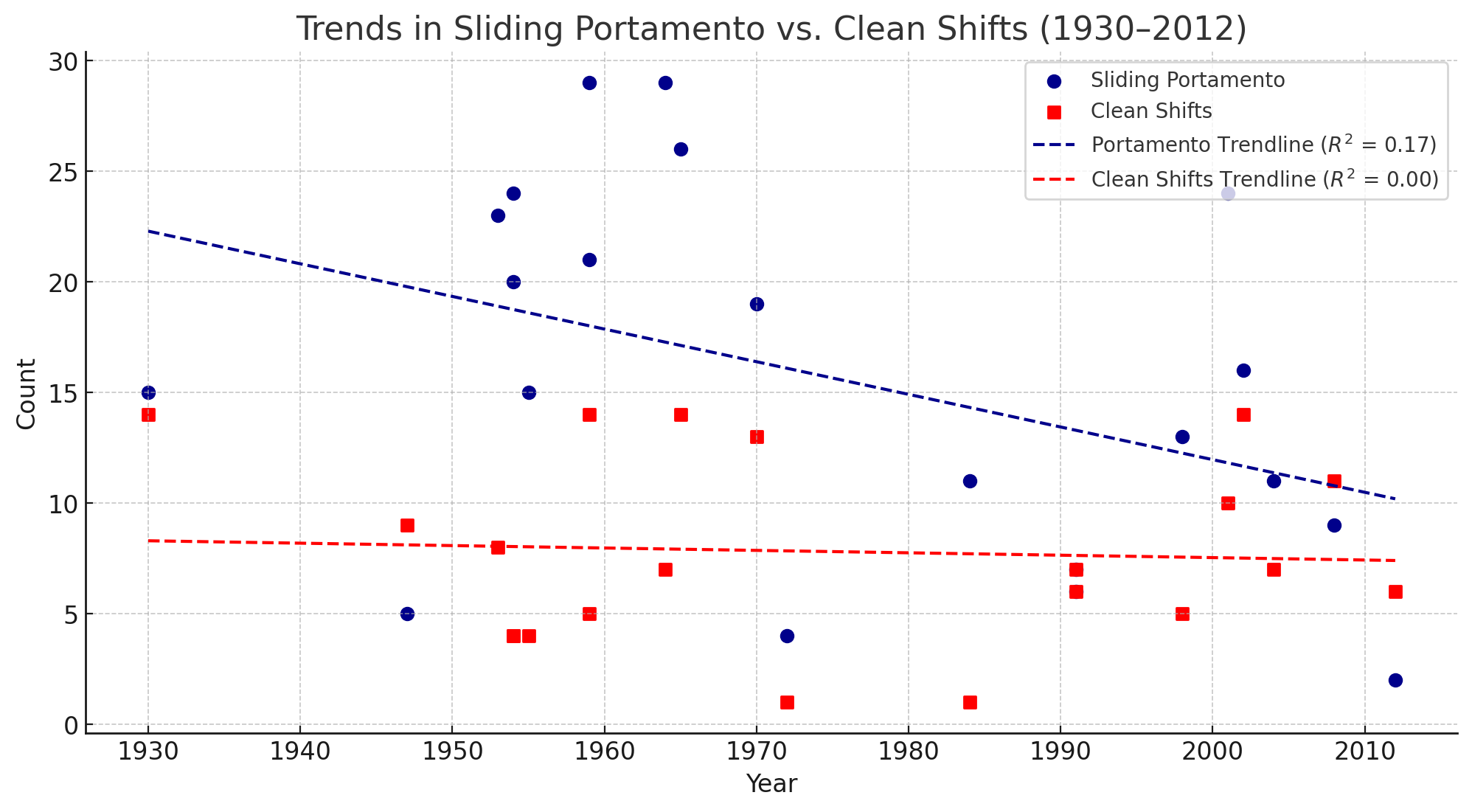
Figure 6: Scatter plot of sliding portamento (blue) and clean shifts (orange) versus recording year for Beethoven’s Sonata Op. 5 No. 1, revealing the clear negative trend in portamento frequency.
Critically, the new metric—gradient (Hz/s)—exhibits a robust, continuous decline across time. Early-century recordings demonstrate high gradients (up to 4,500 Hz/s), corresponding with highly audible, committed portamento. Later recordings either show low gradients (600 Hz/s) or an absence of measurable portamento transitions, often realized as clean shifts.
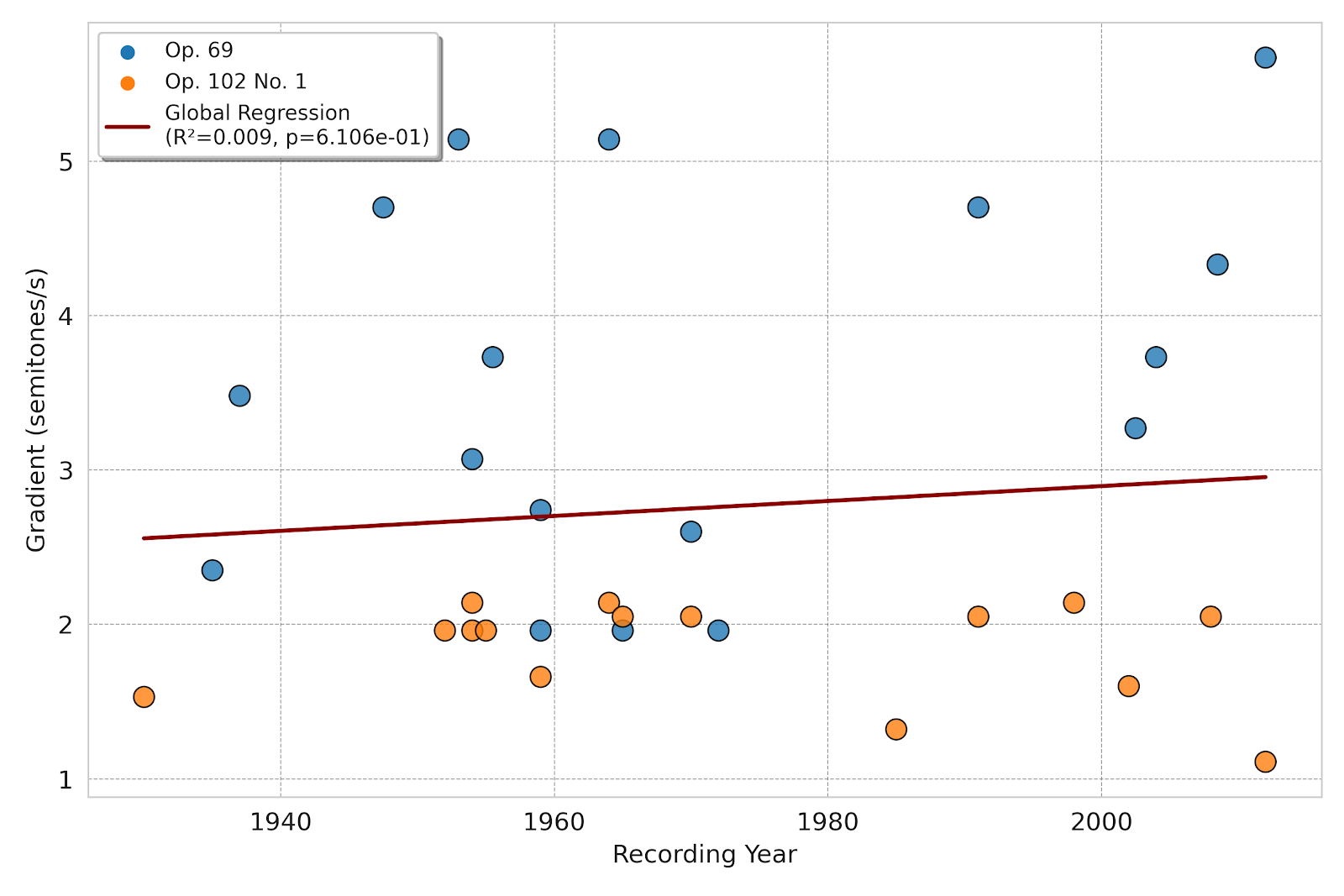
Figure 7: Longitudinal decline of portamento gradient (Hz/s) against recording year for all events in the study, with regression confirming the trend.
This data supports the core claim: portamento's disappearance is preceded by a process of flattening—slides become less audible and less steep before being omitted altogether.
Correlation with Tempo and Expressive Dimensions
The study tests the hypothesis that portamento gradient correlates negatively with tempo. Data show a clear negative regression: slower performances are associated with steeper, longer slides, while higher-tempo performances tend to shallow or omit portamento entirely.
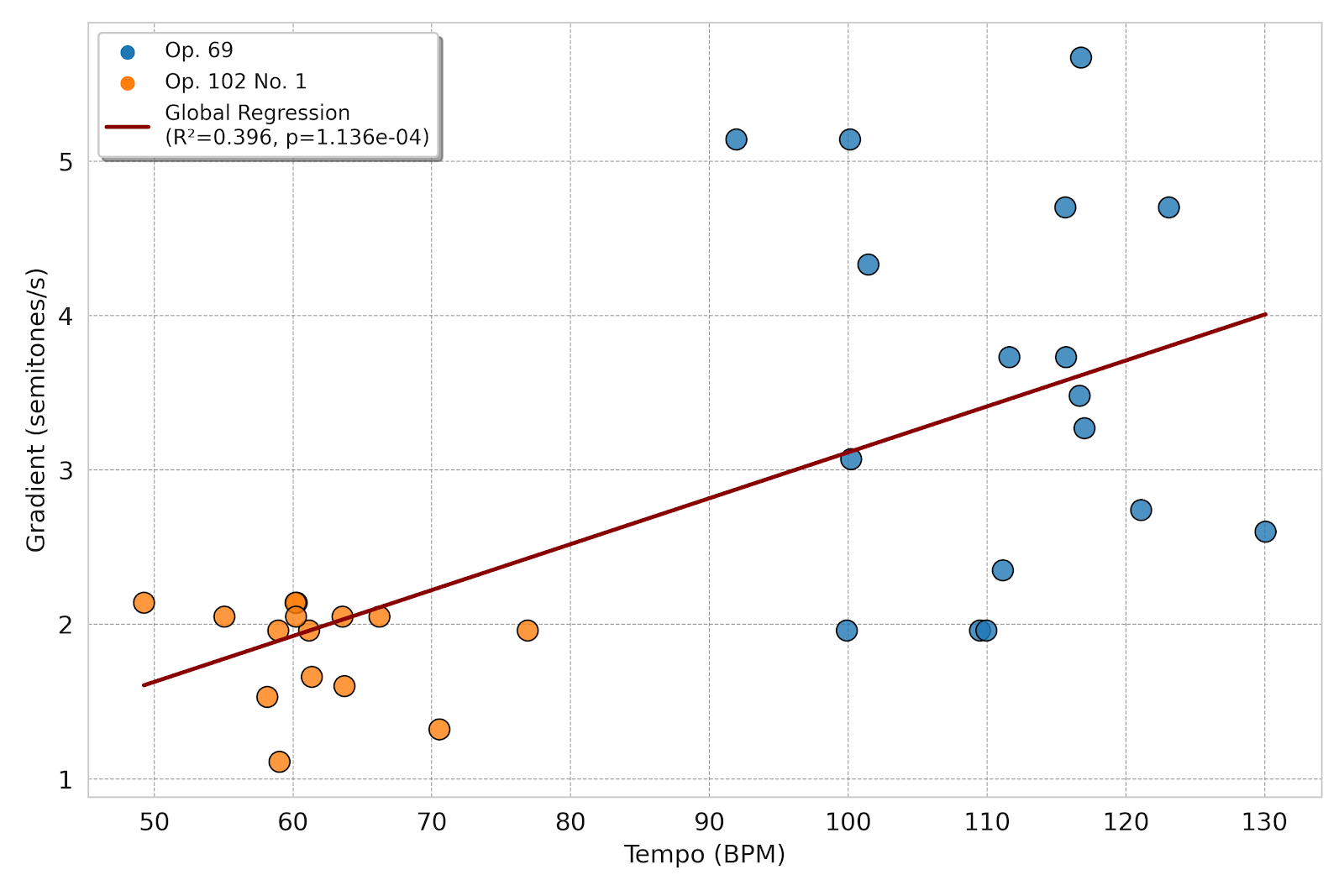
Figure 8: Gradient (Hz/s) vs. mean passage tempo (BPM); the negative correlation confirms that slower tempi facilitate steeper, more expressive slides.
An additional analysis plots portamento duration against gradient to interrogate whether these dimensions reflect the same or independent aspects of expressive intention. The data suggest a nuanced, partially independent relationship, where performers can modulate steepness and duration separately.
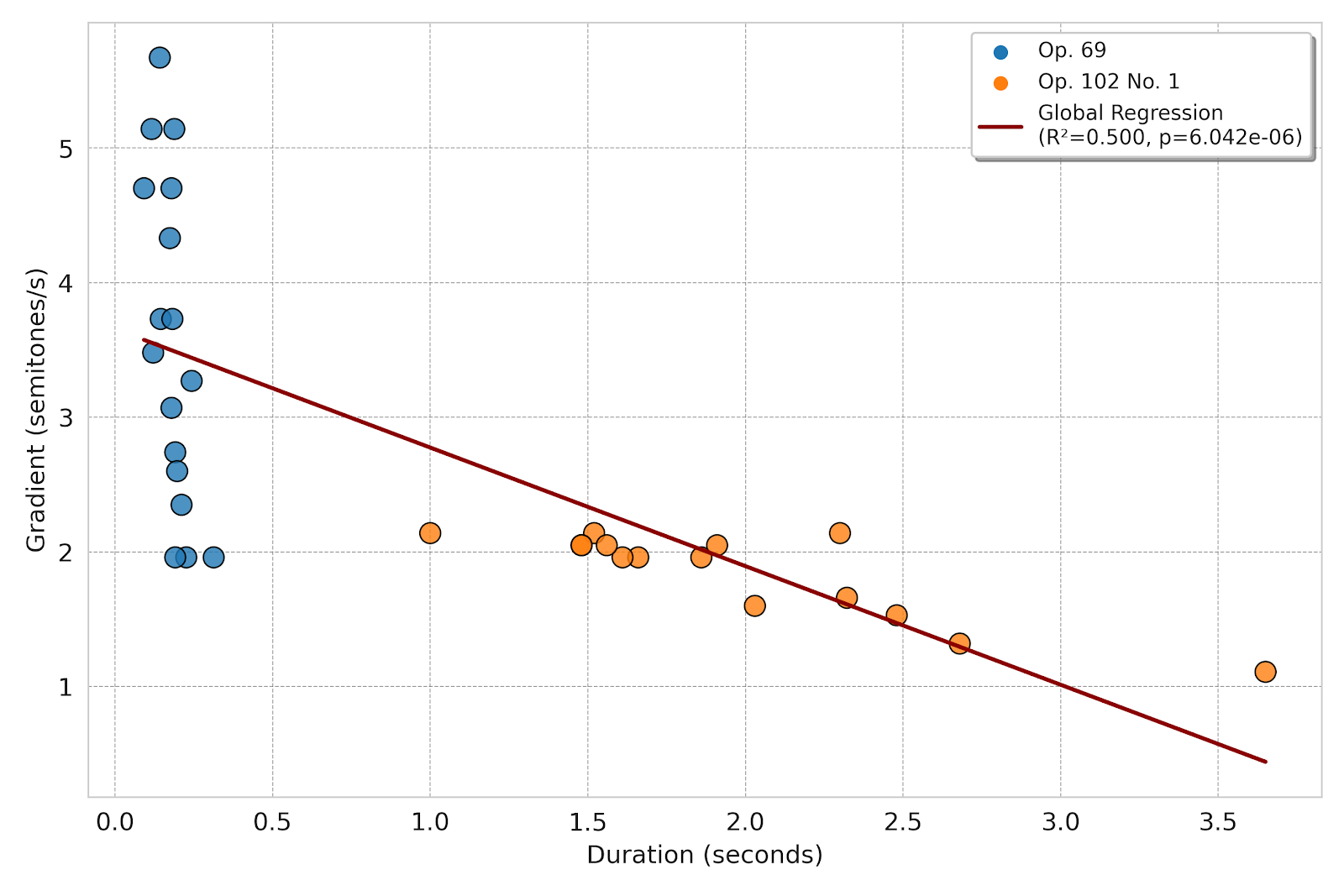
Figure 9: Scatter of portamento duration (s) against gradient (Hz/s) showing varying expressive parameterization.
Spectrographic Categorization of Position Changes
Direct spectrographic comparison demonstrates categorical differences between sliding portamento and clean shifts. Sliding transitions yield clear diagonal traces (high G), while clean shifts show abrupt, essentially vertical jumps (effectively G=0), contravening any notion of a simple continuum.
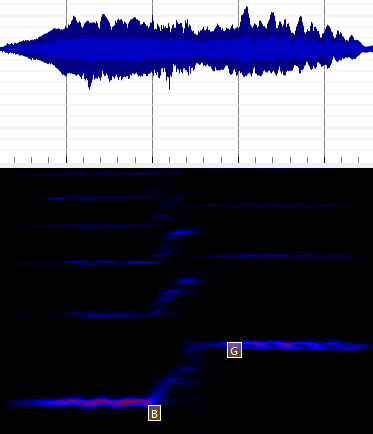
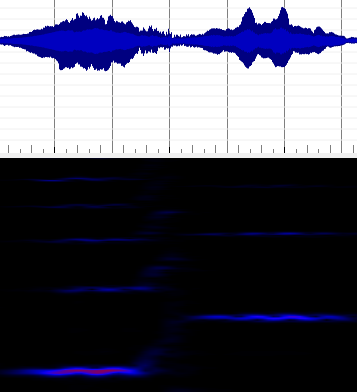
Figure 10: Spectrogram of sliding portamento, illustrating the high-gradient diagonal mutual to earlier performance traditions.
Discussion and Implications
The introduction of the gradient metric provides a direct, physically meaningful quantification of the expressive character of portamento. This enables a re-evaluation of stylistic change: the transition from portamento-rich to portamento-free playing is fundamentally continuous at the expressivity level—portamento becomes less steep and thus less audible—before becoming discrete at the event level.
The negative tempo-gradient relationship further substantiates that the decline is not a function of enforced mechanical constraints at higher speeds, but is linked to evolving performance aesthetics and attitudes towards audible expression. This supports musicological theories that attribute portamento decline to pedagogical trends and recording era pressures, rather than physiological or tempo-driven necessity.
Calibration also enables comparisons with psychoacoustic research on speech and singing, placing cello portamento on a spectrum with vocal glides and suggesting a broader continuity in expressive physicality.
Limitations and Future Work
- Gradient measurements depend on operator judgement in marking trace boundaries, warranting further inter-rater reliability studies.
- Findings rest on two select musical passages; generalization requires broader polyphonic methodological development.
- Calibration protocols must be strictly observed for future cross-dataset compatibility.
Conclusion
This research advances the study of expressive performance practice by providing a physically calibrated, reproducible metric for portamento gradient. Across 22 recordings of Beethoven sonatas, portamento's historical decline emerges not as an on/off switch but as a process of expressive attenuation—flattening gradients presage extinction. The method's quantitative rigor and cross-compatible scale open avenues for future comparative studies, inviting further inquiry into the nuanced mechanics and cultural forces shaping musical expressivity.

