- The paper introduces a corpus of 19.3M biomechanically feasible piano chords generated via exhaustive enumeration and Monte Carlo sampling for larger chord sizes.
- It demonstrates that harmonicity remains invariant to voicing while sensory dissonance is significantly affected by spatial metrics, with negative skewness playing a key role.
- The study offers practical implications for algorithmic music modeling, voice-leading analysis, and revised pedagogical approaches in piano performance.
Large-Scale Corpus Generation of Playable Piano Chords and its Psychoacoustic Implications
Dataset Construction and Methodological Framework
The paper systematically addresses the gap between theoretical chord spaces and instrument-specific, biomechanically viable piano chord spaces through the exhaustive generation of a corpus comprising approximately 19.3 million unique, playable piano chords (2603.29710). The chord search space is explicitly constrained to the 88-key piano range (MIDI 21–108), enforcing a hand span constraint of 1.5 octaves (19 semitones) per hand, with each chord consisting of the union of notes generated by both hands. For chords of size Nnotes=1 to $5$, exhaustive enumeration ensures a complete combinatorial listing, while for Nnotes=6 to $10$, Monte Carlo sampling (1 million instances per cardinality) mitigates computational infeasibility.
Feature extraction for each chord involves two domains: (1) Distributional statistics of pitch (centroid, spread, skewness, kurtosis), residualized to remove variance attributable to pitch class and note count; and (2) psychoacoustic target metrics, specifically Plomp-Levelt sensory dissonance and harmonicity as defined by virtual pitch matching. Crucially, the inclusion of the Interval Class Vector (ICV) ensures control over pitch-class content, allowing robust isolation of effects attributable to the spatial (voicing) arrangement of notes.
Analysis of Intrinsic and Extrinsic Psychoacoustic Properties
Harmonicity: Independence from Voicing Topology
Regression modeling of harmonicity, controlling for pitch-class content (ICV) and note count, reveals that pitch-class content accounts for R2≈0.77 of the variance in harmonicity, and the inclusion of residualized voicing moments yields a negligible increase (ΔR2≈0.00014, p≈0.13). Diagnostic plots confirm no systematic residual structure attributable to voicing (Figure 1).
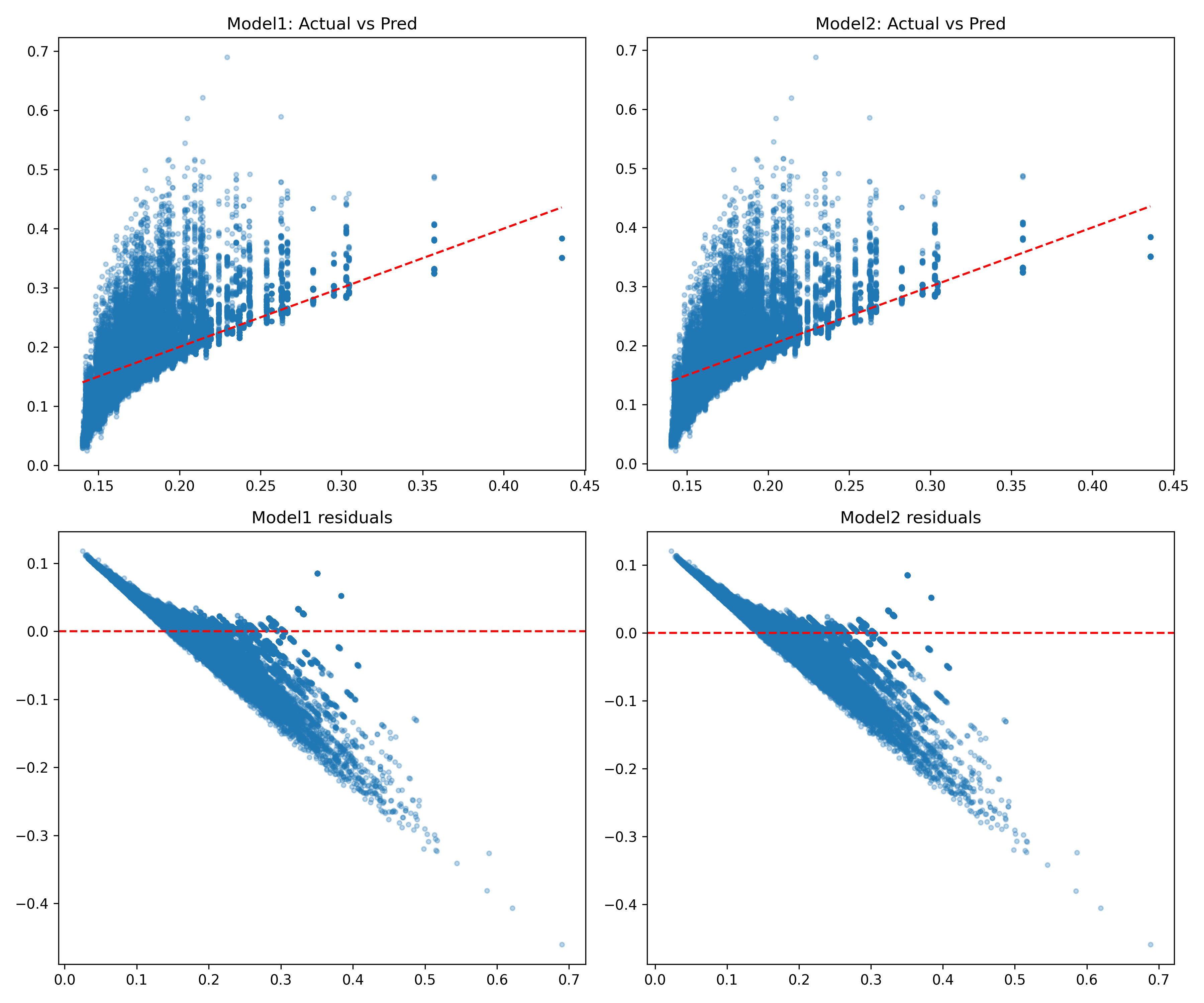
Figure 1: Residuals for harmonicity prediction confirm model adequacy and the absence of added explanatory power by voicing descriptors, indicating that harmonicity is an invariant of the pitch-class content.
These results assert that harmonicity is an intrinsic property of the note set, robust to any permutation of physical realization on the piano. This finding holds impact for symbolic music information retrieval and theoretical harmony analysis, indicating that harmonicity measures need not consider voicing configuration.
Dissonance: Sensitivity to Spatial Voicing
In contrast, regression modeling of Plomp-Levelt dissonance demonstrates that, after accounting for pitch-class content, the addition of voicing moments affords a substantial out-of-sample explained variance increase (ΔR2=6.75%, p≈0.0008; Figure 2):
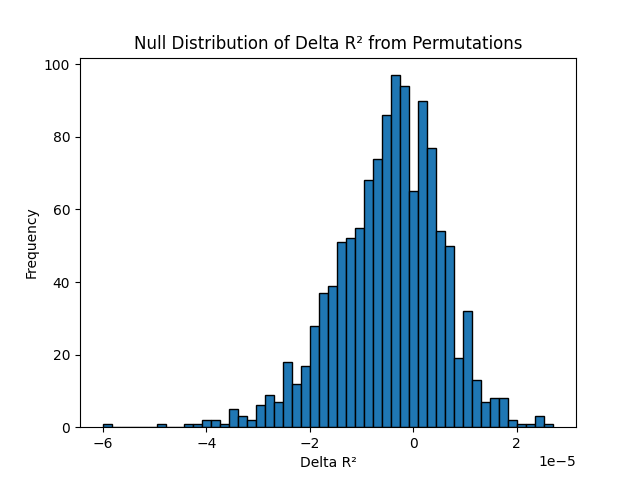
Figure 2: Permutation test demonstrates the statistical significance of voicing shape in predicting sensory dissonance beyond pitch-class content (p≈0.0008).
The out-of-sample $5$0 attains approximately 0.71, reflecting substantial predictive power when spatial metrics are incorporated (Figure 3).
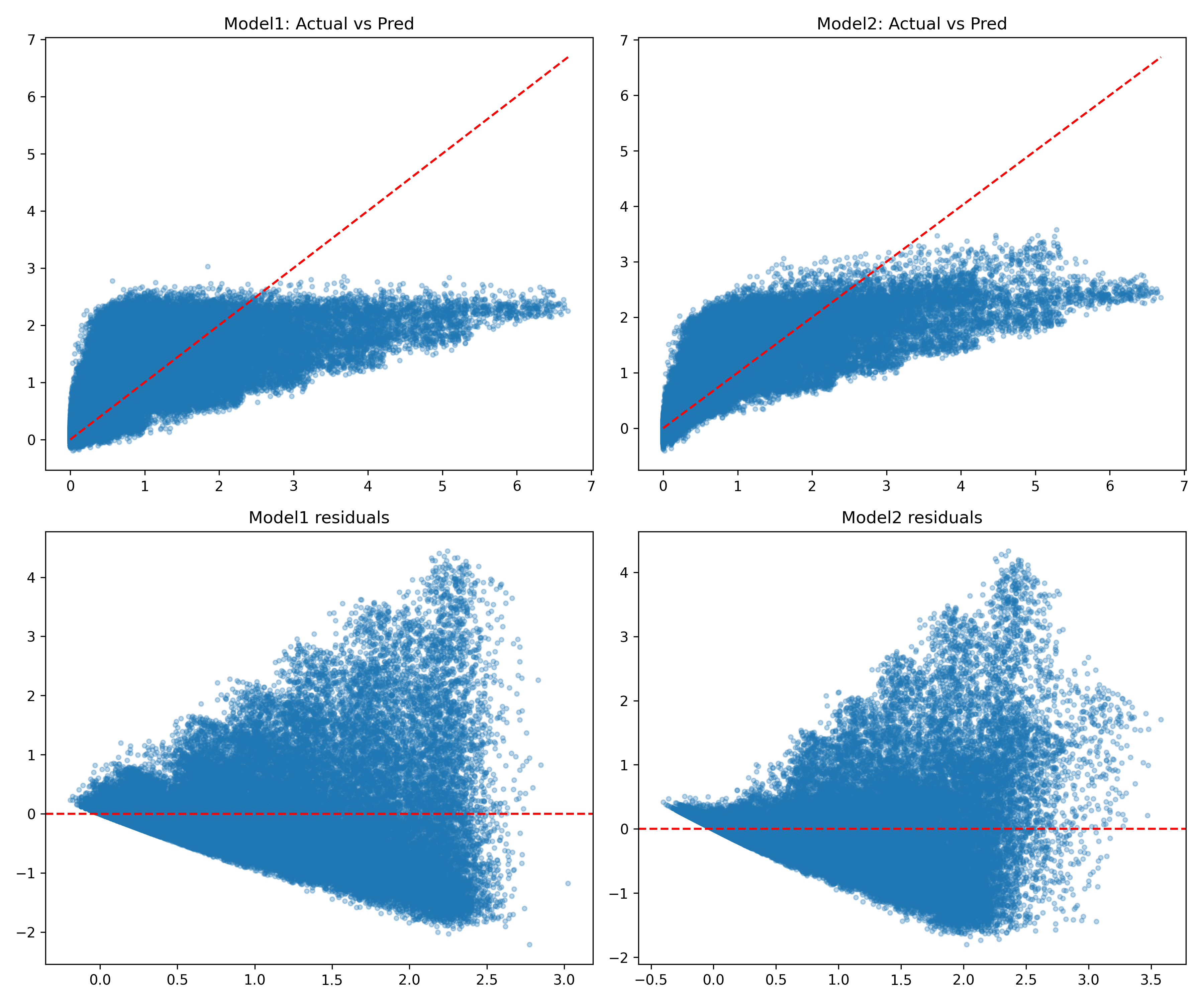
Figure 3: Actual versus predicted dissonance values indicate strong predictive accuracy ($5$1) for models incorporating voicing moments alongside pitch-class controls.
Dissection of Voicing Metrics: Challenging Pedagogical Spread
The analysis rigorously evaluates the relative influence of spread and skewness of a voicing. Standardized regression coefficients indicate that skewness ($5$2) is approximately 5.8 times as predictive of dissonance reduction as spread ($5$3). This quantitatively contravenes the prevailing pedagogical tenet that chord “spread” reduces muddiness. Instead, negative skewness—implying wide bass gaps and clustered upper voices—emerges as the primary determinant of dissonance attenuation.
These results demand a revision of traditional instructions: effective dissonance reduction is achieved not merely by maximizing note-range (“spread”) but by asymmetric allocation, with low-register notes separated widely and treble notes more densely clustered. This finding aligns with psychoacoustic theory regarding the increasing critical bandwidth in low frequencies, but stands as the first empirical quantification of the effect in the context of large-scale enumerated chord realities.
Implications for Computational Modeling and Music Science
The corpus's comprehensive coverage, grounded in instrument biomechanics, directly supports several domains:
- Algorithmic Arrangement and Generative Modeling: The dataset, paired with residualized psychoacoustic quantification, provides a labeled resource for training models that enforce human-physicality constraints and target controllable timbral characteristics. Potential applications include MIDI quantization, style-adaptive pianistic realization, and reward-guided RL for generative music systems.
- Voice-Leading Graph Topology: The exhaustive chord space enables the construction of dense voice-leading graphs. Preliminary exploration indicates strong small-world network properties, suggesting efficient navigability between chords, confirming long-standing hypotheses in piano performance practice.
- Empirical Validation of Pedagogy: Quantification of skewness over spread as a driver of roughness provides a basis for reformulating educational heuristics. Future empirical work with listening studies can further validate these claims.
- Extension to Human Perception and Timbre: Limitations remain due to simplifications such as constant velocity and idealized harmonic spectra, but the corpus provides a scalable substrate for subsequent perceptual and timbral modeling.
Conclusion
This study establishes that the psychoacoustic property of harmonicity is invariant to physical voicing, a result critical for the abstraction of harmonic analysis and algorithm design. In contrast, dissonance is strongly voicing-dependent, with negative skewness serving as a far stronger determinant of psychoacoustic clarity than note-range (“spread”). The methods and corpus facilitate new directions in generative modeling, performative analysis, and cognitive musicology, providing a robust benchmark for the advancement of computational and theoretical music research.

