- The paper introduces an extended parametric model for SIDM halos that incorporates mass accretion effects to delay core collapse.
- The model improves predictions of Vmax and density profiles in cosmological simulations by correcting overestimations seen in the original model.
- Enhanced calibration against matched CDM halos shows the model's potential in addressing small-scale structure issues like the core-cusp problem.
Extended Parametric Modeling of Self-Interacting Dark Matter Halo Evolution
Introduction
The study investigates an improved analytic prescription for the gravothermal evolution of self-interacting dark matter (SIDM) halos, extending prior semi-analytic approaches to better capture the interplay between core formation, collapse, and mass accretion. Classical cold dark matter (CDM) models face persistent discrepancies at the galactic scale, such as the core-cusp, diversity, and too-big-to-fail problems. SIDM, owing to collisional thermalization and gravothermal effects, provides a theoretically motivated resolution via core transformations ranging from isothermal flattening to runaway collapse yielding steep, high-density cusps.
Previous parametric frameworks, notably [yang2024parametric], relate SIDM evolution to matched CDM halo histories via hybrid integral models, primarily tracking the profile-independent parameters Vmax and Rmax and calibrating against isolated N-body SIDM simulations. These models, however, frequently overpredict the onset and degree of core collapse in certain field halos, especially at z=0, due to neglecting the dynamical effects of ongoing mass accretion. The paper proposes an extended model—incorporating mass accretion as a retarding influence on gravothermal evolution—that demonstrably improves quantitative halo profile predictions across cosmological zoom-in simulations.
SIDM and Small-Scale Structure
SIDM models introduce velocity-dependent cross sections to reconcile constraints from observations across mass scales—from high-velocity galaxy clusters (requiring low σ/m) to low-velocity dwarfs (demanding high σ/m), as formalized via differential Rutherford-like scattering parametrizations [nadler2023GROUP, yang2022gravothermal]. In SIDM, heat transport triggered by self-interactions redistributes central energy, forming a core; subsequent gravothermal instability drives core collapse, producing a high-density central cusp potentially steeper than the canonical NFW slope (ρ∝r−1). This pathway, coupled with stochastic accretion histories, naturally accounts for observed halo diversity (core-cusp and rotation curve anomalies, lensing signatures of dense substructure, etc.).
Original Parametric Model
The original parametric approach computes SIDM halo evolution by mapping the time evolution of Vmax and Rmax from matched CDM simulations onto SIDM physics via calibrated integral equations:
Vmax(SIDM)(t)=Vmax(CDM)(tf)+∫tftdt′dVmax(CDM)dt′+∫tfttc(t′)dt′dτ′dVmax(model)(τ′).
The corresponding integral for Rmax follows by analogy. Here, Rmax0 encapsulates gravothermal progression, and Rmax1 is a function of effective cross section, local density, and halo scales. The key limitation is the assumption that gravothermal evolution proceeds unimpeded by external heating: any mass accretion that introduces energy into the outskirts, potentially delaying core collapse, is ignored.
Extended Model: Incorporation of Mass Accretion
The extended model redefines Rmax2 to account for dynamical heating by ongoing accretion, modifying its time derivative:
Rmax3
where Rmax4 is the normalized accretion rate and Rmax5 modulates the accretion-driven suppression of gravothermal evolution. This formulation implies that significant mass accretion bursts (e.g., mergers) or sustained growth episodes can drive Rmax6 back to lower values, effectively delaying or resetting core collapse. The extended model applies this formalism by smoothing the accretion histories (using e.g. interpolated Rmax7 tracks from the Rockstar and Consistent-Trees outputs) and updating Rmax8 incrementally, yielding smoother, physically motivated evolution curves that interact with periods of rapid accretion.
Simulation Setup and Model Calibration
The study leverages matched cosmological zoom-in simulations from the SIDM Concerto suite [Nadler_2025_concerto], comprising both group-scale (Rmax9) and Milky Way–like (z=00) environments. For each field halo, stringent cuts ensure the sample excludes backsplash, highly affected subhalos, and those compromised by outer boundary resolution. For every matched CDM halo, the corresponding SIDM halo is selected based on spatial proximity and accretion history.
Simulations are executed with GADGET-2 [Springel_2005_gadget-2] and utilize velocity-dependent SIDM cross sections (with varying z=01 scale parameters), permitting core collapse in a subset of halos by z=02. The extended model is calibrated by scanning over plausible ranges of z=03 and normalization parameter z=04 (controlling z=05 time scale), and assessed against the simulation via statistics of z=06, z=07, and full density profiles.
z=08 Distributions
The extended model achieves marked reduction in fractional errors of z=09, as indicated by tighter, more symmetric distributions centered nearer zero (Figures 2, 3, 4, 7, and 8). In comparison, the original model exhibits a significant positive tail, systematically overestimating σ/m0 for many halos (particularly those with recent accretion events), suggesting premature and excessive core collapse.
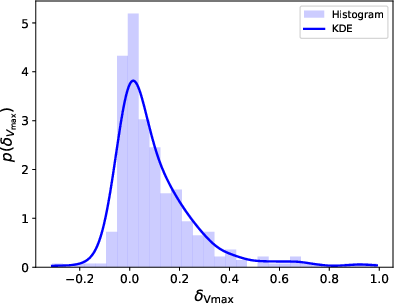
Figure 1: The distribution of fractional offsets in σ/m1 at σ/m2 for the original model, showing a skewed positive tail.
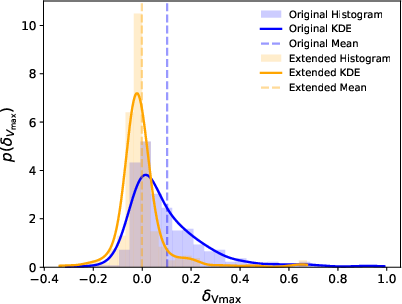
Figure 2: The distribution of fractional offsets in σ/m3 at σ/m4 for the extended model, with strongly reduced skew and tighter peak.
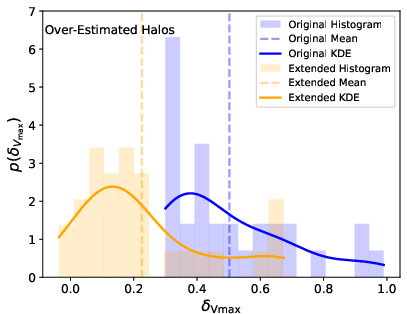
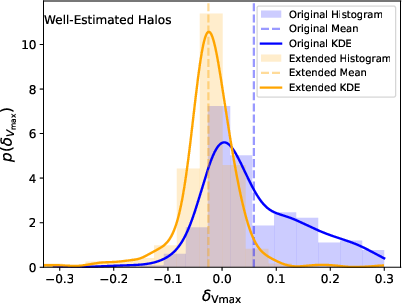
Figure 3: The left panel demonstrates reduction in fractional σ/m5 error for halos overestimated by the original model.
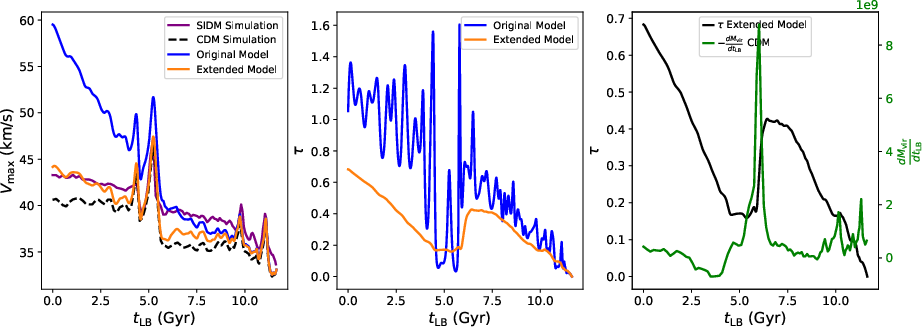
Figure 4: The left panel shows σ/m6 values predicted by both original and extended models versus N-body benchmarks.
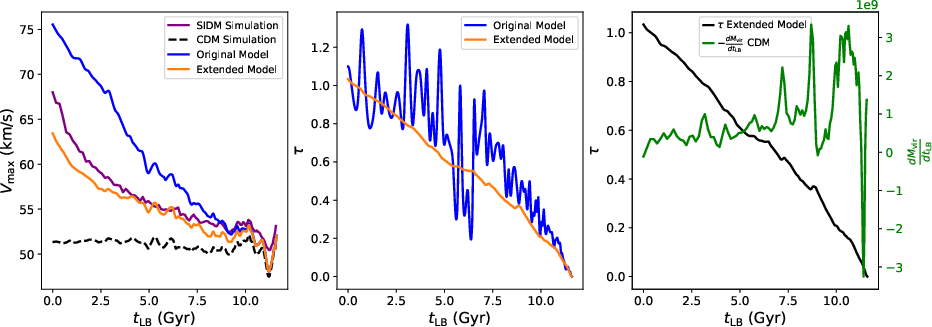
Figure 5: Comparative time evolution and error trajectories of the extended model for steadily accreting halos.
Density Profile Fits
For halos where the original model overpredicts collapse, the density profiles diverge sharply from N-body measurements, often overestimating central density by factors of order >8. The extended model realigns profile predictions, matching both central density and overall shape across radii substantially better Figure 6.
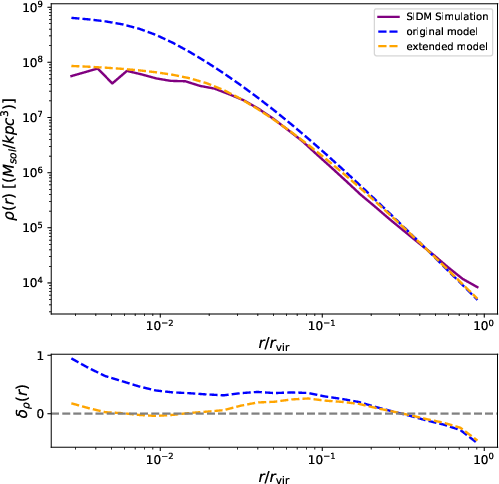
Figure 6: SIDM density profiles for a halo where the original model fails, demonstrating the improved accuracy of the extended model including accretion effects.
σ/m7 and Central Density
While the extended model does not always improve σ/m8 predictions—sometimes overshooting due to delayed core shrinkage—it achieves greater overall accuracy in σ/m9 and central density. Parameter scans (σ/m0, σ/m1) show robust valleys of improved density errors but some dependence on halo accretion history subclass (Figures 5, 12, 10, and related 2D colormaps).
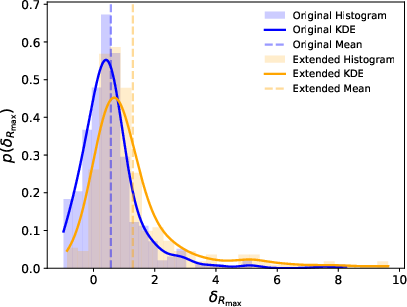
Figure 7: σ/m2 fractional error distribution, showing trade-offs in accuracy for extended model versus original.
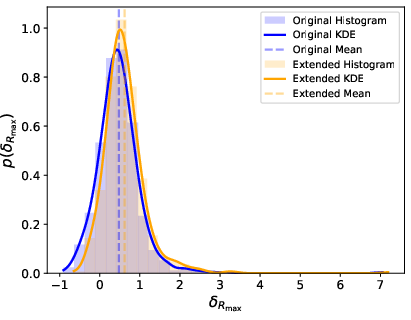
Figure 8: σ/m3 offset distributions in the Milky Way simulation for original and extended models.
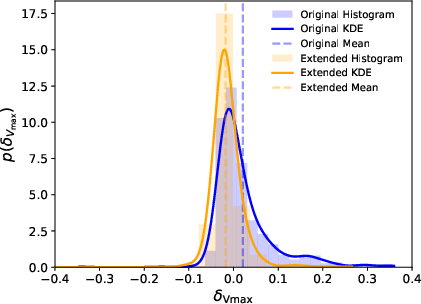
Figure 9: Fractional offset histograms for central density, annotating parameter regions where the extended model outperforms.
Group Versus Milky Way Environment
The optimal σ/m4 values differ between group and Milky Way–like hosts; the extended model shows stronger improvement for group environments with active accretion histories. For Milky Way analogs, improvements are more modest due to less frequent large accretion bursts, but extended model still provides tighter error control and reduces outlier failures.
Implications and Future Directions
The analytic extension acknowledges that halo evolution is strongly non-monotonic in realistic cosmological settings and hinges on the competition between gravothermal collapse and external heating. By dynamically retarding core collapse during mass accretion, the model attains greater predictive fidelity, especially for field halos subject to recent mergers or steady growth. This refinement is critical for interpreting SIDM-induced small-scale structure phenomena, the diversity of rotation curves, and the origin of extreme central densities required by lensing and stellar stream observations.
Practical applications include more reliable semi-analytic population synthesis of SIDM halos, improved comparison to observational constraints, and new understanding of SIDM footprint in satellite dynamics, lensing substructure, and stream perturbations. The framework is extensible: future work should incorporate explicit merger-induced profile changes and calibrate σ/m5, σ/m6 per halo accretion sub-class, possibly incorporating machine learning to map the parameter space.
Conclusion
The extended parametric model introduces a minimal, physically motivated modification—mass accretion–driven retardation of gravothermal evolution—which substantially improves predictions for SIDM halo profiles. By dynamically coupling accretion rates to the evolution of σ/m7, it corrects failures of prior integral-based models and provides a more robust analytic tool for mapping SIDM effects in cosmological structure formation. Continued refinement, numerical calibration, and merger-aware extensions are anticipated to further augment the utility of this model in SIDM phenomenology and astrophysical inference.