- The paper presents a comprehensive 3D twisted Kitaev model for CoNb2O6 that incorporates bond-dependent Ising interactions and anisotropic g-tensors to explain complex field-induced phases.
- It employs semiclassical minimization and linear spin-wave theory to map ordered phases and quantify phase transitions under varying field strengths and orientations.
- The study reveals extreme sensitivity to field misalignment and emphasizes the necessity of quantum methods to capture fluctuation-stabilized incommensurate and spin-flip phases.
Field-Induced Phases in the Twisted Kitaev Model for CoNb2O6: Frustration and Spin-Orbit Coupling
Introduction and Model Foundation
The investigation of CoNb2O6 as a realization of low-dimensional quantum magnetism has evolved from its initial description as an ensemble of transverse-field Ising chains to a more intricate framework incorporating bond-dependent interactions reminiscent of Kitaev physics due to significant spin-orbit coupling and low crystallographic symmetry. Recent structural and spectroscopic data necessitate consideration of twisted Kitaev chains, with bond-dependent Ising couplings and frustration arising not only within chains but crucially among them. The paper constructs a comprehensive three-dimensional model that includes these twisted Kitaev interactions, anisotropic g-tensors, and both isotropic and anisotropic frustrated inter-chain couplings derived from DFT and phenomenological fits.
The crystal structure features two inequivalent zigzag Co2+ chains per unit cell, with inter-chain couplings forming isosceles triangular lattices. Each chain alternates between two local Ising axes set by the crystalline environment, parameterizable with two angles, and the resultant single-chain Hamiltonian can be written as a generalized Kitaev Hamiltonian with significant frustration.
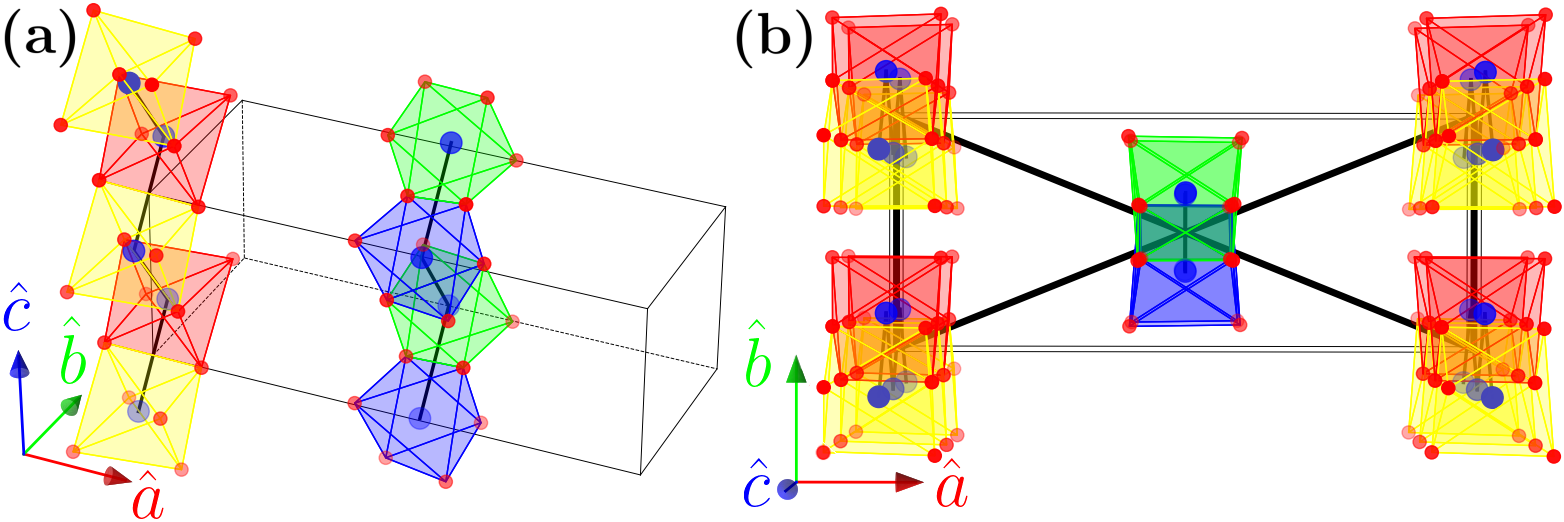
Figure 1: Crystal structure of CoNb2O6. Co2+ ions form quasi-1D zigzag chains along c, arranged into isosceles triangles in the 60 plane.
Microscopic Hamiltonian and Interactions
The effective low-energy Hamiltonian comprises the following:
- Intrachain Hamiltonian: Dominated by bond-dependent Ising (Kitaev-type) terms, supplemented by further neighbor interactions, 61 and 62 couplings, and single-ion anisotropies, with parameters supported by DFT (Konieczna et al., Table I) and experimental fits.
- Inter-chain Interactions: The chain arrangement leads to both antiferromagnetic and geometrically frustrated triangular couplings with tunable relative strengths parameterized by 63, essential for stabilizing commensurate and incommensurate orders.
- Anisotropic 64-tensor: The 65-tensor, fixed by crystal symmetries, introduces pronounced anisotropy in Zeeman response; a principal axis aligns with the chain easy axis, with robust 66-axis transverse-field behavior.
- Spin-Orbit and Symmetry Breaking: All continuous spin symmetries are broken; only discrete symmetries remain, making the system highly sensitive to both field strength and orientation.

Figure 2: Schematic of a single twisted Kitaev chain. Two alternating Ising axes (magenta) define the local easy axes for each bond, as determined by crystal symmetry.
Semiclassical Analysis of Field-Driven Phases
Given the frustration and dimensionality, quantum Monte Carlo methods are inapplicable; instead, the zero-temperature phase diagram is charted using classical minimization on large supercells, followed by LSWT for excitation spectra. Energetics and observable predictions are computed for various field directions and strengths, incorporating corrections for the overestimation of quantum criticality in semiclassical treatments via a transverse field rescaling.
Phase competition is particularly acute around the transverse field direction (67), where quantum and thermal fluctuations are maximized. The semiclassical approach captures symmetry-broken states, order parameters, and magnon spectra, but predictably underestimates fluctuation-stabilized regions, especially the width of incommensurate (INC) phases.
Ordered Phases and Magnetic Phase Diagrams
A salient outcome is the richness of the field-induced phase structure, caused by the interplay of geometric frustration, Kitaev anisotropy, and field orientation. The main ordered phases include:
- Antiferromagnetic (AF): Unit cell doubling along 68 with inter-chain AF order.
- Incommensurate (INC): Characterized by a soliton lattice and dense Bragg peaks along 69; stabilized near 20 and for sufficiently strong frustration.
- Spin-Flip (SF1, SF2, SF3): Ferrimagnetic patterns with 21 magnetic periodicities, respectively, arising from commensurate lock-in to the frustrated lattice.
- Paramagnetic (P): Field-polarized phase at high fields.
Phase boundaries and sequences depend acutely on the strengths of inter-chain couplings (22, 23) and field orientation; small variations can qualitatively alter phase topology and transitions—some transitions (notably INC-P) are continuous for ideal transverse alignment but become first-order upon minimal field tilting.
Static Observables and Dynamical Excitations
Longitudinal and transverse magnetization tracks complex phase transitions across the diagram. For generic field orientation, both components are nonzero due to fully broken continuous symmetries; the transverse magnetization is highly sensitive to field angle, providing a diagnostic for phase changes. Magnetization curves show strong first-order signatures except for the continuous INC-P transition at 24.
The LSWT magnon excitation spectra distinguish ordered phases:
- Gapped branches dominate in commensurate phases, with bandwidths set by intra-chain exchange and further splitting by inter-chain coupling.
- Gapless phason modes emerge in INC due to collective sliding, contributing high intensity at the incommensurate ordering wavevector.
- Dispersions are anisotropic, with largest bandwidths along the chain direction (25).
Numerical Results and Experimental Comparison
The computed transition fields for high-symmetry directions align semi-quantitatively with neutron scattering and bulk measurements when using parameter sets with antiferromagnetic interchain coupling and moderate frustration. However, the semiclassical theory underestimates INC and SF3 stability ranges, which are observed experimentally to be robust over temperature and field.
A strong result is the extreme sensitivity of the phase diagram to field misalignment: tilts of less than 26 modify phase orderings and boundaries, and can render continuous transitions first order. This effect agrees with glassy freezing and hysteretic phenomena seen in calorimetry and susceptibility near the INC region. Macroscopic freezing is associated with large energy barriers for chain reversal due to the hard macro-spin nature of the ordered state.
Implications and Perspectives
The model highlights that even modest spin-orbit-driven anisotropy, combined with inter-chain frustration, yields a magnetic phase diagram of remarkable complexity in a chemically simple material. Theoretical implications include:
- Necessity of fully anisotropic models: Idealized Ising or Heisenberg models fail to capture the full spectrum of observed phases and transitions; bond-dependent and further-neighbor couplings are essential.
- Quantum fluctuation stabilization: The empirical width of the INC phase exceeding semiclassical predictions suggests crucial roles for quantum and thermal fluctuations, motivating methods beyond LSWT, potentially leveraging DMRG or tensor network techniques for quasi-1D arrays.
- Strong field-angle dependence: Precision field alignment and angular resolved probes are necessary for phase identification and quantum criticality studies.
Practically, the findings suggest that uniaxial pressure (tuning 27 and 28) or field rotation can be used to drive the system through rich sequences of phases, with implications for quantum magnetic memory applications, field-tunable frustration, and realization of exotic criticality in solid state systems.
Conclusion
The comprehensive semiclassical modeling of CoNb29O60's twisted Kitaev chains under vector magnetic fields illuminates the decisive roles of spin-orbit coupling, magnetocrystalline anisotropy, and geometric frustration in dictating quantum magnetic phases. While many features of the experimental phase diagram are reproduced, pronounced discrepancies in fluctuation-driven regime widths underscore the need for full quantum treatments. The study establishes a detailed structural and theoretical foundation for future theoretical and experimental advances in anisotropic and frustrated quantum magnets.

