- The paper presents a multi-objective game framework that models quantum circuit design as a four-player potential game balancing trainability, non-stabilizerness, task fidelity, and hardware cost.
- It employs a block-coordinate ε-Nash residual to rigorously certify convergence to Pareto-efficient equilibria through a combination of simulated annealing and gradient descent.
- Demonstrated on MaxCut, TFIM, and LiH problems, the approach shows promising scalability and hardware-aware trade-offs for future quantum circuit optimization.
Four-Player Potential Game Framework for Quantum Circuit Design Under Barren Plateau Constraints
Framework Overview
The paper formulates parameterized quantum circuit (PQC) architecture search as a multi-objective potential game, presenting a four-player structure in which each "player" governs a distinct axis of quantum circuit design: trainability, non-stabilizerness, task fidelity (performance), and hardware cost. The PQC is modeled as a directed acyclic graph (DAG) whose nodes encode gate types and parameters, allowing structural moves—append, remove, retype, and rewire—partitioned as exclusive action sets for each player. This factorization is the central novelty: it provides each figure of merit with an independent trajectory in the combinatorial landscape of circuit structures.
A key aspect of the framework is the use of a block-coordinate ε-Nash residual, δNash, providing a rigorous stopping certificate: a circuit has reached an ε-Nash equilibrium if no player can improve its objective by more than ε via a unilateral structural move. The potential Φ combines the four objectives in a weighted sum, but unlike conventional scalarization, the per-player move separation ensures no objective can be neglected. The combinatorial search is implemented as an outer simulated-annealing loop over discrete circuit modifications, with an inner loop of gradient descent on continuous circuit parameters.
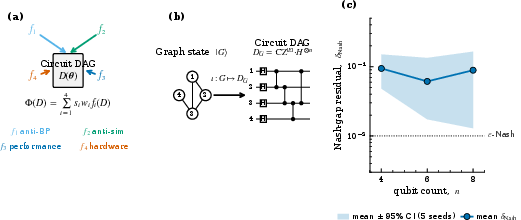
Figure 1: A schematic representation of the four-player potential game, in which each player acts on a distinct subset of structural moves in the shared PQC DAG; an outer simulated-annealing loop alternates with inner parameter optimization.
Pareto Frontier Navigation on MaxCut
The utility of the framework is highlighted with the MaxCut problem on K4 (n=4) as a test case, demonstrating explicit navigation of the fundamental trade-off between barren-plateau-induced trainability and the non-stabilizerness required for quantum advantage. By sweeping weights (w1,w2) corresponding to trainability and non-stabilizerness, Nash equilibria trace out a Pareto frontier: endpoints correspond to a Clifford (classically simulable, maximally trainable) regime and a non-Clifford (quantum-advantaged, minimally trainable) regime. An interior "Pareto-knee" circuit achieves 98.5% of the maximum cut while moving significantly away from the stabilizer regime, unattainable by single-axis optimization.
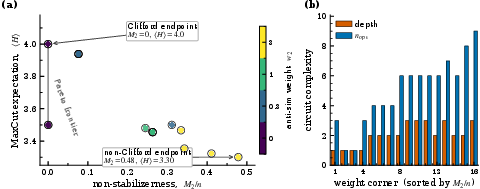
Figure 2: Pareto frontier on K4 MaxCut, displaying Nash equilibria spanning the range from Clifford (trainable, simulable) to non-Clifford (hard, quantum) circuits as the per-objective weights are swept.
This result directly operationalizes the Cerezo--Larocca tension: known methods tend to optimize for either classical simulability (trainability) or quantum hardness (expressivity), but not both. The proposed potential game achieves balanced solutions via explicit coordination among competing objectives.
Comparative Analysis with Simulated-Annealing Baseline
Head-to-head benchmarking on three four-qubit hardware topologies (IBM heavy-hex, δNash0 grid, Rydberg all-to-all) compares Nash search with a single-objective simulated-annealing baseline. Nash search attains the highest mean potential δNash1 on every topology, with observed mean deltas of δNash2 (heavy-hex), δNash3 (δNash4 grid), and δNash5 (Rydberg). However, in five-seed tests for each condition, paired Wilcoxon tests do not reject the null hypothesis of no difference on any individual topology (δNash6), indicating that while Nash tends to perform better, further sampling is needed for conclusive statistical claims.
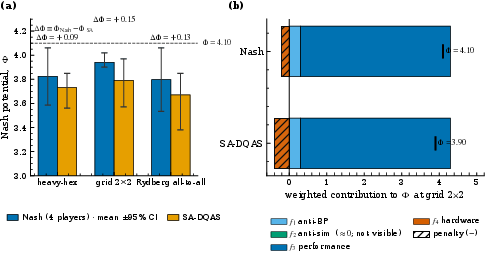
Figure 3: Mean scalar potential δNash7 achieved by Nash and the simulated-annealing baseline on three hardware topologies, with error bars indicating 95% bootstrap confidence intervals; Nash achieves higher means on all topologies, although without statistical significance at current sample sizes.
Nash solutions also demonstrate improved ceiling-hitting frequency (reaching theoretical maxima) versus baseline. The results underscore the advantages of per-objective move restriction and Nash certification, but also highlight the need for larger-scale studies to fully resolve per-topology distinctions.
Scaling Behavior and Chemistry Applications
The framework's scaling properties are examined on the transverse-field Ising model (TFIM) for δNash8 qubits. Warm-started runs using QAOA δNash9 achieve ground-state energy errors ε0 at ε1, while cold starts plateau at substantially higher errors. Per-iteration wall-clock time grows linearly with ε2, at approximately ε3/qubit, indicating feasible resource scaling for moderate system sizes.
A notable aspect is the behavior of ε4 at convergence; for larger ε5, its distribution becomes bimodal across seeds, reflecting the local exhaustion of improvement opportunities for some runs under the current move set. The median residual tightens monotonically with ε6, consistent with the growth in equivalence of Nash candidates.
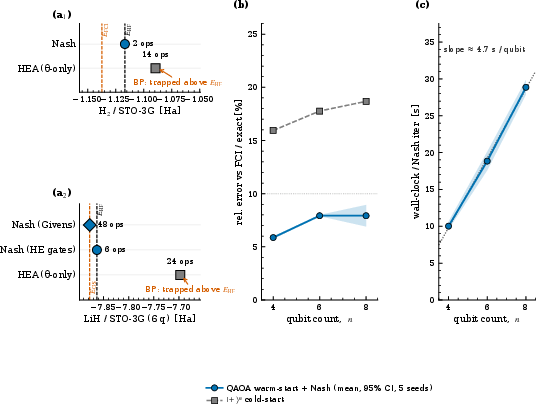
Figure 4: (a) Scaling of ground-state energy error versus qubit number for warm- and cold-started Nash; (b) per-iteration convergence of error; (c) linear scaling of per-iteration wall-clock time, with a plot of Nash residuals at final iteration.
For quantum chemistry, the method is validated on Hε7 as a sanity check (recovering the exact ground state post-symmetry reduction), and then deployed on LiH. Naive hardware-efficient ansatz (HEA) is trapped at high energies, illustrating barren plateau failure. By seeding Nash with a chemistry-aware Givens-doubles ansatz (58 gates), the circuit is refined down to 48 gates with 97.7% recovery of the correlation energy—a cost of 2.3% in energy for a considerable gate reduction, plus controlled increases in non-stabilizerness and trainability.
Importantly, these results are not claims of outperformance on energy alone: ADAPT-VQE and specialized UCC truncations achieve lower gate counts at target accuracy. Rather, the contribution is joint optimization along all four axes, providing circuits that are Pareto-efficient with respect to structure and hardware metrics, not simply energy.
Theoretical and Practical Implications
The formalization of quantum ansatz design as a restricted-action potential game directly captures the critical multi-objective tensions underlying VQA scalability, particularly the barren plateau/simulability trade-off. The certification of local Nash equilibria using per-player move sets generalizes beyond single-objective heuristics and provides a meaningful notion of optimality balancing all relevant axes.
Practically, the method provides a flexible and hardware-agnostic optimization framework. Different hardware topologies enter only as constraints on allowed structural moves, positioning the framework for direct application to emerging quantum architectures.
As quantum circuits scale to larger ε8, open questions remain regarding the persistence and tractability of the Pareto frontier, the resolution of local minima in large combinatorial spaces, and the role of more expressive gate sets. Incorporation of problem structure, as in chemistry-aware seeding and particle-number-conserving gates, is shown to be critical for achieving high physical fidelity.
Future work will need to extend frontier-mapping tests to higher ε9, increase the statistical power of comparative analyses, and introduce first-class quantum-native primitives to close remaining accuracy gaps. The DAG formalism naturally enables unification of ansatz design, error-correcting code synthesis, and compilation algorithms, suggesting broad applicability of the approach.
Conclusion
This work introduces a formal potential-game framework for multi-objective quantum circuit architecture search, enabling explicit equilibrium-driven navigation of fundamental trade-offs such as barren plateaus versus circuit expressivity. The four-player structure, DAG encoding, Nash certification, and simulated-annealing optimizer collectively provide a principled approach for PQC design across diverse tasks and hardware topologies. Benchmarks on MaxCut, TFIM, and LiH confirm practical feasibility and highlight new circuit-local trade-offs invisible to single-objective approaches. The implications for scalable VQA deployment are substantial, with future developments expected in deeper joint optimization, hardware integration, and quantum chemistry applications.