- The paper introduces a game-theoretic formulation to allocate quantum error budgets, resulting in Pareto-optimal Nash equilibria.
- It employs an iterated best response algorithm with Brent’s method to achieve up to 97.81% reduction in resource usage.
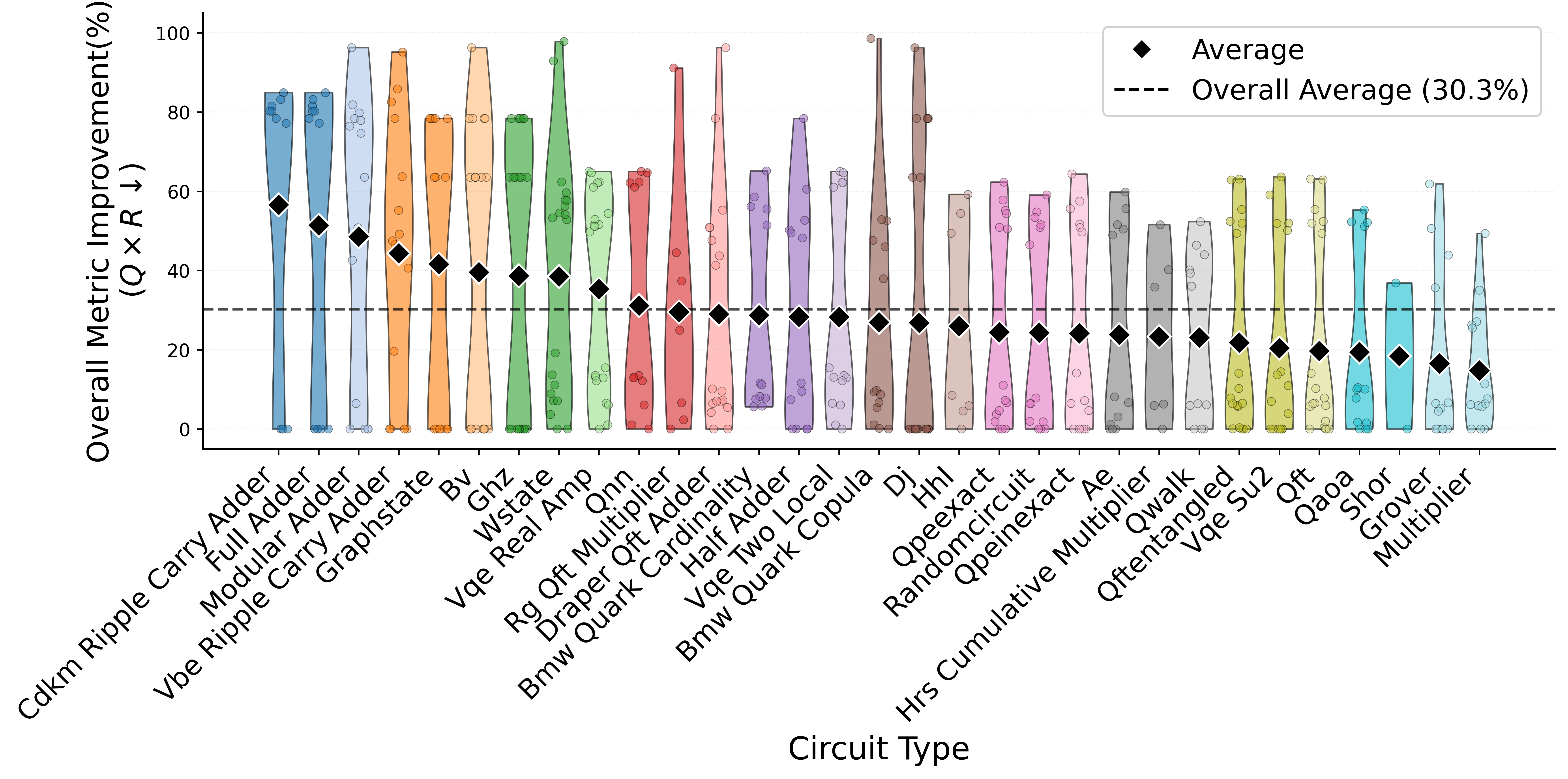
- Empirical results on 433 circuits demonstrate significant reductions in space-time volume compared to uniform and ML-based methods.
Game-Theoretic Optimization of Quantum Error Budget Allocation
Overview
This paper introduces a game-theoretic framework addressing error budget distribution within fault-tolerant quantum computing compilation pipelines. The authors identify limitations with prevailing uniform and supervised machine learning approaches, specifically concerning optimization optimality, generalization, and convergence guarantees. They propose an exact potential game formulation in which logical error correction, T-state distillation, and rotation synthesis act as players sharing a global error budget. The allocation problem is solved through an iterated best response (IBR) algorithm, yielding a Pareto-optimal Nash equilibrium. Empirical results across a large suite of quantum benchmarks establish substantial and heterogeneous improvements in physical resource requirements.
Motivation and Limitations of Existing Approaches
Fault-tolerant quantum compilation necessitates partitioning a total allowed error rate among key subcomponents: logical gate operations, T-state distillation (for magic state synthesis), and rotation synthesis steps. Prevailing methods allocate this “error budget” uniformly or apply supervised learning from labeled circuit datasets. The authors critique such methods on several fronts:
- Uniform allocation ignores circuit-specific sensitivities and bottlenecks, often producing suboptimal resource use.
- Supervised learning approaches [forster2025improving] attain improvements but require expensive data curation, lack explainability, and offer no deterministic convergence guarantees. Their efficacy degrades for out-of-distribution circuits.
- Optimization transparency and guarantee of Pareto optimality are absent from learning-based schemes.
The error allocation challenge is cast as a three-player common-interest game:
- Players: Logical error correction (L), T-state distillation (T), rotation synthesis (R).
- Strategies: Each player chooses a share si of the overall error budget, constrained to a simplex reflecting valid allocations.
- Cost Function: C(s)=Q(s)wR(s)1−w, where Q and R denote physical qubits and runtime, and w∈(0,1) weights their importance.
- Resource Oracle: Maps error allocations to underlying hardware metrics.
- Potential Game Property: The game is exact-potential; Nash equilibria coincide with global minimizers of the shared cost, thus always Pareto-optimal [monderer1996potential].
A monotonic iterated best response (IBR) procedure is employed. At each step, a player optimizes its allocation assuming other players’ splits fixed in relative ratio. Brent’s method efficiently solves the resulting one-dimensional optimization. Multiple random restarts with Dirichlet-initialized allocations mitigate local minima.
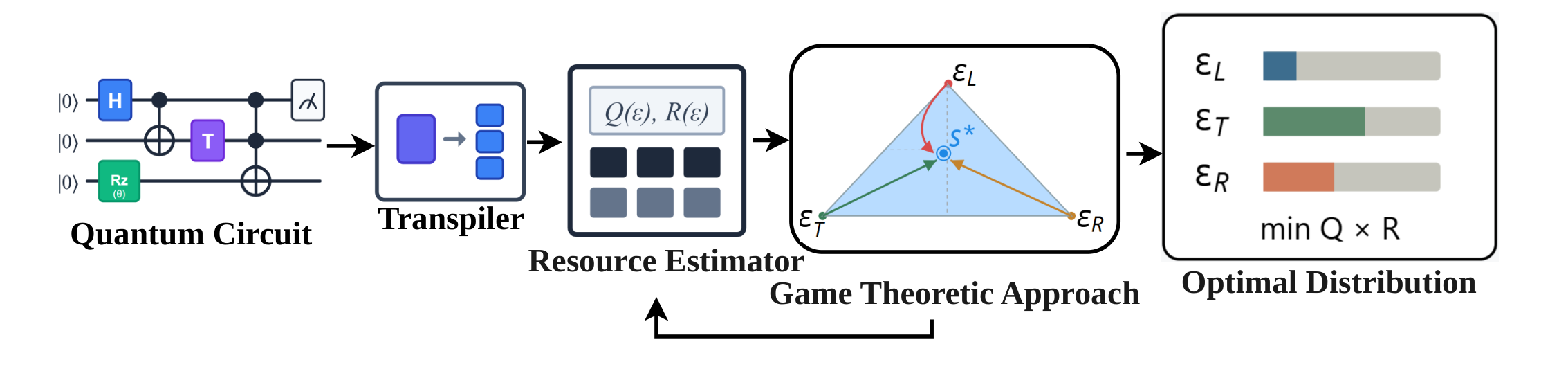
Figure 1: System architecture for resource optimization.
Experimental Evaluation and Results
The framework was evaluated on 433 diverse circuits from 31 families (MQT Bench), comprising algorithmic and arithmetic primitives, with a standardized compilation and error modeling pipeline via Qiskit and Azure Quantum Resource Estimator.
The main empirical findings are as follows:
The algorithm’s robustness is underscored by its ability to adapt to outlier circuits where uniform splitting would otherwise result in catastrophic resource wastage.
Practical and Theoretical Implications
The game-theoretic approach:
- Eliminates the need for supervised training and labeled data, thus lowering barrier to deployment in novel settings and new quantum technologies.
- Guarantees monotonic cost descent and convergence to Pareto-efficient configurations, a property absent from black-box data-driven methods.
- Provides a transparent, extensible analytical foundation, enabling direct incorporation of further physical constraints and additional players (e.g., for nascent error sources or alternate subprotocols).
- Offers a principled strategy for compiler-level resource co-design, suggesting applicability beyond error allocation—such as scheduling, mapping, or cross-layer optimization in fault-tolerant stacks.
Conclusion
This work advances quantum compilation methodology by harnessing game-theoretic optimization for error budget distribution. The proposed potential game formulation and IBR approach lead to significant and circuit-adaptive reductions in physical resource requirements. Extending the number of players, considering dynamic hardware characteristics, and integrating these insights into holistic fault-tolerant toolchains constitute natural directions for subsequent research in quantum systems and automated design.