- The paper establishes a regular black hole metric embedded in a Dehnen-type halo, using a radial pressure condition to ensure nonsingularity and finite mass.
- Analyzing timelike geodesics, the study shows that increasing the halo scale parameter a contracts the ISCO and reduces angular momentum, impacting accretion dynamics.
- Simulating thin disk radiation with the Page–Thorne model, the research demonstrates enhanced Doppler asymmetry and flux variations that are testable through EHT observations.
Radiation Properties and Imaging of Regular Black Holes in Dehnen-Type Dark Matter Halos
The paper develops a static, spherically symmetric regular black hole solution motivated by the Dehnen-type dark matter density profile, characterized by the scale parameter a governing the halo's spatial extension. The construction follows the Einstein field equations with the radial pressure condition Pr=−ρ and Dehnen's profile parameters set to ensure regularity and finite mass. The metric function f(r) is derived to yield a nonsingular geometry, and the resulting spacetime is analyzed for null geodesics to obtain the shadow radius and critical impact parameter.
Crucially, the paper utilizes Event Horizon Telescope (EHT) observational data for Sgr A* and M87* to place quantitative constraints on a at both 1σ and 2σ confidence levels. The constraints demonstrate clear differences between the two black hole systems, with Sgr A* allowing a broader parameter range. The shadow diameter for the Dehnen regular black hole diverges from that of the Schwarzschild solution, enabling a discriminating probe for halo-embedded regularity.
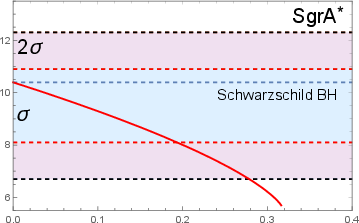
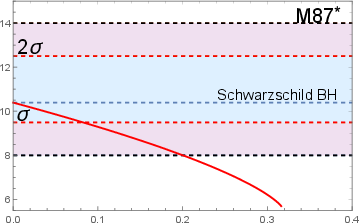
Figure 1: Constraints on the scale parameter a from Sgr A
(left) and M87* (right) EHT shadow diameter observations, superposed against Schwarzschild expectations and
1σ/2σ allowed bands.*
Circular Orbit Structure and Timelike Geodesics
The next focus is the analysis of timelike geodesic structure—specifically, the ISCO radius, orbital energy, angular momentum, and angular velocity—showing how these quantities are systematically modulated by the metric parameter a. As a increases, the ISCO contracts towards the horizon, Pr=−ρ0 rises, Pr=−ρ1 diminishes slightly, and Pr=−ρ2 drops rapidly. These results affirm a direct geometric influence of halo embedding, altering strong-field orbital dynamics and suggesting observable imprints in accretion disk physics.
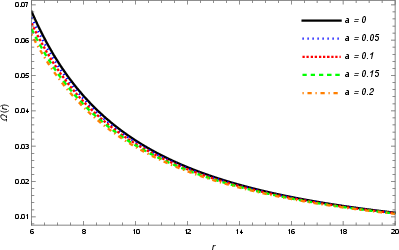
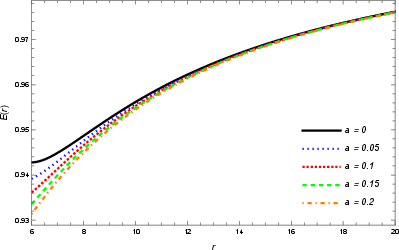
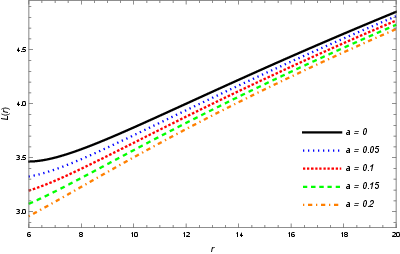
Figure 2: Variation of circular orbit parameters (Pr=−ρ3, Pr=−ρ4, Pr=−ρ5) as functions of radius Pr=−ρ6 for multiple values of the halo parameter Pr=−ρ7, illustrating the contraction and dynamical shifts for increasing Pr=−ρ8 with fixed mass Pr=−ρ9.
Thin Accretion Disk Radiation: Redshift and Flux Imaging
The paper implements the Page–Thorne model for thin accretion disks, incorporating the relativistic formula for local flux, gravitational and Doppler redshift, and the distant observer’s radiative flux f(r)0. The analysis includes backward ray-tracing to simulate emission and imaging properties, distinguishing direct and secondary images formed by photon trajectories. The study reveals that increased f(r)1 enlarges the effective radiation area due to reduced ISCO radius, and that it significantly amplifies left-right asymmetry and Doppler boosting in observed flux and redshift distributions at high viewing angles.
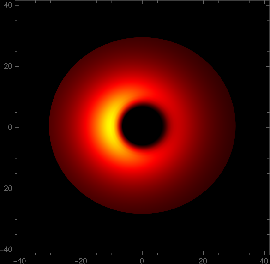

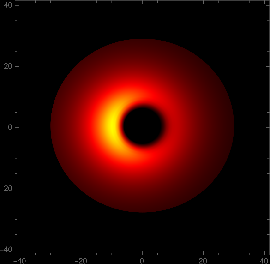
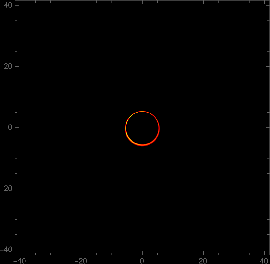

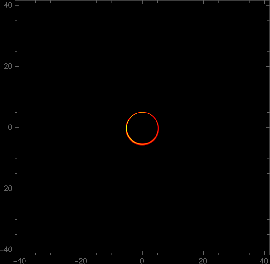
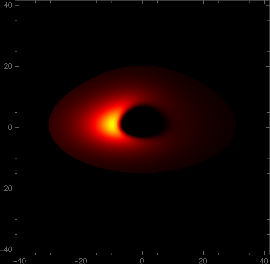
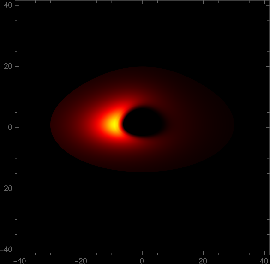
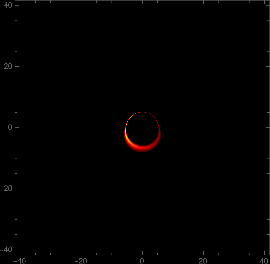
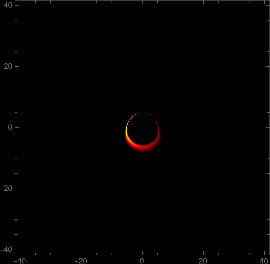
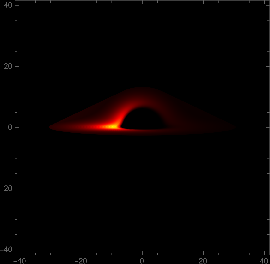
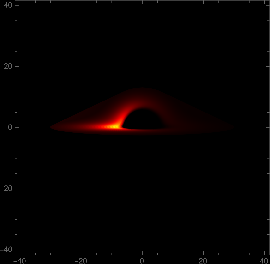
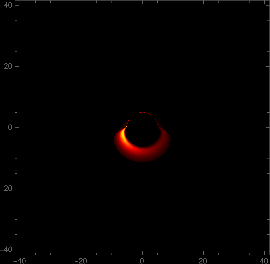
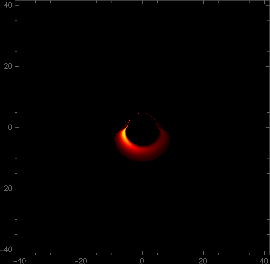
Figure 3: Redshift factor f(r)2 direct image with f(r)3, f(r)4, showing gravitational redshift and mild Doppler asymmetry.
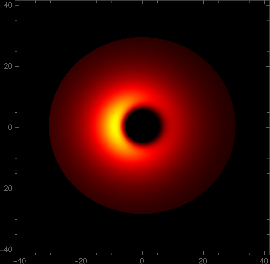
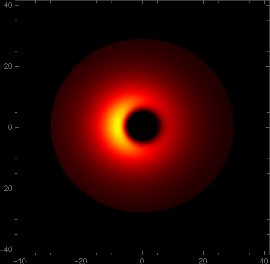
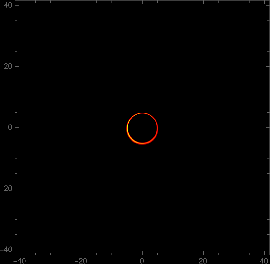
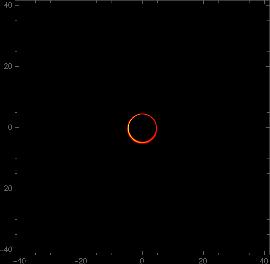
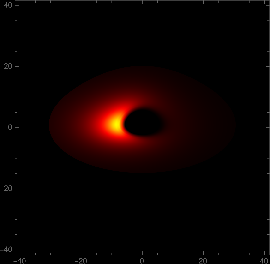
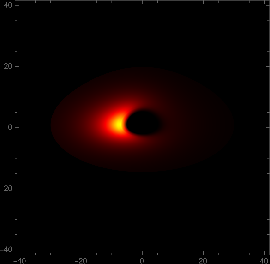
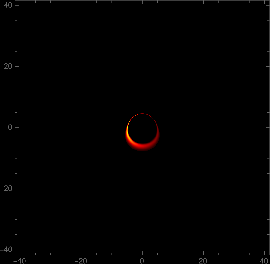
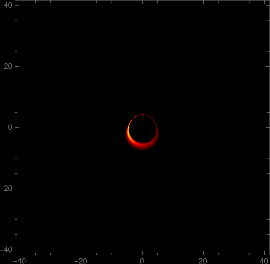
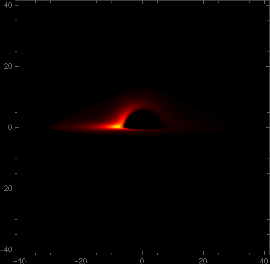
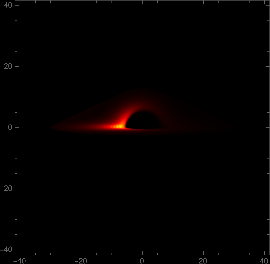
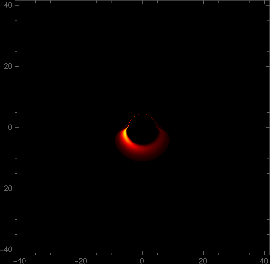
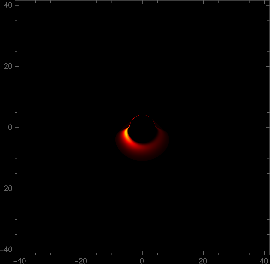
Figure 4: Redshift factor f(r)5 direct image for f(r)6, f(r)7, demonstrating enhanced gravitational redshift compression with increased f(r)8.
Figure 5: Observed radiative flux f(r)9 direct image for a0, a1, illustrating approximately disk-symmetric emission.
Figure 6: Observed radiative flux a2 direct image for a3, a4, highlighting larger effective disk area and asymmetric emission at higher a5.
The secondary images, arising from photons with deflection angles a6, further encode strong gravitational lensing signatures. The study shows that for increasing inclination, the secondary image region and intensity shift, correlating directly with a7 and offering a handle for multi-band observational distinction of regular black holes.
Implications and Prospects
This research delivers several bold claims and notable quantitative results:
- ISCo contraction and increased disk emission area: For larger a8, both the ISCO radius and angular momentum monotonically decrease, resulting in a substantially enhanced effective accretion disk area and increased radiative flux.
- Pronounced Doppler boosting and asymmetry: At large viewing angles, Doppler effects produce strongly asymmetric disk images, with left-right compression of redshift contours and observed flux—a diagnostic sensitive to a9, allowing model differentiation beyond simple Schwarzschild backgrounds.
- Cross-check constraints for halo parameters: Divergent 1σ0 bounds for Sgr A* and M87* open avenues for simultaneous, multi-messenger parameter inference.
Potential future research lines include extending the regular black hole model to axisymmetric (rotating) cases, incorporating realistic disk thickness, cosmological constant effects, and leveraging joint constraints from EHT and gravitational wave observatories such as LISA. These directions will further solidify the optical and dynamical signatures of dark matter halo-modulated regular black holes in the strong-field regime.
Conclusion
The paper establishes a rigorous, systematic framework for the study of radiation and imaging properties of regular black holes embedded in Dehnen-type dark matter halos, with thin accretion disk structures. It quantitatively details how the halo scale parameter 1σ1 modifies shadow radii, orbital dynamics, local and observed radiative fluxes, and image asymmetries, and constrains these effects using EHT observations. The results clarify the interplay between halo-modulated regularity and accretion phenomena, offering a robust theoretical foundation and new observational strategies for delineating strong-field gravitational systems in realistic galactic environments (2604.21615).

