- The paper presents the experimental observation of the quantum multi-Mpemba effect, where a far-from-equilibrium state initially relaxes faster due to larger overlaps with fast decay modes.
- The authors introduce relaxation speed as a key metric that captures contributions from multiple eigenmodes, enabling prediction of nontrivial trajectory crossings.
- Statistical analysis over 50,000 initial state pairs validates a refined phase diagram that distinguishes between standard and multi-Mpemba effects.
Experimental Observation of the Quantum Multi-Mpemba Effect in a Trapped-Ion System
Introduction
The paper "Observation of quantum multi-Mpemba effect in a trapped-ion system" (2604.21320) presents a comprehensive experimental investigation of anomalous quantum relaxation phenomena, specifically the quantum Mpemba effect (ME) and the novel quantum multi-Mpemba effect (multi-ME), in a three-level (qutrit) trapped-ion platform. The study advances theoretical and experimental understanding by directly probing transient relaxation dynamics and by developing a predictive framework based on relaxation speeds, thereby extending beyond the previously established criterion relying solely on the overlap with the slowest decay mode (SDM).
Theoretical Framework
Traditional explanations for the quantum ME in Markovian open systems posit that, at long times, a system initialized further from equilibrium can reach the stationary state faster than one starting closer if the initial state's overlap with the SDM is smaller. This is formalized for a Lindblad master equation with Liouvillian L, whose eigenmodes Ri (with eigenvalues λi) dictate the system's relaxation,
ρt=ρss+i=1∑NaieλitRi,
where ai quantifies the initial state's overlap with the modes. In the long-time regime (t≫τ2, where τi=1/∣Re[λi]∣), the system's distance to stationarity is dominated by ∣a1∣, the overlap with the SDM.
However, these criteria are insufficient to explain rich short- and intermediate-time behaviors observed in the relaxation dynamics, especially in complex spectra with multiple timescales. To address this, the authors introduce the relaxation speed v(t)=∥ρ˙t∥, a scalar capturing the rate at which the system approaches stationarity. This speed is sensitive to overlaps with all decay modes and their respective decay rates, enabling a nuanced understanding of the transient regime and trajectory crossings not predicted by SDM overlap alone.
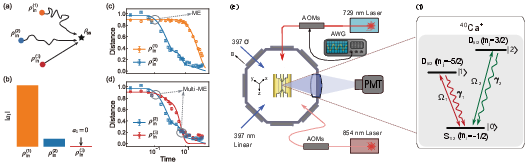
Figure 1: Schematic of initial state dependent relaxation, role of ∣a1∣ in standard ME, and illustration of single and double crossing relaxation behavior. Trapped-ion energy levels and experimental setup are depicted for realization.
Experimental System and Protocol
A single Ri0CaRi1 ion is confined in a linear Paul trap, encoding a qutrit using Zeeman sublevels coupled via bichromatic Ri2 laser fields. The dissipation is engineered through polarization-selective Ri3 pumping, enabling control over decay rate asymmetry crucial for nontrivial relaxation dynamics. The initial conditions Ri4 are prepared using phase-calibrated unitary transformations, allowing fine control of the overlap coefficients Ri5, and full state tomography is performed at each timepoint to reconstruct the transient density matrix evolution.

Figure 2: Eigenspectrum of the Liouvillian and relaxation timescales; the dependence of relaxation speed on initial state parameter Ri6 and overlaps with dominant decay modes over time, highlighting modal competition at different dynamical epochs.
Results: Quantum Mpemba and Multi-Mpemba Effects
Standard Quantum Mpemba Effect
Experimental evidence is provided for the standard quantum ME: for two initial states (with Ri7 and Ri8), the one further from equilibrium, despite its initial distance, becomes closer to stationarity at a finite time due to larger overlaps with faster decay modes. The crossing of the distance trajectories occurs before the onset of SDM-dominated relaxation (Ri9), and is well predicted by analysis of λi0 at short and intermediate times.
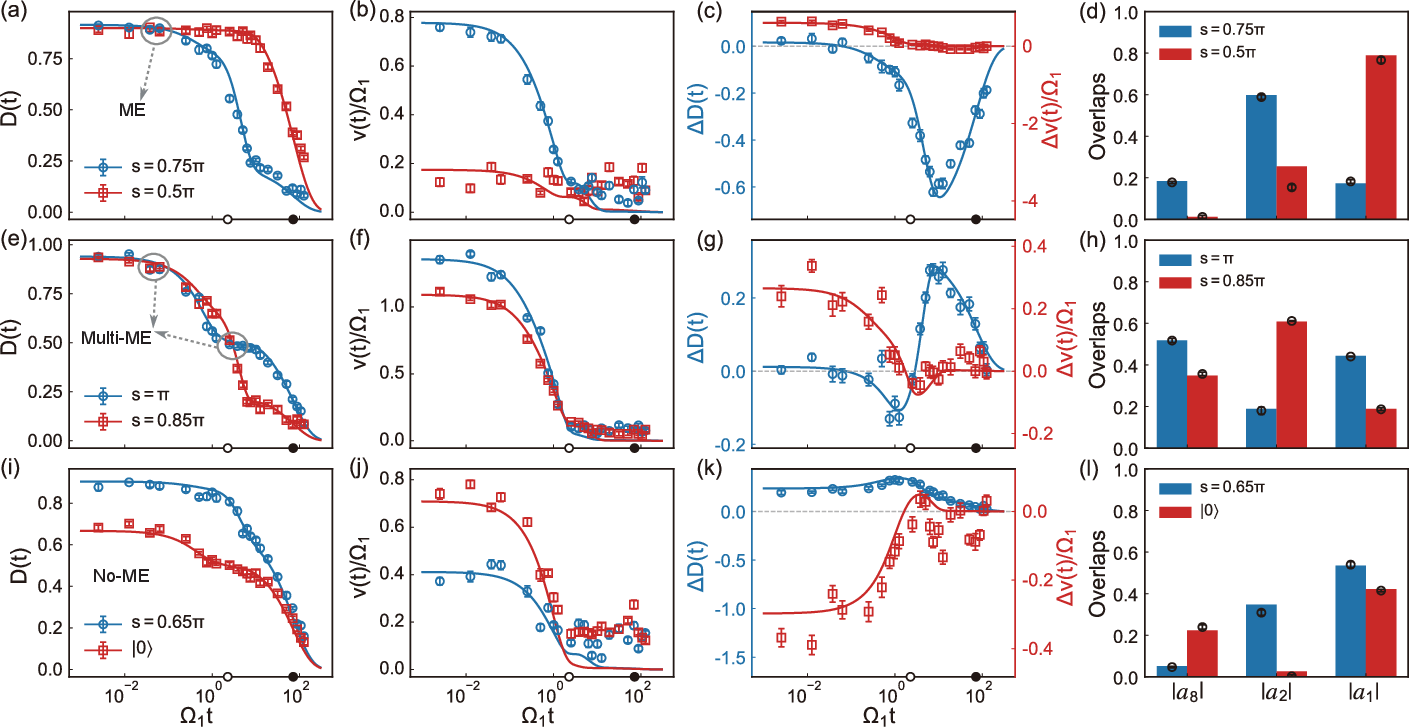
Figure 3: Relaxation distance and speed dynamics for selected initial states under various ME and non-ME scenarios, along with their relevant modal overlaps.
Quantum Multi-Mpemba Effect
The core empirical advance is the direct observation of quantum multi-ME—characterized by two crossings of the relaxation trajectories for two initial states. This arises in circumstances where the farther state has a larger SDM overlap (λi1), violating the conventional ME criterion. Here, the farther state's initially larger overlap with the fastest decay mode (λi2) yields a rapid initial relaxation, effecting the first crossing, while subsequently, the interplay with intermediate decay modes and eventual dominance of the SDM reverses the ordering to restore conventional relaxation, producing a second crossing. The results demonstrate that such complex trajectory crossings are governed by modal competitions beyond the SDM.
Absence of Mpemba Effect
For initial state pairs not satisfying the requisite relationships among λi3 and λi4, no crossing is observed, reaffirming the refined phase diagram's predictive validity.
Statistical Analysis and Phase Diagram
A statistical analysis over 50,000 randomly sampled initial state pairs provides a quantitative phase diagram for the emergence of ME and multi-ME in the parameter plane λi5. The standard ME occurs predominantly when λi6, while the multi-ME is realized with high probability (approximately λi7) if both λi8 and λi9 are fulfilled. These results formalize the modal competition mechanism and delineate the regimes for various relaxation phenomena.
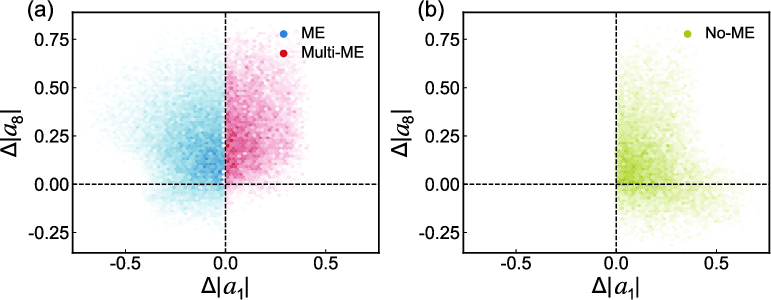
Figure 4: Phase diagram showing the occurrence probability of single and multiple trajectory crossings as a function of differences in overlap coefficients for the SDM and fastest mode.
Additional statistical motifs—such as the distribution of crossing times and the dependence of relaxation speed at distinct time scales on overlap parameters—further reinforce the theory. Multi-crossing events overwhelmingly occur in the transient regime well before the SDM-dominated relaxation, confirming the mechanistic role of fast and intermediate decay modes.
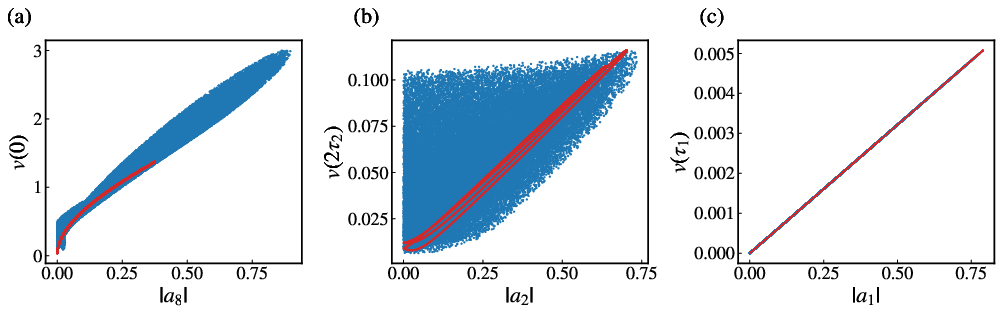
Figure 5: Correlations between relaxation speed at various times and the respective modal overlaps for a broad ensemble of initial states.
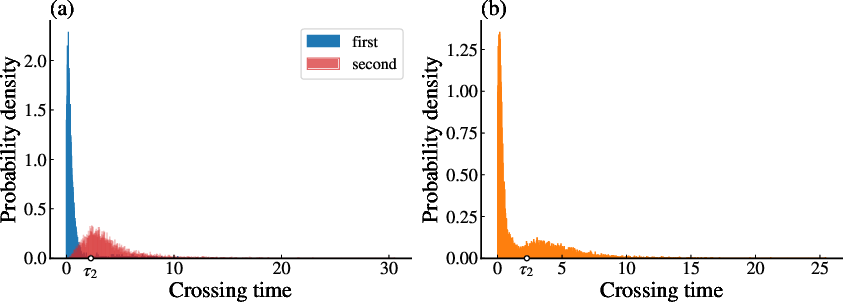
Figure 6: Statistical distributions of first and second crossing times for single and double crossing relaxation phenomena across state space.
Implications and Outlook
The experimental confirmation of quantum multi-ME establishes the necessity of transient-dynamical and modal competition perspectives in the theory of open quantum system relaxation—transcending the previously sufficient SDM criterion. This framework enables the design of optimal relaxation strategies, with applications to quantum state preparation, efficient quantum battery charging protocols, and accelerated many-body dissipative simulations.
Extending these concepts to higher-dimensional open systems, engineered Liouvillian spectra, and regimes with non-Markovianity or nontrivial coherence dynamics could further expand the taxonomy of relaxation anomalies. The identification of key modal overlaps as predictors provides actionable metrics for state initialization and control in quantum technological platforms.
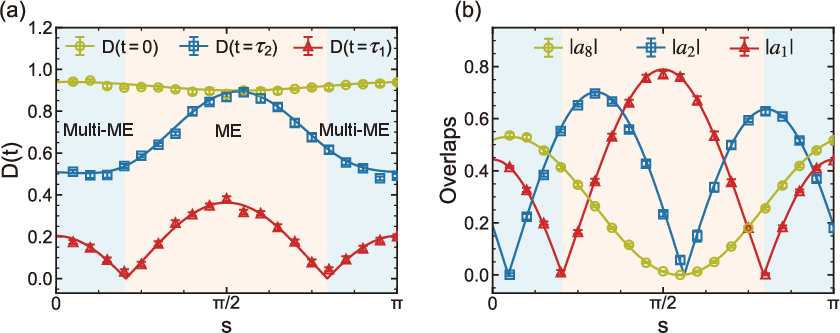
Figure 7: Evolution of relaxation distance and modal overlaps as functions of initial state parameter ρt=ρss+i=1∑NaieλitRi,0, illustrating the tunability and predictive utility of overlap analysis.
Conclusion
This work systematically combines theoretical developments with high-fidelity trapped-ion experiments to demonstrate and characterize both quantum ME and quantum multi-ME. By introducing relaxation speed as a central observable and reconstructing the phase diagram in overlap space, the authors provide a robust, predictive, and generalizable methodology for nonequilibrium quantum relaxation analysis, with broad implications for control in quantum technologies.

