- The paper reports the observation of a new D_{s1}(2933)+ state with J^P=1+, markedly improving the fit likelihood in B0 decay analyses.
- It employs a multidimensional amplitude analysis on 5.4 fb⁻¹ of LHCb pp collision data, using boosted decision trees to suppress combinatorial background.
- The extracted parameters—a mass of ~2933 MeV and width of ~72 MeV—provide a vital benchmark for charm-strange spectroscopy and QCD models.
Observation of the Ds1(2933)+: An Excited Charm-Strange Meson in B0→D+D−K+π− Decays
Introduction and Motivation
The spectroscopy of charm-strange mesons (Ds) is a critical probe of nonperturbative QCD dynamics, offering stringent tests of quark model predictions, coupled-channel effects, and phenomenology beyond naive constituent models. While the lowest Ds states are well established, several anomalies persist, such as the unexpectedly low masses of the Ds0(2317) and Ds1(2460), the quark-model tension at Ds0(2590), and a sparse mapping of higher excitations in the Ds spectrum. These puzzles motivate direct searches for higher excited Ds states—including the first radial P-wave excitations (B0→D+D−K+π−0), many of which remain unobserved or poorly characterized. The analysis presented in "Observation of a new excited charm-strange meson B0→D+D−K+π−1 in B0→D+D−K+π−2 decays" (2604.21257) offers a decisive contribution to this program.
Data Set and Candidate Selection
The study utilizes B0→D+D−K+π−3 collision data from the LHCb detector at B0→D+D−K+π−4, corresponding to B0→D+D−K+π−5 integrated luminosity. The B0→D+D−K+π−6 candidates are fully reconstructed using the B0→D+D−K+π−7 decay modes. Optimized PID, vertex-quality, and kinematic selection criteria are applied, including a gradient-boosted decision tree for combinatorial background suppression. Signal-dominated regions are isolated via an extended unbinned maximum-likelihood fit to the reconstructed B0→D+D−K+π−8 mass spectrum.
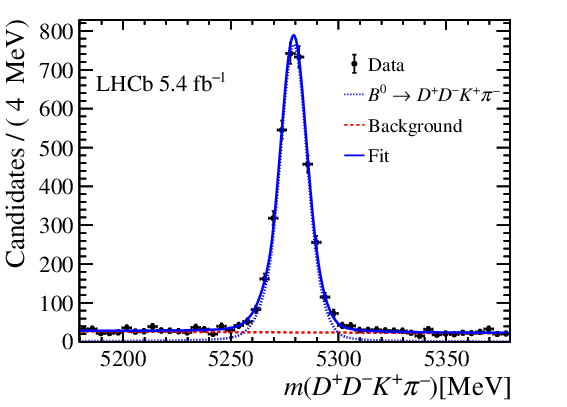
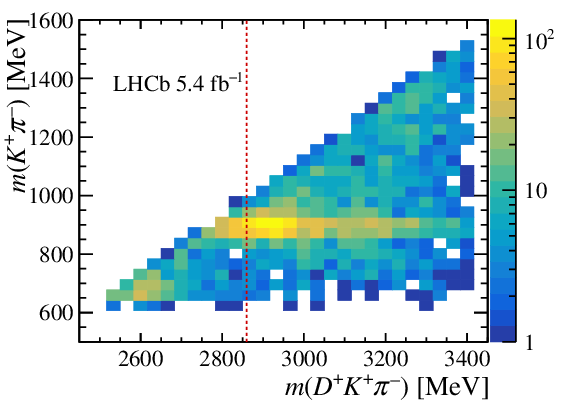
Figure 1: (Left) Mass distribution of selected B0→D+D−K+π−9 candidates with the fit overlaid. (Right) Two-dimensional, background-subtracted mass distribution Ds0 vs.\ Ds1; the red dashed line marks the peak of the known Ds2 states.
The right panel of Figure 1 reveals a distinct enhancement in the Ds3 spectrum near Ds4, above the already-mapped Ds5 threshold, strongly suggestive of an unaccounted excited Ds6 contribution.
The central analysis is a multidimensional amplitude fit over the full five-body kinematic phase space, essential for disentangling overlapping resonances and extracting quantum numbers. Two topologies are considered: (1) cascade decays via excited Ds7 states decaying to the three-body Ds8, and (2) quasi-two-body modes involving charmonium intermediates decaying to Ds9. The fit includes all established resonances and pertinent nonresonant contributions, with lineshapes modeled as Breit-Wigner distributions with mass-dependent widths or via more flexible, model-independent spline interpolations where strong mixing overlaps are present.
Acceptance and efficiency variation across the multi-dimensional Dalitz space is corrected using kernel density estimation techniques on simulated signal MC, ensuring accurate normalization and systematic error control.
Identification and Properties of the Ds0
The baseline amplitude model, including all established contributions, fails to account for the significant excess at Ds1. Introducing a new Ds2 resonance with a Breit-Wigner parametrization into the fit dramatically improves the likelihood, with a statistical significance exceeding 10 standard deviations. The favored quantum numbers are Ds3; alternative (Ds4, Ds5, Ds6) options are strongly excluded (Ds7).
The resonance parameters are:
Ds8
This state is denoted Ds9. Its dominant fit fractions are associated with intermediate decays via vector and axial-vector Ds0(2317)0 and Ds0(2317)1 states in the Ds0(2317)2 system. The extracted pole mass and width are precise and robust under alternative fit models and systematic variations.
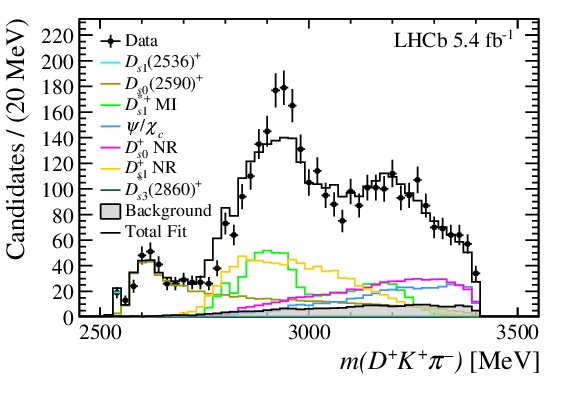
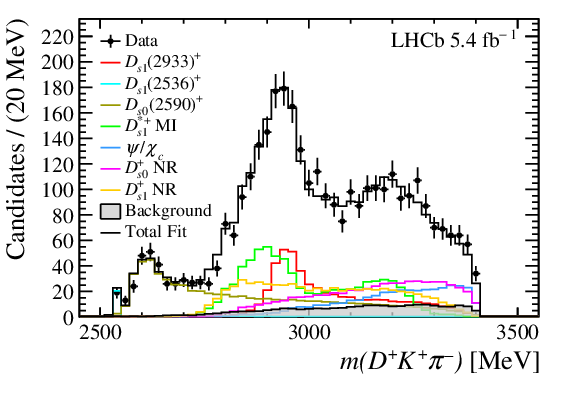
Figure 2: Ds0(2317)3 spectra for selected candidates with fit projections: (left) initial model, (right) baseline including the Ds0(2317)4 state; significant excess at Ds0(2317)5 is well accommodated only in the baseline fit.
Projections and Kinematic Consistency
Projections of the amplitude fit onto relevant invariant-mass and angular kinematic variables confirm the necessity of the Ds0(2317)6 inclusion for accurate data modeling. The fit is validated across multiple subspaces, showing agreement for all dominant resonant and nonresonant structures.
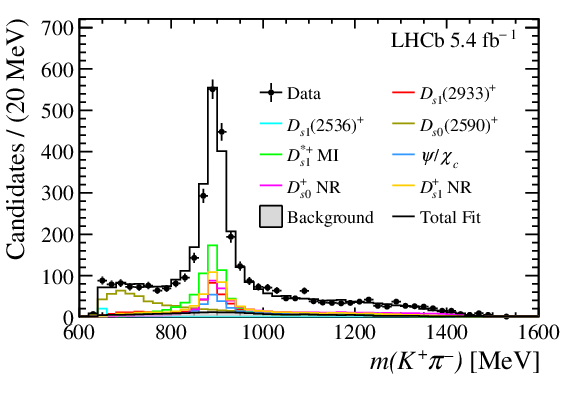
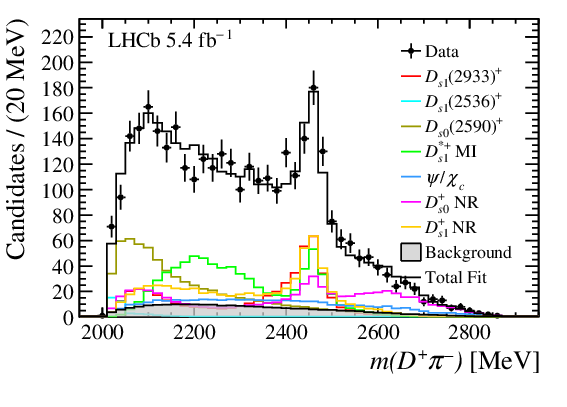
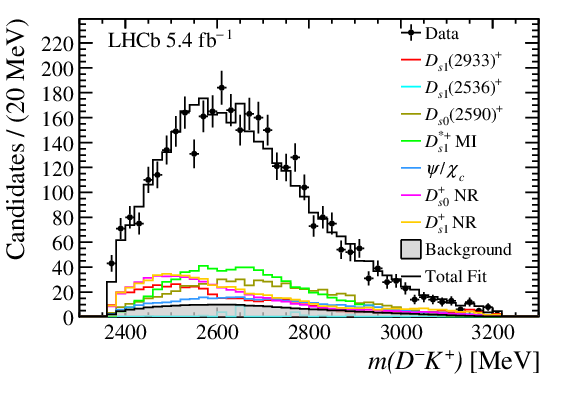
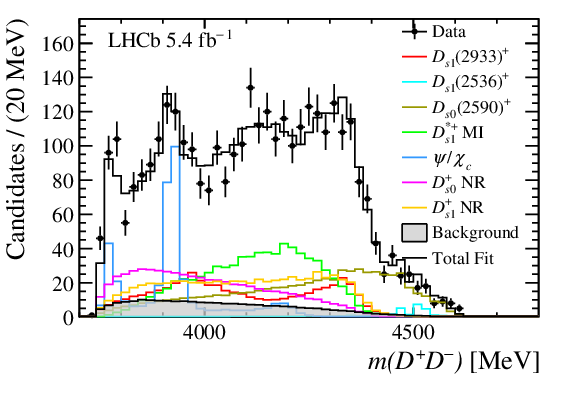
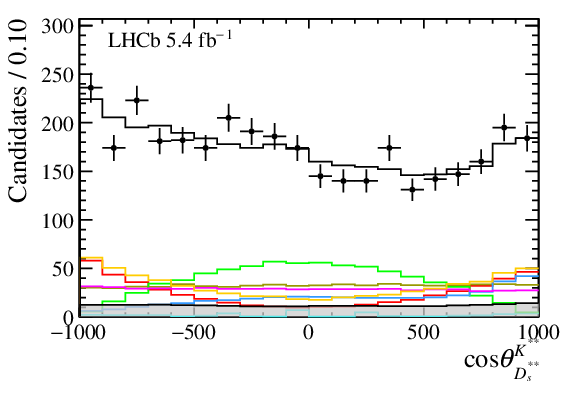
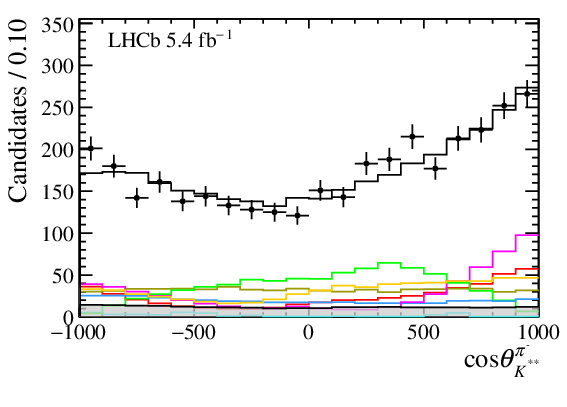
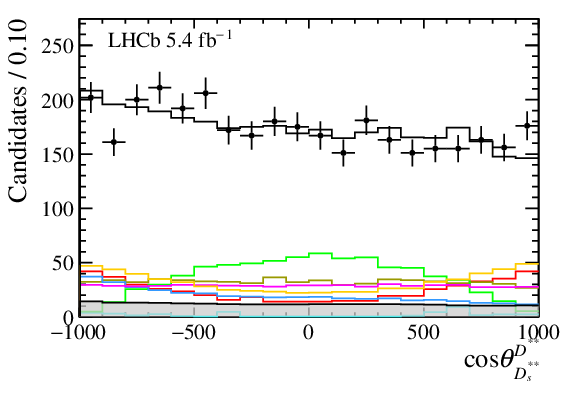
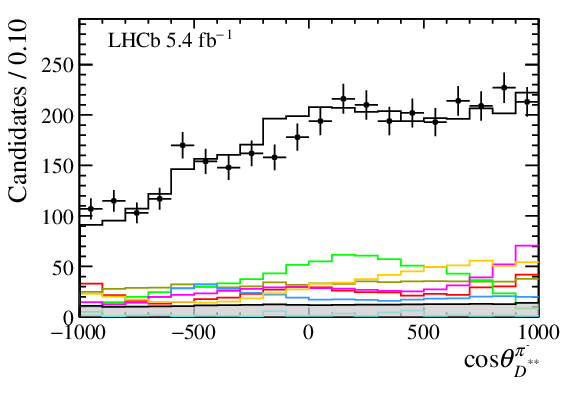
Figure 3: Various kinematic projections for Ds0(2317)7 candidates in the signal region, with baseline fit overlays; all dominant resonant structures, including the Ds0(2317)8, are accommodated.
Implications for Charm-Strange Spectroscopy
The observation of Ds0(2317)9 provides critical data for the mapping of the Ds1(2460)0 (first radial Ds1(2460)1-wave) charm-strange multiplet. The mass and width are broadly consistent with recent unquenched quark-model predictions and lattice studies that allow for significant coupled-channel modifications of bare constituent model expectations (cf.\ [Ni et al., 2022; 2023], [Godfrey & Moats 2016], [Yang et al., 2023]). The spin-parity determination and decay patterns are most compatible with assignment as the Ds1(2460)2.
This result addresses longstanding gaps in the Ds1(2460)3 spectrum above threshold, and provides input for resolving the apparent Ds1(2460)4-wave mass anomalies at low energies. It further challenges models positing strong molecular or multiquark-dominated interpretations for higher resonances in light of the successful Ds1(2460)5/Ds1(2460)6 description at this mass.
Outlook and Theoretical Perspectives
These measurements have the following theoretical and practical implications:
- Validation of coupled-channel and unquenched quark model calculations: The precise Ds1(2460)7 state at Ds1(2460)8 provides an essential calibration point for the coupled-channel dynamics and for lattice QCD computations including open strange thresholds.
- Input to phenomenology of exotic states: Recent LHCb observations of Ds1(2460)9 tetraquark candidates and open-charm exotica at similar and lower masses now have to be interpreted in the broader context of a well-populated Ds0(2590)0 spectrum. Overlaps or misidentification due to incomplete conventional spectroscopy can now be corrected.
- Experimental strategies: The success of full multidimensional amplitude analysis in multi-body Ds0(2590)1 decays strengthens the case for future high-statistics studies of Ds0(2590)2 excited states using advanced fit techniques, especially as Run 3 and beyond delivers larger datasets.
Conclusion
An amplitude analysis of Ds0(2590)3 decays reveals a statistically significant new charm-strange meson, Ds0(2590)4, with Ds0(2590)5, Ds0(2590)6, and Ds0(2590)7. This state fits naturally into the Ds0(2590)8 excitation of the Ds0(2590)9 system and provides a crucial input for resolving the structure of charm-strange mesons and for future progress in heavy-hadron spectroscopy and QCD model building (2604.21257).