- The paper presents a unified analysis of baryonic form factors in light pseudoscalar mesons using the SDE/BSE framework with explicit isospin-breaking effects.
- It employs numerical solutions to gap equations and Bethe-Salpeter amplitudes to derive meson masses, decay constants, and baryon-number radii with robust agreement to experimental benchmarks.
- The study highlights significantly larger baryonic radii for kaons than pions, emphasizing flavor asymmetry and setting the groundwork for future precision QCD investigations.
Introduction
This work provides a comprehensive analysis of the baryonic form factors (BFFs) associated with light pseudoscalar mesons using a first-principles continuum approach grounded in the Schwinger-Dyson equations (SDE) and Bethe-Salpeter equations (BSE). The baryonic form factor, sensitive to the baryon-number current, offers a nontrivial probe of isospin-breaking effects in hadron structure, as it strictly vanishes in the exact isospin-symmetric limit due to G-parity. Thus, any measured signal directly encodes nonperturbative QCD dynamics arising from md−mu. The investigation includes the charged pion, charged, and neutral kaon BFFs, with an explicit treatment of isospin breaking at the quark mass level.
Theoretical Framework and Methodology
BFFs are evaluated within the impulse approximation using nonperturbatively dressed quark propagators, meson Bethe-Salpeter amplitudes, and a fully dressed baryon-current vertex. All dynamical ingredients are determined consistently from their respective SDE/BSEs, solved with a flavour-dependent effective interaction kernel. The analysis incorporates the explicit solution of the quark gap equations for u, d, and s flavours, producing distinct mass functions and propagators for each.
The B-vertex, responsible for coupling the baryon-number current to quark lines, is constructed to satisfy the vector Ward-Takahashi identity (WTI), ensuring correct symmetry properties and current conservation. Its structure is built from a 12-dimensional tensor basis, analogous to the Ball-Chiu construction for the electromagnetic vertex, and encompasses both WTI-saturating and transverse components, the latter being crucial for the correct inclusion of vector-meson effects.
The effective interaction encapsulates nonperturbative gluonic dynamics via a modified Taylor coupling α~T(k2), which incorporates both process-independent contributions from the quark-gluon vertex as well as phenomenological constraints from lattice QCD.
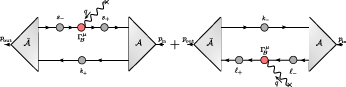
Figure 1: Diagrammatic representation of the baryon-number current in the impulse approximation, showing current insertions, dressed quark propagators, and fully dressed current vertices.
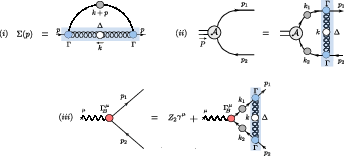
Figure 2: Overview of the primary SDE/BSE ingredients: quark self-energy, meson Bethe-Salpeter amplitude, and baryon-current vertex with effective kernel.
Analytic continuation and advanced numerical techniques are employed to access the requisite propagator and vertex functions in the relevant kinematic regions. The calculation is free from empirical fitting beyond the quark masses, which are fixed to physical meson properties.
Numerical Results
Dressed Quark Propagators and Mass Functions
Solutions of the gap equations yield mass functions for u, d, and s quarks exhibiting infrared enhancement from dynamical chiral symmetry breaking and converging to the appropriate renormalized masses at large scales. Parametric uncertainties are assessed by varying the underlying effective gluonic interaction within the range constrained by lattice data.
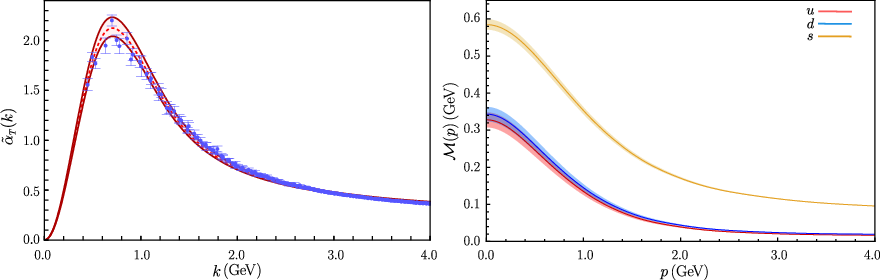
Figure 3: Left: Modified Taylor effective coupling md−mu0. Right: Quark mass functions for md−mu1, md−mu2, md−mu3 flavours.
Bound-State Masses and Decay Constants
Meson masses and decay constants computed from the BSEs are in excellent agreement with experimental values (relative errors md−mu4), validating the chosen interaction and numerical implementation. The explicit treatment of isospin breaking yields mass splittings in line with the absence of electromagnetic effects in the SDE/BSE framework.
The main outcomes are the computed md−mu5 for md−mu6, md−mu7, and md−mu8, all evaluated in the space-like region. The pion BFF is found to be numerically small, vanishing at the origin and consistent with previously extracted dispersive values. The extracted baryonic radius for the charged pion is md−mu9 fm. This result agrees within errors with the BaBar/KLOE-driven dispersive analysis and with constituent quark model expectations.
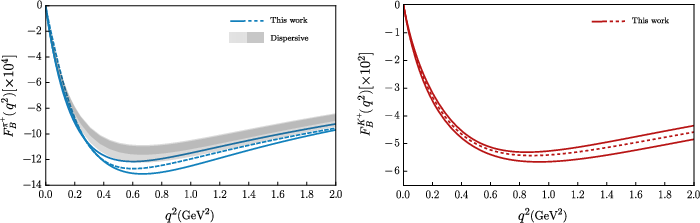
Figure 4: Left: Computed baryonic form factor for the charged pion compared with dispersive results from BaBar and KLOE. Right: Corresponding prediction for the charged kaon.
Kaon BFFs are substantially enhanced relative to the pion, reflecting the increased flavour asymmetry in the u0 system. The charged and neutral kaon radii are u1 fm and u2 fm, significantly larger than the pion case and consistent with chiral model calculations. The kaon BFFs, for which no dispersive benchmark exists, are similarly robust across the full range of momentum transfers considered.
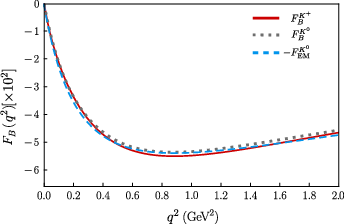
Figure 5: Baryonic form factor for the neutral kaon compared to both the charged channel and the neutral-kaon electromagnetic form factor. The near identity in magnitude and shape is a consequence of the underlying flavour structure of the external currents.
Consistent with current algebra, the neutral kaon's baryonic and electromagnetic form factors satisfy u3 up to details of isospin-breaking corrections, as both encode identical underlying quark contributions but with opposite charge assignments.
The table below summarizes these findings alongside previous phenomenological and model results:
| Source |
u4 (fm) |
u5 (fm) |
u6 (fm) |
| This work |
0.043(2) |
0.265(7) |
0.262(7) |
| BaBar/KLOE dispersive |
0.041(1) |
-- |
-- |
| Chiral NJL model |
0.06(1) |
0.24(1) |
0.23(1) |
The numerical uncertainties primarily originate from the variation of the effective gluon coupling, providing robust, conservative error estimates.
Implications and Future Prospects
The robust agreement achieved for the pion BFF validates the SDE/BSE approach for quantifying isospin-breaking effects in hadronic distributions. The markedly larger kaon radii indicate that future experimental or lattice QCD determinations in the strange sector could provide strong constraints on the modelling of nonperturbative QCD and flavour-dependent kernel structures. The close correspondence between baryonic and electromagnetic radii observed in the kaon sector underscores the importance of consistently implementing both isospin and electromagnetic effects when extracting fundamental QCD parameters.
Extending the present analysis to incorporate explicit electromagnetic corrections (e.g., QED dressing of the gap and Bethe-Salpeter equations) and to further refine quark mass inputs is a clear future direction. Such improvements would allow a first-principles determination of the full isospin and QED splitting in light meson radii and form factors, directly connecting continuum approaches to future high-precision experiments and lattice QCD benchmarks.
Conclusion
The study offers the first unified and dynamical determination of the baryonic form factors and radii of the lightest pseudoscalar mesons within a well-controlled SDE/BSE framework that systematically incorporates isospin-breaking effects via quark mass differences. The results quantitatively match data-driven extractions where available (pion) and set the benchmark for future studies of flavour-dependent baryon-number distributions in QCD. The methodology developed here can be generalized to other currents, hadronic channels, and extended to include electromagnetic and radiative corrections, paving the way for precision investigations into the internal charge structure of light hadrons.