- The paper introduces a microscopic fuzzy-sphere framework to extract complete BCFT data for surface criticality in 3D O(N) models.
- It employs bilayer Heisenberg Hamiltonians with Landau-level projection to accurately determine operator spectra, OPE coefficients, and universal amplitudes.
- The results validate the extraordinary-log scenario and align with Monte Carlo, RG, and conformal bootstrap findings for both O(2) and O(3) models.
Surface Criticality of 3D O(N) Models via Fuzzy-Sphere BCFT Spectroscopy
Introduction and Motivation
This work delivers a quantitative and systematic study of boundary conformal field theory (BCFT) data for the three-dimensional O(N) Wilson-Fisher CFTs (N=2, $3$), focusing on their surfaces. Utilizing the fuzzy-sphere regularization, the authors construct microscopic bilayer Heisenberg Hamiltonians projected to lowest Landau levels, extracting both normal and ordinary surface CFT data. This approach secures direct access to the full operator spectrum, including boundary primary and descendant structure, OPE coefficients, universal amplitudes, and the boundary central charge. The main theoretical context involves the extraordinary-log scenario for the normal surface, a phenomenon established in recent field theory and Monte Carlo (MC) studies but lacking full confirmation in microscopic lattice regularizations. This work addresses this gap and extends fuzzy-sphere boundary methods from Ising to continuous O(N) symmetry.
Fuzzy-Sphere Regularization: Framework and Implementation
The fuzzy-sphere approach embeds the three-dimensional O(N) quantum critical point as a ground state of a finite-size, sign-free Hamiltonian with Landau-level-projected fermionic degrees of freedom, defined on a sphere. The state-operator correspondence then enables a mapping between many-body eigenstates and boundary CFT operators. Surface criticality is implemented by modifying the occupation structure of the m<0 orbitals, either through a symmetry-breaking pinning field (normal boundary condition) or by emptying the orbitals to preserve O(N) (ordinary boundary condition). The Hamiltonian interpolation between O(3) (N=3 bilayer Heisenberg) and O(2) (via anisotropic deformation) realizes both Wilson-Fisher universality classes and facilitates criticality tests via OPE coefficient benchmarking.
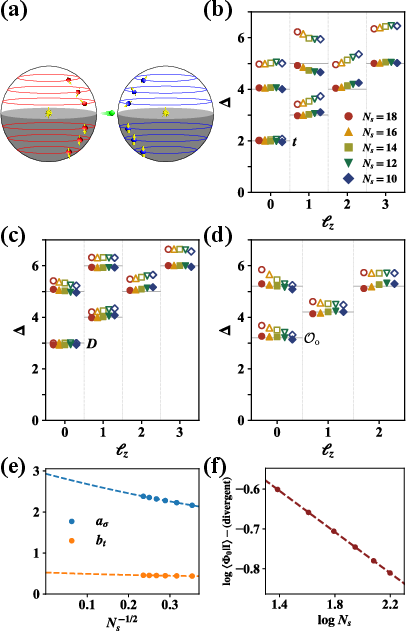
Figure 1: (a) Schematic realization of an N=20 normal surface CFT on the fuzzy sphere. (b)-(f) Operator spectra, OPE amplitudes, and boundary overlap results for the N=21 normal surface CFT.
Normal Surface CFTs: Operator Spectra and OPE Data
The normal boundary condition pins the surface, breaking N=22 to N=23. Boundary operators organize into primaries under the 2d boundary conformal algebra, with protected operators—the tilt N=24 and displacement N=25—arising from broken symmetries. The numerical spectra exhibit precise integer-spaced descendant structure after leading irrelevant drifts are removed via conformal perturbation theory, using N=26 for calibration.
For N=27, the lowest unprotected primary dimensions are found to be N=28 (lowest N=29-odd) and $3$0 (lowest $3$1-even). OPE amplitudes, $3$2 and $3$3, quantitatively match high-precision MC and conformal bootstrap benchmarks. The boundary central charge, $3$4, agrees with two-loop AdS/CFT expansions.
For $3$5, the protected structure remains intact, and new unprotected primaries in the $3$6 sectors are identified, all above the displacement. The universal amplitudes $3$7 and $3$8, and $3$9, match MC and perturbative predictions.
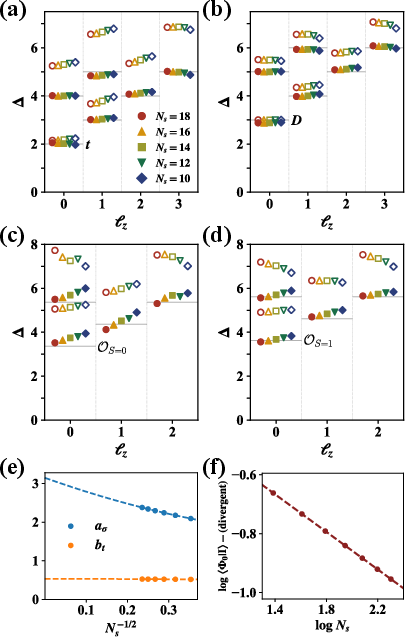
Figure 2: (a)-(d) Operator multiplets, (e) amplitude extrapolations, (f) boundary overlap scaling for the O(N)0 normal surface CFT.
A salient result is the independent confirmation of the extraordinary-log phase for O(N)1: the universal combination O(N)2 governing log-suppressed order-parameter correlations is extracted as O(N)3 for O(N)4 and O(N)5 for O(N)6, both positive and thus corroborating the extraordinary-log scenario expected from RG and MC results.
Ordinary Surface CFTs: Spectra and Irrelevance of Additional Primaries
The ordinary boundary condition, which is O(N)7 symmetric, supports a single relevant surface operator, O(N)8, whose scaling dimension is computed as O(N)9 (O(N)0) and O(N)1 (O(N)2). These values are slightly lower than MC and conformal bootstrap estimates, likely due to finite-size corrections accentuated in O(N)3, where the parent bulk Hamiltonian is less fine-tuned.
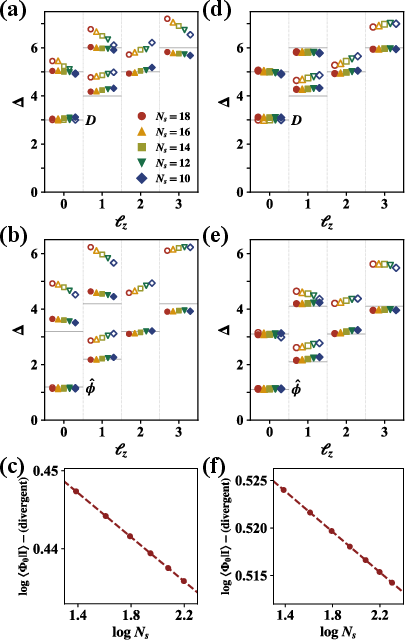
Figure 3: (a)-(b) Multiplets for O(N)4 and O(N)5 in O(N)6, (d)-(e) O(N)7 and O(N)8 in O(N)9. (c), (f): Scaling of wavefunction overlaps to extract m<00.
Additional boundary primaries, such as the lowest m<01-odd singlet in m<02 and the lowest m<03 in m<04, are found to be irrelevant (m<05). Thus, the fixed-point structure is robust, confirming standard RG expectations.
The measured boundary central charges for the ordinary class, m<06 (m<07) and m<08 (m<09), are compatible with perturbative results and highlight the contrast with the normal class.
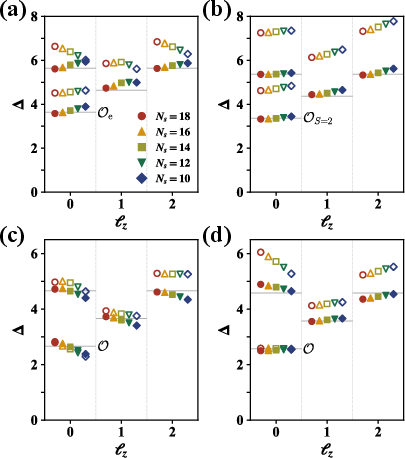
Figure 4: Supplementary conformal multiplets: additional O(N)0 even/odd primaries and O(N)1 O(N)2 multiplet (normal); O(N)3-odd singlet and O(N)4 traceless tensor (ordinary).
Consistency Checks and Robustness
The analysis includes spectral checks using both orbital-space and real-space boundary constructions. The integer descendant structure recurs regardless of the cut, establishing the topological-nature equivalence of the realizations at large system size.
Calibration of scaling dimensions via the bulk stress tensor confirms agreement to expected protected values, further supporting the adopted normalization conventions and the reliability of conformal perturbation corrections.
Theoretical and Practical Implications
This study validates the fuzzy-sphere approach as a rigorous and versatile method for nonperturbative boundary CFT data extraction for 3D O(N)5 models. Numerically accessible CFT data, including OPE coefficients, universal amplitudes, full multiplet structure, and central charges, enable sharp tests of field-theoretic predictions, including the extraordinary-log scenario and the structure of low-lying irrelevants.
These results establish that the fuzzy-sphere approach is robust not just for Ising, but for continuous O(N)6 symmetry as well, with the potential to extend toward higher O(N)7, topological boundary conditions, and other symmetry classes. Given the agreement with both MC and conformal bootstrap, fuzzy-sphere BCFT spectroscopy emerges as a standard for boundary universality class characterization.
Advancements such as optimization of Hamiltonians (particularly O(N)8), scaling to larger systems with tensor network methods (DMRG), and further development for multi-boundary/defect configurations are natural directions. Investigation around the critical value O(N)9 for extraordinary-log/ordinary-class crossover is highlighted as an outstanding target.
Conclusion
This work provides comprehensive BCFT data for the 3D O(3)0 and O(3)1 Wilson-Fisher models, obtained using a microscopic fuzzy-sphere framework that allows full state-operator correspondences on the boundary. The results deliver strong, consistent estimates of operator spectra, universal amplitudes, and the extraordinary-log exponent, in quantitative agreement with MC and conformal bootstrap. The methods generalize boundary CFT spectroscopy tools to continuous global symmetry, setting the stage for systematic studies of surface, defect, and multi-boundary critical phenomena in higher-dimensional CFTs.
(2604.21091)