- The paper demonstrates that defect-induced carrier doping activates a giant Kerr effect in MnTe, revealing macroscopic time-reversal symmetry breaking.
- It employs high-resolution MOKE imaging and transport analysis to correlate carrier density with Kerr rotation magnitudes in varied sample types.
- It establishes that defect-activated, gossamer ferromagnetism—not ideal altermagnetic order—is key to unlocking robust TRSB, with implications for spintronic devices.
Defect-Activated Macroscopic Time-Reversal Symmetry Breaking in Altermagnetic MnTe Probed by Giant Spontaneous Kerr Effect
Introduction
The study investigates the microscopic origins of macroscopic time-reversal symmetry breaking (TRSB) in the archetypal altermagnet MnTe by leveraging polar magneto-optical Kerr effect (MOKE) at telecommunication wavelengths. Altermagnetism, a recently recognized class of collinear magnetism, features vanishing net magnetization but non-relativistic, momentum-dependent spin splitting due to crystalline rotational symmetries. While MnTe was shown to exhibit spontaneous anomalous Hall effect (AHE) and weak "gossamer" remanent moments, the macroscopic symmetry breaking's ties to ideal altermagnetic order—or to defect-activated phenomena—remained unresolved. This work systematically disentangles these possibilities by comparing chemically distinct single crystals and thin films, performing quantitative MOKE imaging, and correlating these to sample transport characteristics.
Experimental Methodology
All Kerr experiments were performed with a zero-loop fiber-optic Sagnac interferometer in a polar geometry at 1550 nm ($0.8$ eV). This approach is maximally sensitive to TRSB, yields micro-radian-level angular resolution, and allows for micron-scale imaging across bulk and film samples. Single-crystal specimens of MnTe (A, B, and C, with varying resistivities) were grown via self-flux and characterized with X-ray diffraction, while 50nm films were grown epitaxially on InP(111) and capped in situ to eliminate extrinsic surface oxidation. Transport measurements (resistivity, AHE) and domain manipulation protocols (zero-field cooling, field cooling) provided orthogonal readouts of the electronic ground state and its symmetry.
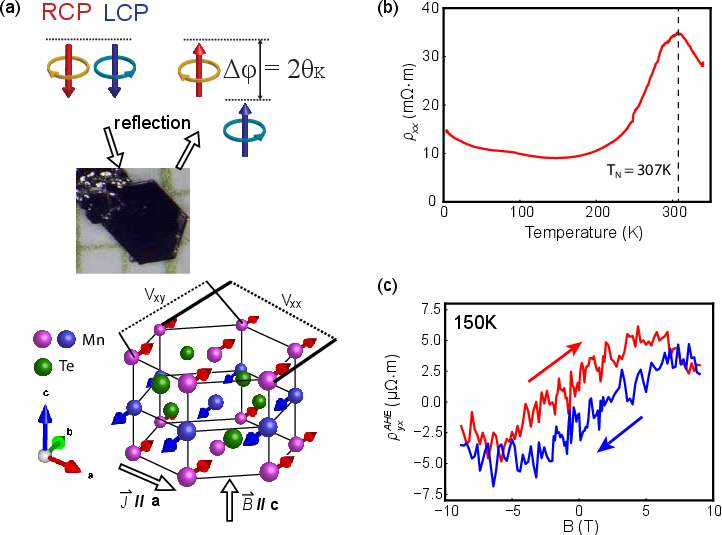
Figure 1: Schematic of the MOKE experiment, photograph of a MnTe single crystal, and representative longitudinal and anomalous Hall transport showing a characteristic resistive anomaly and a hysteretic AHE loop.
Observation of Giant Spontaneous Kerr Rotations in Bulk MnTe
Bulk, hole-doped MnTe single crystals exhibit giant spontaneous Kerr effect—Kerr rotations reaching ±1500μrad—that emerge precisely upon cooling through the Néel temperature (TN=307 K). Domain-resolved MOKE imaging reveals micron- to millimeter-scale regions of positive and negative chirality; importantly, large portions of the crystal show no detectable signal, testifying to a pronounced local inhomogeneity resulting from variations in the carrier (hole) density.
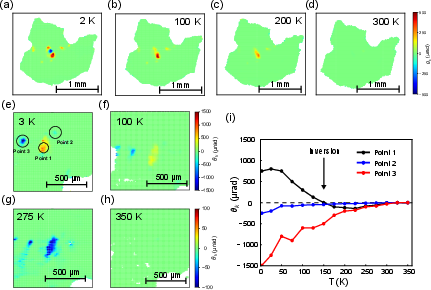
Figure 2: High-resolution MOKE imaging demonstrates spontaneous domain nucleation and evolution below TN, with chirality inversion and localized Kerr rotations exceeding 1000μrad.
Immediately below TN, domains nucleate with random chirality and exhibit thermal and spatial evolution upon subsequent warming. Domain chirality can be robustly trained by modest out-of-plane fields ($0.3$ T), resulting in deterministic selection of one domain type, and this chirality can invert with temperature, indicating a competition among SOC-coupled channels that control the Berry curvature.
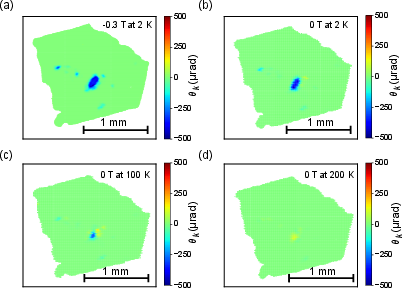
Figure 3: Domain chirality can be field-trained and shows a temperature-driven inversion, signifying underlying coupling between carrier-induced moment and Berry curvature.
Correlation with Carrier Self-Doping
The magnitude of spontaneous MOKE scales non-monotonically with the sample resistivity (hence, carrier density). Crystals A and B (low resistivity) show maximal Kerr response (∼±1500μrad), while crystal C—with an order of magnitude higher resistivity—shows a significantly reduced amplitude (∼±200μrad).
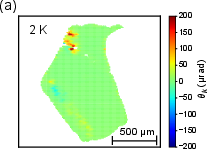
Figure 4: Crystal C, with higher bulk resistivity, exhibits an order of magnitude reduction in spontaneous Kerr rotation, highlighting the role of carrier doping.
This correspondence directly supports the hypothesis that defect-induced hole self-doping activates macroscopic TRSB in MnTe.
Null Result in Pristine Stoichiometric Thin Films
Strikingly, MOKE in stoichiometric, resistive 50nm0 MnTe/InP(111) films is entirely absent to below the instrument noise floor (50nm1) across the full 50nm2 K temperature range. The films are confirmed stoichiometric and insulating, with capping preventing any unintentional doping or oxidation.
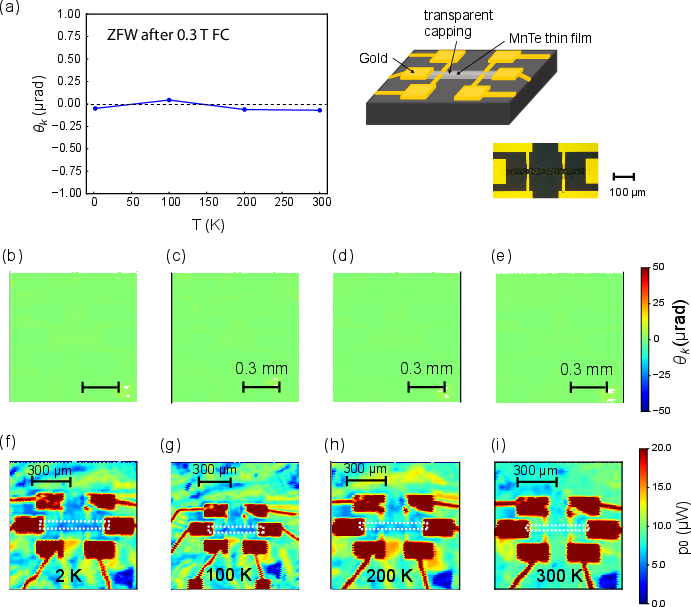
Figure 5: In capped, insulating 50nm3 thin films, no spontaneous Kerr effect is detected, ruling out the ideal collinear bulk order as a source of macroscopic TRSB signals.
Since these films retain the full altermagnetic electronic structure (as established by ARPES and diffraction), the absence of a detectable Kerr effect cannot be attributed to the lack of order; rather, it establishes that the macroscopic MOKE signature is not a direct probe of ideal altermagnetic order, but rather a carrier-activated, defect-derived effect.
Microscopic Mechanism: Gossamer Ferromagnetism and Symmetry Analysis
First-principles DFT calculations for ideal MnTe predict robust Kerr rotations at visible and near-IR wavelengths; however, these require symmetry-breaking beyond the purely collinear, compensated ground state. Theoretical analyses show that MnTe's point group supports an effective 50nm4-symmetry (time-reversal plus spin rotation) that forbids Berry-curvature contributions to MOKE. In real samples, significant SOC and the presence of itinerant holes (introduced by defects or off-stoichiometry) induce a minute out-of-plane canting of the Mn moments (the "gossamer" moment), breaking the effective 50nm5-symmetry and activating the band-structure Berry curvature. The magnitude of the Kerr response is set by the proximity of the Fermi level to a narrow 15–18 meV window below the valence band maximum, as independently shown in transport-based activation energy studies.
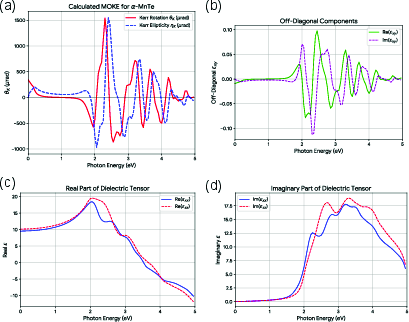
Figure 6: DFT-calculated Kerr rotation for ideal MnTe shows strong MOKE response only when effective time-reversal symmetry is broken by carrier-induced canting or SOC.
Theoretical and Practical Implications
The results demonstrate that neither the net antiferromagnetic order parameter nor the collinear altermagnetic band structure alone guarantees a macroscopic TRSB visible by transport or optics. Only via defect or carrier engineering—which breaks the effective 50nm6-symmetry—can large AHE and Kerr rotations be realized. This makes MOKE, particularly at telecommunication wavelengths, a highly sensitive optical probe of subtle carrier-activated magnetic phenomena and provides a new metrological path distinct from ARPES or XMCD.
Defect and carrier control thus become central parameters in any attempt to realize or manipulate device functionality in altermagnetic systems. For practical spintronics or integrated photonics, MnTe's strong, dopant-dependent MOKE response at 1550 nm is of immense utility, enabling domain visualization, readout, and manipulation on technologically relevant platforms, provided carrier density is properly engineered.
Comparison to Other Spin-Compensated Systems
Unlike noncollinear antiferromagnets (e.g., Mn50nm7Sn, Mn50nm8Ge), where SOC-driven Berry curvature or scalar spin chirality yields large intrinsic MOKE without net moment, MnTe's macroscopic symmetry breaking is not an intrinsic property of the perfect collinear state. Instead, it serves as an exemplar of the critical role of weak ferromagnetism (via "gossamer" canting) in unlocking the full potential of the altermagnetic band structure for macroscopic electromagnetic effects.
Conclusion
This work provides unambiguous evidence that the observed giant spontaneous Kerr effect and AHE in MnTe are not direct manifestations of the ideal altermagnetic order, but are defect-activated phenomena attributable to carrier-induced, symmetry-breaking canting. These findings establish a clear hierarchy and framework for understanding macroscopic TRSB in compensated collinear magnets and solidify the importance of carrier engineering for future altermagnetic spintronic and optoelectronic applications. The robust, fiber-compatible MOKE demonstrated here further positions MnTe as an enabling material for integrated, room-temperature, chip-scale photonic devices, provided its carrier density is appropriately tuned.
Reference: "Giant spontaneous Kerr effect reveals the defect origin of macroscopic time-reversal symmetry breaking in altermagnetic MnTe" (2604.21021).