- The paper establishes scanning polar MOKE microscopy for direct imaging of macroscopic altermagnetic domains in bulk MnTe.
- It reveals that the Kerr effect in MnTe originates from intrinsic time-reversal symmetry breaking in the band structure, independent of net magnetization.
- Thermal and magnetic protocols enable controlled domain manipulation, suggesting promising spintronic and magneto-optical memory applications.
Magneto-Optical Imaging and Control of Macroscopic Altermagnetic Domains in MnTe
Introduction
The emergence of altermagnetism—collinear antiferromagnetic order yielding global time-reversal symmetry breaking (TRSB) without net magnetization—presents a paradigm shift in the categorization of magnetic materials. MnTe, a hexagonal antiferromagnet with a Néēl temperature near 303 K and a well-defined m′m′m order, stands as a prototypical altermagnet. Theoretical work predicts six energetically degenerate domains with distinct TRSB and unconventional symmetry-protected band structures. Real-space imaging and manipulation of these domains has been inaccessible using standard laboratory probes: existing visualizations require synchrotron-based XMCD/XMLD on ultrathin (< 100 nm) films, leaving domain stability, dynamics, and scaling behavior in bulk crystals largely unexplored.
This work establishes scanning polar magneto-optical Kerr effect (MOKE) microscopy in the telecom infrared (1550 nm, 0.80 eV) as a laboratory-accessible probe of altermagnetic domains in high-quality bulk single crystals of MnTe (2604.14947). It provides direct, quantitative evidence for macroscopic, mobile domains (up to 1 mm), their response to thermal and magnetic field protocols, and—through comparison with first-principles calculations—demonstrates that the observed Kerr angle is an intrinsic manifestation of the underlying altermagnetic order, fundamentally decoupled from net magnetization.
Structure, Magnetic Order, and Optical Probing
MnTe crystallizes in the hexagonal P63/mmc structure, with alternating layers of Mn and Te atoms (Figure 1). Magnetic moments in MnTe order ferromagnetically within a layer but stack antiferromagnetically between layers, with in-plane moment orientation that can select from six distinct directions determined by the broken symmetry. The relevant point group for the collinear state is m′m′m, and the altermagnetic nature arises as time-reversal cannot map each domain onto itself via crystal operations, and the associated band structure features unconventional high-degree (g-wave) momentum-dependent spin splitting.
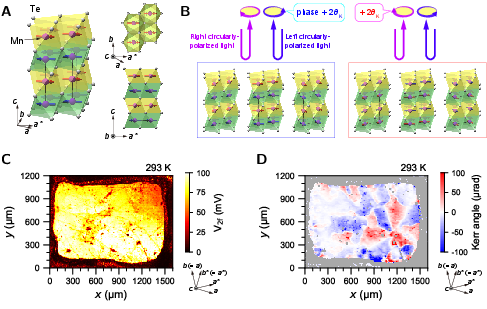
Figure 1: Crystal and magnetic structure of MnTe, the six symmetry-related altermagnetic domains with associated MOKE responses, and real-space reflectivity/Kerr mappings revealing positive and negative domains.
Unlike conventional Kerr effect, which scales directly with the net magnetization, altermagnetic domains exhibit MOKE signal due to intrinsic TRSB in the electronic structure, even with vanishing M. The polar scanning MOKE microscope with a loop-less Sagnac interferometer achieves spatial resolution down to ∼2 μm with precise phase-sensitive extraction of Kerr rotation, immune to linear birefringence and extrinsic Faraday backgrounds.
Magneto-Optical Imaging of Domain Patterns
Large-scale MOKE scans at 293 K (below TN) reveal macroscopic domains with positive and negative Kerr angle, up to 1 mm across, demarcated by sharp walls (Figure 1D). The domain distribution demonstrates strong temperature dependence—both the domain contrast and histogram width of Kerr angle sharply diminish near TN=303 K, vanishing above (Figure 2A–F). This confirms the origin of the observed domains as spontaneous altermagnetic order rather than surface artifacts.
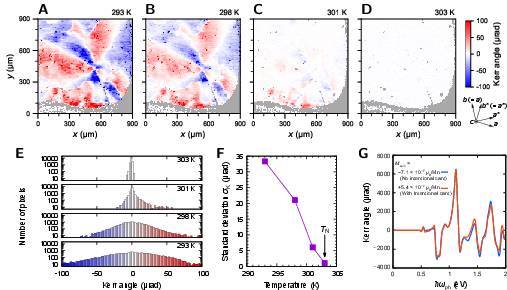
Figure 2: Temperature evolution of Kerr maps and their statistical distribution, plus comparison of ab initio calculated Kerr angle with and without canted magnetization.
Single-point MOKE measurements down to 5 K confirm robust TRSB, but with stochastic sign selection upon each cooldown, characteristic of spontaneous symmetry breaking in the absence of sample training.
Origin of Kerr Rotation: Band Theory Versus Magnetization
To quantitatively assess the mechanism behind the large observed Kerr angle, density functional theory (DFT) calculations of MnTe’s electronic structure were performed for both collinear (m′m′m) and intentionally canted AFM configurations. The calculated Kerr angle at 0.8 eV for the collinear state is P63/mmc0 P63/mmc1rad, in close correspondence with the experimental P63/mmc2 P63/mmc3rad at low temperature. Artificially increasing the canting by five orders of magnitude produces negligible change in the computed P63/mmc4 (Figure 2G), ruling out the canted magnetization as the dominant contribution.
Momentum-resolved optical Hall conductivity calculations identify that spontaneous Kerr rotation arises from interband transitions at the P63/mmc5 points in the Brillouin zone; the broken mirror symmetry in the P63/mmc6 state avoids cancellation among contributions at symmetry-equivalent points, while in an P63/mmc7 configuration the total Hall conductivity vanishes.
Domain Manipulation and Mesoscopic Structure
Thermal cycling above P63/mmc8 results in re-randomization of the macroscopic domain structure, confirming the spontaneous and metastable nature of TRSB (Figure 3A–C). Fine features, including certain domain walls, persist across cycles, indicative of local pinning mechanisms (strain/defect-induced). Application of a modest P63/mmc9-axis magnetic field (m′m′m0 T) during cooling provides efficient domain selection, as the majority domain switches sign with field polarity, though persistent minority domains may nucleate in the sample interior (Figure 3D–F). The fine structure of the Kerr angle profile is largely conserved across trained and untrained states, further underscoring the local crystalline environment’s role in domain energetics.
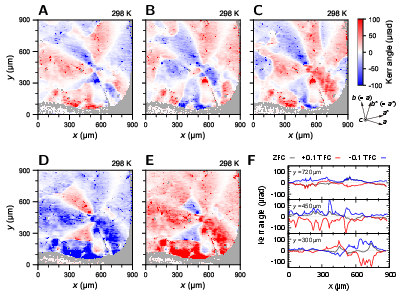
Figure 3: Domain configuration evolution under thermal cycles and m′m′m1-axis field cooling, and linecuts demonstrating domain wall and fine structure persistence.
High-resolution (m′m′m2 m′m′m3m step) scans demonstrate sharp domain walls of apparent width m′m′m4 m′m′m5m, likely limited by instrumental resolution; in the literature, X-ray probes on thin films resolve domain walls as thin as sub-nanometer scale. Further, the authors observe previously undocumented bubble-like subdomain modulation within macroscopic domains, with m′m′m6m lengthscale, independent of reflectivity (Figure 4). This is reminiscent of the complex domain morphology seen in thin films by synchrotron studies.
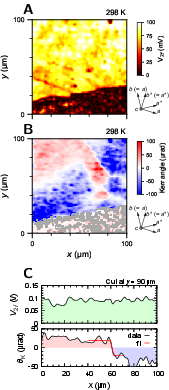
Figure 4: Mesoscopic reflectivity and Kerr mapping of domain and sub-domain structure, with linecut analysis of domain wall width.
Comparative Analysis and Theoretical Implications
The m′m′m7 ratio (Kerr angle per unit magnetization) in MnTe is six to seven orders of magnitude (up to m′m′m8 mrad/T) larger than in classical ferromagnets or even other antiferromagnets with TRSB. As tabulated, Fe, Ni, and ferrimagnets yield ratios m′m′m9 mrad/T, while altermagnetic MnTe demonstrates that Kerr response can be entirely decoupled from the bulk magnetization.
The juxtaposition of domain sizes measured here (sub-mm to mm in bulk) and those previously measured (g0m in ultrathin films) prompts a depth-dependent domain morphology model: fine subdomains nucleate near the surface, with larger domains manifesting in the bulk. Given the optical penetration depth at 1550 nm is g194 nm, both coarse and fine structures are accessible to the polar MOKE technique utilized here.
Implications and Perspectives
The demonstration that standard MOKE microscopy can resolve, manipulate, and stably read out macroscopic altermagnetic domains fundamentally expands the toolkit for investigating TRSB order in antiferromagnets. The ability to couple domain structure to thermal and moderate magnetic perturbations enables robust protocols for information writing and reading, facilitating high-density magneto-optical memory concepts based on altermagnets. Furthermore, the decoupling of the Kerr effect from net magnetization removes stray-field constraints, essential for densely packed devices.
From a theoretical perspective, the observation of such large, mobile, and easily trained domains confirms symmetry-based predictions of degeneracy and domain multiplicity in altermagnets, while the overall compatibility between DFT and experiment consolidates the understanding of MOKE as a probe of electronic-structure-originated TRSB, independent of conventional spin physics.
Conclusion
This work provides the first direct, laboratory-accessible imaging and deterministic control of macroscopic altermagnetic domains in a bulk antiferromagnet. It establishes MnTe as an ideal platform for spintronic and magneto-optical functionalities that exploit global TRSB without stray fields and demonstrates the power of polar MOKE for domain science in this new materials class. Future avenues include vector-field control of domain topology, dissection of domain wall conductivity and mobility, and integration of MOKE-based optical memory architectures leveraging the unique symmetry and electronic properties of altermagnets.
References
- Gakuto Watanabe et al., "Magneto-optical imaging of macroscopic altermagnetic domains in MnTe" (2604.14947)