Ansätz Expressivity and Optimization in Variational Quantum Simulations of Transverse-field Ising Model Across System Sizes
Published 22 Apr 2026 in quant-ph, cond-mat.stat-mech, and hep-lat | (2604.20961v1)
Abstract: We explore the application of the Variational Quantum Eigensolver (VQE) to investigate the ground state properties, particularly the entanglement entropy, of the Transverse Field Ising Model (TFIM) in one, two, and three dimensions, considering systems of up to 27 spins. By benchmarking VQE results against exact diagonalization and analyzing the entanglement properties across different system sizes and geometries, we assess the algorithm's effectiveness in capturing critical phenomena. Using results of TFIM, we also investigate how VQE's expressivity and optimization influence the simulation of highly entangled quantum states. We employ different ansätze: the hardware-efficient EfficientSU2 from Qiskit, the physics-inspired Hamiltonian Variational ansätz (HVA) and HVA with symmetry breaking, and benchmark their performance using energy variance, entanglement entropy, spin correlations, and magnetization. We further discuss the implications for scaling these methods to larger quantum systems.
The paper demonstrates that balancing ansatz expressivity with optimization is key for accurately simulating TFIM ground states.
The paper compares HEA, HVA, and HVA-SB circuits, revealing trade-offs between hardware efficiency and capturing symmetry-protected quantum correlations.
The paper finds that as system dimensionality increases, scalability challenges intensify, urging hybrid quantum-classical optimization to overcome barren plateaus.
Ansätz Expressivity and Optimization in Variational Quantum Simulations of TFIM
Introduction
This paper investigates the performance of Variational Quantum Eigensolver (VQE) algorithms for simulating ground-state properties of the transverse-field Ising model (TFIM) in one, two, and three spatial dimensions. The study systematically benchmarks VQE results—specifically entanglement entropy and critical behavior—against exact diagonalization and other classical approaches, focusing on the effect of circuit ansatz expressivity, optimization difficulty, and scalability as system sizes increase to 27 spins.
Central to the study is a comparison between hardware-efficient (HEA), physics-inspired Hamiltonian Variational Ansatz (HVA), and HVA with symmetry-breaking (HVA-SB) circuits. The core goal is to elucidate the expressivity–optimization trade-off endemic to NISQ-era quantum simulation and to identify metrics and observables that accurately quantify simulation quality in highly entangled and critical regimes.
VQE Framework and Ansatz Selection
The VQE algorithm optimizes a parametrized quantum circuit∣ψ(θ)⟩ to approximate ground states by minimizing the expectation value of the Hamiltonian. The TFIM Hamiltonian,
H=Jz⟨ij⟩∑σizσjz+hxi∑σix,
is non-stoquastic, with periodic boundary conditions and well-defined critical points in all spatial dimensions.
The expressivity of an ansatz circuit is quantified using the 1-design frame potential, a diagnostic for the uniformity with which a circuit samples Hilbert space under randomization. The three ansatz families considered embody distinct trade-offs:
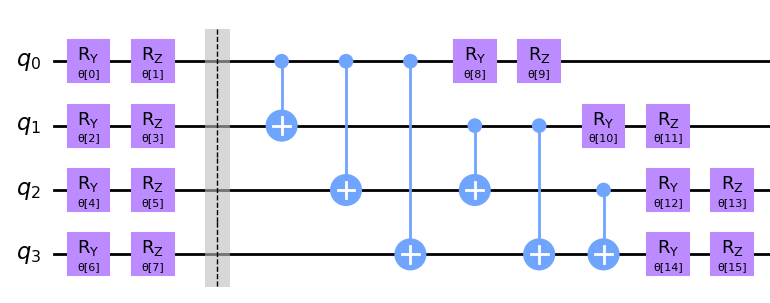
Hardware-efficient ansatz (HEA): Favors implementation efficiency and smooth cost landscapes at the expense of physical specificity.
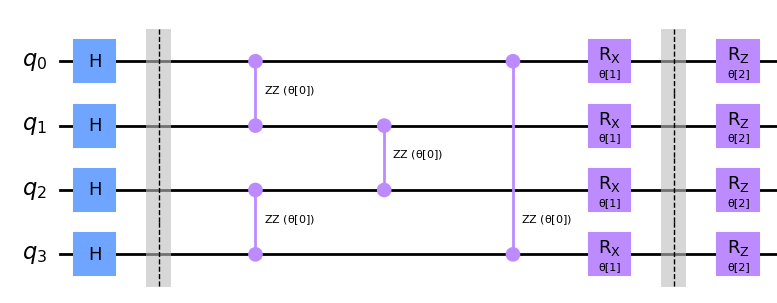
Hamiltonian Variational Ansatz (HVA): Trottorizes the Hamiltonian structure; captures quantum correlations with minimal parameter count but yields rugged optimization landscapes.
HVA with symmetry-breaking (HVA-SB): Augments HVA with explicit symmetry-breaking layers, increasing expressivity and access to entangled or symmetry-broken sectors.
Figure 1: Schematic illustration of the hardware-efficient ansatz (HEA) and HVA with symmetry-breaking layer (HVA-SB) circuits, demarcating initialization, variational, and SB blocks.
Quantification of Ansatz Expressivity
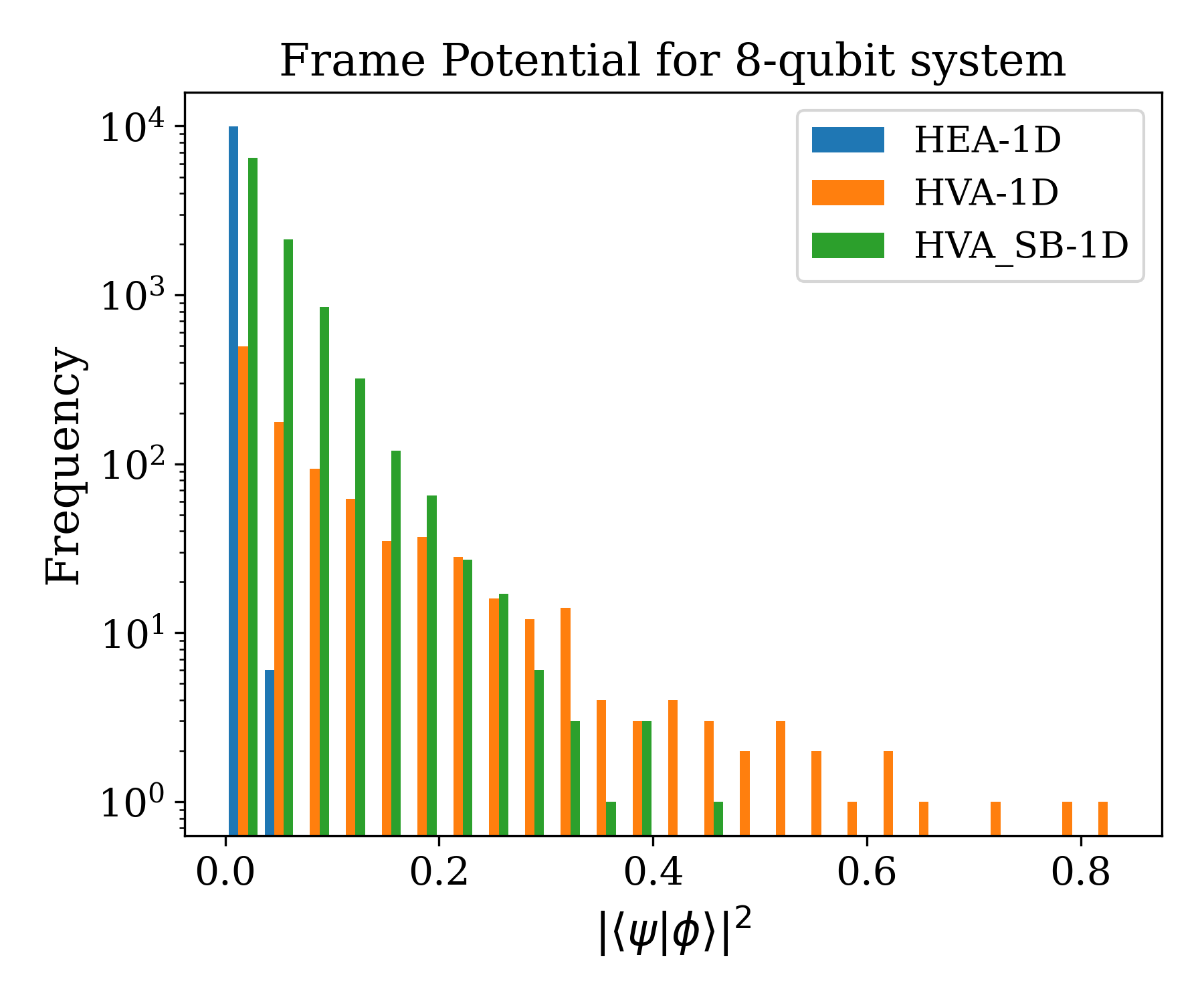
Expressivity is benchmarked via the distribution of the 1-degree norm—specifically, the frame potential F1—across randomly initialized pairs of circuits for each ansatz type. A lower F1 implies higher circuit expressivity. The empirical distributions for HEA, HVA, and HVA-SB on the 1D TFIM system demonstrate that HEA achieves highest expressivity, HVA the lowest, and HVA-SB is intermediate due to symmetry-breaking enhancements.
Figure 2: Distributions of the 1-degree norm for HEA, HVA, and HVA-SB, indicating relative circuit expressivity on 1D TFIM instances.
While a high-expressivity circuit is capable of exploring large swaths of Hilbert space, this is not always beneficial: expressivity must be balanced against the optimizer's capacity to efficiently navigate the corresponding loss landscape, which can become exponentially flat ("barren plateaus") for device-agnostic ansätze.
Ground-State Energies and Entanglement Signatures
VQE simulations of 1D, 2D, and 3D TFIM employing HEA circuits are carried out on systems up to 27 qubits using the CUDA-Q statevector simulator. These results are benchmarked against exact diagonalization and DMRG/MPS where feasible. The following trends emerge:
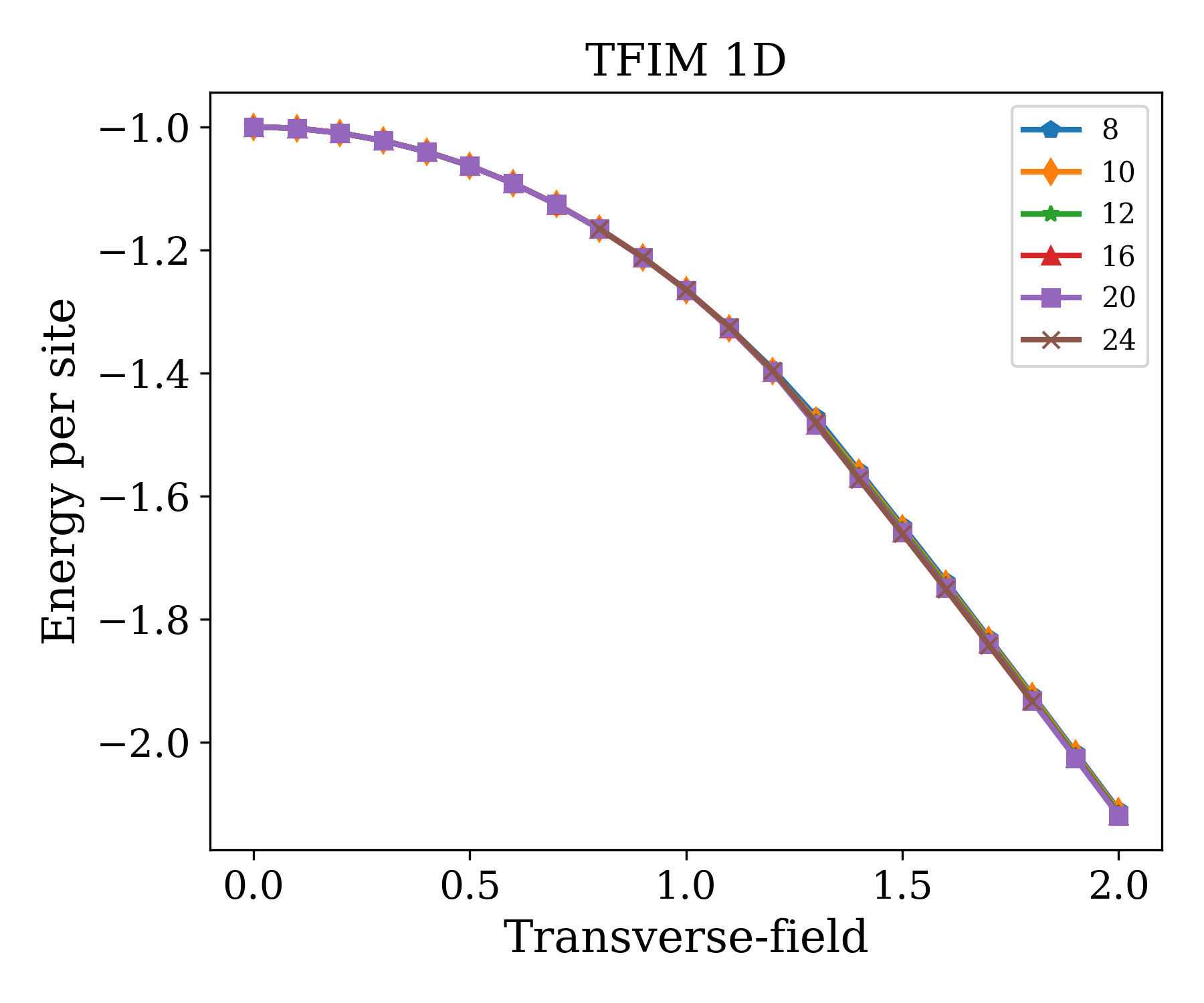
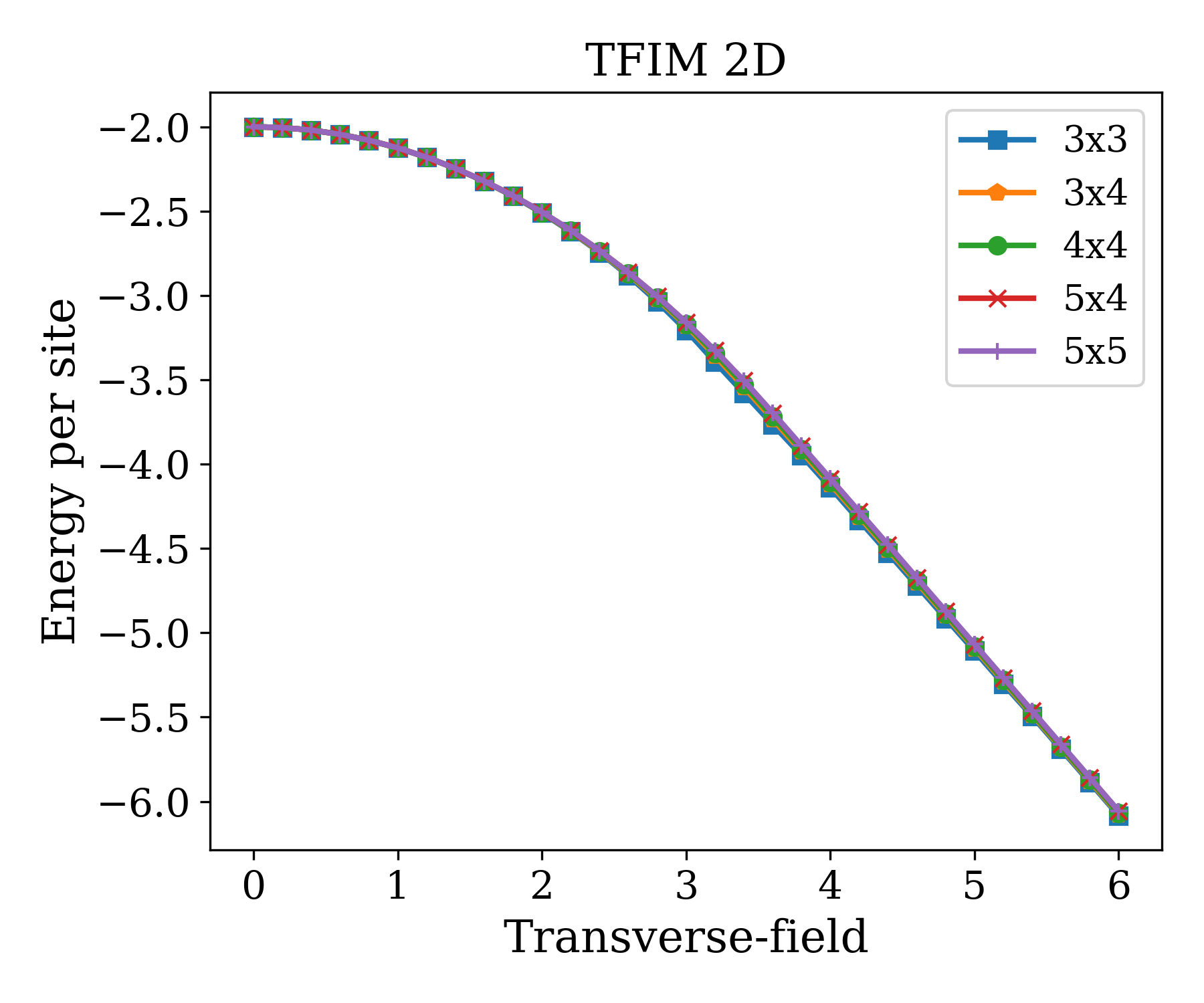
Energy per site is consistent across system sizes and dimensionalities in all regimes away from criticality.
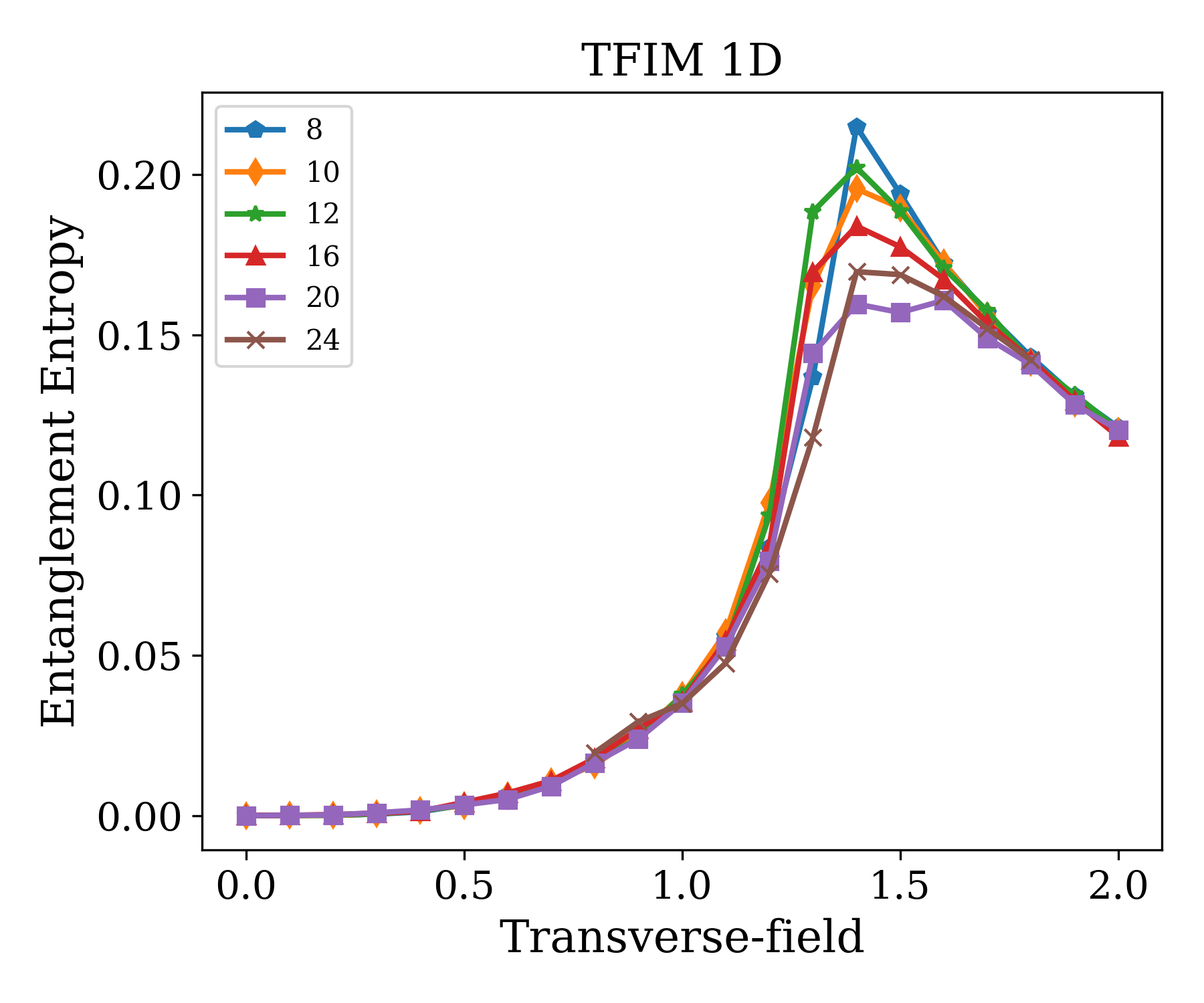
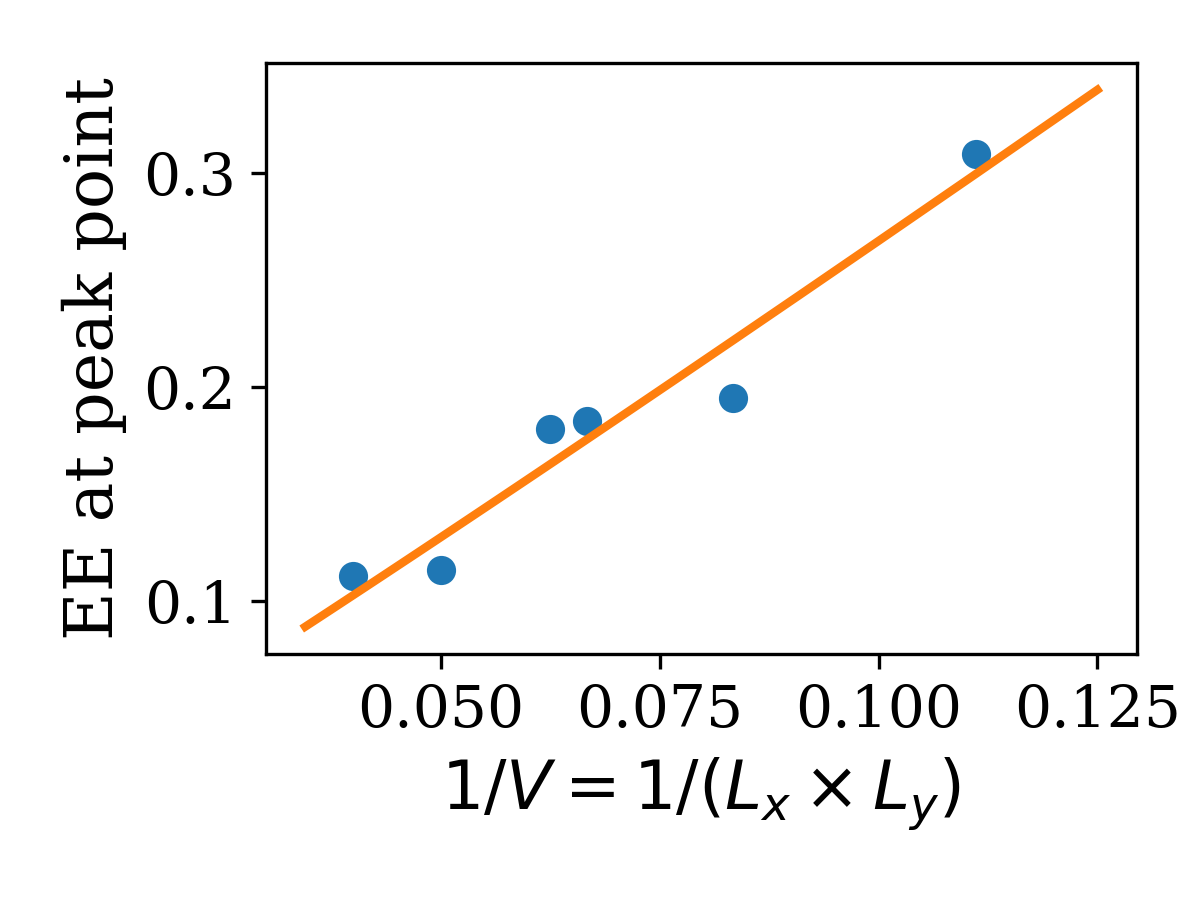
Single-site von Neumann entanglement entropy exhibits pronounced maxima near known quantum critical points: hx(1D)=1.0, hx(2D)≈3.3, hx(3D)≈5.3. The entropy magnitude per site decreases as system size and dimension increase, consistent with area-law entanglement scaling in higher dimensions.
Figure 3: Average ground-state energy per site for TFIM under different system sizes and spatial dimensions as a function of transverse field.
Figure 4: Peak structure in single-site entanglement entropy along transverse-field sweeps, signaling quantum criticality and highlighting dimension-dependent entropy scaling.
Optimization Stability and Benchmarking Against Classical Methods
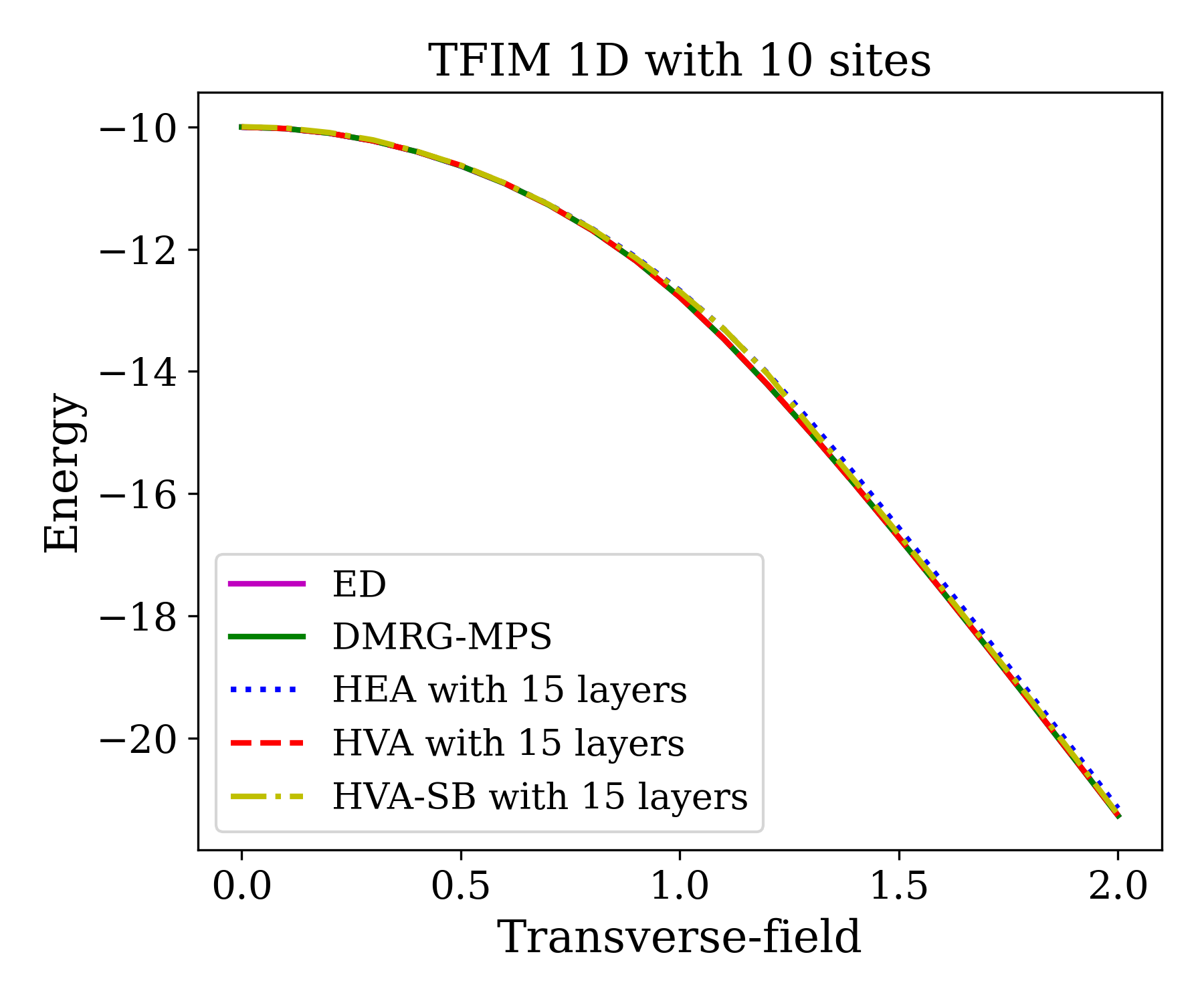
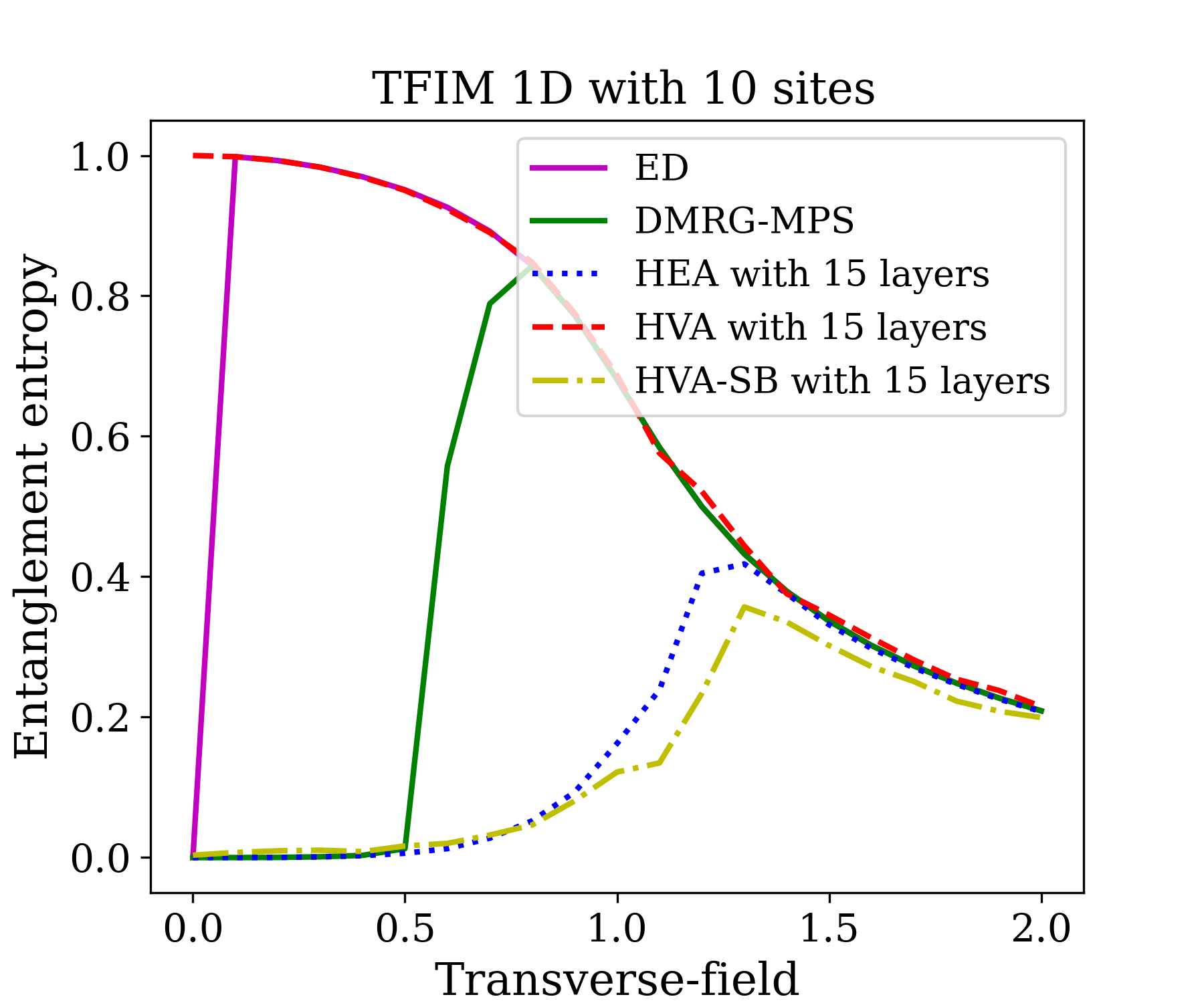
A detailed comparison of energies and entanglement entropies across ED, DMRG, and VQE with multiple ansatz choices is performed, especially in 1D. The principal findings are:
All approaches yield nearly identical energies in the non-critical regime.
Only the HVA ansatz closely matches ED results for entanglement entropy; HEA and HVA-SB tend to reproduce smeared or symmetry-broken states due to greater accessibility to superpositions or symmetry-violating sectors.
VQE with HEA suffers increased energy variance and entanglement entropy errors near criticality due to optimization artifacts, including failure to isolate the correct parity sector in finite-size simulations.
The variance of energy, absolute magnetization, and spin correlations further diagnose optimization quality: HVA yields minimal variance and preserves symmetry, while HEA/HVA-SB can induce artificial symmetry breaking.
Figure 5: Energy variance as a function of transverse field for different ansatz circuits, demonstrating optimizer stalling and symmetry effects.
Scaling to Higher Dimensions
Benchmarking in 2D and 3D TFIM systems using the same ansatz set highlights the rapid growth in optimization difficulty:
HEA remains tractable and yields consistent mean energies but underestimates critical entanglement entropy in strongly correlated regimes.
HVA and HVA-SB accurately capture critical physics in 1D but become susceptible to rugged landscapes and initialization sensitivity in higher dimensions, especially as connectivity increases.
In 3D, variational optimization is often intractable for HVA without improved classical optimizers or adaptive ansatz strategies; only HEA circuits provide viable ground-state estimates.
Practical and Theoretical Implications
The study demonstrates that neither maximal expressivity nor strict physical motility alone is sufficient for VQE scalability on NISQ hardware:
Hardware efficiency enables rapid convergence in classically simulable regimes but systematically fails to capture symmetry-protected or highly entangled ground states in critical or degenerate sectors.
Physics-inspired designs (HVA/HVA-SB) reproduce entanglement with high fidelity but require advanced classical optimization due to the proliferation of barren plateaus and rough cost landscapes as problem size and dimensionality increase.
These observations suggest that future developments in quantum many-body simulation must prioritize not only better ansatz adaptation but also robust, landscape-aware classical optimization and potentially the integration of symmetry constraints and problem-specific structure at the quantum circuit level.
Conclusion
This paper provides a comprehensive benchmark of VQE strategies for TFIM in 1D–3D, highlighting that the interplay between ansatz expressivity and optimizer performance fundamentally limits current NISQ-era quantum simulation. The results underscore that scalable quantum many-body simulation will require hybrid approaches: physically informed, yet optimizer-friendly ansatz circuits, potentially adaptive or problem-aware, combined with advanced quantum–classical optimization modules.
The extension of VQE to 3D TFIM and the development of systematic expressivity–optimization diagnostics represent a substantive step towards robust variational quantum simulation of large, entangled systems. The methodology and findings have broad implications for quantum simulation of critical phenomena and guide future ansatz and optimizer design for quantum advantage in many-body physics.
“Emergent Mind helps me see which AI papers have caught fire online.”
Philip
Creator, AI Explained on YouTube
Sign up for free to explore the frontiers of research
Discover trending papers, chat with arXiv, and track the latest research shaping the future of science and technology.Discover trending papers, chat with arXiv, and more.