- The paper introduces a quasilocal probability framework that reveals correlated quasinormal mode deviations in black hole ringdown.
- It demonstrates that effective non-Hermitian dynamics produce amplitude-dependent damping rates and distinctive oscillatory waveform patterns.
- The analysis distinguishes QP predictions from modified gravity models by highlighting a measurable mismatch between waveform decay and energy flux.
Smoking Gun Signatures of Quasilocal Probability in Black Hole Ringdowns
Introduction and Theoretical Foundations
The study develops the implications of the quasilocal probability (QP) framework for black hole ringdown, articulating a direct connection between spacetime causal structure, Hermiticity as an emergent symmetry, and observable waveform features post-merger. Within standard quantum theory, Hermiticity of the Hamiltonian enforces real eigenvalues, unitary time evolution, and global conservation of the inner product. However, in curved spacetime with causal horizons—exemplified by the black hole event horizon—global probability conservation is obstructed. This motivates a transition to a quasilocal formalism, where the inner product and associated conserved charge are defined within the accessible spatial domain, and flux across the boundary is encoded as an effective non-Hermitian term in the regional dynamics.
Formally, for any region R bounded in spacetime, the evolution of the quasilocal charge QR[Σ] is determined by the flux of the conserved current through the boundary. This naturally yields an effective non-Hermitian regional Hamiltonian, HR=H0−iΓ, with the anti-Hermitian component Γ generated by boundary leakage of the inner-product current. The direct physical implication is that probability need not be globally conserved; instead, a boundary flux encodes the "loss" of probability into inaccessible domains, such as the black hole interior.
Predictive Signatures in Black Hole Ringdown
The central observable consequence is a set of correlated multimode deviations in the quasinormal mode (QNM) spectrum governing black hole ringdown. Unlike parameterized deviations of generic modified gravity theories, the QP framework enforces that all mode shifts originate from a single boundary flux parameter, resulting in covarying frequency, damping, and amplitude corrections across the mode hierarchy.
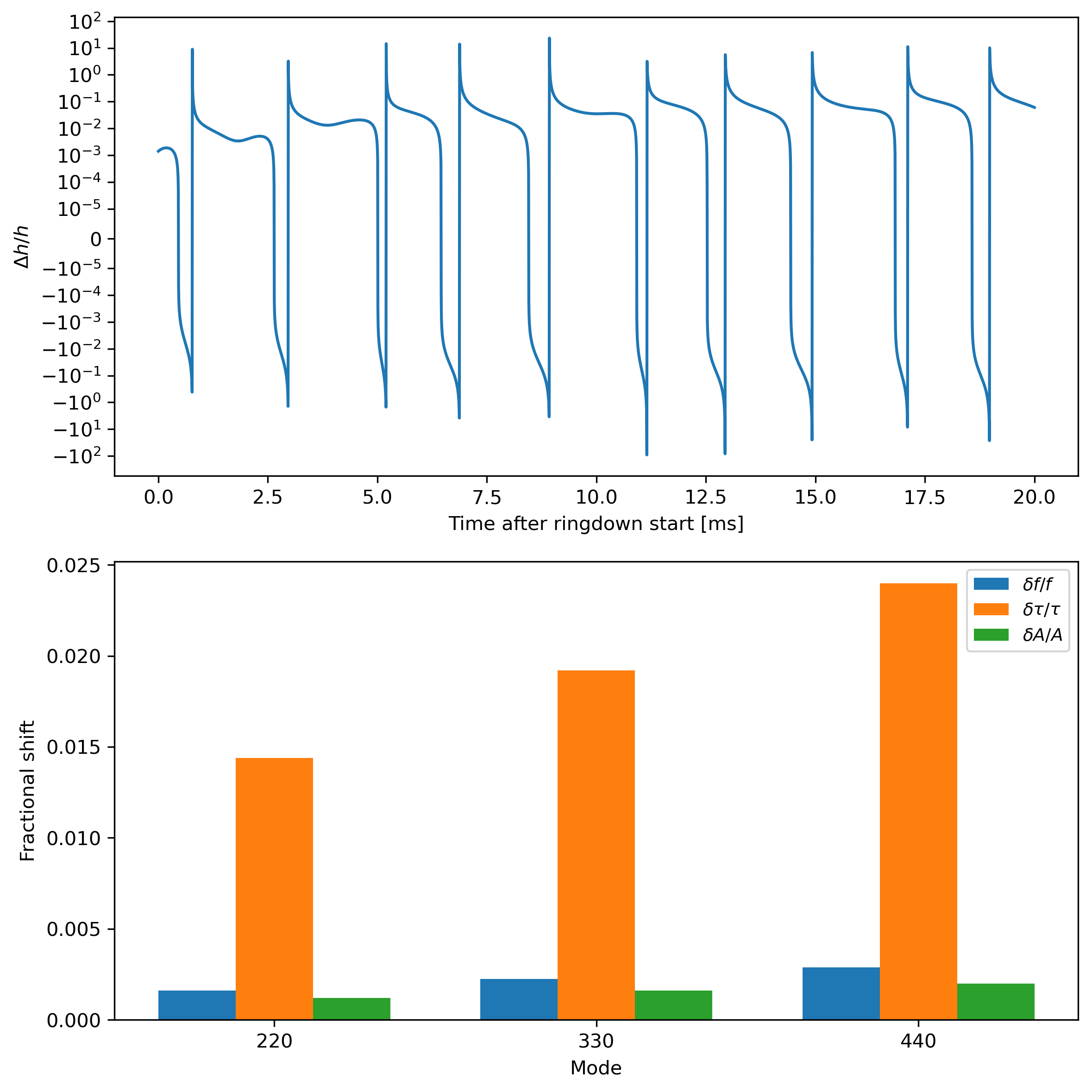
Figure 1: The structured oscillatory residual and correlated shifts among (ℓ,m,n)=(220,330,440) modes, all controlled by a single quasilocal parameter ϵ, demonstrating low-dimensional, multi-mode coherence.
These correlated deviations manifest as structured oscillatory residuals between the QP-predicted waveform and the Kerr expectation. The oscillatory pattern, enhanced near waveform nodes, reflects multimode interference constrained by a single leakage parameter, providing a robust, distinctive test for QP versus high-dimensional, unconstrained deformations from modified gravity.
Amplitude and State Dependence
The QP framework predicts weak, but observable, amplitude (state) dependence in damping rates—nonlinear corrections to the flux across the boundary induced by higher-order field configurations. This results in an amplitude-dependent effective damping coefficient within the evolution equation for each mode. The effect, negligible for small excitations, grows with larger amplitude and is not captured by standard or linearized modified gravity scenarios.
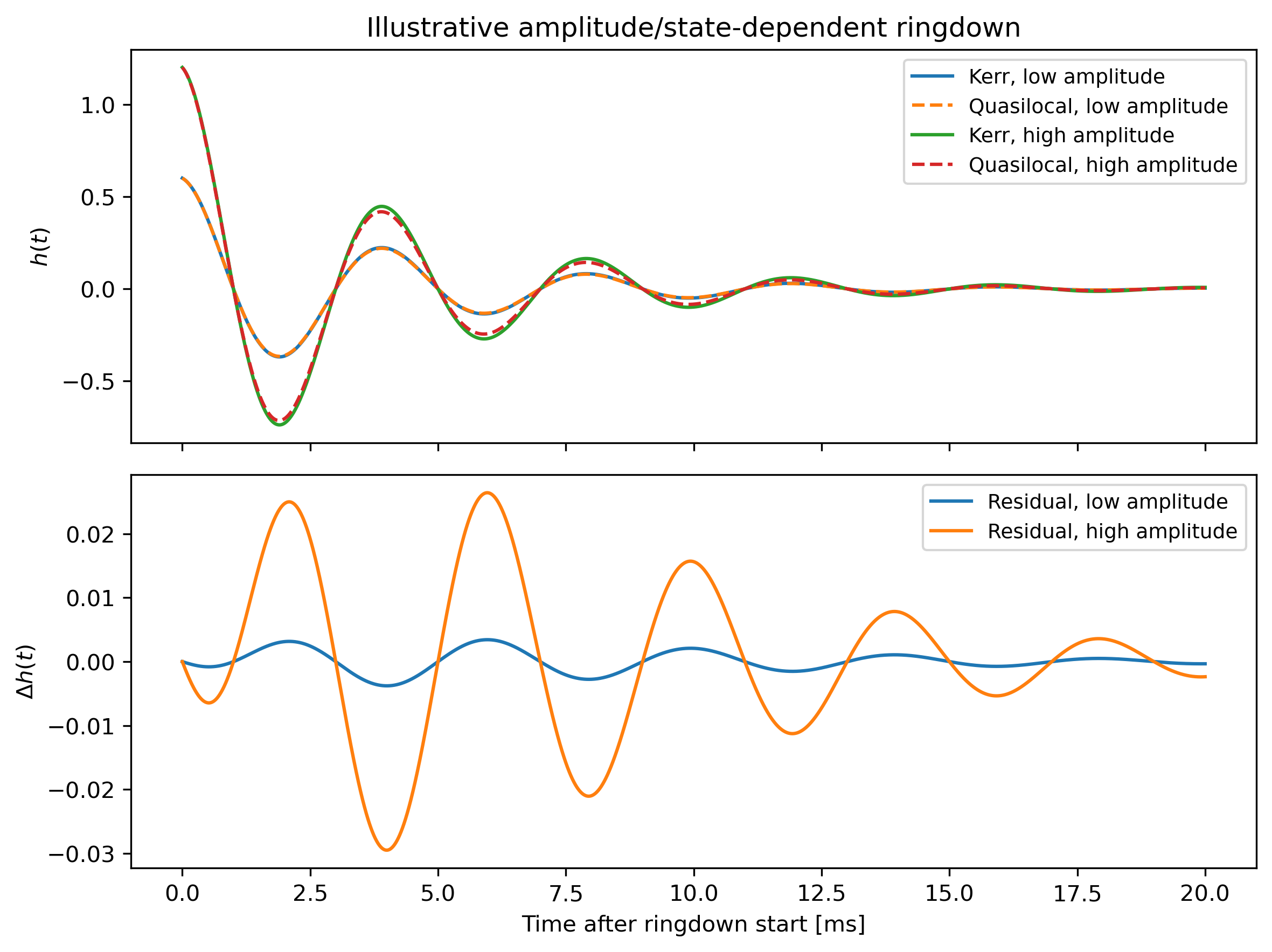
Figure 2: Distinction between Kerr and quasilocal waveforms for different mode amplitudes, highlighting state-dependent deviations which scale with excitation strength.
At the waveform level, this leads to deviation patterns that cannot be removed by a simple rescaling, as the decay envelope itself becomes amplitude dependent—providing a further constraint on possible non-Hermitian or boundary-origin alternative models.
Mismatch Between Damping and Energy Accounting
Perhaps the most direct probe of the non-Hermitian structure is the predicted mismatch between the rate of waveform amplitude damping (inferred from QP leakage) and the actual rate of energy loss (from the stress-energy flux). While both the inner product and energy flux obey their own conservation laws, they are not identical; thus, the measurable rate at which the waveform decays (probability leakage) can differ from the rate expected from energy flux alone.
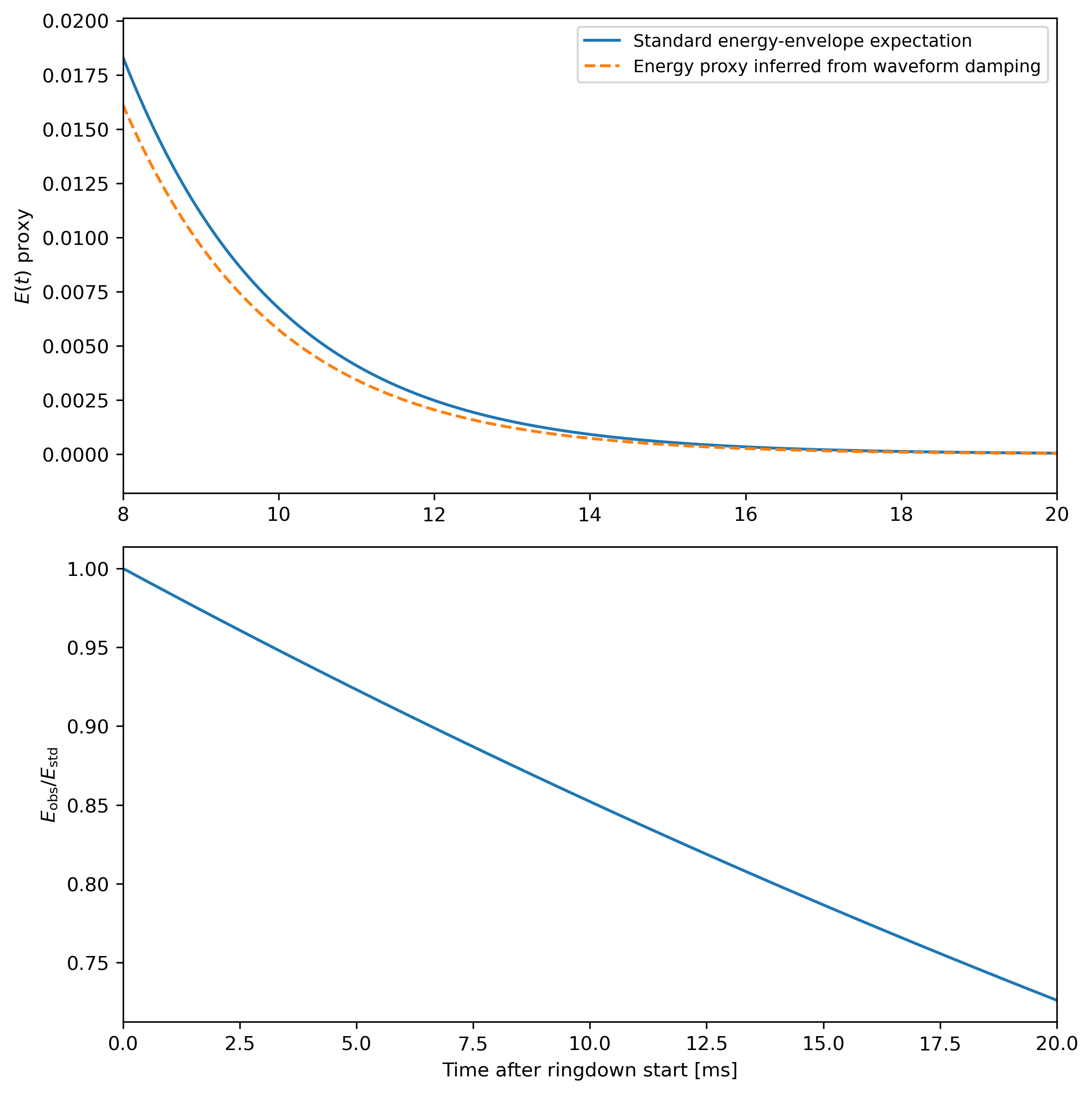
Figure 3: Comparison of energy decay from waveform damping (dashed) versus standard energy evolution (solid), and ratio indicating systematic deviations over time.
This cumulative discrepancy is encapsulated in the time evolution of the energy-proxy derived from the observed waveform compared to the expectation for standard black hole ringdown, manifesting as a secular drift in their ratio—a direct signature of the distinct origins of damping and energy loss within QP.
Discriminating QP from Modified Gravity
A suite of comparative diagnostics distinguish QP from alternative phenomenological or modified gravity explanations:
- Single-parameter structure: All QNM deviations in QP derive from the boundary flux and so trace a low-dimensional, highly constrained function space. In contrast, generic modifications to the perturbation potential or background geometry generate independent, mode-specific shifts.
- Amplitude dependence: Any nonlinear amplitude effect in modified gravity requires explicit nonlinearity (rare near the linear regime of ringdown), whereas QP naturally produces weak amplitude dependence due to its quadratic underpinning in the flux.
- Damping-energy decoupling: Standard and modified gravity theories intrinsically tie waveform damping to the energy flux; QP (via independent conserved currents for the inner product and energy) allows for a measurable deviation.
These features manifest in waveform residuals: QP predicts a regular, oscillatory pattern with correlated shifts; modified gravity typically yields decorrelated, irregular deviations.
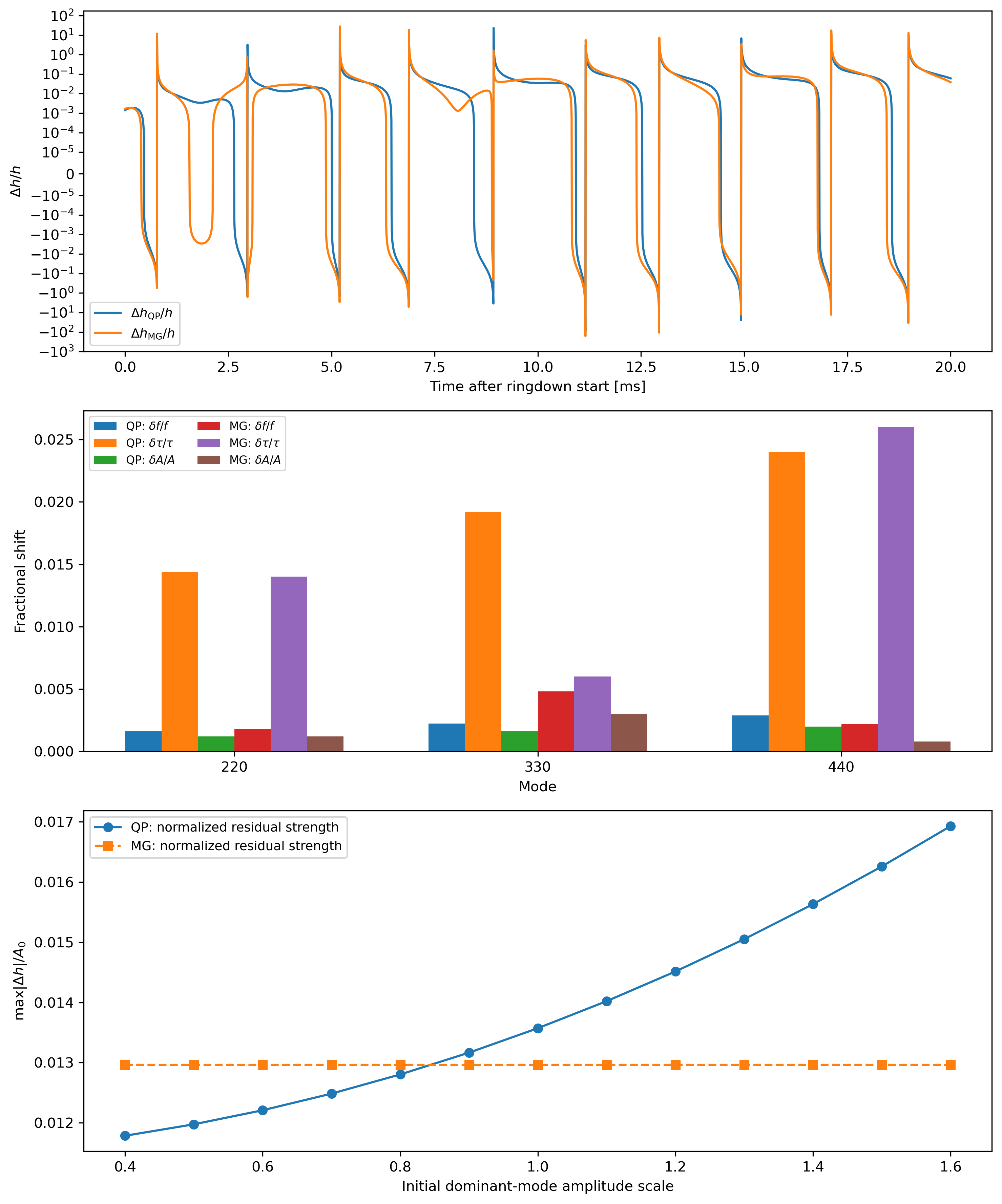
Figure 4: Comparative analysis of QP (blue) and modified gravity (orange) on ringdown residuals, fractional deviations, and amplitude scaling, showing QP’s unique correlated, state-dependent structure.
Observational Prospects
Current gravitational wave detector networks constrain leading QNM deviations at the 10–40% level. However, as measurement precision and ringdown mode separation improve with next-generation instruments (e.g., Cosmic Explorer, Einstein Telescope, LISA), the correlated structure of QP can be statistically extracted or bounded, even if individual uncertainties remain percent-level. Multiple modes, amplitude-resolved measurements, and energy-proxy comparisons provide opportunities for stacking analyses and consistency tests across events—significantly enhancing detectability of the proposed QP signatures.
Theoretical and Foundational Implications
Beyond phenomenology, this work situates Hermiticity in quantum mechanics as an emergent symmetry—its global validity contingent on spacetime’s causal structure and observer access. In the presence of horizons, effective non-Hermitian contributions naturally arise, and the QP framework prescribes unique observational signatures for their presence. Detection of correlated, amplitude-dependent, and energy-mismatched ringdown deviations would provide empirical evidence that Hermiticity in quantum gravity is not an absolute, foundational principle but rather an emergent, context-dependent symmetry.
Conclusion
The QP framework yields a predictive and testable structure for black hole ringdown waveforms, distinguished by correlated multimode deviations, weak nonlinear amplitude dependence, and a damping-energy mismatch, all traceable to horizon-induced probability flux. These features provide a stringent diagnostic for the physical nature of quantum probability in curved spacetime and gravitationally bound, causal domains. Advanced gravitational wave observatories, enabled by black hole spectroscopy and multimode inference, are positioned to empirically test the emergent-symmetry character of Hermiticity and the true boundary structure of quantum probability in the gravitational regime.
Reference: "Smoking Gun Signatures of Quasilocal Probability in Black Hole Ringdowns" (2604.20922)