- The paper presents a novel baryogenesis mechanism where an axion-like scalar field induces electroweak walls, creating a localized chemical potential for baryon asymmetry.
- Numerical and analytic studies confirm that biased sphaleron transitions generate the observed baryon-to-entropy ratio, independent of wall velocity in key regimes.
- The framework predicts observable gravitational wave signals from domain wall collapse and shock wave scenarios, opening new avenues for experimental detection.
Spontaneous Baryogenesis from Axions on Induced Electroweak Walls
Introduction and Framework
The paper "Spontaneous Baryogenesis from Axions on Induced Electroweak Walls" (2604.20762) develops a baryogenesis paradigm where the electroweak phase boundary is not created by the Higgs sector alone but induced locally by a wall-like configuration (domain wall or shock wave) of an axion-like scalar field, ϕ. The mass parameter of the Higgs depends on the value of ϕ, so the scalar wall locally separates the electroweak-symmetric and broken phases, forming an induced electroweak wall. This setup introduces a derivative coupling between ϕ and the B+L current, effectively generating a localized chemical potential for baryogenesis. The mechanism is fundamentally local—baryon asymmetry is generated only in the vicinity of the wall, decreasing the usual constraints on spontaneous baryogenesis that involve a homogeneous background.
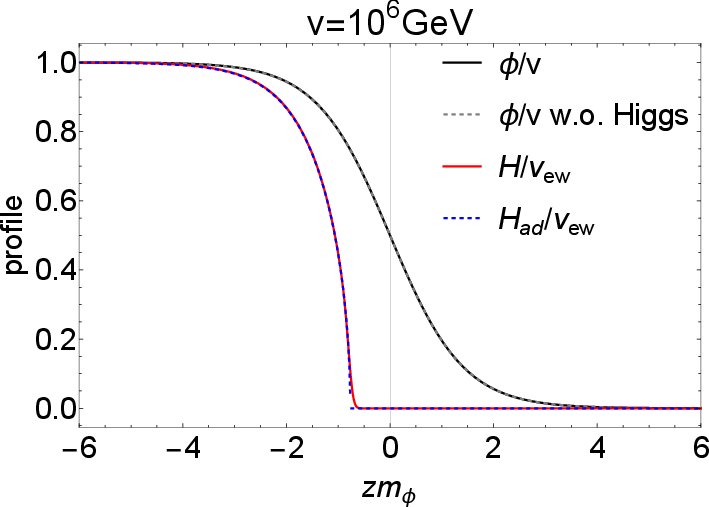
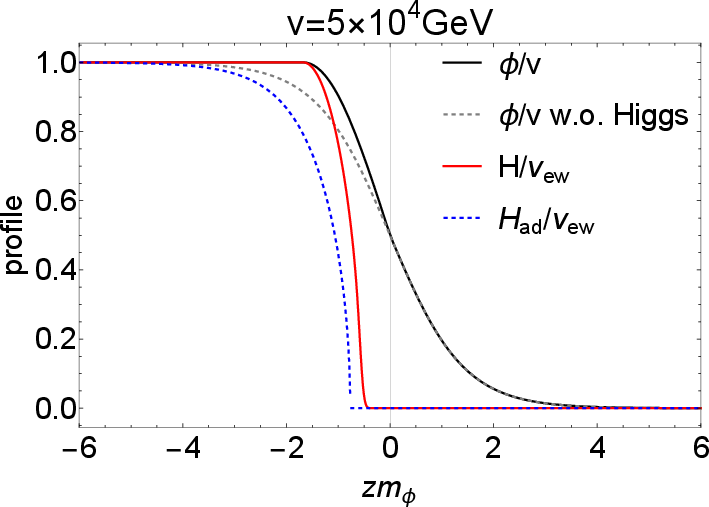
Figure 1: Wall profiles of the Higgs field and ϕ obtained by solving the coupled equations of motion for various portal and self-coupling regimes.
The model relies on the scalar potential of the form V(H,ϕ)=−mH2(ϕ)∣H∣2+λ∣H∣4+Vϕ(ϕ), where mH2(ϕ) contains portal and linear couplings, and Vϕ(ϕ) admits wall-like solutions (ϕ[z=−∞]→v,ϕ[z=+∞]→0). Numerical studies confirm that the Higgs field follows the local minimum determined by ϕ, and the induced electroweak wall structure is robust against Higgs backreaction, provided the portal and self-coupling are appropriately chosen.
Mechanism of Spontaneous Baryogenesis
The baryogenesis mechanism utilizes an anomalous axion coupling of the form ϕ0, which acts as an effective chemical potential for ϕ1 in the plasma frame, ϕ2. The dynamical wall (domain wall or shock front) translates spatial gradients in ϕ3 to time-dependent chemical potential, biasing sphaleron transitions frontside of the wall and generating baryon asymmetry. The evolution of the local ϕ4 number density follows a Boltzmann equation parameterized by the wall velocity and width, the sphaleron rate, and the temperature.
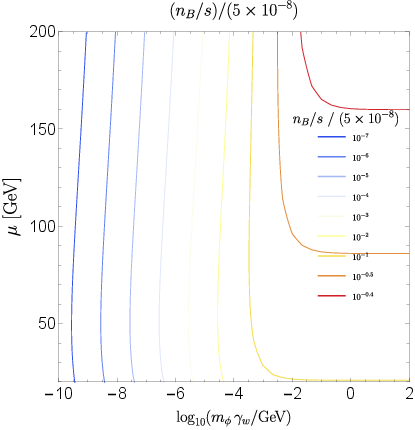
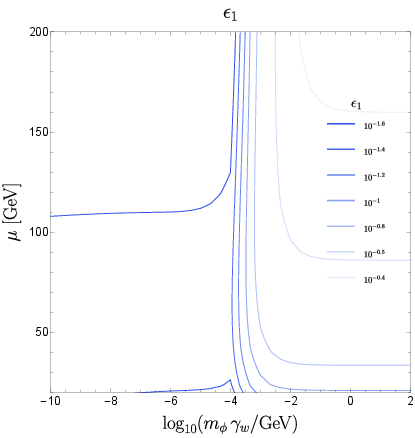
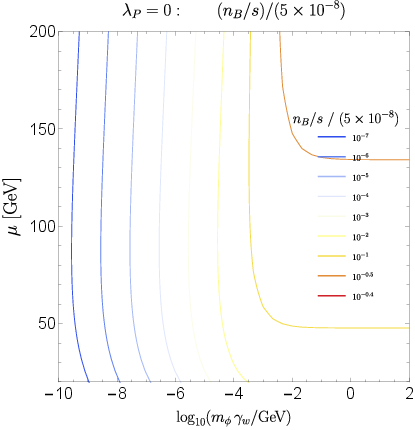
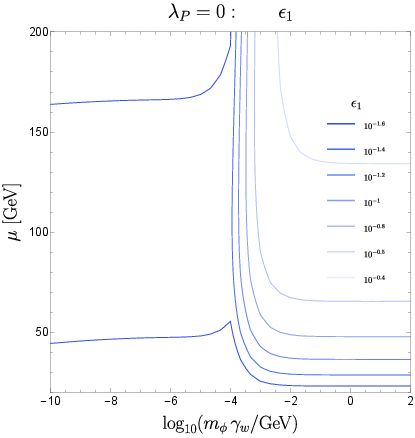
Figure 2: Baryon-to-entropy ratio and CP-violating efficiency parameter ϕ5 produced during the wall passage for different parameter regimes.
Numerical solutions confirm analytic estimates, showing that for ϕ6 and ϕ7, the baryon asymmetry becomes independent of wall velocity—so acceleration or cosmic expansion suppresses inhomogeneities. The wall-induced chemical potential leads to a baryon-to-entropy ratio compatible with observation for suitable parameters, and the leptonic or quark decay channels of the axion field determine reheating and dilution dynamics.
Cosmological Realizations: Domain Walls and Shock Waves
Domain Wall Scenario
The paper analyzes axion domain walls formed at ϕ8, entering a scaling regime with tension ϕ9 dominating over thermal bias. Electroweak symmetry breaking occurs in patches with ϕ0, while others remain symmetric. Collapse of the network can be immediate or delayed, but must occur before domain wall domination or vacuum inflation to avoid cosmological problems. The baryon asymmetry is produced locally during collapse, reheating proceeds via axion decay, and the mass/coupling ranges are determined by precision constraints and dilution requirements.
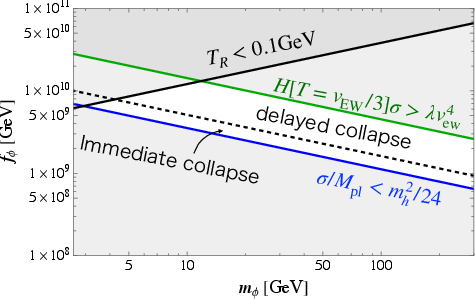
Figure 3: Parameter space for ALP domain walls, highlighting regions compatible with observed baryon asymmetry, the timing of collapse, and decay dynamics.
Entropy dilution and inhomogeneities are carefully addressed: with domain wall collapse timed above the electroweak scale and decay constant in the range ϕ1 GeV, inhomogeneities are suppressed; chains of walls further reduce variance by factors of ϕ2.
Shock Wave Scenario
In the alternative scenario, shock waves induced by inflation or other dynamics lead to instantaneous phase boundaries. The wall is formed by a scalar potential with large hierarchy (ϕ3), and reheating is regulated by axion decay. The baryon-to-entropy ratio follows directly for a wide parameter regime, and inhomogeneities are mild given the subhorizon origin of shock bubbles and insensitivity to wall Lorentz factor.
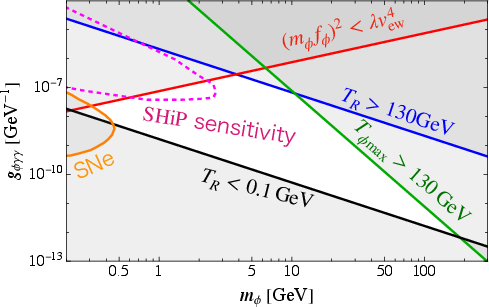
Figure 4: Parameter space for the ALP in the shock wave scenario, including projected SHiP sensitivity and astrophysical constraints.
Gravitational Wave Signatures
Both domain wall and shock wave scenarios predict prominent gravitational wave signals, with spectra shaped by bubble collisions, domain wall collapse, and sound waves. The merged signal is expected to be detectable by next-generation space-based interferometers (LISA, MAGIS, BBO), with the sum of sources setting the final shape.
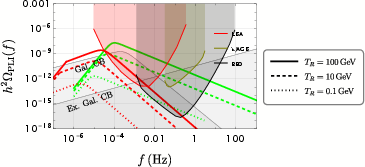
Figure 5: Gravitational wave spectrum induced by bubble collision (red) and domain wall network (green) compared to LISA, MAGIS, and BBO sensitivity bands and astrophysical foregrounds.
The frequency and amplitude follow from the tension, collapse timing, and dilution factors (scaling as ϕ4). The shock-induced background is similarly calculable, and figures demonstrate anticipated observational reach.
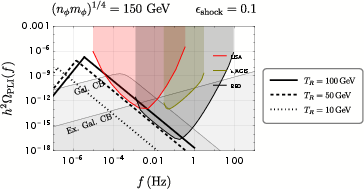
Figure 6: Gravitational wave spectrum induced by shock propagation—peaks in the mHz to nHz band with entropy dilution taken into account.
Comparison to Standard EWBG Mechanism
A systematic comparison shows that the conventional electroweak baryogenesis source—with CP-violating dimension-5 operators—fails to reproduce the baryon asymmetry given EDM bounds and suffers from strong spatial dependence translating to inhomogeneity constraints.
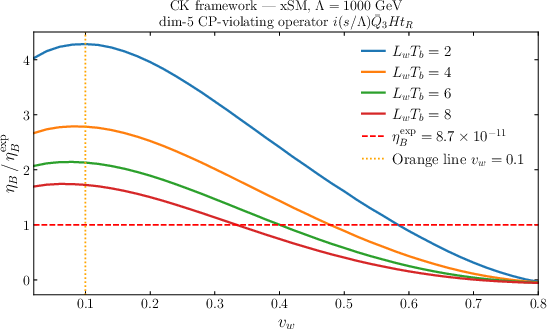
Figure 7: Baryon number produced for ϕ5 TeV at the symmetry breaking boundary as a function of wall velocity, referencing the impact of EWBG source.
The wall-induced chemical potential mechanism removes reliance on chiral charge diffusion, and remains viable even in the limit of vanishing Yukawa couplings.
Conclusion
This work defines a paradigm in which baryon asymmetry is generated locally at an electroweak boundary induced dynamically by an axion-like scalar wall. The coupling to ϕ6 current generates a chemical potential localized to the wall, and sphaleron transitions frontside freeze the asymmetry, with cosmological evolution determined by the wall’s collapse and decay mechanisms. Domain wall scenarios require timely collapse and proper decay channels; shock wave scenarios offer instantaneous inhomogeneity suppression. Gravitational wave spectra accompanying the baryogenesis process are observable, making this a compelling scenario for future experimental tests. The approach offers flexibility in model building, removes some constraints of homogeneous spontaneous baryogenesis, and provides clear predictions for gravitational wave signals and baryon inhomogeneities. Future investigations should explore detailed model architectures, the interplay with other cosmological probes, and avenues for laboratory detection.