- The paper demonstrates that AI models can generate physically implausible outputs (hallucinations) when modeling unstable viscous fingering flows.
- It shows that spectral bias in models like ViT and DAE-LSTM leads to unphysical artifacts, while the DeepFingers architecture closely replicates DNS spectral energy distributions.
- The work underscores the need for hybrid, physics-constrained neural operators to reliably predict complex, multiscale flow dynamics in critical applications.
AI-Induced Hallucination in Modeling Unstable Viscous Fingering Flows
Introduction
Viscous fingering—where a less viscous fluid displaces a more viscous one in porous media—serves as a canonical example of nonlinear, multiscale instability that is central to numerous geophysical, engineering, and industrial processes. Despite advances in direct numerical simulation (DNS) techniques, data-driven AI surrogates have been proposed to accelerate and generalize the resolution of such complex flows. This paper systematically investigates a critical failure mode in AI-based flow surrogates: hallucination—the generation of physically implausible but visually plausible outputs, previously associated mainly with LLMs. The study introduces and validates DeepFingers, a hybrid Neural Operator architecture which enforces multiscale fidelity through spectral balancing, and provides a rigorous assessment against transformer and autoencoder-based deep learning baselines.
Hallucination Phenomena in Physics-Based AI Modeling
The paper provides conclusive evidence that state-of-the-art AI architectures applied to unstable flow prediction are susceptible to hallucinations, especially in the context of viscous fingering with high viscosity contrast and nontrivial Peclet numbers. Hallucinated outputs are identified as spurious fluid interfaces and unphysical diffusion/reverse mixing, which visually track expected evolution but violate conservation laws and established fluid mechanics.
A systematic comparison against DNS makes clear that DAE-LSTM (latent dynamical system architectures) and Vision Transformer (ViT) models are vulnerable to two distinct hallucination regimes: DAE-LSTM yields oversmoothed finger tips and spurious isolated fluid patches at early times, while ViT exhibits nonphysical islands of the more viscous fluid embedded in the advancing less viscous region at later times. These artifacts cannot be attributed to discretization or sampling errors in DNS, but emerge from architectural and learning biases in the AI surrogates.
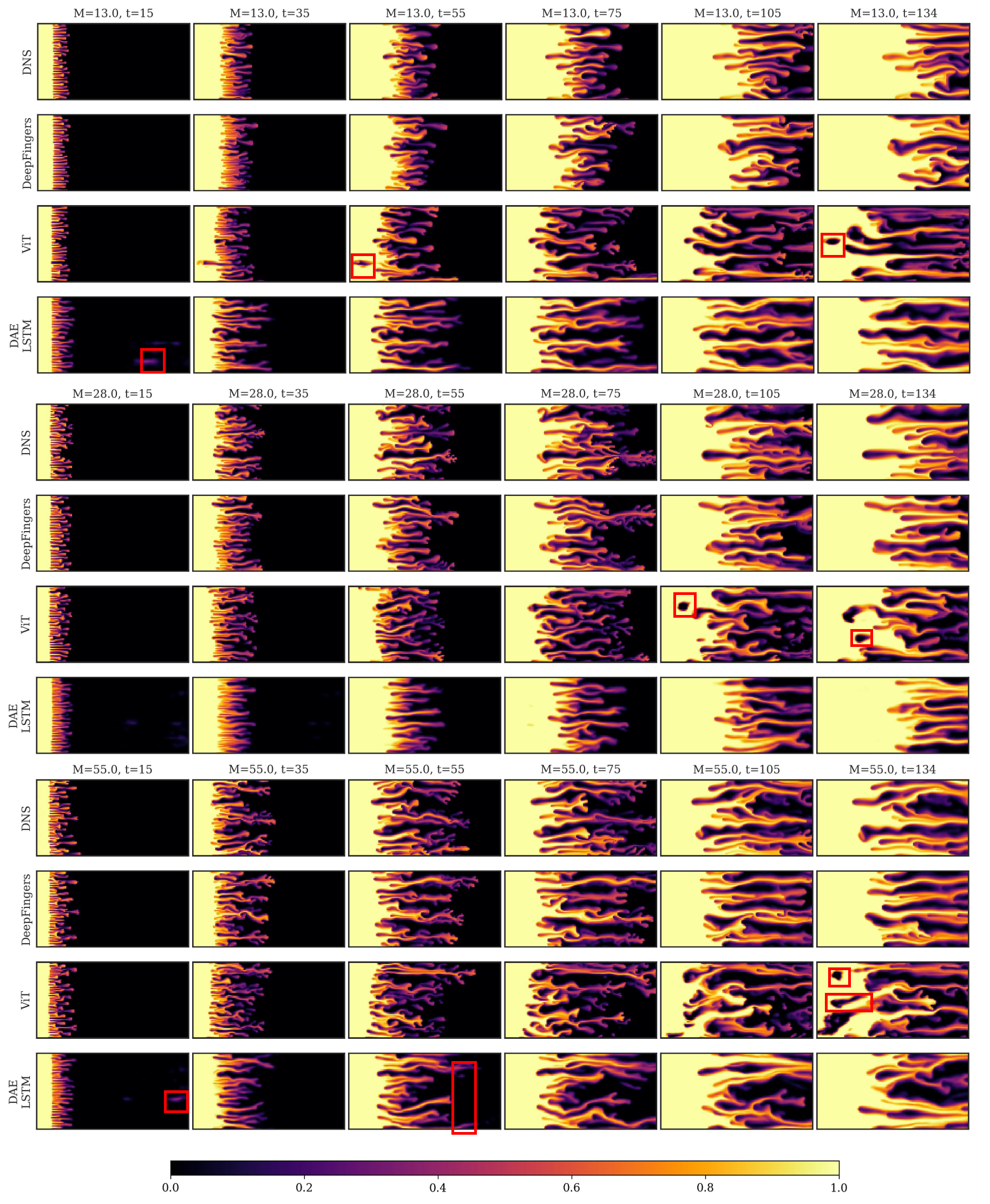
Figure 1: AI architectures (DeepFingers, ViT, DAE-LSTM) exhibit visually plausible but physically inconsistent predictions; only DeepFingers tracks the DNS reference without introducing hallucinated patterns.
Expanding the definition of hallucination into the domain of scientific physical modeling provides a critical framework for diagnosing, interpreting, and ultimately mitigating nonphysical AI failures in complex spatiotemporal systems.
Spectral Bias and Operator Learning
The spectral analysis delineates spectral bias as the principal driver of hallucinations in the evaluated neural network architectures. ViT structurally underrepresents dominant low-frequency spatial modes while over-amplifying higher modes, leading to artificial fine-scale fluctuations and discontinuous interface artifacts. In contrast, DAE-LSTM exhibits an M-dependent suppression of higher modes, resulting in too few, overly diffused fingers and loss of boundary integrity.
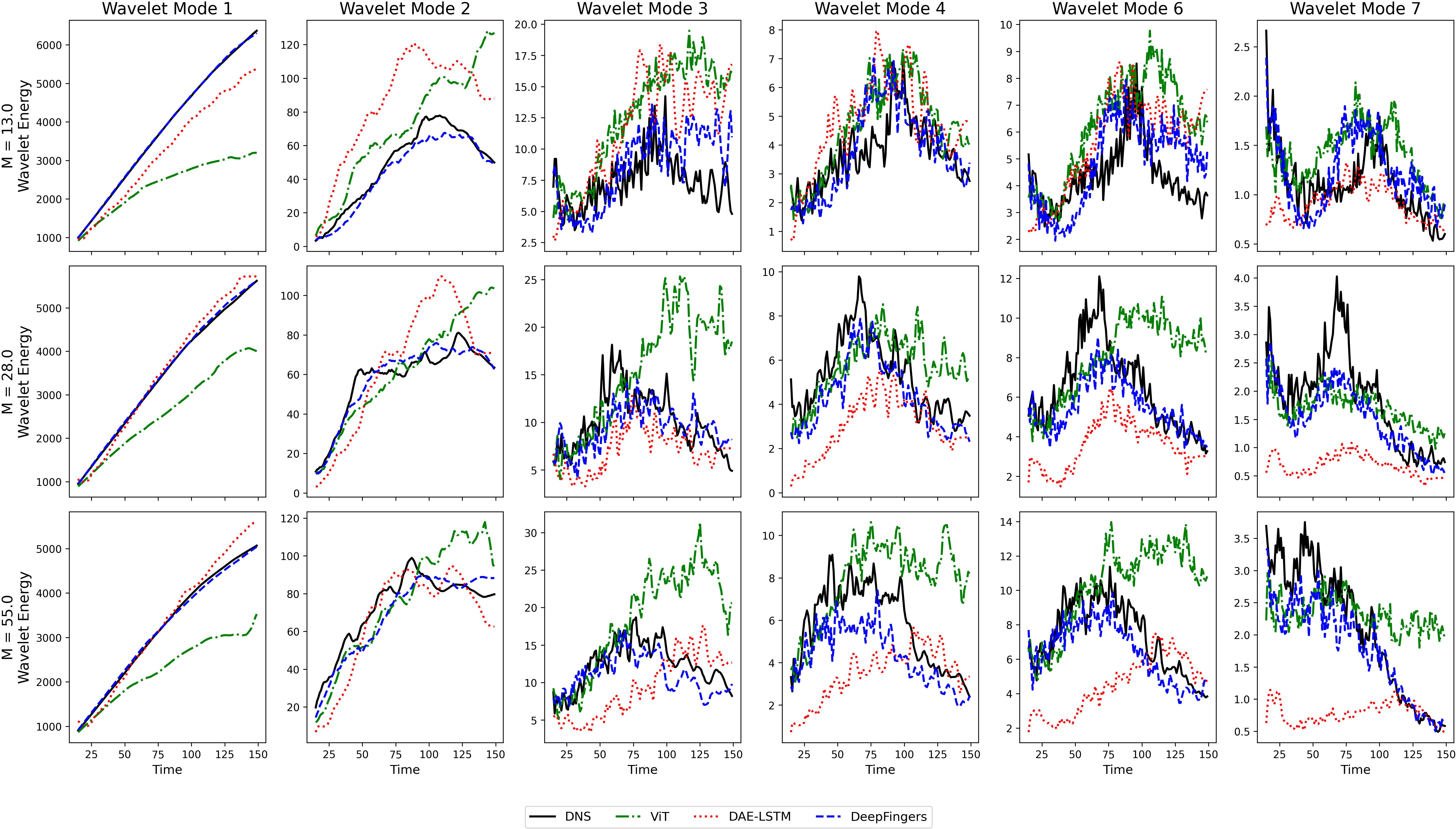
Figure 2: Spectral mode analysis shows DeepFingers preserves the DNS mode distribution, while ViT and DAE-LSTM release spectral imbalances manifesting as hallucinated spatial features.
Aggregated over time and viscosity ratio, the mean spectral energy further quantifies these biases. DeepFingers matches DNS closely across modes, whereas ViT consistently overestimates intermediate-high modes and DAE-LSTM alternates between over- and underestimation across physical regimes.
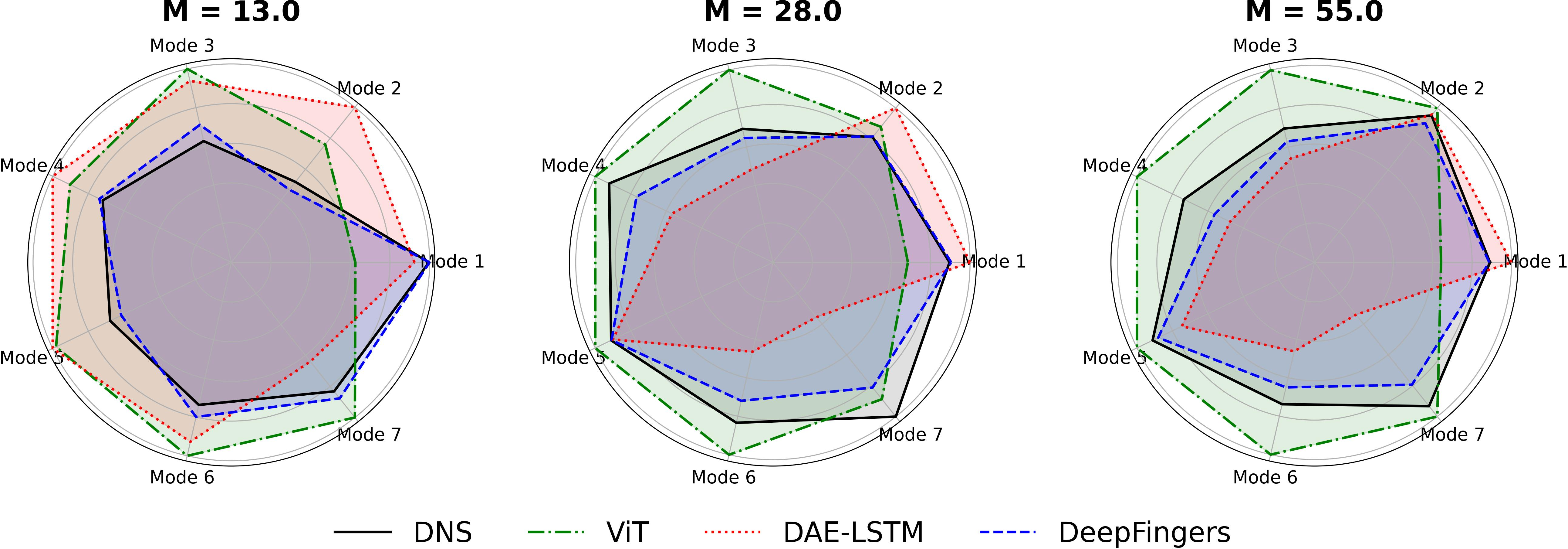
Figure 3: DeepFingers achieves balanced fidelity to DNS spectral energy in all modes, ViT and DAE-LSTM show persistent mode-wise biases correlated with hallucination.
DeepFingers Hybrid Neural Operator Architecture
DeepFingers is proposed as a hybrid framework: the branch network leverages a Fourier Neural Operator (FNO) for capturing global, nonlocal field dependencies and the trunk network is a fully connected operator that conditions on time and physical parameters (e.g., viscosity ratio M). Two U-FNO layers—embedding multiscale U-Net hierarchical convolutions—project the merged representations to efficiently transfer multiresolution spectral content and resolve nonlinear finger evolution.
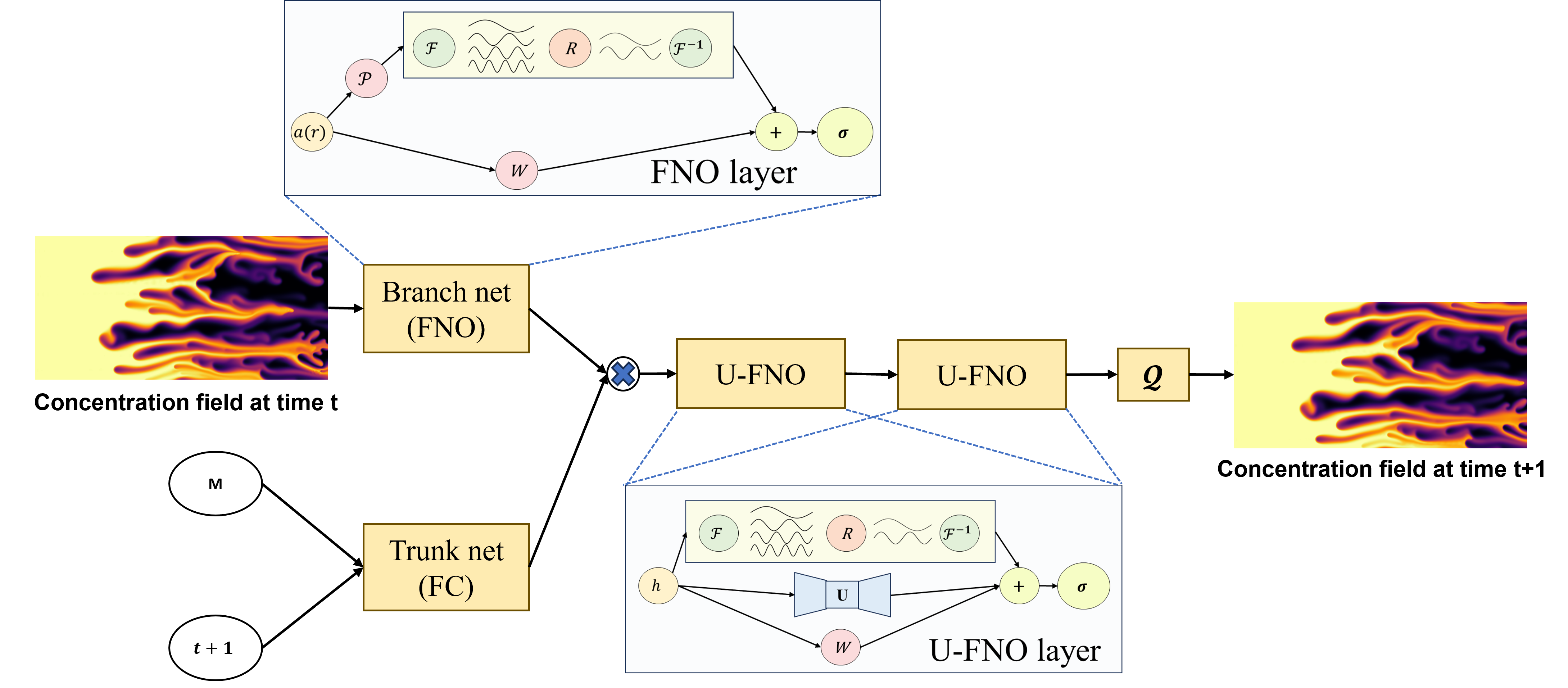
Figure 4: The DeepFingers architecture fuses FNO and U-Net mechanisms within the operator learning paradigm for enhanced multiscale representation in viscous fingering.
This induces spectrally balanced learning and enforces fidelity to the underlying PDE physics without explicit recourse to governing equations. DeepFingers reliably approximates time evolution of mixing, tip-splitting, and channeling even in large M regimes.
Mitigating Hallucination via Spectral Debiasing
Transformer-based models trained for static image tasks (e.g., ViT) fail to encode temporal correlations or enforce spectral regularization, rendering them prone to hallucination. Introducing cross-attention blocks, inspired by the CViT operator learning architecture, into the ViT model substantially improves temporal continuity and spatial coherence, effectively eliminating nonphysical islands observed previously. However, residual deficiencies at low/intermediate M reflect that further architectural advancements are required for full physical consistency.
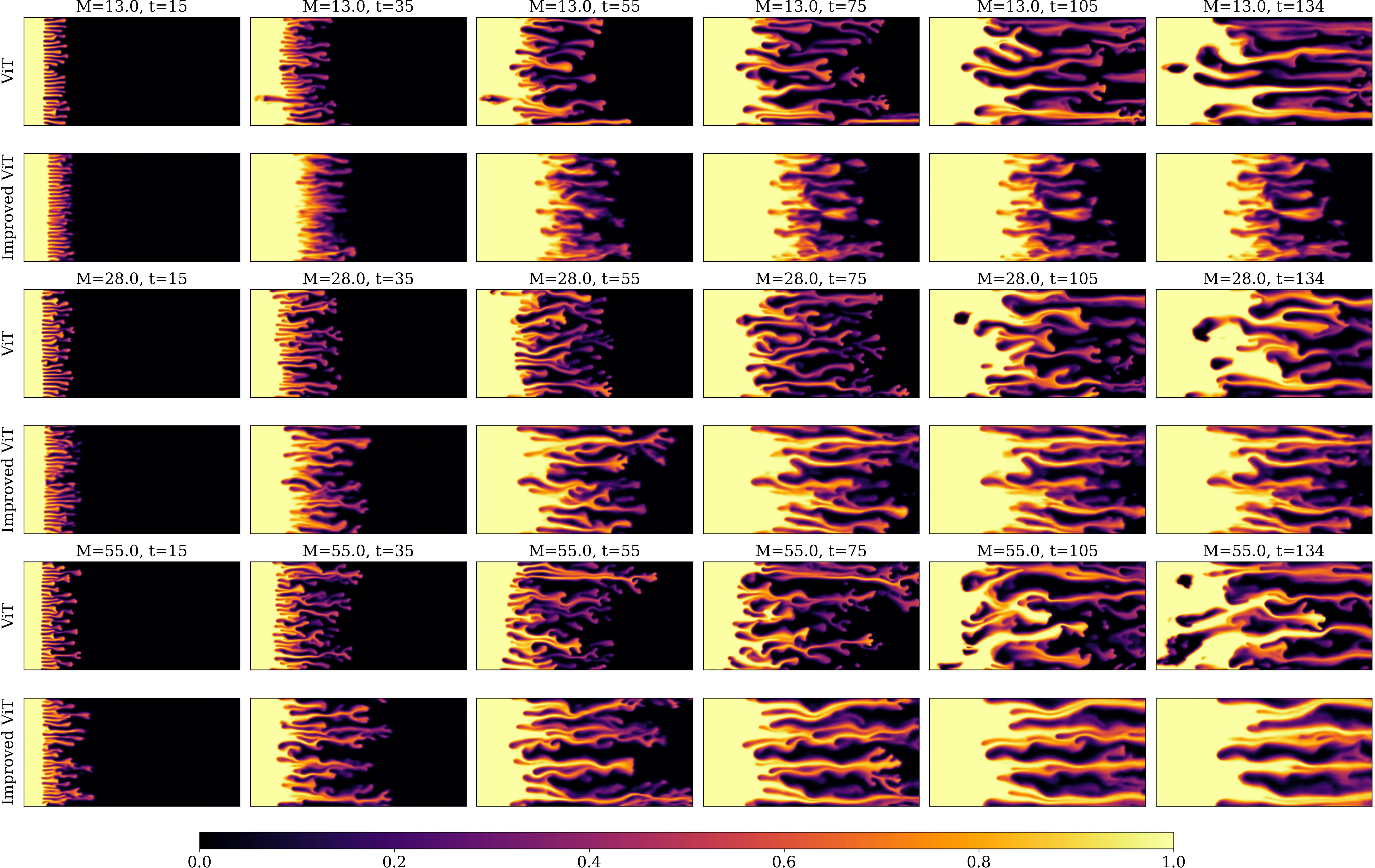
Figure 5: Incorporation of cross-attention blocks into ViT eliminates major hallucinated features, evidencing the value of operator-spectral debiasing.
Global Mixing Metrics and Uncertainty Quantification
Evaluation on field-aggregated metrics (domain-averaged concentration, breakthrough, mixing degree, dissipation rate) demonstrates that DeepFingers consistently approximates DNS across all test scenarios, while ViT and DAE-LSTM are inconsistent and subject to hallucinated behaviors that distort physically significant statistics. Quantifying uncertainty propagation across initial conditions, DeepFingers accurately tracks the full distribution of mixing metrics both in median and variance over time and M, which is essential for geoscientific and industrial applications involving natural heterogeneity.

Figure 6: Time-evolving PDFs of mixing metrics confirm DeepFingers as an accurate uncertainty propagator, matching DNS variance and median statistics under diverse initial conditions.
Implications and Outlook
This work demonstrates that the classical hallucination failure mode of large AI models is not exclusive to language or generative domains but constitutes a fundamental risk for scientific and physics-based surrogates, especially in underconstrained multiscale systems. The findings underscore the necessity of spectral bias diagnosis and mitigation for physically trustworthy surrogate modeling. The success of operator-based hybrid approaches such as DeepFingers points toward new research avenues in embedding explicit spectral regularization and architectural bias corrections into machine learning for physics.
Practically, robust hallucination detection, a move beyond naive pixelwise accuracy, and rigorous uncertainty quantification are indispensable for deployment of AI in critical scientific and engineering workflows such as resource management, CO2 storage, and contaminant remediation.
Conclusion
This paper advances the state of understanding of AI-based modeling of hydrodynamically unstable flow by rigorously defining and characterizing hallucination, tracking its origins to spectral biases, and proposing an effective operator-based architecture that eliminates these artifacts. The implications extend beyond viscous fingering, signaling a broader need for physics-constrained architectures and diagnostic metrics in deep learning for the sciences. Future development is likely to focus on scalable, interpretable, and spectrally balanced operator learning frameworks capable of delivering both high-fidelity prediction and quantifiable physical consistency in complex natural systems.

