- The paper introduces partially coherent skyrmions by passing coherent beams through random phase screens, enabling controlled topological phase transitions.
- It employs cross-spectral density and Stokes-vector mapping to renormalize polarization fields and preserve topological invariants even under turbulence.
- Experimental results show that partial coherence suppresses phase singularities, ensuring robust skyrmion number quantization despite modal imbalances.
Incoherent Light as a Resource for Skyrmionic Topology: Stability and Transitions
Introduction
The study systematically extends the framework of optical skyrmions, typically confined to fully coherent and polarized electromagnetic fields, to the general domain of partially coherent—intrinsically stochastic—light fields. Employing the rigorous mathematical apparatus of cross-spectral density and Stokes-vector mapping, the authors introduce and characterize stochastic optical skyrmions, elucidating regimes where spatial coherence acts as a critical determinant of topological stability, robustness, and reconfigurability. This work delineates not only how incoherence can enhance skyrmion stability in adverse environments but also how coherence engineering becomes a new handle for topological phase control, with theoretical and practical ramifications for photonic information transport and structured light manipulation (2604.20207).
Theoretical Framework: Stochastic Skyrmion Textures
Optical skyrmions are defined via the topological mapping between the real-space polarization texture of structured light and the Poincaré sphere. For coherent beams, these textures are generated by superposing independently polarized Laguerre–Gaussian modes of differing vorticity, generating transverse Stokes fields with nontrivial topological charge.
The core advancement of the paper is the introduction of partially coherent skyrmions, generated by passing a coherent skyrmion beam through a temporally varying, polarization-insensitive random phase screen and performing ensemble (time) averaging. The resulting field is described by the cross-spectral density matrix, with the degree of spatial coherence μ(r1,r2) controlling the statistical correlation and thus the spatial coherence landscape.
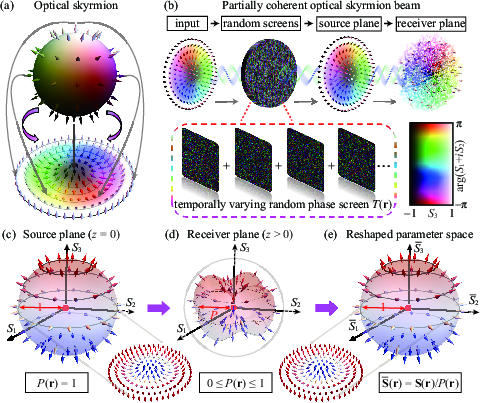
Figure 1: Schematic—partially coherent optical skyrmion generation, Stokes-space mapping, and local normalization scheme.
Upon propagation, partial coherence leads to spatially inhomogeneous depolarization, causing the Stokes vector locus to shrink into the unit Poincaré sphere’s interior. To rigorously define skyrmionic topology in this context, the Stokes vectors are locally renormalized, restoring a unit-sphere mapping and preserving the applicability of the skyrmion number as a topological invariant.
Propagation Dynamics and Robustness
The authors analyze propagation dynamics of partially coherent skyrmion beams with Gaussian-spatial-coherence profiles. Experimental Stokes polarimetry and calculated textures demonstrate that the skyrmion topology—quantified by the number Nsk—persists through real-space Née–Bloch transitions, with only minimal deviation from quantized values, provided the amplitude ratio between constituent LG modes η≤1. Strong amplitude imbalance (η>1) triggers rapid breakdown of topological character due to propagation-induced on-axis intensity crossovers, a fundamentally modal effect distinct from that seen in fully coherent structures.
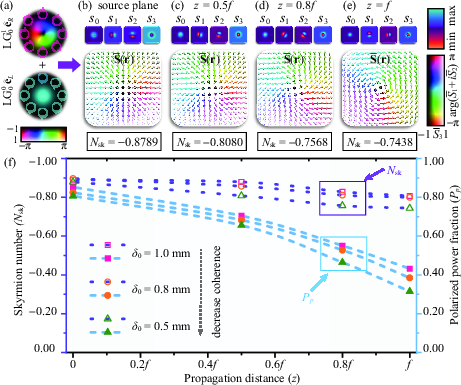
Figure 2: Measured and calculated evolution of unnormalized and renormalized Stokes textures under free-space focusing for a typical partially coherent skyrmion beam.
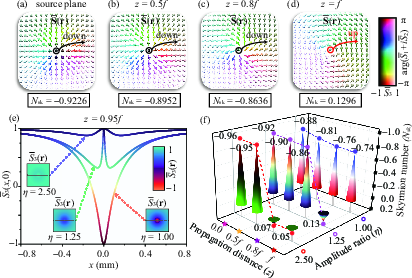
Figure 3: Topological breakdown occurring for amplitude ratio η>1—central S3 sign reversal and loss of full parameter sphere mapping.
This modal sensitivity underscores the necessity of precise modal weight control in practical implementations of partially coherent skyrmions.
Turbulence Resilience via Partial Coherence
A key result is that partial coherence—contrary to the canonical view of incoherence as a detrimental effect—enables striking stabilization of skyrmion topology in strong atmospheric turbulence. Fully coherent skyrmion beams subjected to turbulent channels exhibit proliferation of phase singularities, fragmentation of parameter-sphere mapping, and substantial realization-to-realization instability in Nsk (with σ≈0.64 for Cn2=1×10⁻⁸m−2/3). By contrast, partially coherent beams (δ0=0.5–Nsk0 mm) suppress these singularities and maintain stable, quantized Nsk1 across realizations, even in the strong-fluctuation (SI > 1) regime.
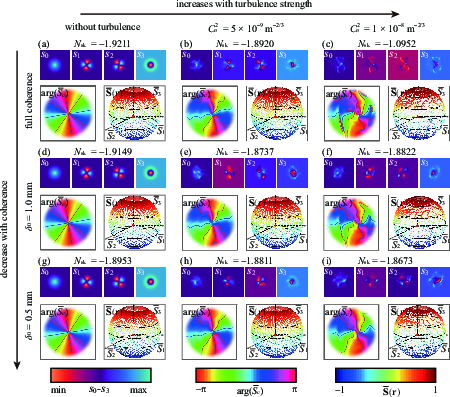
Figure 4: Experimental and simulated Stokes textures, singularity maps, and parameter-sphere mappings across turbulence strengths and coherence widths.
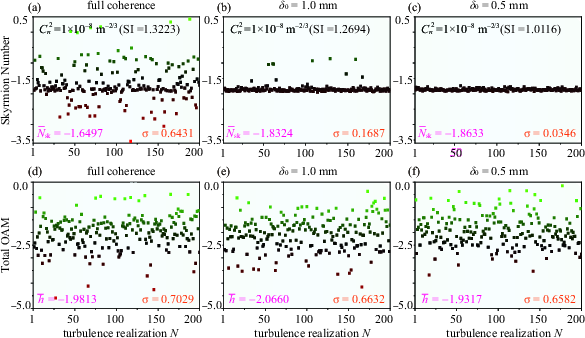
Figure 5: Statistical distributions of skyrmion number and total OAM for multiple turbulence realizations, highlighting coherence-driven stability.
The coherence-induced robustness is unique to the topology; other global observables (e.g., total OAM) remain unstable. The physical mechanism is modal self-averaging, which smooths out turbulence-induced local phase discontinuities and inhibits proliferation of topological singularities, in sharp contrast to recovery strategies relying on time-ensemble averaging or post-processing.
Coherence-Engineered Topological Transitions
Beyond robustness, the spatial coherence landscape is harnessed as a control parameter for on-demand topological phase transitions. By programming non-Gaussian coherence functions—specifically, Laguerre–Gaussian and Hermite–Gaussian correlations—the authors demonstrate:
- Coherence-driven skyrmion Nsk2 skyrmionium conversion, in which a Née-type texture evolves into a nested pair of Bloch-type skyrmions of opposite polarity, yielding Nsk3 at focus.
- Controlled multiplication and splitting of skyrmion textures driven by the symmetry and phase discontinuities of the coherence landscape, with the total skyrmion number quantized accordingly.
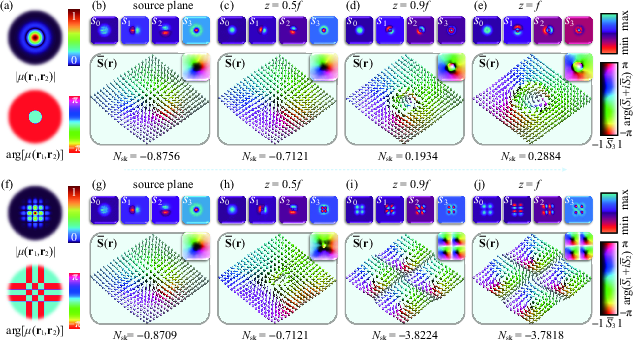
Figure 6: Skyrmion–skyrmionium conversion and skyrmion lattice formation induced by LG and HG coherence profiles, respectively, with corresponding Stokes parameter maps and topological number evolution.
These transitions are realized without any dynamic polarization or phase manipulation during propagation; the target topology emerges from the initial coherence structure encoded at the source.
Experimental Realization
The complete experimental system enables synthesis, propagation, and Stokes-resolved characterization of arbitrary partially coherent vector fields using a division-of-SLM-hologram approach. The design guarantees perfect correlation of random phase perturbations across polarization channels and provides quantitative agreement with theoretical predictions.
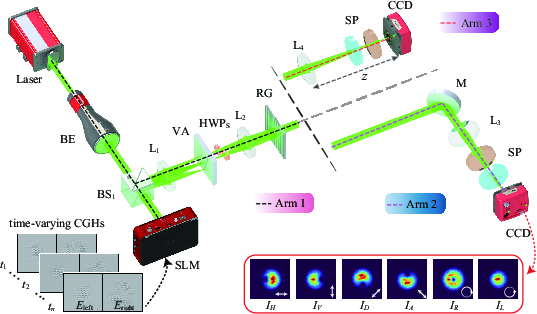
Figure 7: Experimental setup for generation and characterization of partially coherent skyrmion beams with variable coherence properties.
Implications and Outlook
This framework fundamentally shifts the operational paradigm of topological photonics. Partial coherence is shown to be not only non-detrimental but actively advantageous for the persistence and control of skyrmion-based topological invariants under realistic environmental conditions. The possibility to program topological phase transitions via coherence engineering introduces a new class of spatial multiplexing and structured-light control strategies unencumbered by the impracticalities of field-level phase or polarization manipulation in transit.
Practical Implications
- Robust, real-time topology-encoded optical communication channels immune to turbulence-induced decoherence.
- Coherence-programmable skyrmion states for on-the-fly reconfigurable photonic metrology, multiplexing, and high-dimensional information processing.
- Enhanced applicability of topological photonics in nonideal and noisy channels, bridging the gap between laboratory demonstrations and field-deployable systems.
Theoretical Implications
- Merges statistical optics with topological field theory, extending the notion of topological protection to stochastic fields.
- Provides a novel modality to study and design coherence-induced topological transitions independent of traditional polarization or global phase manipulation.
Conclusion
This study establishes the foundational role of partial coherence in the stabilization and control of optical skyrmion topology, presenting convincing experimental and theoretical evidence for the resilience of the skyrmion number in partially coherent, stochastic fields. The identification and exploitation of coherence as a handle for both robust transmission and active topological reconfiguration signals a transformative advance for topological photonics and enables a suite of new applications in complex, real-world environments (2604.20207).

