- The paper shows that even minimal perturbations can change the skyrmion number from Q_sk = ℓ2 – ℓ1 to Q_sk = max(ℓ2, ℓ1), overturning traditional assumptions.
- It employs analytical contour integration, detailed numerical simulations, and experimental interferometry to verify the topological unfolding of optical skyrmionic textures.
- These findings have significant implications for the design of photonic devices and optical systems that rely on conserved topological charge for robustness.
Unstable Skyrmionic Polarization Textures and Their Topological Unfolding
Introduction
The study "Unfolding unstable skyrmionic polarization textures" (2604.13601) rigorously investigates the stability of optical skyrmions—topologically non-trivial polarization textures analogous to solitonic structures in condensed matter—and reveals the topological consequences of perturbations to these structures. The work addresses a fundamental aspect that had been largely overlooked: in generic conditions, the skyrmion number of a superposition of two vortex beams is not given by the commonly cited difference in their topological charges but by the larger of the two. This revision has substantial implications for the design and interpretation of wavelength-scale structured light fields and any application where robustness of topological charge is presumed.
Analytical Framework for Optical Skyrmions
Optical skyrmions, particularly Stokes skyrmions, are realized by superposing two vortex beams of distinct topological charge and polarization state. The vector field thus formed parameterizes a mapping from the transverse plane to the Poincaré sphere, with the skyrmion number Qsk defined by the degree of this map. Conventionally, when the zero-intensity (singular) points of the two field components are perfectly coincident—a scenario of codimension 4 in 2D—the skyrmion number is given by Qsk=ℓ2−ℓ1 [Gao2020ParaxialBeams, Ye2024TheorySkyrmions]. However, this configuration is topologically unstable.
The authors rigorously demonstrate, via analytic, numerical, and experimental means, that a generic arbitrarily-small perturbation, which splits the coincident singularities, results in Qsk=max(ℓ2,ℓ1). This follows from a general topological line-integral approach akin to that of McWilliam et al. [McWilliam2023TopologicalMulti-skyrmions], and is independent of orthogonality between polarization states.
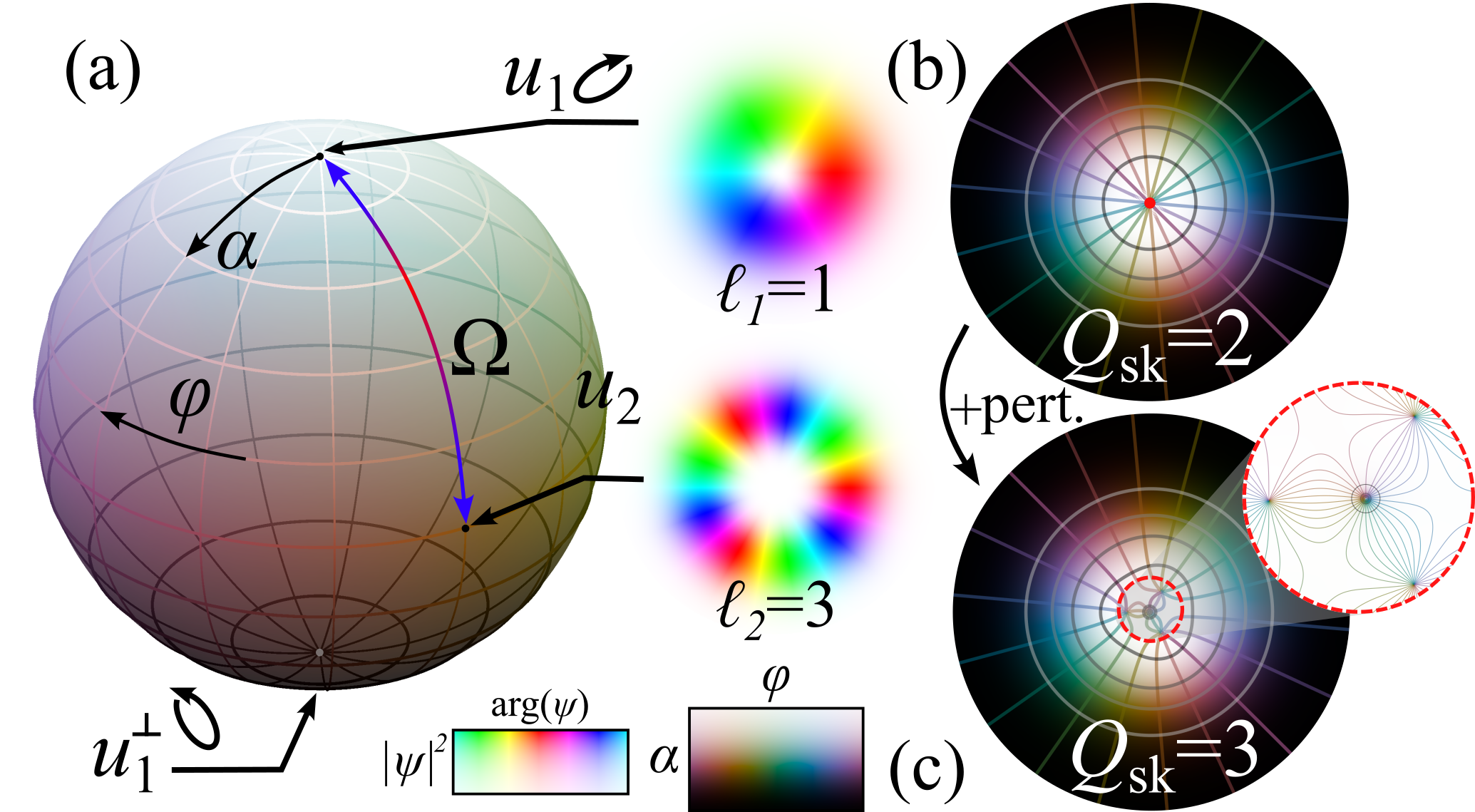
Figure 1: (a) Geometry on the Poincaré sphere illustrating the polarization vectors of the constituent beams, and the definition of spherical angles (α,φ). (b, c) Skyrmionic polarization textures for ℓ1=1, ℓ2=3 without (b) and with (c) perturbation, demonstrating the jump in Qsk and the splitting/unfolding of singularities.
Perturbation-Induced Topological Transitions
The core mechanism is the instability of coincident high-order phase singularities. In two dimensions, perfect coalescence of the zeros of two complex fields is non-generic: any infinitesimal perturbation, even below experimental noise, causes the singularity to split. Upon such splitting, the skyrmion number abruptly transitions from Qsk=ℓ2−ℓ1 to Qsk=max(ℓ2,ℓ1).
The authors provide a detailed analytic derivation, recasting the skyrmion number as a contour integral, distinguishing contributions of zeros and poles in the meromorphic mapping of polarization states. They show the only stable invariant is the winding of the component with maximal charge, since the denominator and numerator’s zeros generically do not coincide post-perturbation.
Numerical Demonstrations and Practical Implications
Numerically, the jump in Qsk is verified for perturbed vortex pairs, analyzing both intensity thresholding and spatial undersampling. Both effects—exclusion of low-intensity regions (practically encountered when imaging or performing polarimetry) and inability to resolve closely spaced singularities—can artificially recover the “difference rule” for Qsk=ℓ2−ℓ10, which is then a numerical artifact rather than a physical invariant.
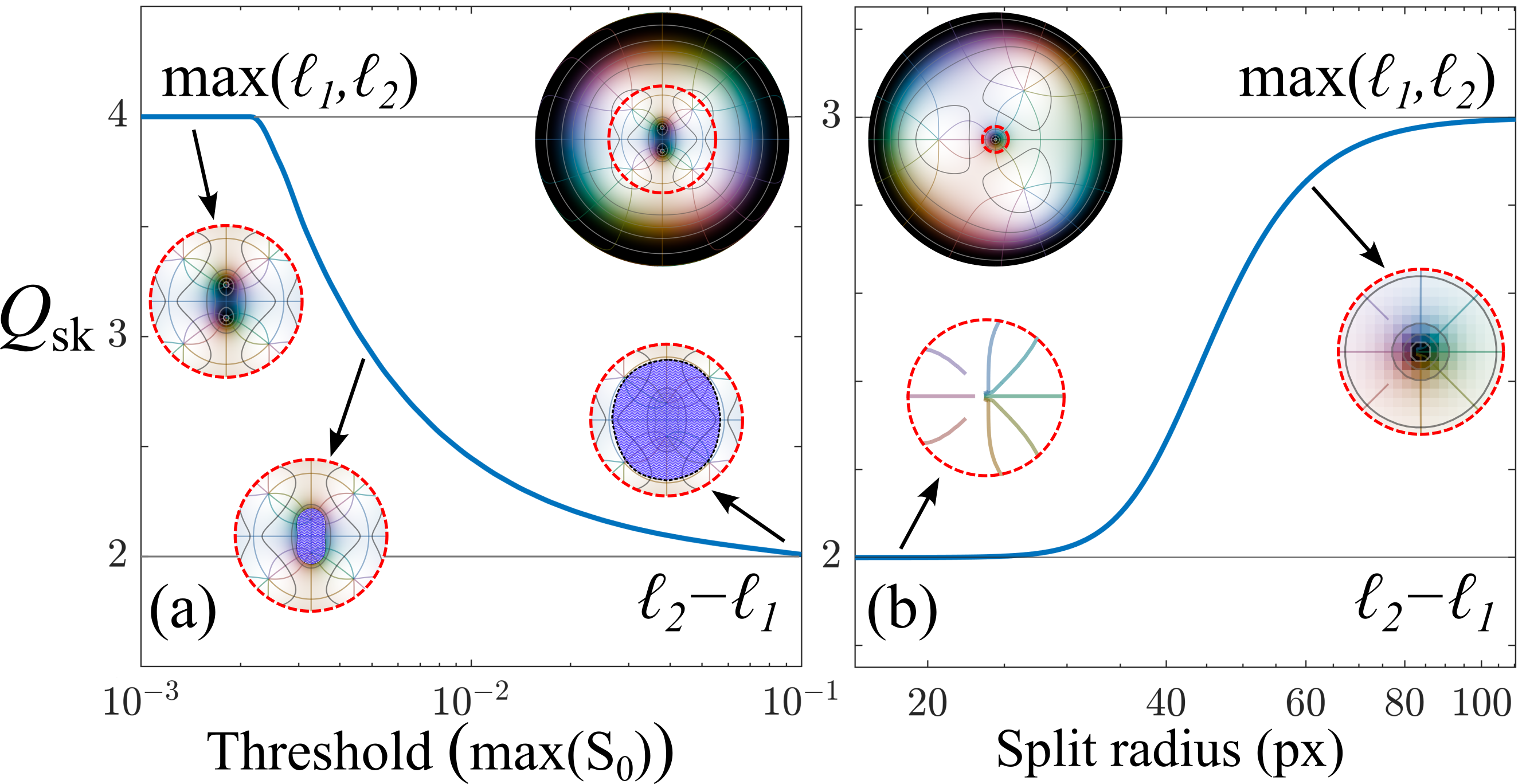
Figure 2: Numerically integrated Poincaré sphere coverage Qsk=ℓ2−ℓ11 showing the convergence to Qsk=ℓ2−ℓ12 unless low-intensity regions are excluded or singularities are undersampled.
Experimental Verification
A flexibly reconfigurable Sagnac-based interferometric apparatus with spatial light modulator (SLM)-based generation of arbitrary vector beams was assembled to address the unfolding in the laboratory. Polarimetry measurements as a function of controlled perturbation amplitude reveal the predicted abrupt transition in Qsk=ℓ2−ℓ13.
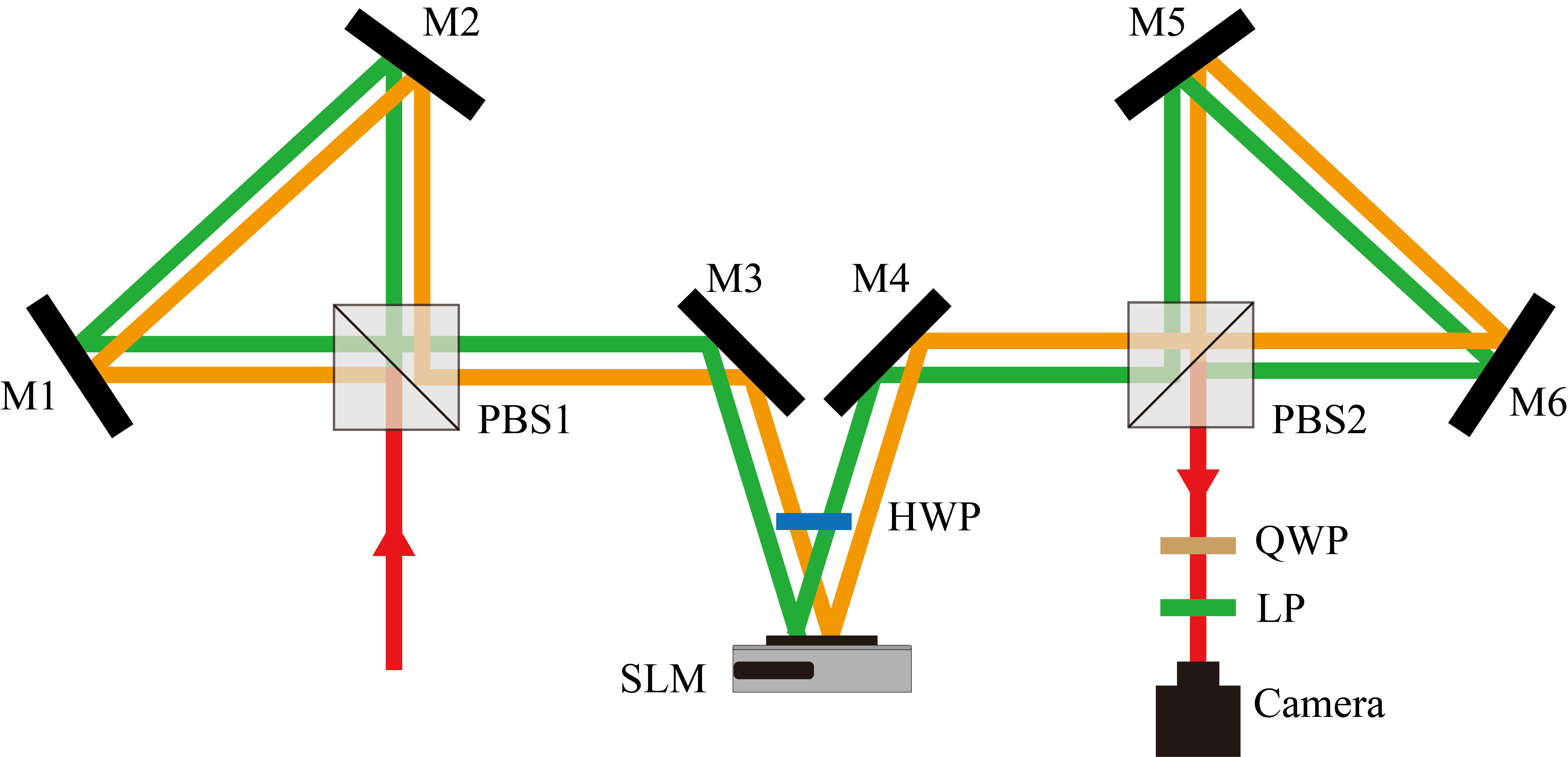
Figure 3: Optical setup incorporating a Sagnac interferometer, SLM, and full Stokes polarimetry.
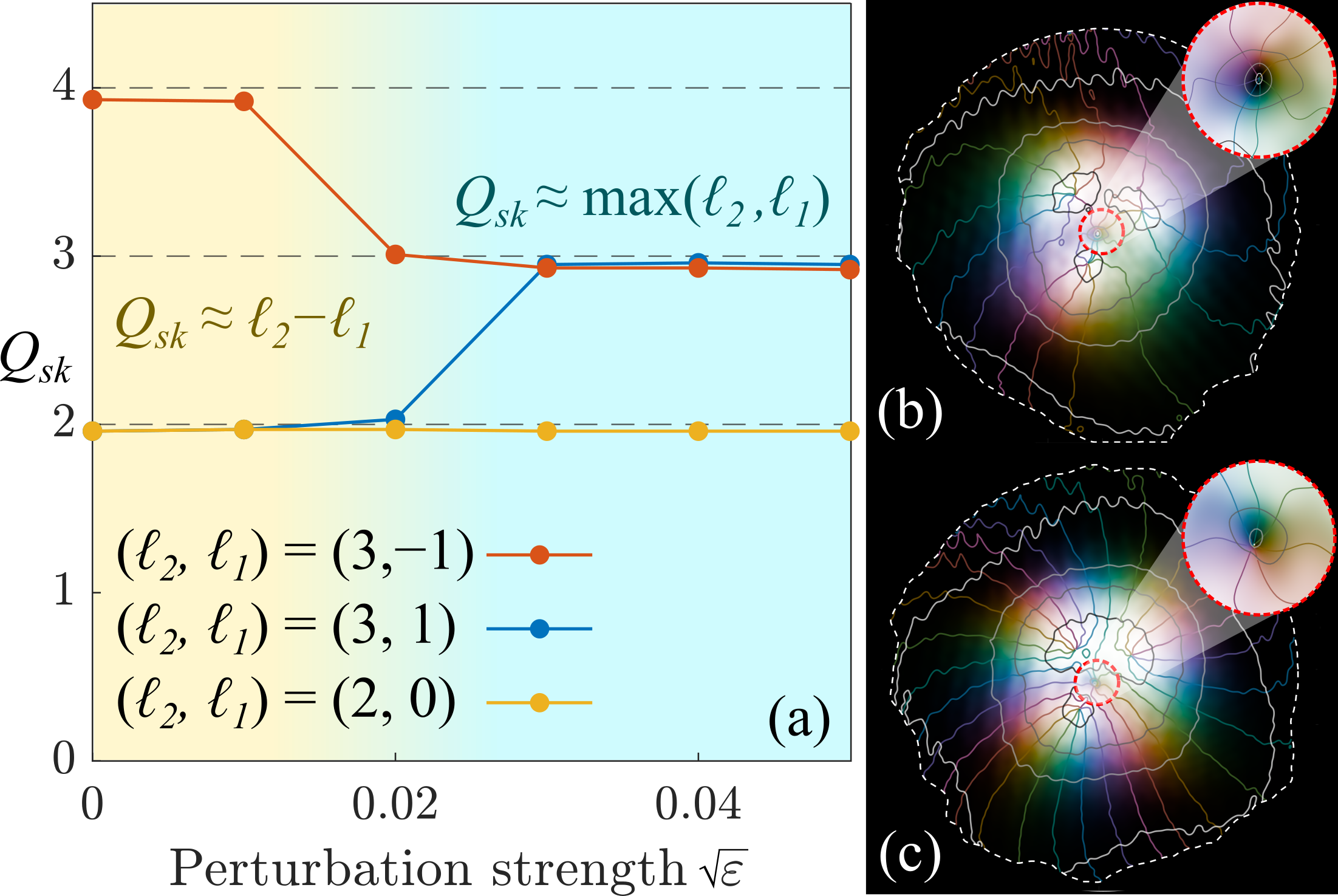
Figure 4: Experimentally retrieved skyrmion number as a function of perturbation strength, for various vortex superpositions. Insets: resolved polarization textures illustrating the emergence of additional polarization singularities.
Broader Consequences and Future Directions
The topological “fragility” of the difference rule has direct ramifications for the design and interpretation of all optical systems where skyrmion textures are employed, including photonic metasurfaces [Mata-Cervera2025TailoringMetasurfaces], nanophotonic devices [He2024OpticalFeatures], and communication protocols employing topological protection. Structured light with an assumed conserved Qsk=ℓ2−ℓ14 can in fact exhibit a jump in topological charge under minimal aberration or noise, undermining error-resilient encoding designs unless the maximal charge prescription is used.
For three-dimensional spin textures, or configurations at the wavelength scale (for instance, in tightly focused spot or nanophotonic platforms), the splitting is unavoidable, implying that observed topology is always governed by high-charge branches, invalidating prior analyses predicated on the difference formula.
The results also point to the importance of exploiting or protecting against such topological transitions in all-optical information processing, topological photonics [Shi2021TopologicalMetaphotonics], high-NA microscopy, and other systems where vector singularities are integral. Further research is suggested into the stability of more complex multi-component and higher-dimensional singular textures, as well as the controlled engineering of such “topological jumps” for switching and nonlinear optics applications.
Conclusion
This study elucidates a foundational inconsistency in traditional topological charge assignments for optical skyrmions, showing that Qsk=ℓ2−ℓ15 is strictly valid only in the ideal and unstable scenario of perfectly-coincident component singularities. Any generic perturbation enforces Qsk=ℓ2−ℓ16 and thus fundamentally alters the topological landscape of singular polarization textures. The implications extend across optical physics, photonic technologies, and emerging topological light-matter interaction platforms, warranting a re-examination of designs and theoretical interpretations where topological charge conservation is assumed (2604.13601).

