- The paper demonstrates that separable pathways enable dynamic restructuring of the hypothesis space via context graphs and targeted detectors.
- It employs a modular agent architecture that uses context graphs for systematic inference and dynamic behaviors for regime-change detection.
- Empirical results reveal that dynamic behaviors significantly reduce early termination errors, bolstering performance under hidden moderator conditions.
Separable Pathways for Causal Reasoning in LLM Agents: Enabling Hypothesis-Space Restructuring via Architectural Scaffolding
Introduction and Motivation
The paper "Separable Pathways for Causal Reasoning: How Architectural Scaffolding Enables Hypothesis-Space Restructuring in LLM Agents" (2604.20039) addresses a persistent limitation of LLM-based agents: their inability to restructure the hypothesis space when encountering evidence outside their pre-trained causal frameworks. While LLMs can often regurgitate correct causal relationships found in training data, they generally fail at genuine causal discovery via intervention, especially when forced to entertain previously unconsidered classes of causal rules or mid-episode regime changes. This work posits that causal reasoning, as observed in human learners, fundamentally involves overhypothesis revision—the ability to revise not only belief weights within a hypothesis space but the very structure and dimensions of that space itself.
The authors instantiate this notion in a compositional agent architecture that separates the mechanisms of within-hypothesis space inference from those responsible for detecting—and appropriately restructuring—the hypothesis space itself. They evaluate this through an extended blicket detector paradigm, integrating conditions requiring agents to both detect and adapt to abrupt, unannounced shifts in causal regimes.
Architectural Framework: Context Graphs and Dynamic Behaviors
Central to the proposed solution is a modular architecture with two orthogonal architectural pathways: context graphs (CGs) and dynamic behaviors (DBs). The context graph (Figure 1) structures the agent's reasoning along explicitly typed state-machines, reflecting the paradigm of scientific hypothesis generation, systematic testing, evaluation, and verification. It defines a four-state progression—initial exploration, combination testing, hypothesis evaluation, verification—with transitions determined by the agent's actions and observations.
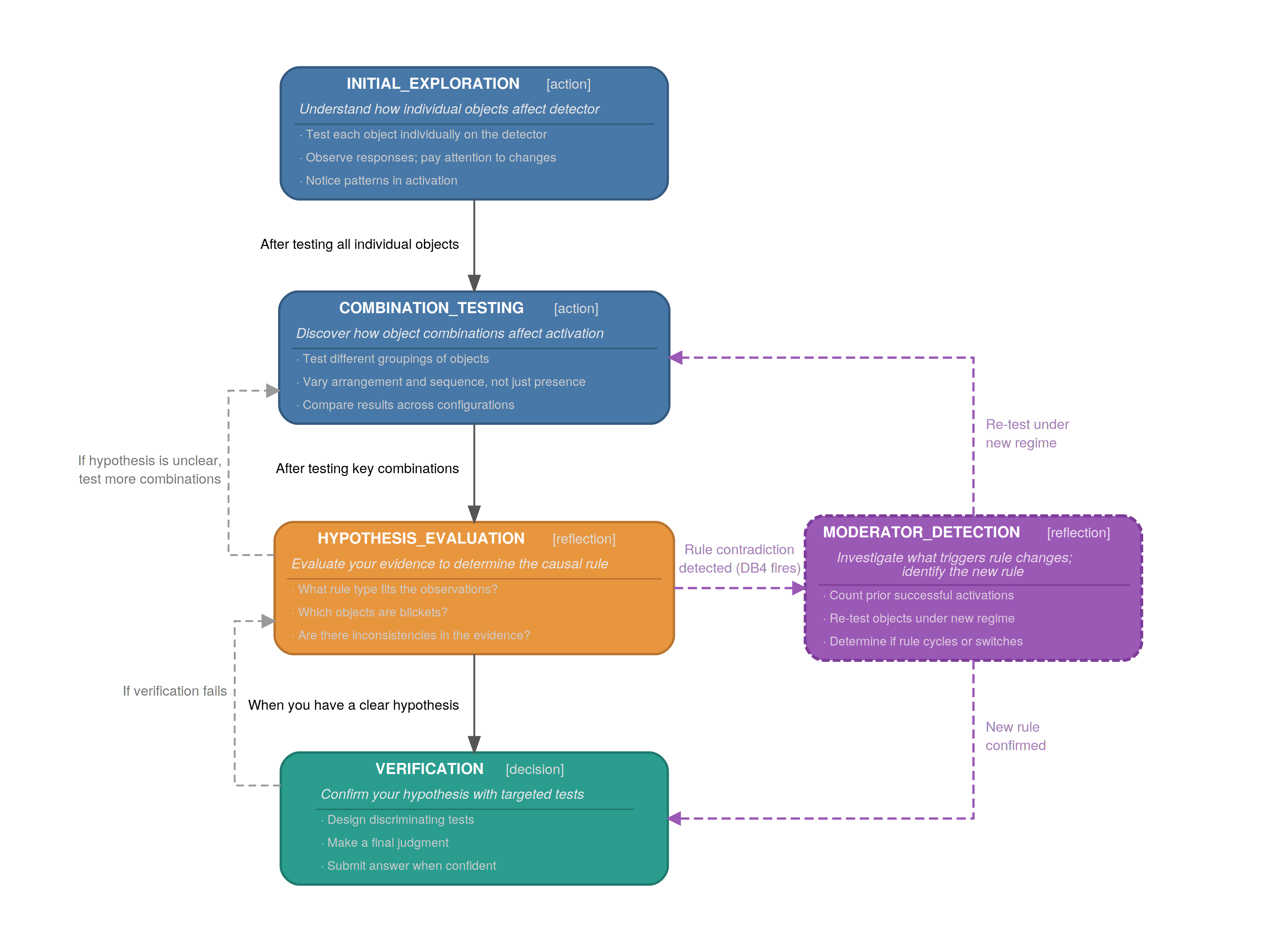
Figure 1: The compositional context graph architecture illustrated with the base 4-state structure and the expanded graph following dynamic behavior firing (DB4), which adds the MODERATOR_DETECTION state to support post-regime-shift inference.
Dynamic behaviors operate as external monitors (detectors), continuously probing for evidence that the current hypothesis space is structurally inadequate. When such evidence is detected (e.g., observation of a regime change, unexpected order effect, or stochasticity), a dynamic behavior fires, expanding the context graph in real time with new states and transitions tailored to address the novel causal phenomenon. This leads to explicit architectural support for hypothesis-space restructuring. Dynamic behaviors are empirically mapped onto the concept of overhypotheses: one for regime change (DB4), ordering effects (DB2), stochasticity (DB3), and exploration stagnation (DB1), each adding specialized states (e.g., MODERATOR_DETECTION) and guidelines to the active reasoning graph as necessitated by evidence.
Extended Blicket Benchmark and Experimental Protocol
To rigorously evaluate the approach, the authors propose the Extended Blicket Benchmark—a suite of tasks derived from the developmental science tradition of the blicket detector. The standard conditions (conjunctive and disjunctive rules over object sets) serve as an accuracy ceiling. Critically, three extended conditions test the limits of hypothesis-space restructuring: a hidden moderator (mid-episode rule change), order-sensitivity (rules contingent on sequence), and stochasticity (probabilistic activation).
The experimental hierarchy tests three agent variants:
- A bare LLM agent lacking architectural scaffolding;
- An agent with only the context graph (CG);
- An agent with both context graph and dynamic behaviors (CG+DB).
Agents interact step-wise with the environment by proposing actions and transitions, with their error structure, efficiency, and response to regime change exhaustively logged.
Analytical Methods and Metrics
The key methodological innovation is the introduction of "reasoning-eligible accuracy" (RE accuracy): The analysis explicitly filters out episodes where the agent did not (and could not) observe evidence of a regime change (pre-switch, exactly-N cases), isolating episodes in which the agent had the opportunity to revise its hypothesis space (reasoning-eligible). This allows precise attribution of performance differences to architectural interventions rather than to stochastic or structural traps.
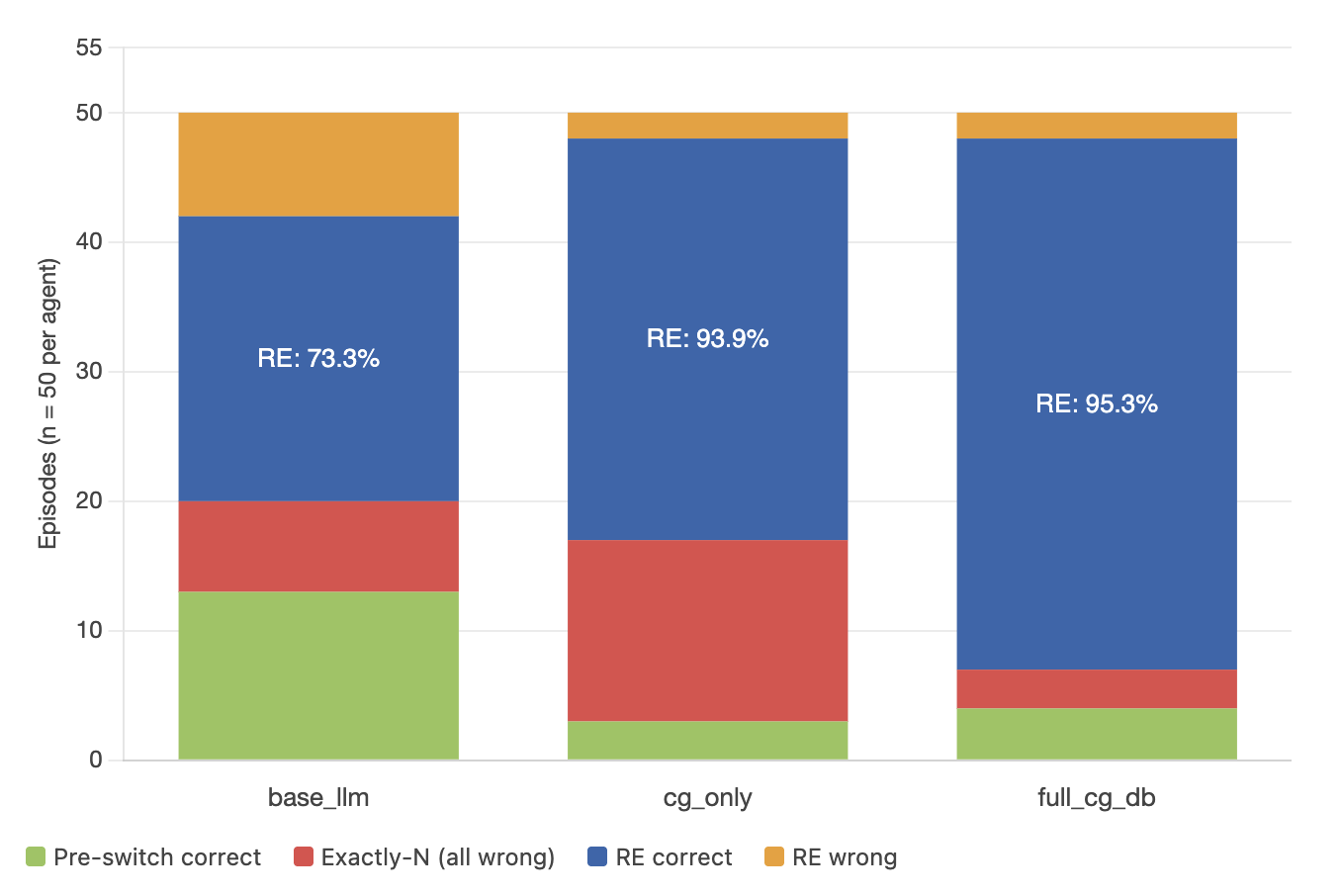
Figure 2: Run 08 episode-level decomposition demonstrates the segregation of failure modes, attributing reasoning quality improvements to CG and regime-change detection (exactly-N avoidance) to dynamic behaviors.
Empirical Results and Separable Pathways Decomposition
Under standard conjunctive/disjunctive conditions, all agents solve the tasks at ceiling, consistent with rote pattern learning. With a disjunctive post-switch rule, raw accuracy benefits accrue to CG+DB via the reduction of the structural exactly-N failure mode: agents equipped with dynamic behaviors are less likely to prematurely commit to answers before observing critical post-switch evidence.
The essential result emerges under the hard hidden moderator condition (conjunctive triple as the post-switch rule; Figure 2). Here, the division of labor is unambiguous:
- Context graphs contribute 94% of the reasoning-eligible accuracy gain: CG-based agents, whether or not they include DBs, exploit structured state-driven exploration to efficiently search combinatorial hypothesis spaces post-regime-change.
- Dynamic behaviors eliminate the exactly-N trap: Without DBs, CG agents maximize regime switch hits but lack a mechanism to pause and reconsider after the change, often submitting incorrect pre-switch rules. DBs inject system-level notifications to enforce post-hoc re-evaluation, sharply reducing such errors.
Notably, there is no significant improvement in reasoning-eligible accuracy when adding DB to CG (CG: 93.9%, CG+DB: 95.3%, p=1.0). Instead, the DBs' sole pathway of impact is decreasing the prevalence of structural trap errors by ensuring agents do not terminate abnormally early after rule changes.
Boundary condition experiments (ordering, stochasticity) confirm the specificity of the advantage: the architecture’s benefits vanish when the only adaptation required is iterative refinement or inference within a fixed, albeit complex, hypothesis space; only tasks that demand the explicit restructuring of the hypothesis space exhibit significant improvement.
Interpretation, Theoretical Implications, and Future Directions
The core finding is that genuine hypothesis-space restructuring—detecting the inadequacy of the current causal model and expanding representational capacity—is not a byproduct of LLM scale but an architectural capability. The decomposition into separable pathways supports the following claims:
- Architectural factorization enables mechanistically auditable, interpretable causal reasoning: The distinct, timestamped dynamic behavior firings provide direct evidence of abstract reasoning events not attainable via chain-of-thought analysis alone.
- Alignment with the sparse mechanism shift hypothesis: By decomposing regime-shift detection and within-regime inference, the architecture maps directly onto real-world distributions where only a subset of causal mechanisms shift at any given perturbation.
Additionally, the Extended Blicket Benchmark provides a scalable, parameterized platform to stratify agent performance along axes of causal inference difficulty, thereby resisting static-benchmark saturation and supporting diagnostic evaluation of emergent agent capabilities.
Several immediate research avenues are identified: (i) cross-model validation to demonstrate the architecture’s independence from LLM backbone; (ii) extension to cross-episode overhypothesis induction, where the agent autonomously discovers new classes of hypothesis-space shifts across multiple episodes, closing the loop on developmental analogies between artificial and human learners; and (iii) expansion to domains of real-world causal protocol monitoring and adaptation, as in clinical or regulatory environments, where silent distributional changes can invalidate standing decision rules.
Conclusion
This work establishes that the failure of LLMs to perform causal discovery via intervention is not solely, nor primarily, a function of pretraining limitations; rather, it reflects a lack of architectural mechanisms for recognizing when and how to restructure hypothesis spaces. Through rigorous ablation, comprehensive benchmarking, and mechanistic trace analysis, the authors demonstrate that compositional scaffolding—explicitly separating state-driven inference from architectural detectors of representational inadequacy—enables LLM agents to bridge a critical gap in robust causal reasoning (2604.20039). The benchmark and design methodology are readily extensible, providing both a diagnostic and prescriptive template for future agent architectures with aspirations toward human-like causal learning.