- The paper shows that UHE tau neutrinos improve constraints on Planck-scale Lorentz invariance violations via high-energy flavor measurements.
- It utilizes Monte Carlo simulations of cosmogenic neutrino fluxes and detailed detector modeling to assess LIV effects.
- The study reveals that flavor-dependent LIV operator coefficients and degeneracies significantly influence tau event rates and parameter sensitivity.
Ultra-High-Energy Tau Neutrinos as Probes of Lorentz Invariance
Introduction
This paper presents a detailed investigation into the capability of upcoming cosmic neutrino experiments, specifically GRAND and POEMMA, to probe Planck-suppressed Lorentz invariance violation (LIV) in the neutrino sector through observations of ultra-high-energy (UHE) tau neutrinos. By leveraging the extremely steep energy scaling of higher-dimensional LIV operators and the expected flux of cosmogenic neutrinos at EeV energies, the work demonstrates that tau neutrino flavor measurements at these facilities will improve current constraints on isotropic LIV coefficients by several orders of magnitude, probing parameter spaces relevant for quantum gravity.
The analysis is situated within the Standard-Model Extension (SME), wherein deviations from Lorentz invariance are encapsulated by a tower of higher-dimensional, flavor-dependent operators, each characterized by a coefficient κ˚αβ(d). The effective Hamiltonian for flavor evolution gains energy-dependent off-diagonal terms: Htotal=H0+HLIV
with
HLIV=d∑Ed−3κ˚αβ(d).
Given the polynomial energy scaling, the effect of LIV operators with d>4 becomes increasingly apparent at UHE.
The paper computes the probability for a neutrino born in one flavor eigenstate to be detected as another, incorporating cosmological redshifting and the energy- and flavor-dependent mixing modification due to LIV. The implications for the observable flavor ratios at Earth are systematically computed as a function of energy.
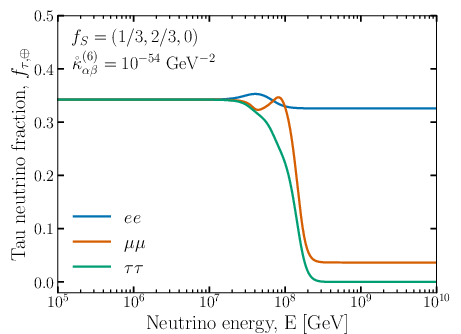
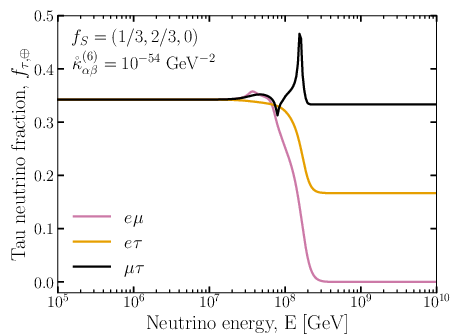
Figure 1: Tau neutrino flavor fraction at Earth, fτ,⊕, as a function of energy, illustrating departures from standard oscillations introduced by dimension-6 LIV for diagonal and off-diagonal coefficients.
Cosmogenic Neutrino Flux Modeling
Cosmogenic neutrinos predominantly originate from photopion interactions of ultra-high-energy cosmic ray (UHECR) protons with the CMB and EBL. The paper utilizes SimProp-v2r4 Monte Carlo simulations to produce two benchmark flux models assuming proton primaries—with and without source evolution (SFR or no evolution). The uncertainty in flux normalization from UHECR composition is addressed.
The resulting spectra are compared to present experimental upper bounds and projected sensitivities. The SFR scenario, which yields a higher flux, typically drives the strongest derived sensitivities.
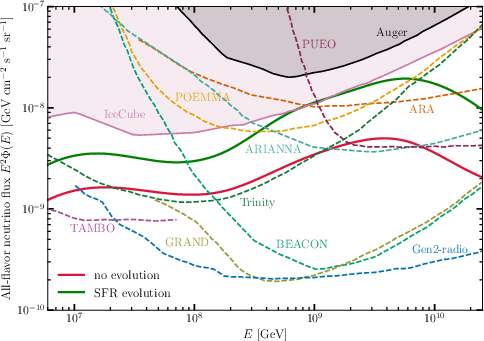
Figure 2: Cosmogenic neutrino fluxes (red and green lines) considered in the analysis, compared with existing limits and future sensitivities from several experiments.
Neutrino production redshifts are tracked in the MC so that flavor transition probabilities can be consistently applied along the propagation history, including the energy dependence of LIV from production to Earth.
Tau Neutrino Event Rates at GRAND and POEMMA
Tau neutrino detection is considered in the context of the primary signatures for both GRAND (radio emission from air showers induced by Earth-skimming tau emergence) and POEMMA (optical Cherenkov emission). The energy-dependent expected event rates of tau neutrinos are computed given the detailed detector acceptances, exposure, and field of view.
The paper finds that LIV generically suppresses the expected number of tau neutrino events relative to the standard three-flavor oscillation expectation, except for specific coefficients (notably ee and μτ), where the effect is less pronounced.
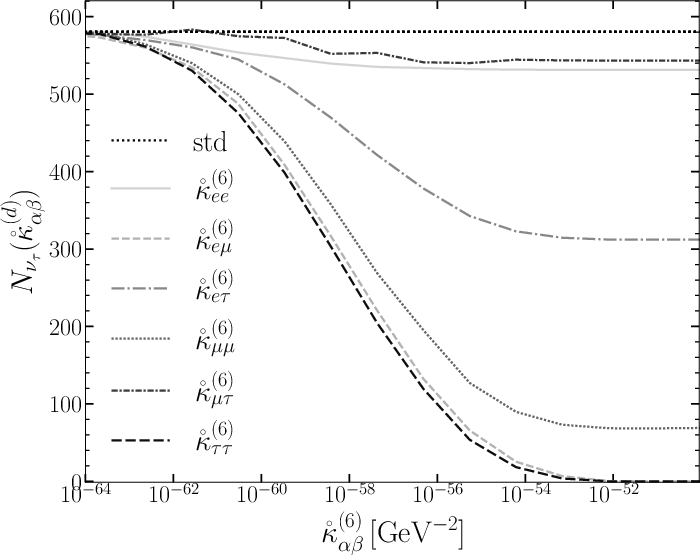
Figure 3: Number of expected tau neutrino events at GRAND versus LIV parameter strength for various flavor combinations at d=6; the dotted line shows the standard oscillation expectation.
The analysis assumes background-free detection for both GRAND and POEMMA, justified by the event topology and background mitigation capabilities.
Sensitivity to LIV Parameters
A Poisson log-likelihood is implemented to assess the statistical sensitivity to LIV parameters. Sensitivities are profiled both in single-parameter scenarios (one nonzero κ˚αβ(d)) and in two-parameter "blind spot" scenarios.
Projected sensitivities for POEMMA (single-parameter, d=3–8) are summarized as follows:
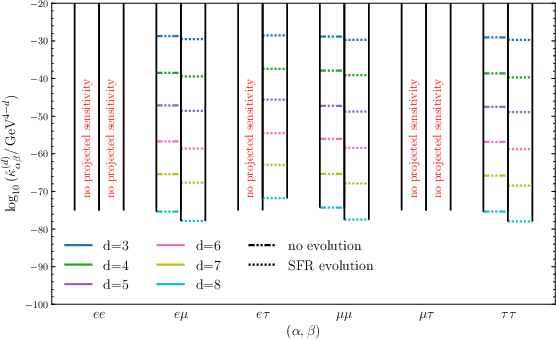
Figure 4: Projected 90% C.L. sensitivities to LIV parameters for POEMMA, showing strong improvement for higher operator dimension and SFR source evolution.
Analogous results for GRAND demonstrate even stronger reach, owing to greater exposure:
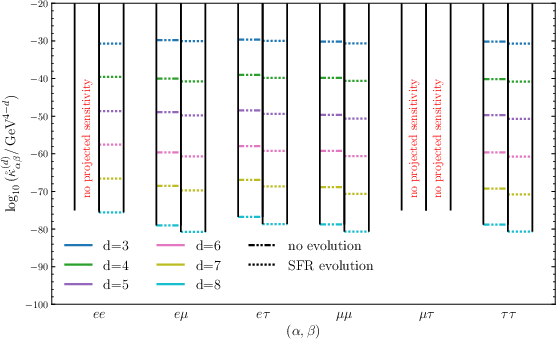
Figure 5: Projected 90% C.L. sensitivities for GRAND, highlighting access to all flavor combinations except Htotal=H0+HLIV0 for specific dimensions and evolution models.
For each, the energy scaling ensures that Htotal=H0+HLIV1 operators are probed at levels directly motivated by Planck suppression, often surpassing existing lower-energy constraints (e.g., those from IceCube) by 10–30 orders of magnitude.
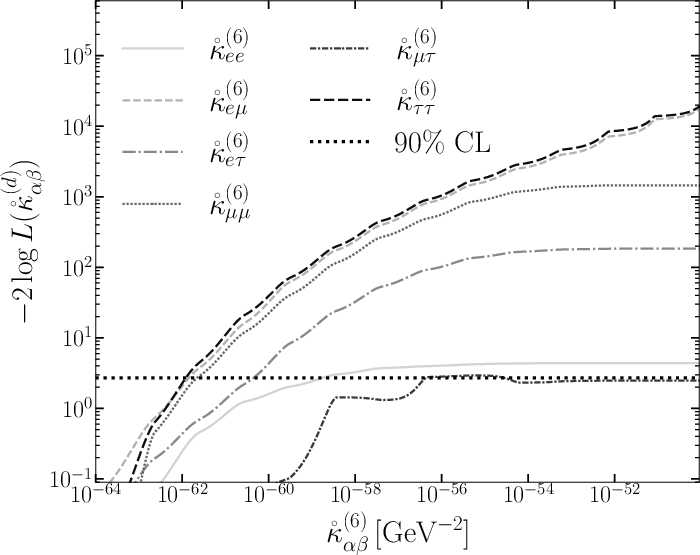
Figure 6: Log-likelihood scan versus LIV parameter for GRAND, indicating the statistical reach for each flavor combination.
The work highlights and quantifies the presence of degeneracies: combinations of two nonzero LIV parameters can in some cases mask the flavor transition effects due to partial cancellations or compensation, leading to "blind spots" in sensitivity.
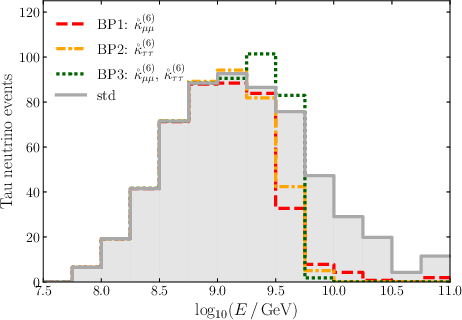
Figure 7: Expected number of tau neutrino events at GRAND in energy bins for benchmark single- and two-parameter LIV scenarios, demonstrating the blind spot effect when multiple LIV operators are nonzero.
The two-parameter sensitivity analysis is visualized for selected pairs:
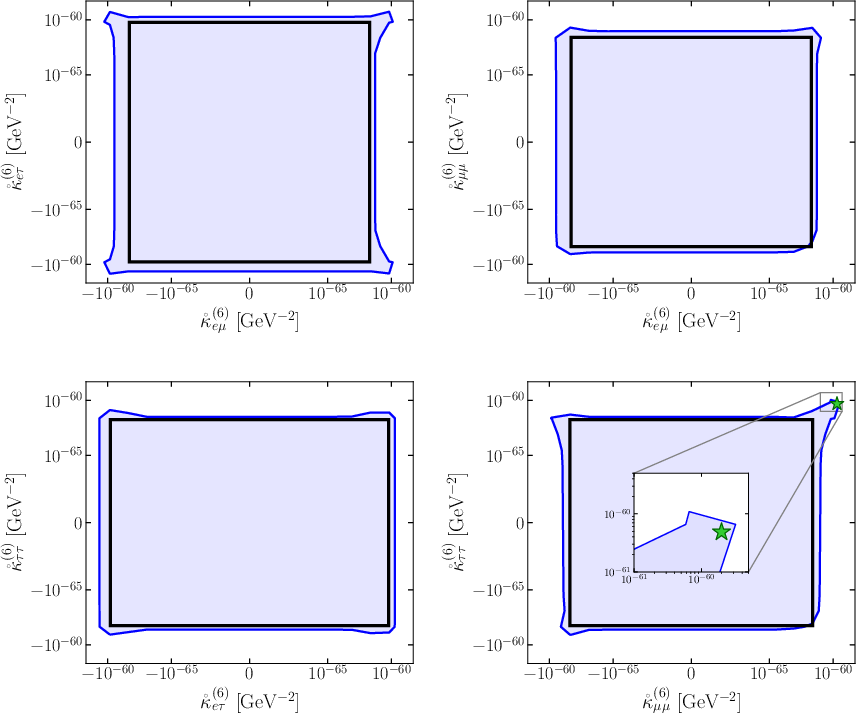
Figure 8: GRAND's projected two-parameter sensitivity regions (white, 90% C.L.) compared to the naive product of single-parameter sensitivities (black lines), exposing the reduction in constraining power in multi-parameter scenarios.
Implications and Outlook
The implications of these results are profound:
- Ability to probe Planck-scale physics: The sensitivities achieved for Htotal=H0+HLIV2 with Htotal=H0+HLIV3–8 correspond to LIV effects suppressed by one or more powers of Htotal=H0+HLIV4—a direct window on new physics at the Planck scale.
- Flavor and parameter degeneracies: Multi-parameter fits reveal the necessity of global approaches to constraints, where apparent null results in single-parameter searches can be evaded in certain flavor structures. This informs best practices for future analyses.
- Model discrimination: The sensitivity of tau rates to flavor-dependent LIV distinguishes them from other models for neutrino deficit (e.g., heavy UHECR composition), especially when coupled with independent all-flavor measurements (e.g., from IceCube-Gen2 radio).
- Robustness to flux uncertainties: Since the analysis incorporates a range of plausible cosmogenic flux normalizations and details the sensitivity degradation accordingly, future direct flux measurements can immediately sharpen LIV limits.
Conclusion
Upcoming UHE tau neutrino detectors such as GRAND and POEMMA are poised to significantly extend experimental constraints on Lorentz invariance violation in the neutrino sector. By exploiting the steep energy dependence of higher-dimension operators and the high energies probed, these facilities will test parameter spaces motivated by quantum gravity and the SME at an unprecedented level. The work demonstrates the importance of multi-parameter fits, careful modeling of flavor transitions, and coordinated operation of multiple experiments to resolve degeneracies and maximize discovery potential. Detection, or even stringent null results, will have major implications for the structure of fundamental symmetries in nature.