- The paper establishes the unique extremal hypergraph construction that maximizes sunflower counts in r-uniform hypergraphs under bounded matching constraints.
- It extends the shifting method to prove that sunflower counts for S₍r₋1,k₎ʳ do not decrease, ensuring robust structural analysis.
- The study generalizes the Erdős Matching Conjecture to the (r-1,k)-norm, providing explicit asymptotic bounds and deep insights into Turán-type problems.
Counting Sunflowers in Hypergraphs with Bounded Matching Number and the Erdős Matching Conjecture in the (t,k)-Norm
Introduction
This work presents a structural and quantitative study of sunflowers in r-uniform hypergraphs under matching constraints, leveraging the shifting method. The sunflower Sr−1,kr is defined as the r-graph formed by k hyperedges that all share a common (r−1)-set (the core), and are otherwise disjoint (the petals). The main goal is to determine, for a fixed r, k, and matching bound s, the hypergraph(s) on n vertices with the largest number of r0 copies. This generalizes previous results for the case r1.
The study is deeply connected not only to generalized Turán-type questions, which concern extremal substructure counts rather than edge counts, but also to an "average" variant—Turán problems under the r2-norm, introduced by Chen et al.—where the goal is to maximize a particular norm of the degree sequence over r3-sets, and whose combinatorial meaning is tied to counting sunflowers.
Main Results and Implications
Let r5 denote the matching of size r6 in r7-graphs, i.e., the hypergraph substructure formed by r8 pairwise disjoint r9-edges. The core theorem establishes that for all Sr−1,kr0, the extremal number of Sr−1,kr1 copies in Sr−1,kr2-free Sr−1,kr3-graphs on Sr−1,kr4 vertices and sufficiently large Sr−1,kr5 is achieved uniquely (up to isomorphism) by the initial segment hypergraph Sr−1,kr6 (i.e., the family of all Sr−1,kr7-sets meeting a fixed set of Sr−1,kr8 vertices).
Strikingly, both the extremal numbers and the extremal constructions are invariant with respect to Sr−1,kr9, generalizing and unifying the results for r0 and classical results about extremal edge numbers (the original Erdős Matching Conjecture).
These assertions are formalized in Theorem 1 and the Erdős Matching Conjecture in the r1-norm (Theorem 2).
The Shifting Method and Sunflower Monotonicity
A technical highlight is the extension of the shifting method to maximization of sunflower counts for all r2. The shifting operation is shown to never decrease the number of r3 copies (Lemma~\ref{newlem}), a fact that is not generally true for sunflowers with smaller cores or for other hypergraph families.
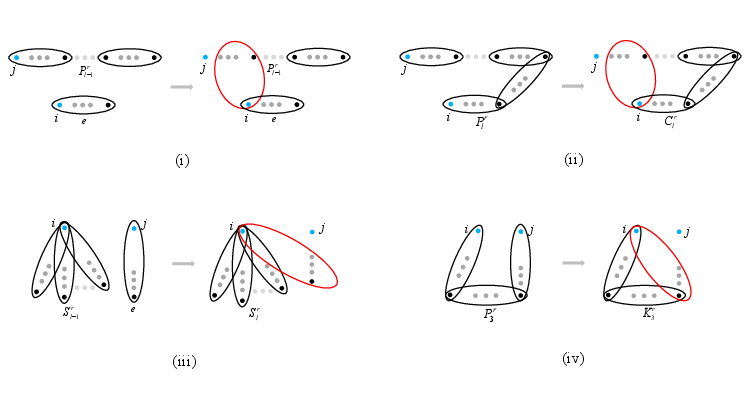
Figure 1: Shifting operations fail to preserve several expansion-freeness properties (e.g., for paths, cycles, stars, cliques), but for matchings they are safe.
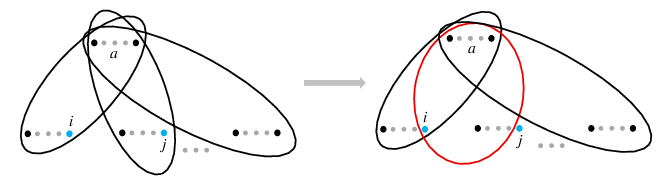
Figure 2: For some general r4 (with r5), shifting can strictly decrease the sunflower count.
The paper constructs a detailed case analysis and injective mapping to verify the non-decreasing property for r6 under shifting, resolving a question raised in prior work by Wang and Peng.
Sunflower Counting and r7-Norm Optimization
Counting copies of r8 is tightly connected to optimization of the r9-norm
k0
which by Newton's identities can be decomposed as a weighted sum of the sunflower counts for all k1.
Thus, the paper confirms the Erdős Matching Conjecture for the k2-norm and describes all extremal hypergraphs for this norm (Theorem 2), generalizing previous work for k3 and classical (k4) cases.
Methodological Advances
The main technical tools are:
- Iterated Shifting: Shifting preserves k5-freeness (due to Frankl) and does not decrease k6 copy counts, justifying induction on the shifted class.
- Petal/Core Decomposition Counting: Detailed recurrences and decompositions for counting k7 copies in general hypergraphs (Lemma~3.1), sensitive to potential petal/core overlaps and the vertex of interest.
- Structural Reduction: Careful exploitation of the shifted property and edge-maximality to reduce to the unique extremal candidate set system.
Numerical Outcomes and Explicit Bounds
Strong asymptotic and sometimes explicit bounds are given for extremal counts and minimal required k8 (see, e.g., inequalities (3.2) and (3.3)). The case k9 can in fact give better lower bounds on (r−1)0 compared to the classical threshold.
Theoretical and Practical Implications
Theoretical: The results illuminate the landscape of generalized Turán-type extremal problems in hypergraphs, especially those invariant under shifting and reducible to highly symmetric initial segment hypergraphs. They also clarify for which subhypergraphs shifting is suitable (e.g., for (r−1)1 but generally not (r−1)2 with smaller cores).
Practical: Understanding the structure of extremal families for matching-bounded hypergraphs informs combinatorial optimization, design theory, and applications in randomized algorithms and information theory, where sunflowers play a role in derandomization and splitters.
Future Research: The authors raise open questions regarding the characterization of all families for which shifting preserves freeness or maintains subhypergraph counts, an area ripe for further exploration. Additionally, seeking explicit expressions for (r−1)3 and extending the approach to other norm-based extremal problems are prospective directions.
Conclusion
This work gives a comprehensive solution for maximizing sunflower counts in (r−1)4-graphs with bounded matching number, characterizes the unique extremal constructions, and resolves the Erdős Matching Conjecture under the (r−1)5-norm for all (r−1)6. The application of the shifting method is shown to be robust for these families, but its limitations are also carefully documented, opening several fruitful avenues for further theoretical development.

