- The paper provides asymptotic bounds and exact results for r-uniform hypergraphs that exclude a matching as a trace, notably determining ex_r(n, Tr_r(Mₛ₊₁)).
- It introduces a construction based on an (r-1)-uniform extremal core combined with a blow-up process, which is key to characterizing optimal structures.
- The work bridges classical Turán theory and domination parameters, extending extremal results to trace constraints and offering insights for clique maximization problems.
Introduction and Background
The paper investigates Turán-type extremal problems in uniform hypergraphs, focusing on configurations forbidding a matching as a trace. Traces generalize induced substructures in hypergraphs: a hypergraph H contains a hypergraph G as a trace if there exists a vertex subset S such that the system of intersections {e∩S:e∈E(H)} contains G as a subhypergraph. The function exr(n,Trr(G)) denotes the maximal size of an r-uniform hypergraph on n vertices not containing G as a trace.
The investigation is motivated by classical Turán-type extremal results and their extensions to hypergraphs. Previous works have resolved numerous cases for forbidding traces of (expanded) complete graphs, paths, and cycles, but the trace version for matchings remained open aside from light asymptotics. This work closes significant gaps by asymptotically (and in some cases exactly) determining the extremal functions for forbidding trace matchings, yielding new insights into the interplay between domination, clique structure, and extremal combinatorics in hypergraphs.
Main Theorems
The paper's principal results are a hierarchy of asymptotic and exact bounds for exr(n,Trr(Ms+1)), where G0 is the G1-edge matching as a forbidden trace, as well as corresponding bounds for the generalized Turán problem (maximizing cliques) and for simultaneous forbidding of different traces.
For fixed G2 and G3, the paper proves that for large G4,
G5
where G6 is the maximum number of edges in a G7-uniform hypergraph with dominated number at most G8 (i.e., the maximum size for hypergraphs "resistant" to being dominated by small sets).
The main constructions combine a small extremal "core" hypergraph and a blow-up process:
- Take a G9-uniform extremal hypergraph S0 with S1 and no isolated vertices.
- For each additional vertex S2, adjoin all hyperedges S3 for each S4.
This construction achieves the bound, and structural arguments show that essentially all extremal examples must follow this template (up to S5 exceptions).
2. Exact Results for Triple Systems (S6)
For S7, exact extremal numbers are determined: S8
for sufficiently large S9, with uniqueness characterization: the extremal hypergraphs are constructed by removing a minimum edge cover from {e∩S:e∈E(H)}0 to form a core {e∩S:e∈E(H)}1, blowing up as above, and adding all possible triples inside the core.
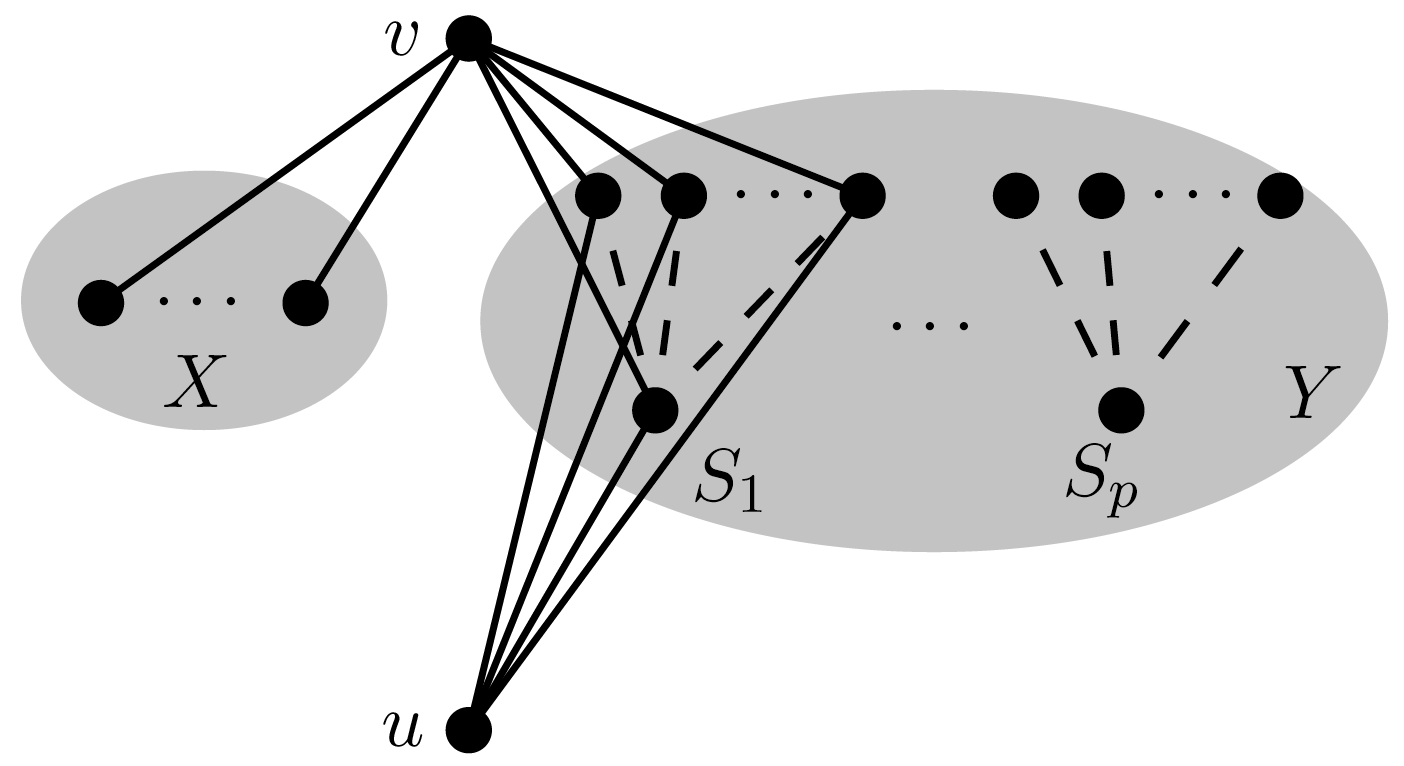
Figure 1: The dotted lines are the missing edges in {e∩S:e∈E(H)}2.
3. Maximizing Clique Count Subject to Trace Constraints
For the generalized problem (maximizing the number of copies of {e∩S:e∈E(H)}3), asymptotically sharp bounds are established: {e∩S:e∈E(H)}4
where {e∩S:e∈E(H)}5 is the maximal number of {e∩S:e∈E(H)}6-uniform cliques of size {e∩S:e∈E(H)}7 in a hypergraph with dominated number {e∩S:e∈E(H)}8.
For {e∩S:e∈E(H)}9, G0, with constructions analogous to the edge extremal case.
4. Simultaneous Forbidding of Trace Matching and Another Trace
The extremal number forbidding both a matching and a general graph G1 as traces is shown to be
G2
where G3 is the maximum number of hyperedges in an G4-uniform hypergraph with dominated number at most G5 and no dominated copy of G6 for any independent set G7 of G8. This draws a close parallel with classic Turán-type theorems for graphs with forbidden matching number, adapted to the trace framework in hypergraphs.
Analysis and Structural Insights
A crucial technical aspect is the use of various domination and "dominated set" parameters in hypergraphs to relate the existence of large trace-free hypergraphs to known bounds and constructions in extremal graph theory (e.g., Vizing's theorem, the Erdős matching conjecture, and Kruskal-Katona).
Key structural lemmas classify hyperedges into "light" and "heavy" according to how many times their shadows can be extended, and the proofs leverage detailed analysis of trace cores and their interactions with extremal configurations. The extremum is always achieved by a small dense core and the "star-like" blowing-up construction, with the structure of the core tightly constrained by domination requirements.
Implications and Future Directions
The results establish new sharp bounds and characterizations for Turán-type extremal functions in the trace setting for hypergraph matchings, complementing previous results for Berge and expansion versions. The methods demonstrate that domination-based parameters are intrinsically linked to trace extremal problems.
The implications are both theoretical (extending the landscape of Turán extremal combinatorics in a trace context) and methodological (showing domination and enclaveless-set techniques as powerful in high-uniformity hypergraphs). The results also connect to related generalized Turán problems (maximizing clique counts, simultaneous forbidden substructures).
Two explicit conjectures are posed:
- The extremum for G9 is conjectured to be achieved either by complete hypergraphs or by deleting exactly enough edges such that each exr(n,Trr(G))0-set is covered once (when a suitable Steiner system exists).
- For the clique maximization parameter exr(n,Trr(G))1, it is conjectured that the extremum is always realized by the complete exr(n,Trr(G))2-uniform hypergraph on exr(n,Trr(G))3 vertices.
Resolution of these conjectures would not only refine the constant terms in the main results but also clarify the structural theory of extremal trace-free hypergraphs. The paper's approach promises further development in quantitative and stability results for trace-based extremal problems, potentially informing algorithms for extremal constructions, stability analysis, and related metric parameters.
Conclusion
This work determines, up to an explicit asymptotic and often exact value, the maximal size and clique count of exr(n,Trr(G))4-uniform hypergraphs forbidding a matching as a trace. The results link these extremal quantities to hypergraph domination theory and unveil structural characterizations, yielding a comprehensive picture for this class of trace problems. The conjectures and methodology motivate ongoing research into domination-restricted extremal problems and the subtle differences between trace, Berge, and expansion subgraph constraints.

