- The paper demonstrates that SHU disorder in the honeycomb Hubbard model raises the critical interaction strength (Uc) for magnetic ordering compared to random disorder.
- SHU bond distributions, generated via reverse Monte Carlo optimization, significantly modify the density of states and suppress localization near the band edge.
- Vertex analysis reveals that SHU constraints reduce homogeneous local environments, leading to distinct spatial magnetization patterns and rare-region effects.
Introduction
The study offers a comprehensive investigation into the effects of stealthy hyperuniform (SHU) bond disorder on the electronic and magnetic ground states of the Hubbard model on the honeycomb lattice. SHU patterns, characterized by a structure factor S(k) that vanishes for all ∣k∣ less than some kc, interpolate between random and highly correlated non-periodic structures. While disordered hyperuniformity has been recognized in soft matter, photonics, and other domains, its impact on strongly correlated electron systems and phase transitions has not been systematically examined at the Hamiltonian level on discrete lattices. This paper introduces SHU bond distributions via reverse Monte Carlo optimization and analyzes their consequences for electronic localization, spectral characteristics, and magnetic phase boundaries in comparison with random and quasiperiodic analogues.
Model and Methodology
The authors consider a half-filled Hubbard model on a honeycomb lattice, with the nearest-neighbor hopping integrals tα and tβ distributed according to either truly random, SHU, or quasiperiodic tilings, maintaining the bond ratio NBα/NBβ=τ (golden mean). Bond centers are used to define the structure factor for diagnosing SHU characteristics. SHU configurations are constructed by minimizing a cost functional that enforces S(k)=0 within a window ∣k∣<kc in reciprocal space, gradually extending kc to interpolate between randomness and strong hyperuniformity. The resulting vertex statistics and bond inhomogeneity are then analyzed.
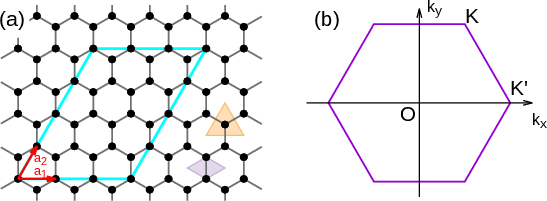
Figure 1: Representation of the honeycomb lattice and its unit vectors; the parallelogram denotes the simulation cell.
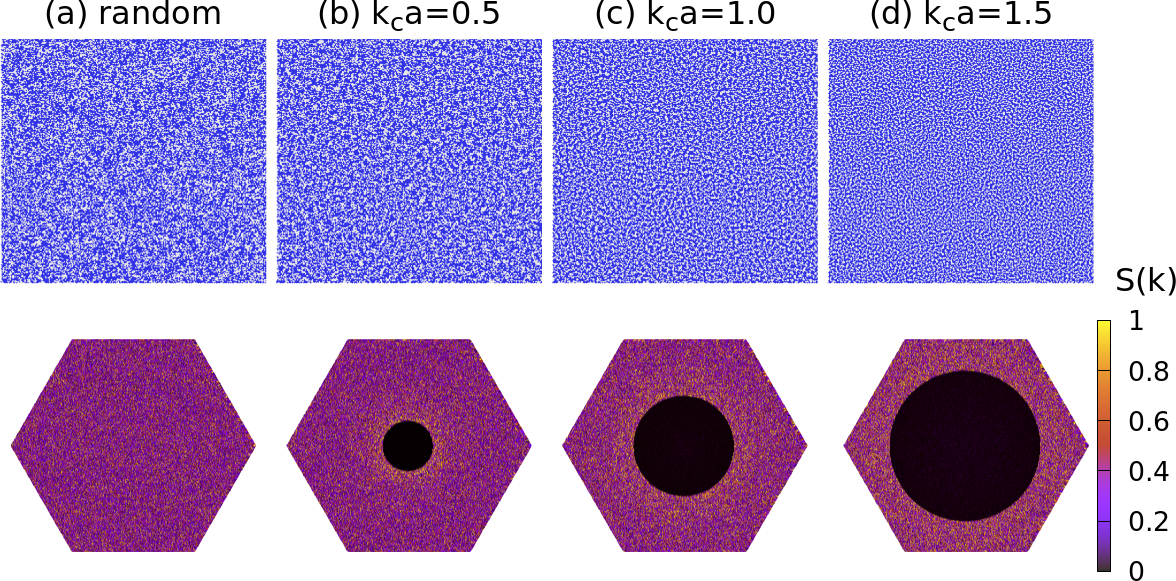
Figure 2: Bond distributions and corresponding structure factors for different kc, illustrating the tuning from random to stealthy hyperuniform order as ∣k∣0 increases.
Noninteracting Electronic Structure: Density of States and Localization
Exact diagonalization of the noninteracting Hamiltonian (∣k∣1) reveals that the linear density of states (DOS) at the Dirac point is robust against both random and SHU disorder, provided the global bond ratio is kept fixed. However, significant modifications emerge at higher energies near the band edge for SHU configurations with large ∣k∣2. The band edges shift to lower energies and the DOS becomes enhanced, with the most notable effects for ∣k∣3. Concomitantly, the inverse participation ratio (IPR) analysis demonstrates that SHU disorder suppresses localization and leads to more extended one-particle eigenstates over a substantial energy window near the band edge.
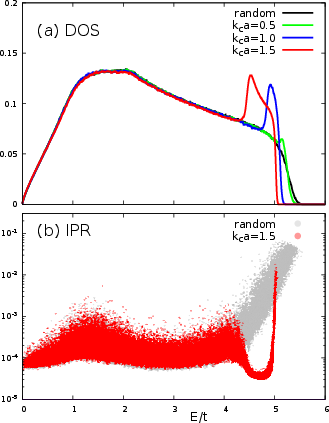
Figure 4: (a) DOS for several values of ∣k∣4; (b) Logarithmic IPR spectra for ∣k∣5 (random) and ∣k∣6 (SHU), showing reduced localization for the SHU case at high energies.
The effect is not uniform in ∣k∣7-space: imposing the stealthy constraint around the ∣k∣8 point significantly alters the high-energy electronic structure, whereas enforcing stealthiness in windows centered at the K/K' points (the Dirac points) predominantly leaves both the low- and high-energy DOS unchanged except for minor features in the intermediate range.
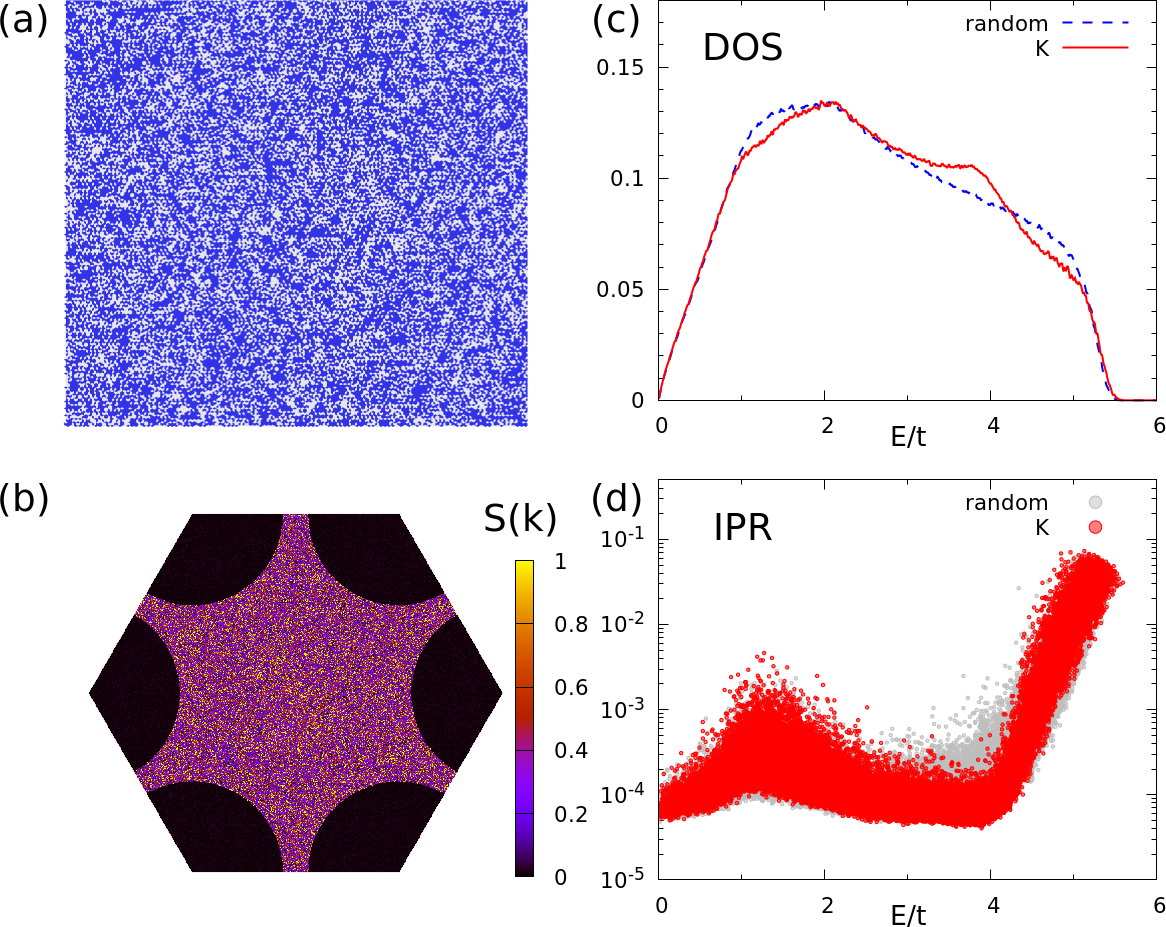
Figure 3: K-pattern bond configuration, associated structure factor, and DOS/IPR spectra, emphasizing the locality of SHU effects in reciprocal space.
Vertex Structure and Local Correlations
A classification of vertex types (C∣k∣9) according to their local bond environments reveals that SHU patterns selectively reduce the fraction of locally homogeneous sites (Ckc0, Ckc1) as kc2 increases. The vertex statistics for SHU and quasiperiodic tilings differ, indicating the nontrivial role of spatial correlations beyond the random ensemble, which impacts local electronic and magnetic properties.
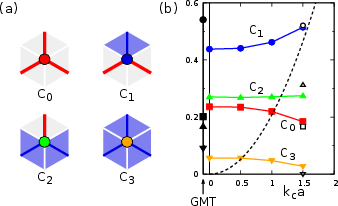
Figure 5: (a) Four vertex types in the honeycomb lattice and their bond environments; (b) Vertex-type fractions as a function of kc3, with comparisons to the golden-mean quasiperiodic tiling.
Magnetic Order and Phase Transition
Employing the real-space Hartree approximation, the phase diagram is analyzed for the Mott semimetal–antiferromagnet transition. Across all bond distributions, a finite kc4 is required for magnetic order. However, the critical interaction strength kc5 is observed to be sensitive to stealthiness: the SHU-disordered system demonstrates a larger kc6 than its random counterpart for fixed bond ratio and vertex statistics. The averaged staggered magnetization grows more slowly with kc7 for SHU patterns and is consistently smaller than the random case in the vicinity of the transition.
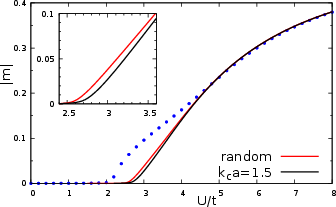
Figure 7: Average local magnetization versus kc8 for random, SHU, and quasiperiodic cases, with the golden-mean tiling result displayed for comparison.
The Hartree-level critical kc9 is underestimated compared to exact Monte Carlo results but the qualitative trends regarding bond distribution survive.
Fine Structure of Magnetization: Inverse Participation Ratio Analysis
The spatial inhomogeneity and rare-region effects in the developing antiferromagnetic order are quantified using first and second moment IPRs of the local magnetization. For large tα0, all systems exhibit nearly uniform magnetization reflecting saturated order. For tα1, however, the SHU system exhibits smaller IPRtα2 but larger IPRtα3 compared to random, indicating more homogeneous but sharper rare-peak distributions—a signature of spatially isolated strongly ordered regions amidst an otherwise weakly ordered background.
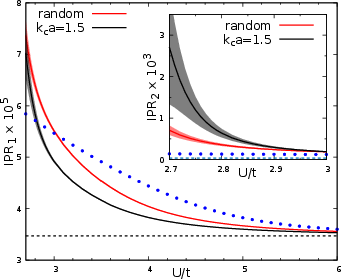
Figure 6: IPRtα4 (main) and IPRtα5 (inset) of the magnetization as a function of tα6 for SHU, random, and quasiperiodic bond structures, with error bands from disorder averaging.
Spatial magnetization maps support this: the SHU case produces more regular patterns with isolated strongly ordered sites, while the random case yields more widespread magnetization with smaller contrast.
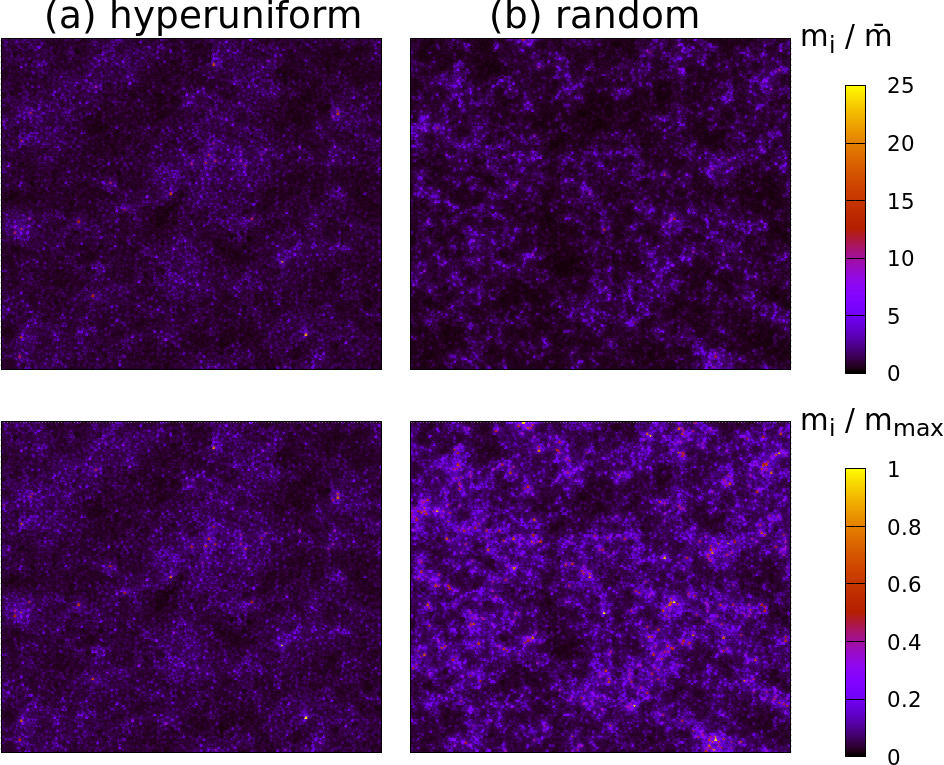
Figure 8: Real-space maps of local magnetic moments at tα7 for SHU and random bond distributions, normalized to average (upper panels) and maximum (lower panels) values.
Interplay with Quasiperiodic Order
Comparison with quasiperiodic tilings reveals that higher fractions and clustering of highly magnetizable vertex types (Ctα8) lead to stabilization of the ordered phase at smaller tα9 than in both SHU and random systems. Thus, the precise nature of structural correlations—periodic, quasiperiodic, or SHU—strongly modifies the balance of rare region effects and collective order.
Vertex-Constrained SHU Patterns
Applying SHU constraints simultaneously to bonds and vertex distributions further suppresses Ctβ0 sites, but induces only minor additional changes in the DOS, IPR, and magnetization profiles compared to bond-only SHU, indicating the robustness of the main findings to the details of constraint implementation.
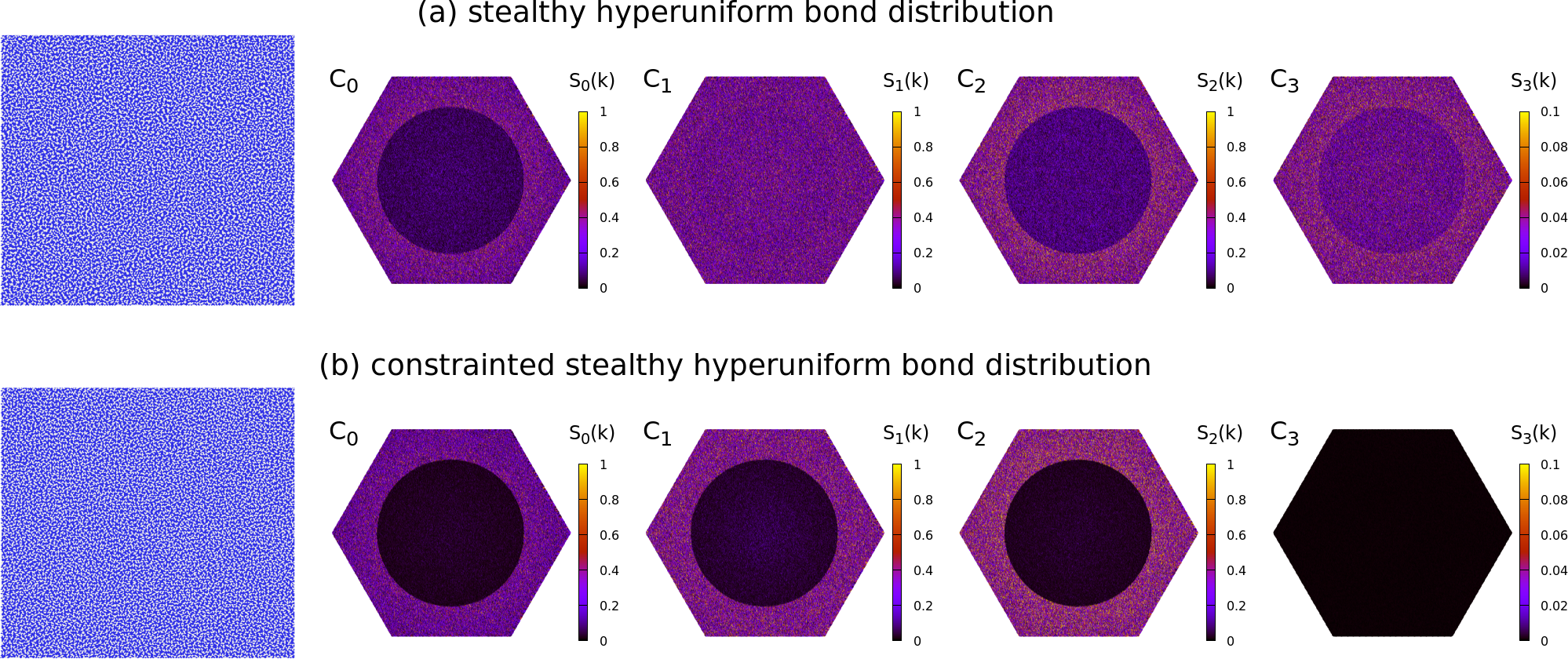
Figure 9: Top: Joint SHU constraint on bonds and vertices with the corresponding structure factor; the Ctβ1 fraction is strongly reduced.
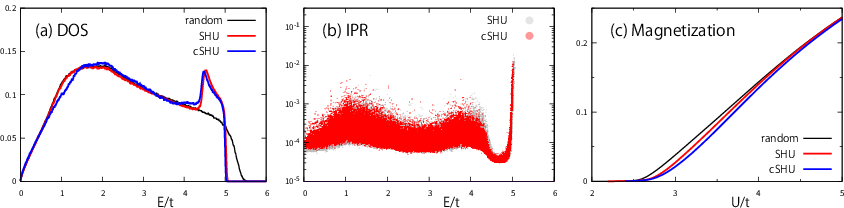
Figure 10: (a) DOS and (b) IPR for SHU vertex constraint; (c) magnetization versus tβ2, showing near quantitative agreement with SHU bond-only results.
Implications and Outlook
This study establishes SHU disorder as a distinctive route to patterning the electronic spectrum and tuning magnetic phase boundaries in correlated systems via the suppression and spatial structuring of rare regions. The results highlight the sensitivity of correlated ground states to nontrivial long-range correlations in disorder, going beyond conventional random or patterned lattices. Practically, this enables the prospect of harnessing SHU microstructure in engineered quantum materials for customizable spectral and phase behavior, including possible stabilization of Griffiths-like phases. Theoretically, it motivates further work employing many-body techniques surpassing mean-field, and the extension to multi-orbital or topological correlated models.
Conclusion
Stealthy hyperuniform disorder fundamentally modifies both one-particle and many-body electronic properties in the honeycomb Hubbard model. While the linear low-energy DOS and Dirac physics are robust, SHU patterns induce substantial delocalization at high energies and systematically raise the threshold for magnetic order relative to random and quasiperiodic analogues. The observed modulation of rare region statistics, vertex type distributions, and spatial inhomogeneity of magnetization demonstrates SHU disorder as a flexible and impactful tool for controlling quantum electronic and magnetic states in correlated lattices.
Reference: "Stealthy hyperuniform disorder: A new route to controlling electric states and magnetic phase transition in correlated systems" (2604.19041)