- The paper introduces a novel barrier certificate framework that bounds the probability of cumulative target occupation in finite time.
- It employs dissipative and attractive barrier certificates with SOS relaxations to derive rigorous upper and lower probability bounds.
- Empirical studies validate tight bounds, capturing subtle transition behaviors in continuous-time stochastic systems under safety constraints.
Quantitative Verification of Finite-Time Constrained Occupation Measures in Stochastic Systems
Introduction and Motivation
This work presents a formal framework for the quantitative verification of finite-time constrained occupation times in continuous-time stochastic systems governed by SDEs. Traditional verification paradigms—such as probabilistic safety and reachability—are limited to single-event properties (safety: “never exit safe set”, reachability: “eventually hit target set”), omitting long-term cumulative requirements crucial for practical autonomous operation. For tasks such as dynamic surveillance, persistent monitoring, and safety-constrained energy delivery, systems must not only visit a target set, but accrue a prescribed cumulative duration within it, without violating safety constraints. This cumulative metric, termed "constrained occupation time," is strictly stronger than the classical occupation measure.
The paper advances the theory and computational practice of occupation-time property verification via the synthesis of barrier certificates. The framework rigorously bounds the probability that a stochastic process accumulates at least a given amount of time in a target set during a finite horizon, provided it never exits a larger safety set. The key technical approach involves the construction of dissipative and attractive barrier functions whose analytical constraints reduce to semidefinite programs via sum-of-squares (SOS) relaxations.
The setting is a continuous-time stochastic process Xt in Rn, governed by an Itô SDE:
dXt=f(Xt)dt+σ(Xt)dWt,X0=x0∈X
where f (drift) and σ (diffusion) satisfy standard regularity conditions. Two sets of interest are defined: an open, bounded safe set X, and its compact target set T⊂X. The safety exit time τsafe is the first exit from X. The constrained occupation time over horizon H is:
Rn0
where accumulation ceases immediately upon leaving Rn1. The central verification task is to compute upper and lower bounds on Rn2 for given Rn3 (horizon) and Rn4 (minimum occupation).
Barrier Certificate Framework
The novelty of the approach lies in the development of three classes of Lyapunov-like barrier certificates—dissipative and two variants of attractive barriers—which provide, respectively, upper and lower bounds on the constrained occupation probability. The framework is underpinned by
- Stopping the process upon boundary exit (stopped processes);
- Adapted martingale constructions;
- Dynkin’s formula for expectations up to random horizons.
Upper Bound: Dissipative Barriers
A dissipative barrier Rn5 obeys specific generator (infinitesimal) conditions, with a “dissipative drift” on Rn6 and a sink condition on the boundary Rn7. The main result asserts that, for Rn8, a suitable exponential weighting yields
Rn9
where dXt=f(Xt)dt+σ(Xt)dWt,X0=x0∈X0 tunes the exponential moment and dXt=f(Xt)dt+σ(Xt)dWt,X0=x0∈X1 is an explicit global drift upper bound.
Lower Bounds: Attractive Barriers
Two attractive barrier constructions are introduced, sensitive to the global or local dynamics of the process.
Attractive Barriers I
This form penalizes time spent outside dXt=f(Xt)dt+σ(Xt)dWt,X0=x0∈X2 by an exponential weight. The generator conditions enforce positivity of drift with offset dXt=f(Xt)dt+σ(Xt)dWt,X0=x0∈X3 (interpreted as “leakage” from the score process). The lower bound is:
dXt=f(Xt)dt+σ(Xt)dWt,X0=x0∈X4
with dXt=f(Xt)dt+σ(Xt)dWt,X0=x0∈X5 and dXt=f(Xt)dt+σ(Xt)dWt,X0=x0∈X6 the global upper bound on dXt=f(Xt)dt+σ(Xt)dWt,X0=x0∈X7.
Attractive Barriers II
This class embeds a bidirectional time-weighting, giving strong results in “strictly attractive” systems when the net drift toward the target is positive (dXt=f(Xt)dt+σ(Xt)dWt,X0=x0∈X8). The bound involves:
dXt=f(Xt)dt+σ(Xt)dWt,X0=x0∈X9
where f0 and f1 explicitly incorporate the effect of positive drift.
Computational Synthesis and Numerical Case Studies
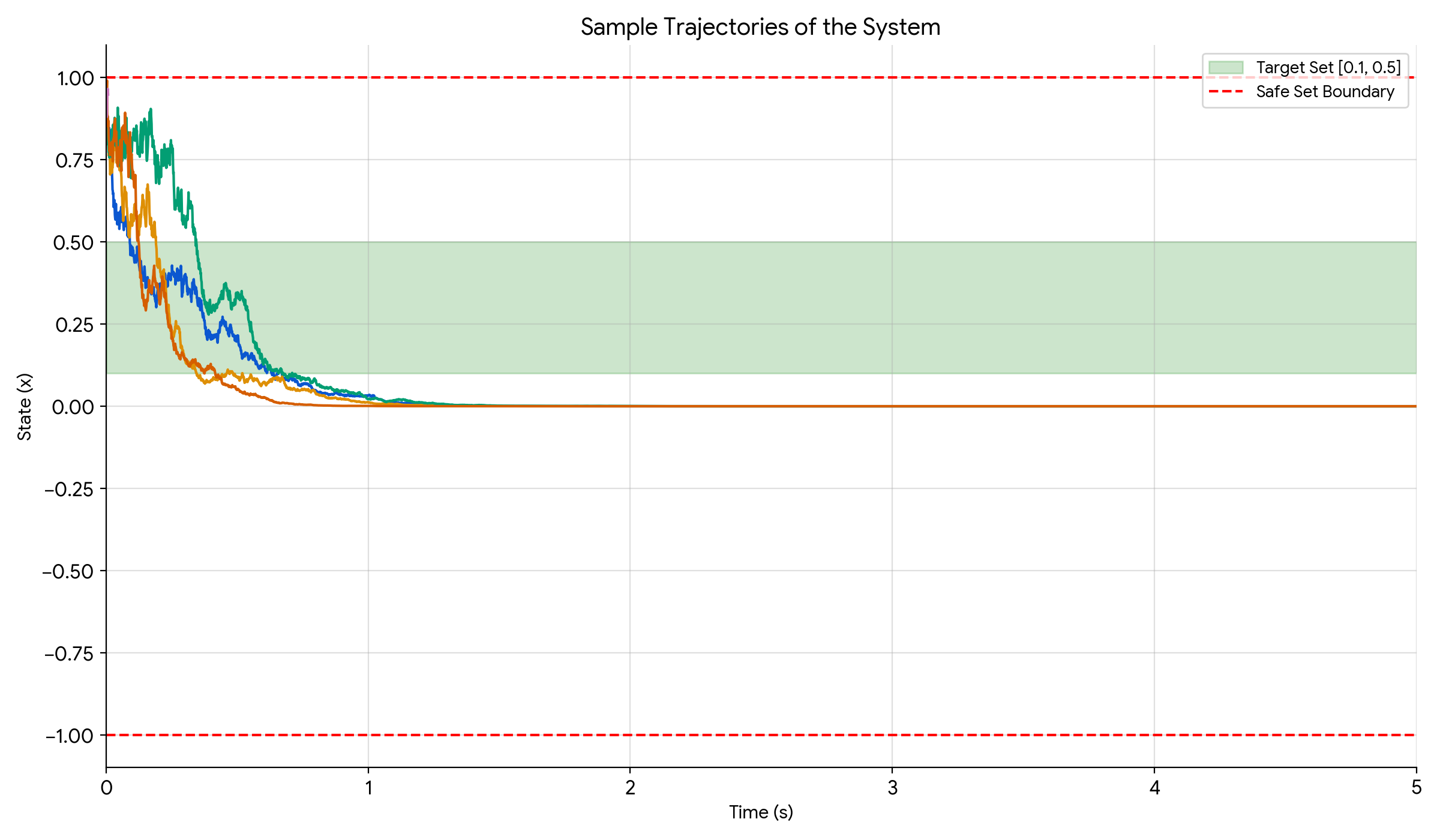
Barrier functions are implemented as polynomials in state variables, and their synthesis reduces to checking matrix inequalities (SDPs) using SOS relaxations. The approach is validated on polynomial SDE examples. Empirical probabilities from f2 Monte Carlo simulations (Euler-Maruyama) corroborate the tightness and sharpness of the derived bounds.
The method is illustrated with two representative systems:
Analysis and Implications
This framework decisively extends the scope of formal verification for continuous-time stochastic systems, bridging the gap between single-event reach-avoid and cumulative service-type properties. The splitting of lower bound strategies is particularly effective, as illustrated by parameter regimes where only one attractive barrier is feasible or dominant. The convexity of the SDP formulations ensures computational tractability for models up to moderate polynomial degree and dimensionality. Notably, the framework provides rigorous numerical bounds that can be directly compared against empirical estimates, with no notable conservativeness in well-posed regimes.
A salient implication is that the approach captures, under explicit and checkable analytic and algebraic conditions, subtle transition phenomena not detected by traditional reach/avoid analysis—e.g., requiring repeated visits to the target, or tracking the interplay of stochastic exit and cumulative presence in σ7.
Contradictory Behavior: The infeasibility of Theorem 3’s barrier for Example 2 (when positive drift is not present) highlights the necessity of matching the certificate construction to the system’s qualitative dynamics.
Future Directions
Ongoing research avenues include:
- Full automation of parameter selection (notably, decay rate σ8 and barrier upper bound σ9);
- Theoretical quantification of conservativeness and completeness of the SDP relaxation hierarchies;
- Scalability improvements for higher-dimensional, non-polynomial dynamics;
- Extension to multiple targets and time-varying or stochastic constraint sets.
Conclusion
The analyzed framework establishes a theoretically-sound, computationally-efficient pipeline for the verification of finite-time cumulative specifications in continuous-time stochastic systems. By leveraging the expressiveness of barrier certificate methods and the tractability of SOS/SDP relaxations, it offers strong guarantees even in the presence of significant process noise and under nontrivial temporal requirements. The practical and analytical insights provided are expected to motivate integration with synthesis, planning, and robust control in next-generation autonomous system development.
Reference:
For full algorithmic and theoretical details, see "Quantitative Verification of Finite-Time Constrained Occupation Measures for Continuous-time Stochastic Systems" (2604.19014).