- The paper introduces barrier certificate methods for verifying cumulative occupation-time probabilities in stochastic systems under safety constraints.
- Using dissipative and attractive barrier certificates, the study provides upper and lower bounds for the probability of repeated target visitation, leveraging switched-system transformation.
- The framework eliminates state augmentation, maintaining consistent computational complexity, and validates results through Monte Carlo simulations.
Quantitative Verification of Constrained Occupation Time in Stochastic Discrete-Time Systems
Problem Setting and Motivation
The paper "Quantitative Verification of Constrained Occupation Time for Stochastic Discrete-time Systems" (2604.17902) develops a rigorous barrier certificate framework for verifying cumulative behavioral properties in safety-critical stochastic discrete-time settings. Rather than focusing solely on single-event properties like reachability or invariance, the study targets the probability that a system visits a designated target set at least k times—prior to any safety violation—over finite or infinite horizons. This formalizes specifications crucial to domains such as surveillance, inspection, and periodic maintenance, where repeated successful interactions with a target under safety constraints are required.
While classical probabilistic verification relies on supermartingale or Lyapunov-inspired methods tailored to single-event specifications, constrained occupation time properties are inherently cumulative and historically under-explored. Prior approaches for ω-regular properties (e.g., recurrence/persistence) typically rely on explicit state augmentation, increasing computational complexity with the visit count k, or cannot efficiently encode strict safety requirements. The present work circumvents these limitations by implicitly representing visit counts within the algebraic structure of barrier certificates, leveraging a switched-system formulation that absorbs safety violations and enables reduction to unconstrained probabilistic analysis.
Barrier Certificate Framework: Switched-System Approach
The switched-system transformation is pivotal: whenever the system's state exits the safe set, the dynamics are frozen, and the system remains in an absorbing unsafe region. This allows safety requirements to be handled implicitly and reduces the original constrained occupation-time verification to an unconstrained problem on an augmented process.
Two classes of certificates are introduced:
- Dissipative Barriers: These yield exponential upper bounds on the probability of frequent target visitation via a contraction parameter α∈(0,1). The multiplicative structure of the barrier certificate amplifies state values upon target visits, enabling rigorous geometric-bounds using Markov's inequality and martingale properties.
- Attractive Barriers: These provide quantitative lower bounds using submartingale analysis. Upon each target visit, the barrier is amplified (using factors α>1 or α2 under weighted variants), certifying repeated interaction probabilities even under positive drift. Sink conditions enforce penalization in absorbing states for soundness.
For both finite and infinite horizons, the framework derives tight probabilistic bounds on occupation time without explicit state augmentation. The certification complexity remains constant as k increases.
Theoretical Results
The main theoretical contributions are:
- Rigorous Upper and Lower Bounds: The framework decouples verification complexity from the frequency requirement k. Dissipative barriers yield bounds that decay exponentially with k, e.g., P(NT(∞,ω)≥k)≤v(X0)ρ(X0)αk, while attractive barriers provide lower bounds such as ω0, where ω1 is the certificate function and ω2 encodes amplification upon visits.
- Handling Positive Drift: For systems with additive drift, weighted attractive barrier certificates (using ω3 within the target) enable the establishment of non-trivial lower bounds, accommodating scenarios where geometric contraction is not strictly achievable.
- Piecewise Barrier Synthesis: Although the use of indicator functions in barrier conditions introduces piecewise structure and non-convexity, for finite-disturbance settings these can be partitioned and verified via polynomial inequalities, often using sum-of-squares or convex programming when tractable.
Numerical Examples and Empirical Validation
The paper illustrates certificate-based occupation time guarantees with scalar stochastic systems possessing discrete disturbances. Results demonstrate:
- For a system initialized away from a remote target, dissipative barriers yield very tight upper bounds on repeated visitation (with infinite-horizon bounds certifying probability zero if the barrier vanishes on the robust invariant).
- For a system where the initial state is outside but dynamically attracted to the target, attractive barriers rigorously certify strong lower bounds on the probability of multiple visits—even over long horizons. Weighted variants provide bounds decaying with ω4, confirming the trade-off between certificate strength and ease of synthesis.
Monte Carlo simulations corroborate the theoretical limits: empirical occupation-time probabilities strictly obey the certified upper and lower bounds, validating rigor and conservatism.
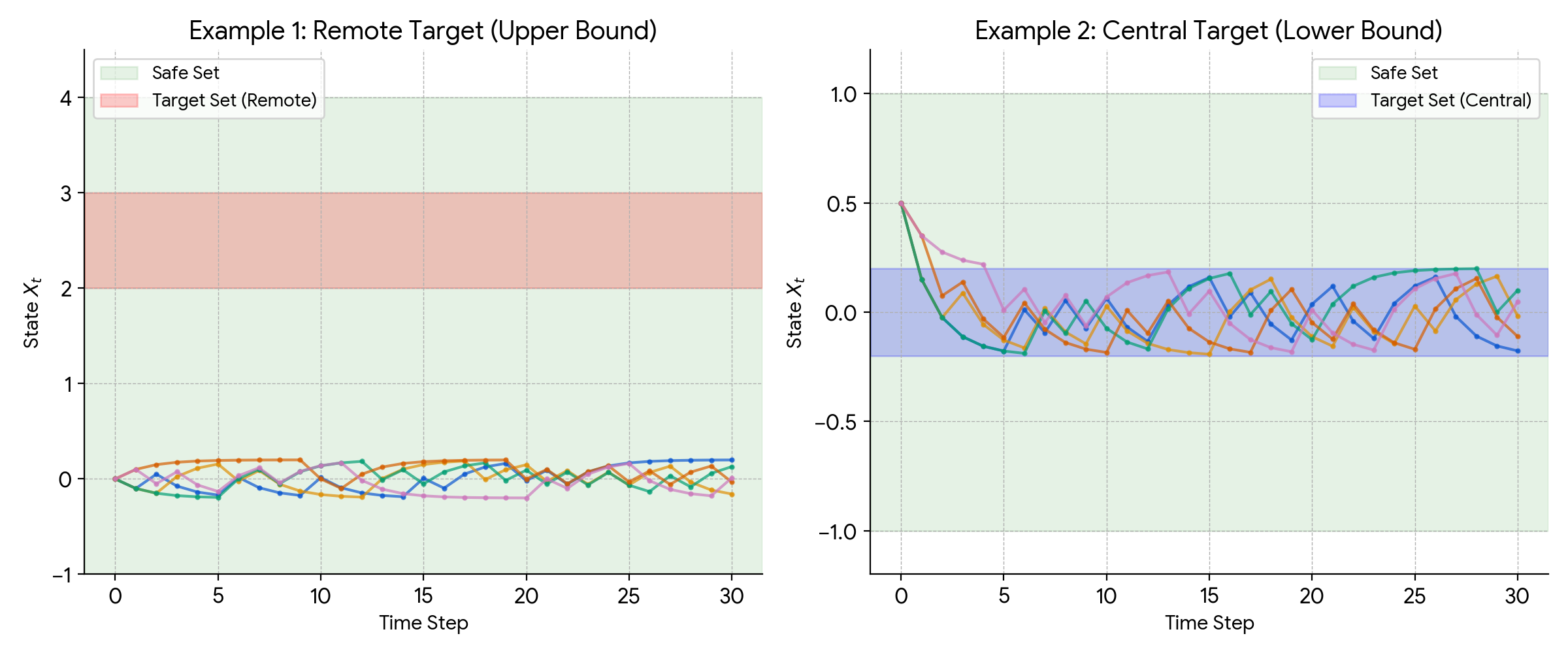
Figure 1: Numerical illustration for constrained occupation time: empirical and certified occupation-time statistics for representative system trajectories.
Practical and Theoretical Implications
The framework enables formal certification of repeated behaviors—critical in robotics, inspection, and energy-aware autonomy—where cumulative interactions are vital under uncertainty. By avoiding state augmentation, it is scalable and extensible to high-frequency requirements and continuous-state settings.
From a theoretical perspective, the extension of Lyapunov-like certificate techniques to cumulative properties moves quantitative verification beyond classical invariance and reach-avoid analysis, laying foundational ground for future ω5-regular verification with safety. The piecewise-affine structure is compatible with emerging applied approaches using neural barriers, ReLU networks, and PAC-style learning, suggesting direct avenues for algorithmic synthesis.
Future Directions
Further research can target efficient automated synthesis in high-dimensional and continuous-state systems, leveraging neural certificate paradigms that naturally encode piecewise barrier structures. Extensions to continuous-time stochastic systems, formal ω6-regular specification decomposition, and data-driven verification with PAC bounds are all plausible.
Conclusion
This paper advances the theory and practice of stochastic verification by introducing a scalable, certificate-based framework for constrained occupation-time analysis. The approach provides two-sided probabilistic guarantees for cumulative target visitation under safety constraints, applicable across finite and infinite horizons, with computational and empirical validation. Its structural compatibility with neural certificate methods and unification of cumulative behavioral specifications positions it as a foundation for formal verification of repeated behaviors in stochastic autonomous systems.

