- The paper introduces a semi-smooth Newton method that leverages the strong semi-smoothness of projections onto generalized simplicial cones to achieve local quadratic convergence.
- It reformulates the KKT conditions via conic projection equations, eliminating the need for smoothing techniques and enhancing computational efficiency.
- Numerical experiments on circular cone programming and low-rank matrix completion demonstrate significant speed-ups and high-precision solutions.
Semi-Smooth Newton Methods for Nonlinear Conic Problems with Generalized Simplicial Cones
This paper addresses the nonlinear conic programming problem (NCP):
x∈Xmin f(x)subject tog(x)∈K
where K⊂Y is a closed convex cone, f:X→R and g:X→Y are C2 functions, and X,Y are finite-dimensional inner product spaces. The analysis targets the case where K is a generalized simplicial cone, that is, K=MK where K is a symmetric cone and M:E→Y is linear (possibly not full rank). This structure generalizes classical settings such as the nonnegative orthant, second-order, and positive semidefinite cones.
The impetus for this generalization is both theoretical and algorithmic: generalized simplicial cones arise naturally in problems such as second-order and circular cone programming, matrix completion with rank constraints, and variational inequalities. Handling constraints of this form calls for both deep structural analysis of the underlying geometry and efficient algorithmic schemes.
Generalized Simplicial Cones and Their Properties
A central contribution of the paper is the study of projections onto generalized simplicial cones. Closedness is delicate under linear transformations: while convexity is preserved, the image K⊂Y0 may fail to be closed even for symmetric cones. The authors establish two sufficient conditions for closedness, focused on the behavior of K⊂Y1 relative to K⊂Y2:
- Trivial intersection (K⊂Y3): Ensures the image K⊂Y4 is closed [Proposition 2.1].
- Kernel meets interior (K⊂Y5): Ensures K⊂Y6 (and thus closed) if K⊂Y7 is symmetric [Proposition 2.2].
Projections onto K⊂Y8 can be reduced to solving a convex quadratic program over K⊂Y9. The KKT conditions lead to a nonlinear system involving the projection f:X→R0, for which semi-smooth Newton methods are particularly efficient.
The dual cone f:X→R1 is characterized explicitly in terms of f:X→R2 and f:X→R3. Even when f:X→R4 is not invertible, Moreau’s decomposition enables equivalence between projection onto f:X→R5 and its dual, facilitating practical computation.
Most critically, the paper establishes that the projection onto a generalized simplicial cone is strongly semi-smooth—a property essential for quadratic convergence of semi-smooth Newton methods, and one that is preserved even when f:X→R6 is rank-deficient [Theorem 2.3].
The conic projection equations generalize Robinson’s normal equations. Instead of laboring with smoothing or penalization, the approach enforces complementarity via a direct nonlinear system that is equivalent to the KKT conditions of the original NCP [Theorem 3.1]. More concretely, if f:X→R7 solves
f:X→R8
then f:X→R9 are KKT points. This removes the need for smoothing or relaxation and allows the direct exploitation of the projection's metric regularity.
Specialization to identity constraints or to problems with additional conic structure leads to further simplifications; in the latter, KKT pairs can be computed via a reduced system involving only the duals and projections.
The Semi-Smooth Newton Method
The authors propose a semi-smooth Newton method to solve the conic projection system. The algorithm iteratively updates g:X→Y0 using the generalized Jacobian (Clarke’s) of the system, leveraging:
- Strong semi-smoothness of the projection, ensuring local quadratic convergence.
- Globalization via Armijo linesearch: Descent is enforced via the residual merit function g:X→Y1.
- Regularization in the presence of singular Jacobians, ensuring a search direction can always be computed.
- Stationarity diagnosis/escape: If the method encounters “singular” stationary points where g:X→Y2 but g:X→Y3, the residual is decomposed into its optimality and feasibility parts, and progress is sought along the latter.
Quadratic convergence is rigorously established under standard nonsingularity conditions on the local Jacobian [Theorem 4.1].
The robustness and efficacy of the method hinge on these algorithmic features. The escape mechanism for non-optimal stationary points is novel and experimentally effective, though the authors note that handling optimal, but non-solution, stationary points remains an open challenge.
Immediately after introducing the conic projection equations, the relationship between stationary point structure and the geometry of the feasible set is made visually explicit.
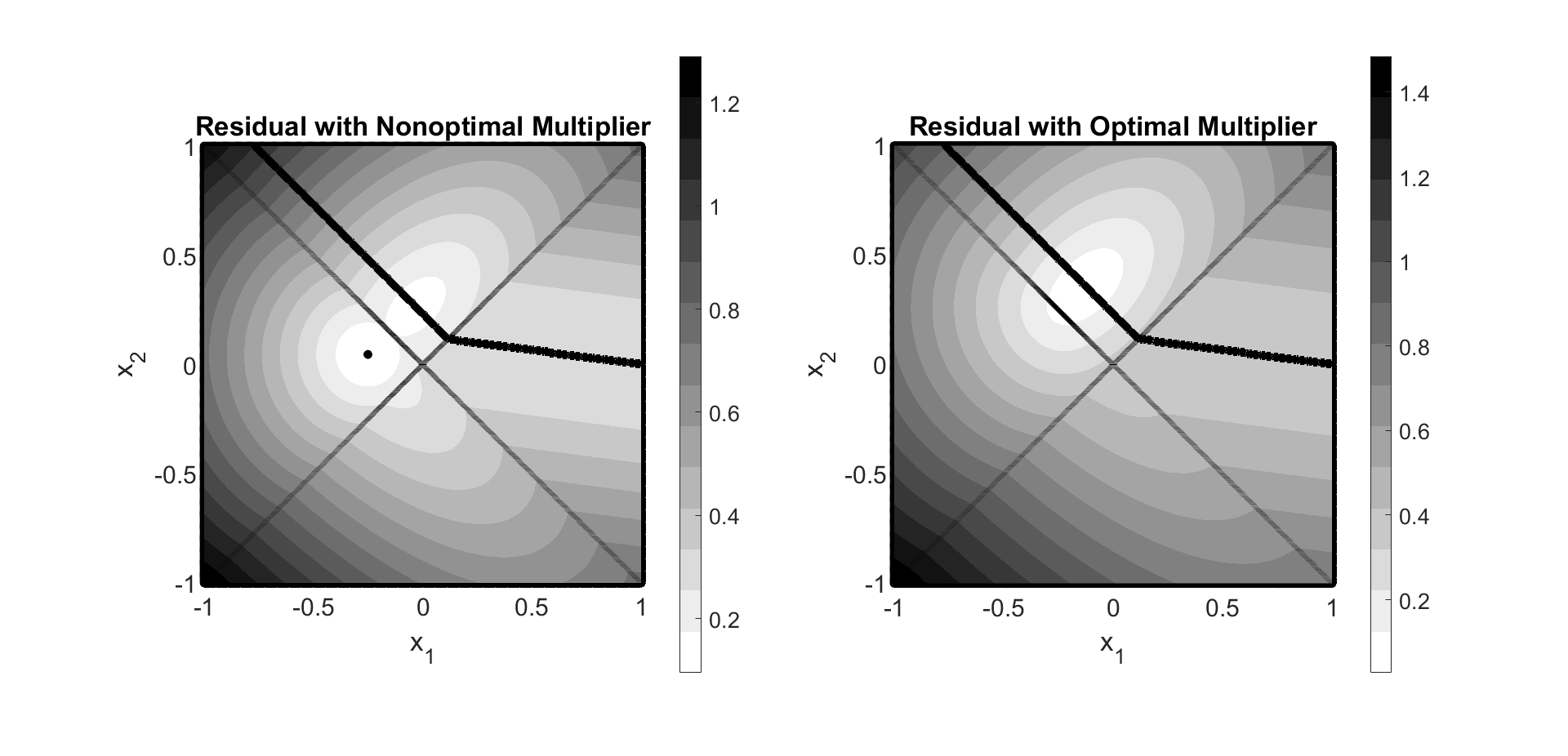
Figure 1: Stationary points of g:X→Y4 for a second-order conic problem; left, non-optimal multiplier yields non-optimal stationary points; right, optimal multipliers yield genuine solutions.
Numerical Results
Circular Cone Programming
On the problem class where the cone constraint is a circular cone (the image of a SOC under a parameterized linear map), the proposed SSN method outperforms state-of-the-art smoothing Newton methods (TZ [Tang & Zhou, 2022]):
- Precision: SSN achieves residuals 2–3 orders of magnitude below g:X→Y5 in most configurations.
- Efficiency: SSN is consistently two orders of magnitude faster than TZ for moderate dimensions (g:X→Y6); this advantage grows with problem size.
- Iteration counts: SSN typically converges in fewer than 8 steps, while smoothing methods require dozens per instance.
- Robustness: Though performance varies with the starting point, SSN reliably finds optimal KKT points from the origin or random initializations.
Figures and summary tables demonstrate the convergence basins and computational efficiency for a range of cone parameters and ambient dimensions.
Low-Rank Matrix Completion
Applying SSN to low-rank matrix completion (using a continuous reformulation via matricial quadratic and trace constraints [Bertsimas et al., 2021]) yields:
- High success rates: For g:X→Y7 and moderate rank/sparsity, SSN finds KKT points with residuals g:X→Y8 in over 94% of instances.
- Scalability: Solution times are order-of-magnitude competitive with global (combinatorial) mixed-integer approaches for small g:X→Y9, and show better flexibility for large-scale or heuristic refinement.
- Limitations: Instances with tight rank bounds or high sparsity occasionally stall at non-solution stationary points; residuals remain within several orders of magnitude of the target.
These outcomes suggest that continuous, projection-based Newton methods are viable as refinement phases following coarse heuristics, or as standalone solvers in applications where global optimality is not strictly necessary.
Implications and Future Outlook
This work provides a unifying framework for first-order and second-order conic problems constrained by generalized simplicial cones, and demonstrates the power of semi-smooth Newton schemes for these settings.
Practical impact: The methods are readily applicable to large-scale conic problems from control, signal processing, or low-rank recovery, whenever constraints manifest via conic sets or linear images thereof. The required structure—projection evaluation and adjoint Jacobians—matches that in popular conic solvers.
Algorithmic insight: The strong semi-smoothness property broadens the range of cones for which fast Newton-type algorithms are provably and practically effective, eliminating the need for smoothing or penalization-based relaxations.
Theoretical contribution: The equivalence between conic projection equations and the KKT optimality system for generalized cones allows a direct mapping of first-order and strong stationarity points, and will inform future studies on regularity, constraint qualification, and error bounds in nonlinear conic optimization.
Conclusion
The paper establishes that semi-smooth Newton methods—armed with robust escape mechanisms and operating over generalized simplicial cones—can solve nonlinear conic programs efficiently and to high precision. Quadratic convergence is ensured by an expanded semi-smoothness theory. The authors’ numerical results and analysis confirm that their methods surpass traditional smoothing techniques on challenging benchmarks. An open line of inquiry remains in the robust detection and avoidance of non-optimal stationary points, which is relevant for theoretical guarantees in nonconvex and rank-constrained applications. The practical flexibility and power of these methods make them strong candidates for future conic optimization frameworks, especially as the geometry of feasible sets in modern applications grows increasingly intricate.