- The paper introduces a novel framework for fourth-order galaxy-galaxy lensing by deriving connected four-point correlation functions and mixed aperture moments.
- It employs adaptive binning and FFT-based direct estimators to achieve subpercent precision in measuring non-Gaussian signals from simulated survey data.
- The methodology helps break degeneracies in galaxy-mass mapping, offering a pathway for precision cosmology in upcoming Stage IV surveys.
Fourth-Order Galaxy-Galaxy Lensing: Theoretical Framework and Direct Estimation
Introduction and Motivation
Weak gravitational lensing, particularly galaxy-galaxy lensing (GGL), is a principal probe of the connection between the distribution of galaxies and the underlying matter field. While second- and third-order lensing statistics (e.g., two-point and three-point correlation functions, GGL and G3L) have seen extensive theoretical development and observational application, these are fundamentally limited in their exploitation of the full non-Gaussian information embedded in large-scale structure. The work "Fourth-order galaxy-galaxy-lensing: Theoretical framework and direct estimation" (2604.18378) formulates a comprehensive theoretical and computational framework for fourth-order lensing statistics (G4L), with particular focus on the mixed aperture moments encapsulated in the four-point galaxy-shear correlator ⟨N3Map⟩. The goal is to facilitate the practical extraction of this higher-order signal from data in the era of Stage IV surveys.
The paper offers a rigorous derivation of the connected galaxy-galaxy-galaxy-shear four-point correlation function (4PCF) and its correspondence to the projected galaxy-galaxy-galaxy-mass trispectrum. The construction generalizes standard second-order cross-correlation Pδgδ to a quartic correlator, inheriting permutation symmetry properties and encapsulating higher-order bias and galaxy-mass correlation parameters (b4, r4). The 4PCF at the field level is shown to encode biasing and galaxy-matter coupling information inaccessible to lower orders.
The statistical homogeneity and isotropy of the underlying matter and galaxy fields are exploited to parameterize the 4PCF by three separations (ϑ1, ϑ2, ϑ3) and two opening angles (ϕ12, ϕ23), reducing redundancy in the correlation function arguments. A careful treatment of the shear projection angle ζ ensures proper invariance properties under coordinate transformations, critical for constructing unbiased estimators for observed fields.
A central aspect is the transformation of the 4PCF signal into mixed aperture statistics through a convolution with compensated filter functions. This transition from configuration space (5D 4PCF) to aperture statistics provides significant data compression, localizes the sensitivity to the trispectrum, and facilitates E-/B-mode separation.
Numerical Methods and Precision Assessment
The practical computation of the high-dimensional aperture statistics integral is nontrivial. The authors develop a Riemann-sum-based numerical pipeline, leveraging dimensionless logarithmic binning for radial separations and adaptive angular binning for efficient sampling in Pδgδ0 space. The impact of bin size, finite integration domain, and bin-averaging—reflecting the observational realities of constructing the 4PCF estimator—are studied with precision.
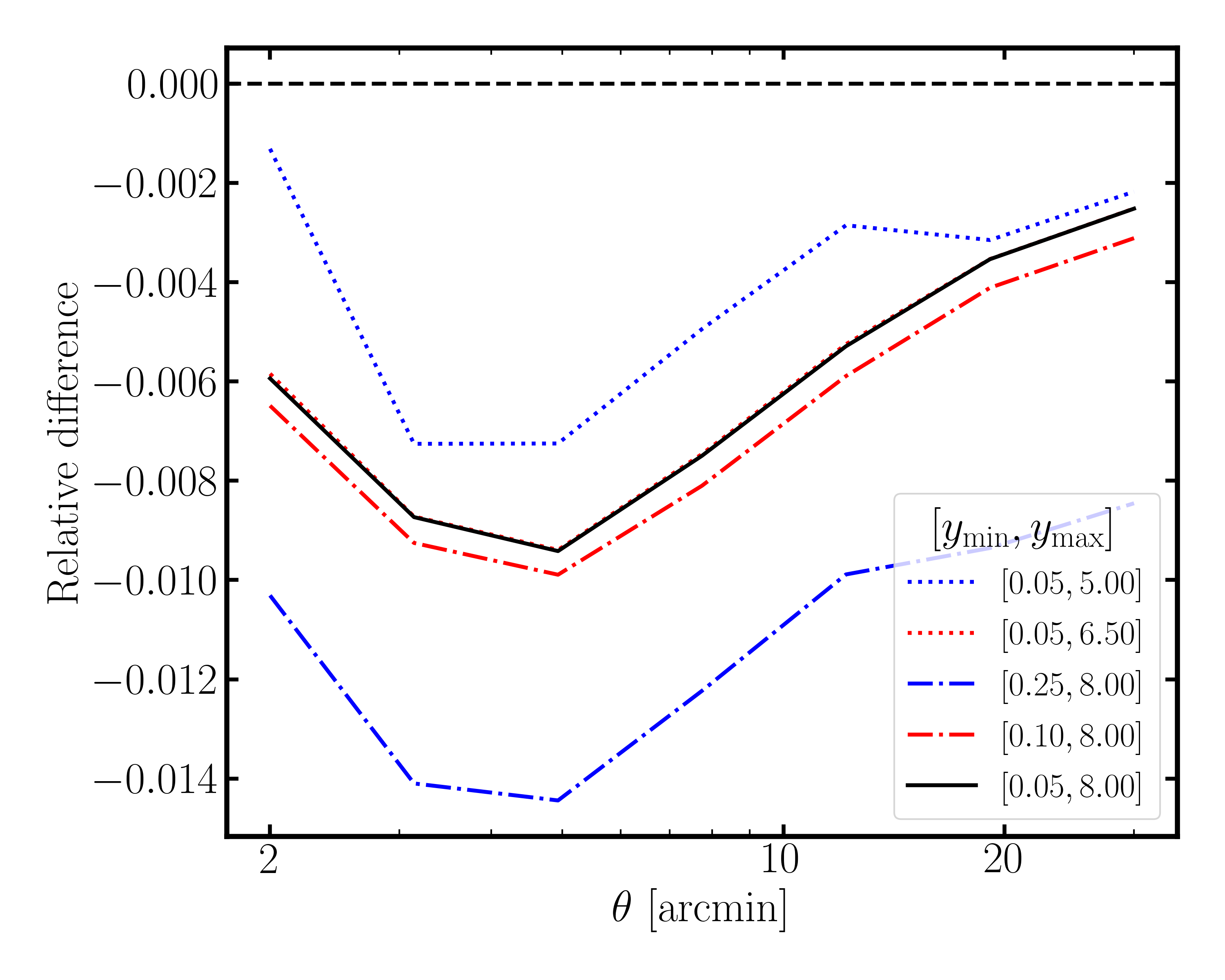
Figure 1: Relative bias in Pδgδ1 from numerical integration as a function of aperture scale and binning scheme, showing convergence properties.
The integration is validated by considering Gaussian fields where the expected result can be constructed from lower-order statistics. Using a logarithmic bin size Pδgδ2 and appropriate range cropping, the numerical bias is held below the percent level for all relevant aperture scales.
For robust estimator development—including addressing the bin-averaged nature of practical 4PCF measurements—the integration routine is further generalized to implement sub-bin sampling for improved accuracy on large scales.
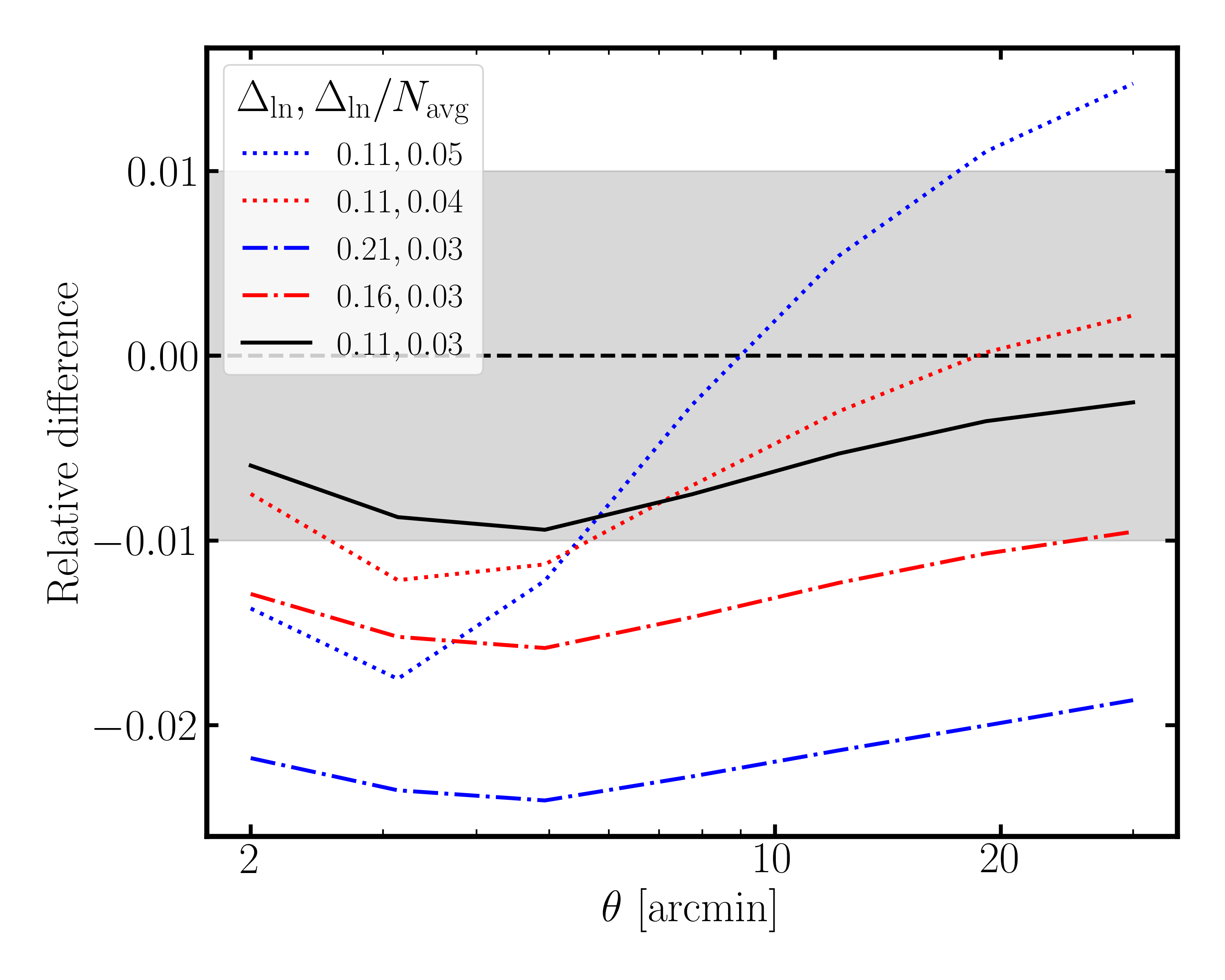
Figure 2: Impact of radial bin size and the effective bin-averaging on numerical estimation errors for Pδgδ3, demonstrating subpercent convergence.
The adaptability of the binning scheme in angular parameters is justified by analysis of the integration kernel's structure in Pδgδ4 space, which is sharply peaked only near the origin and otherwise smooth. This enables targeted computational effort where precision gains are highest.
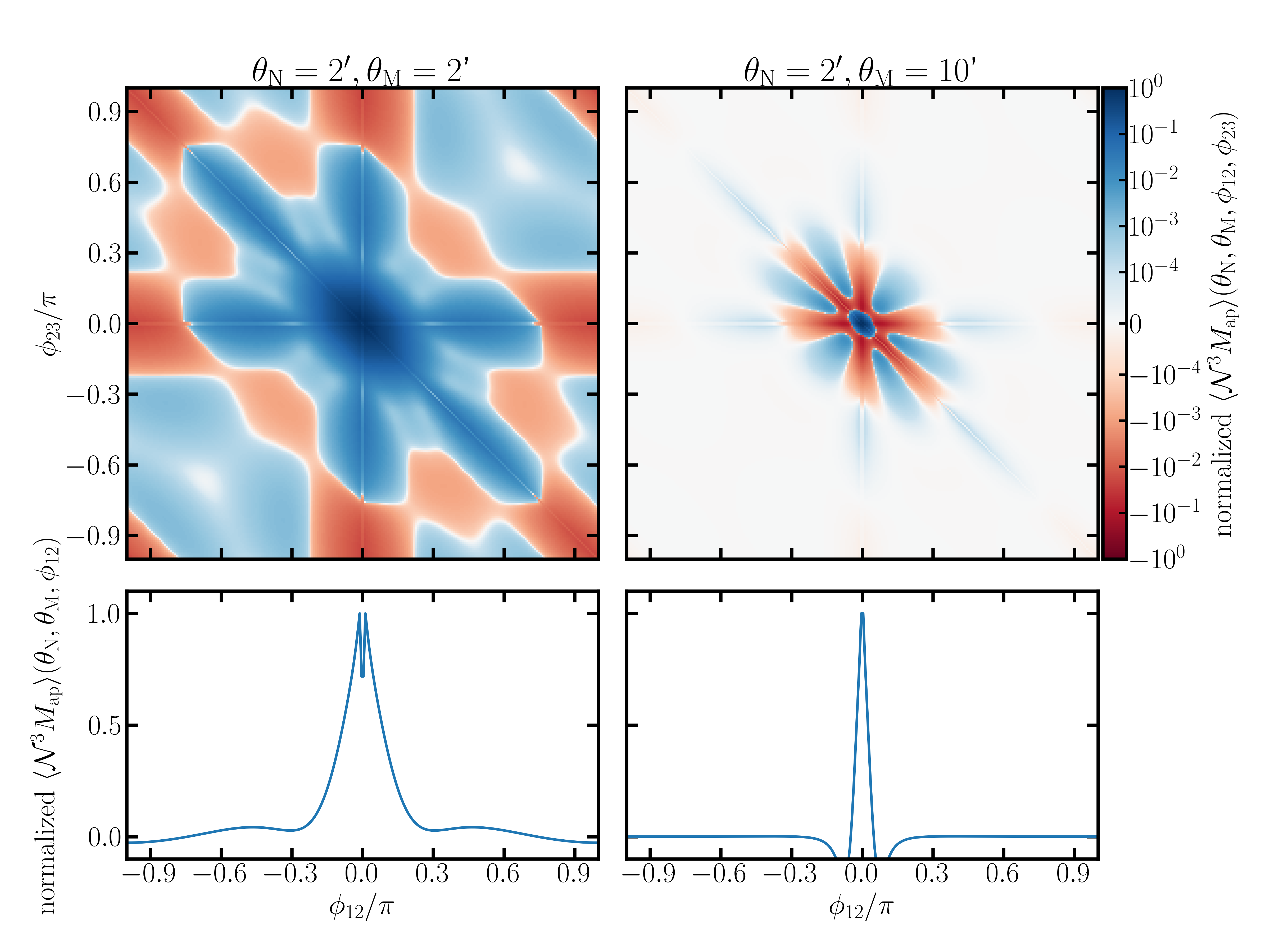
Figure 3: Structure of the angular integrand for Pδgδ5 after marginalization over radial separations, informing adaptive binning strategies.
FFT-based Direct Estimator for Aperture Statistics
Going beyond traditional correlation function integration, the authors advance an alternative direct estimator for arbitrary mixed aperture moments Pδgδ6 leveraging pixelized (discrete) data. By translating the continuous convolution with the filter function to the pixel grid and executing the sum via Fast Fourier Transform (FFT), the estimator achieves scalability independent of the galaxy number density.
The error budget for pixel-based estimators is carefully characterized:
- At small aperture scales, pixelation induces a systematic negative bias in galaxy count moments due to filter function under-resolution, particularly severe for the pure Pδgδ7-moments, but negligible for Pδgδ8-based statistics.
- Increasing pixel resolution reduces this bias at the cost of computational cost, suggesting an optimal tradeoff for survey-scale analyses.
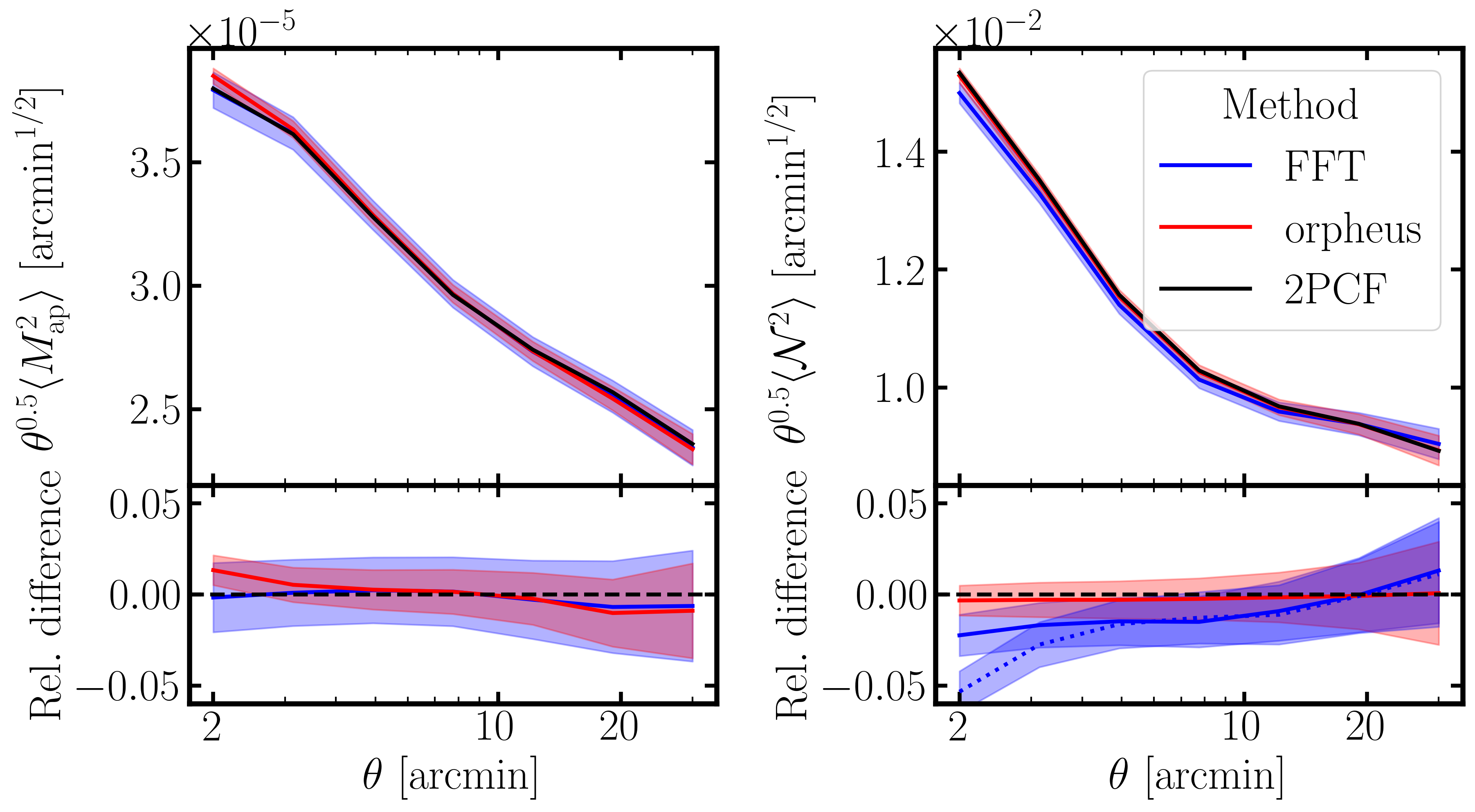
Figure 4: Comparison of Pδgδ9 and b40 from FFT-method, direct 2PCF integration, and the orpheus code, quantifying agreement and pixelation bias.
Application to Realistic Simulations and Signal Detectability
Realistic mocks based on the Takahashi simulation suite, featuring log-normal galaxy distributions with deterministic linear bias, serve as the testbench for the G4L statistical significance forecast. The analysis pipeline is tested on 1632 independent b41 sky patches, with Stage IV survey densities and appropriate redshift binning.
The full, Gaussian, and connected parts of b42 are extracted as a function of aperture scale.
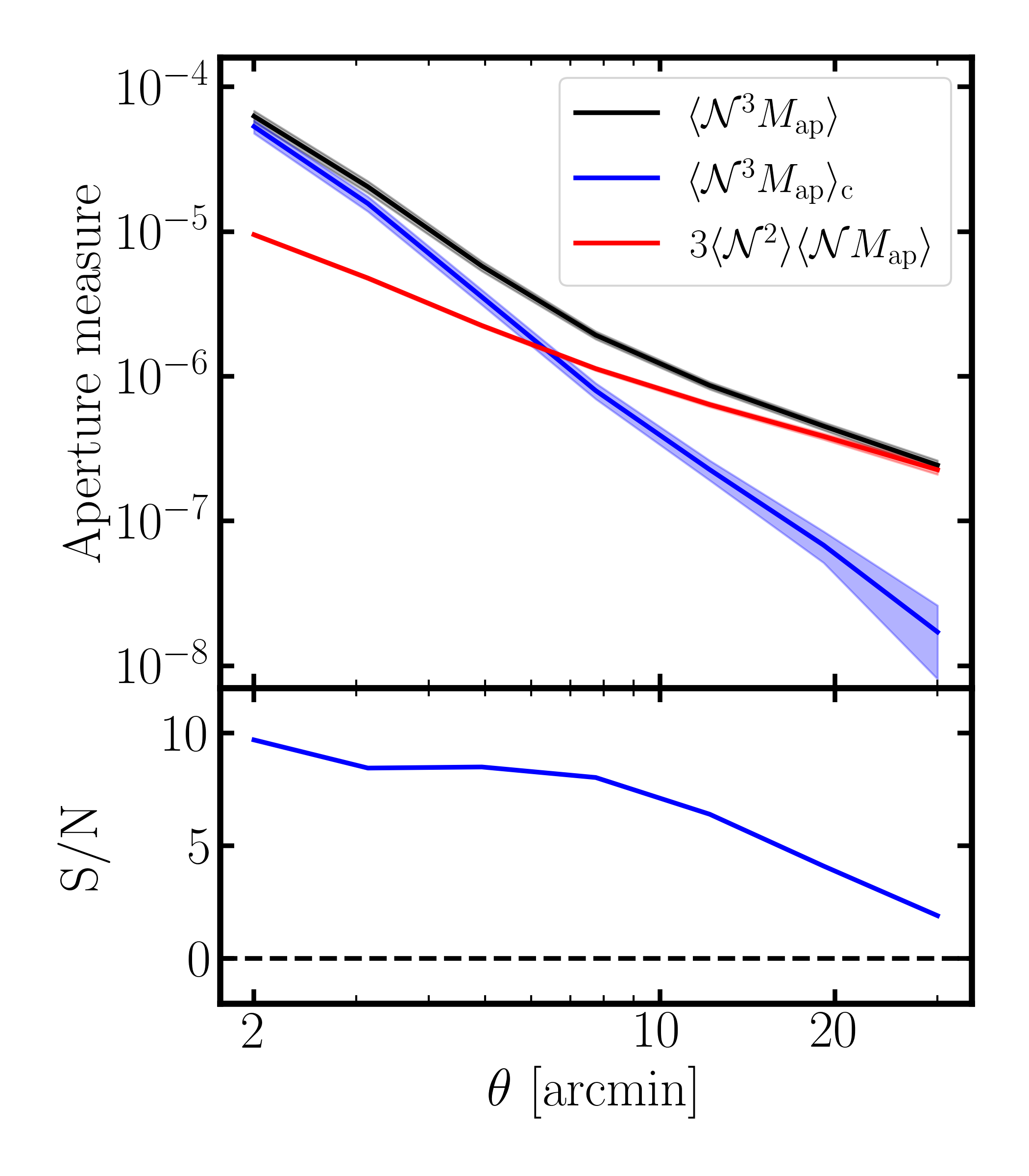
Figure 5: Measured b43 (full, Gaussian, connected) and corresponding b44 for the connected part as a function of aperture scale using the FFT estimator on simulated data.
Key quantitative results:
- The connected (non-Gaussian) signal in the fourth-order aperture moment is dominant at small scales (b45), with b46, only slowly declining towards larger apertures.
- The bias in FFT-based estimators for small-scale b47-moments is small compared to the statistical uncertainty for the expected survey sizes, confirming the practical viability of the approach.
Implications and Future Directions
The formalism, estimator architectures, and precision validation implemented in this work make a strong case that fourth-order galaxy-galaxy lensing statistics will be not only measurable but provide unique cosmological and astrophysical constraints in advanced weak lensing surveys. The fourth-order moments allow for characterization—and eventual breaking—of degeneracies associated with nonlinear bias and stochasticity in galaxy-mass mapping, critical for precision large-scale structure cosmology.
Conceptually, this work demonstrates that the information content of lensing data can be systematically extended to higher order correlators with robust methodology that is computationally tractable for realistic data volumes. The compression from the 4PCF to aperture statistics is particularly crucial for analysis pipelines to remain feasible.
The extension to the full suite of fourth-order galaxy-shear correlators (including those with multiple shear arguments) and their role in constraining halo anisotropy, mass-light misalignments, and beyond-Lambda-CDM signatures is an immediate direction for further investigation. Additionally, future work should systematically test the sensitivity of these higher-order measures to systematics including survey masks, photometric redshift errors, and galaxy selection incompleteness—under real survey conditions.
Finally, the general approach is extendable to higher-order statistics, opening the path for even deeper inference of non-Gaussian structure formation physics from Stage IV weak lensing observables.
Conclusion
This work delivers a rigorous framework for fourth-order galaxy-galaxy-lensing statistics, from field-level correlation functions through to practical data analysis pipelines, and establishes the detectability of non-Gaussian information in forthcoming weak lensing surveys. The combination of theoretical, numerical, and estimator advancements positions the community to exploit higher-order lensing statistics as a precision probe of the galaxy-mass connection and nonlinear structure formation.