- The paper introduces a contrastive learning framework using triplet construction to effectively differentiate valid Verilog RTL from minimally perturbed erroneous variants.
- It integrates proactive error screening during autoregressive decoding, significantly improving compilation success and functional correctness with measurable metric gains.
- Empirical results demonstrate marked improvements in pass@1 scores and compilation rates, reducing EDA cycles and iterative debugging in HDL synthesis.
VerilogCL: Contrastive Learning and Proactive Error Screening for Robust LLM-Based Verilog Generation
Motivation and Problem Setting
LLMs have demonstrated notable advancements in software code synthesis, but reliable Verilog RTL generation remains an unresolved challenge due to the scarcity and low diversity of high-quality HDL corpora and the strict syntactic/structural constraints inherent to hardware design. Even minimal deviations in RTL, such as assignment operator misuse or inconsistent signal declarations, can yield code that either fails compilation or generates incorrect logic under simulation and synthesis. The prevailing approaches rely on larger models, dataset augmentation, or post-hoc error repair by external compilers and validators, perpetuating inefficient iterate-and-debug paradigms and failing to teach LLMs fine-grained RTL validity boundaries.
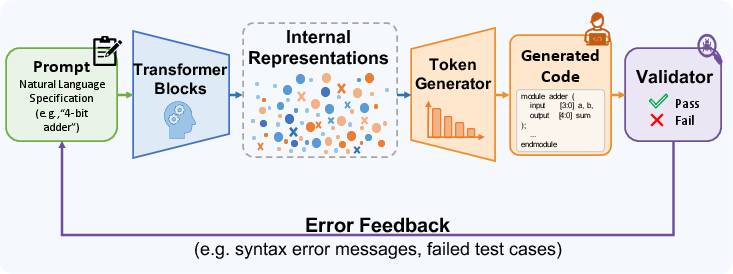
Figure 1: Comparison of existing LLM-based Verilog generators, highlighting typical error-prone assemblages and downstream compilation failures.
VerilogCL Framework: Minimal-Error Contrastive Learning and Proactive Screening
VerilogCL introduces a framework combining minimal-error data augmentation, contrastive learning, and inference-time error screening to systematically distinguish valid RTL from erroneous variants and reduce error propagation during generation.
Minimal-Error Augmentation and Triplet Construction
The dataset synthesizes triplet sets per reference design: anchors (valid Verilog), positives (semantic-preserving transformations), and negatives (single, minimally perturbed errors reflecting real-world RTL bug patterns—e.g., structural violations, declaration faults, punctuation/token issues). Negative candidates are validated to ensure strict compilation or functional mismatches, exposing the LLM to controlled divergence from the anchor.
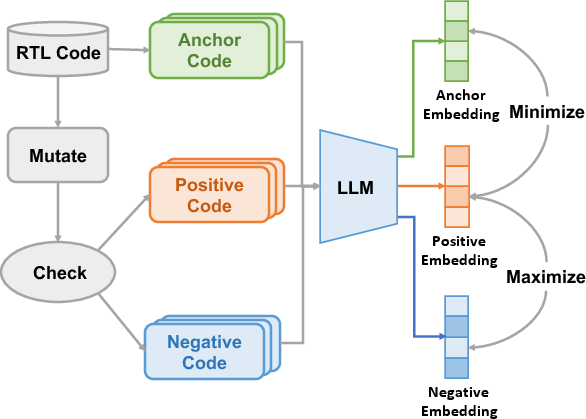
Figure 2: Triplet construction for contrastive learning; anchor, positive (semantic transformation), and negative (a single injected error).
Contrastive Representation Learning
Contrastive learning leverages triplet margin loss to transform the latent space—embedding representations of correct and erroneous RTL are explicitly separated, with anchors and positives mapped closer, while negatives are pushed further. Max-pooling is applied to final-layer hidden states to derive fixed-length code embeddings, and training is performed with LoRA adaptation for parameter efficiency.
This mechanism enables the LLM to internalize syntactic and structural boundaries, reducing reliance on memorization and enhancing discriminability even where code snippets are superficially similar but structurally invalid.
Proactive Error Screening
After contrastive tuning, a classifier head is trained to predict the validity of code continuations using hybrid features: pooled semantic embeddings and token-level uncertainty statistics (e.g., average NLL, entropy spikes, token confidence for keywords/punctuation). During autoregressive decoding, the classifier evaluates partial sequences at statement boundaries; risky continuations are rejected and resampled, shifting error handling from post-hoc repair to online generation-stage control.

Figure 3: VerilogCL framework combining augmentation, contrastive learning, and proactive screening for error mitigation during generation.
Empirical Analysis and Numerical Results
Representation Quality Improvement
Semantic embedding separation between correct and erroneous RTL is visualized with PCA. Before contrastive training, clusters overlap extensively; post-training, the distinction is pronounced, validating the efficacy of minimal-error contrastive learning in improving feature separability.
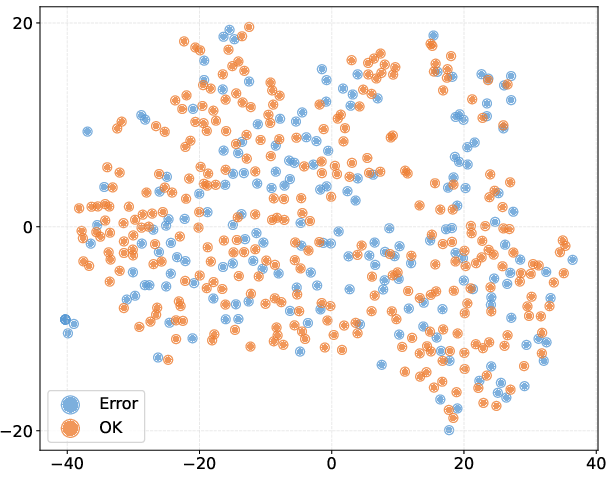
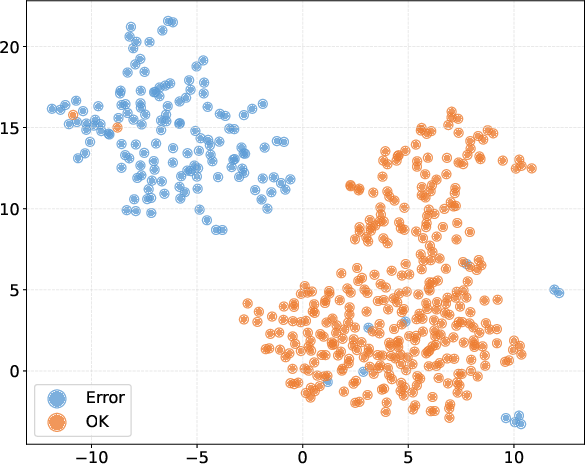
Figure 4: PCA visualization of semantic embeddings before contrastive learning: extensive overlap in representation.
The classifier attains a maximal validation F1 score of 92.58% at a screening threshold of 0.507, significantly outpacing the baseline (F1 79.96%). This improvement demonstrates robust generalization, with accuracy stable across threshold ranges, and underscores the impact of hybrid features sourced from contrastive-optimized latent spaces.
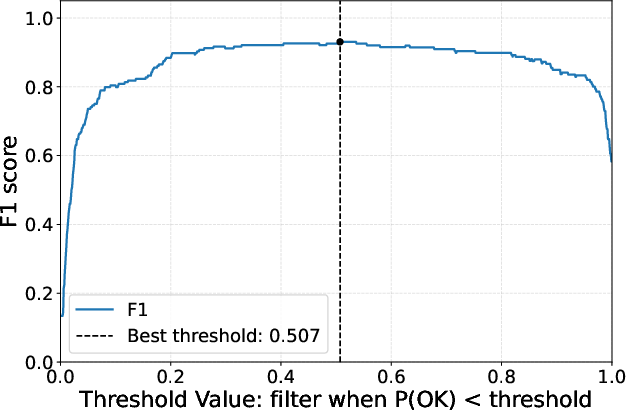
Figure 5: Validation-set F1 score as a function of screening threshold for P(OK).
Functional Correctness and Compilation Success
VerilogCL achieves the highest pass@1 and pass@5 scores across VerilogEval-human, VerilogEval-machine, RTLLM v1.1, and v2.0 benchmarks. Notably, pass@1 for VerilogEval-human improved by 23.6 points over the base DeepSeek-7B (55.3% vs. 31.7%), and functional success rate on RTLLM v1.1 rose from 32.1% (base) to 56.6%. Compilation success rate reached 94% (RTLLM v1.1), a 23-point increase.
Ablation analysis demonstrates that both contrastive learning and proactive screening are non-redundant, with their combination yielding maximal gains in compilation and functional success. Gains are attributed to explicit representation learning of bug-prone RTL boundaries and the suppression of error-prone continuations at statement boundaries.
Implications and Future Perspectives
The introduction of validity-aware contrastive learning and generation-stage risk screening changes the prevailing paradigm for LLM-based HDL synthesis. Rather than iterative debug loops or mere dataset expansion, it incorporates structured separation of RTL correctness in the model’s latent space and intervention during decoding, aligning error control with the semantic structure of hardware code. This is especially significant as Verilog correctness is not solely determined by compilation, but is tightly coupled with functional simulation outcomes and downstream synthesis reliability.
Practically, VerilogCL reduces wasted EDA cycles, preserves compilation bandwidth, and enhances the reliability of automated front-end digital design flows. Theoretically, the approach positions contrastive objectives as core mechanisms for modeling validity boundaries in domains where errors propagate nonlinearly and are costly. Extensibility to multi-module RTL assembly, design-aware objectives (PPA metrics), and formal verification protocols is suggested as fertile ground for advancing AI-assisted hardware synthesis.
Conclusion
VerilogCL delivers robust improvements in syntactic and functional correctness for LLM-generated Verilog through the integration of minimal-error contrastive learning and proactive error screening, outperforming both commercial and Verilog-specialized baselines by large margins in all relevant benchmarks. The dual paradigm of explicit representation separation and online risk-controlled generation provides a principled foundation for advancing reliable HDL code synthesis and inspires future developments at the intersection of machine learning and EDA (2604.18162).

